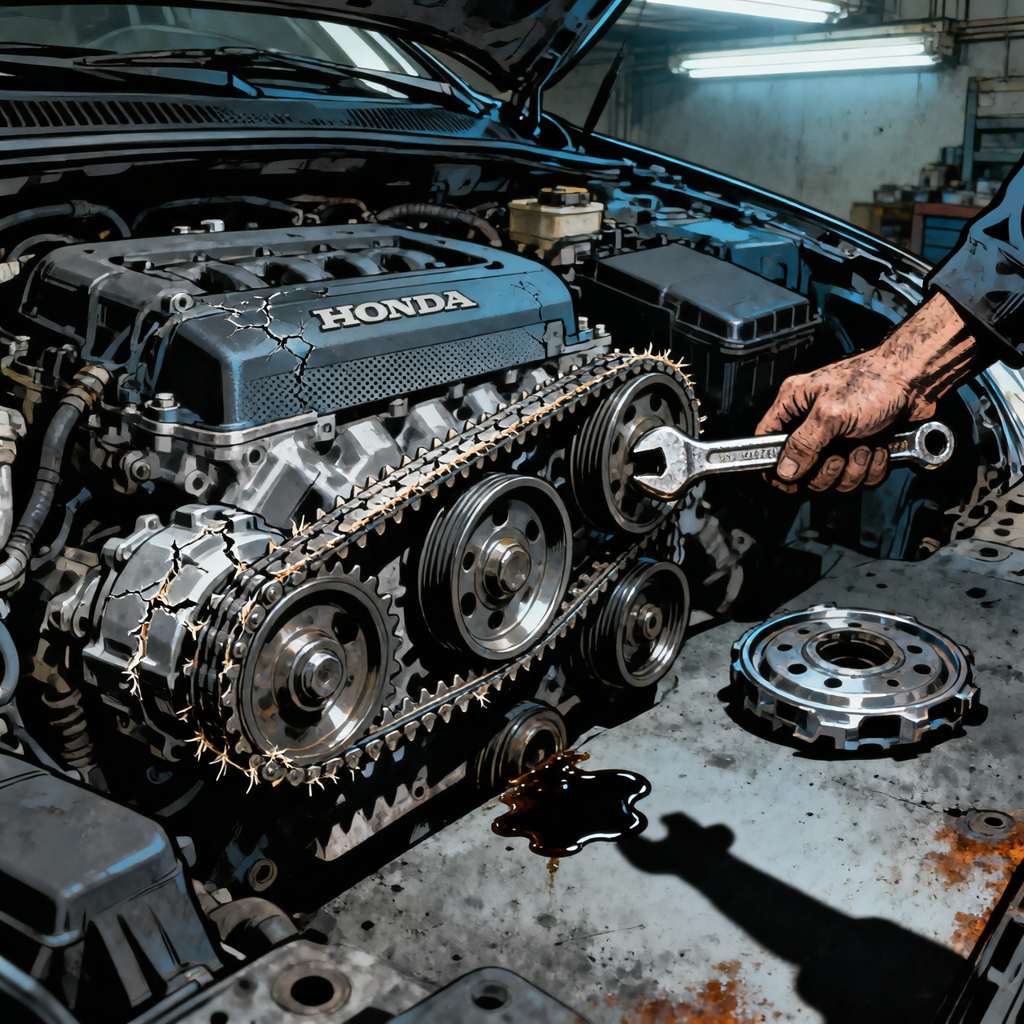
Every technician has seen it: a customer rolls in with a timing belt that looks like it’s been through a war zone, somehow still holding together at 200,000+ miles. The Reddit thread that sparked this discussion featured a Honda V6 belt at 212,000 miles that looked ready to disintegrate—yet it was still functioning. While some owners brag about pushing belts to extreme mileage, the reality is that this “game” has consequences that range from roadside breakdowns to catastrophic engine damage. Understanding the difference between luck and sound maintenance practice is critical for both technicians and vehicle owners who want to avoid turning a $400 service into a $4,000+ engine rebuild.
Understanding Timing Belt Service Intervals and Why They Matter
Manufacturer-recommended timing belt replacement intervals typically fall between 60,000 and 105,000 miles, depending on the engine design and model year. Honda and Acura V6 engines, for example, generally call for replacement at 105,000 miles or seven years, whichever comes first. The time component matters because rubber degrades with age regardless of mileage—a critical factor for vehicles that see light use.
These intervals aren’t arbitrary. Engineers calculate them based on material fatigue, environmental exposure, heat cycling, and safety margins. The belt itself is a composite material with reinforced rubber and fabric or aramid fiber tensile cords. Over time, heat from the engine bay causes the rubber to harden and crack, while constant flexing around pulleys and sprockets fatigues the internal fibers. Oil contamination from leaking seals accelerates this degradation significantly.
When technicians examine severely overdue belts, common failure patterns emerge: surface cracking (dry rot), glazing from heat exposure, rib separation, fraying edges, and visible cord exposure. The belt in the Reddit example showed advanced glazing and rib wear, clear indicators that it was operating on borrowed time. While some non-interference engines can survive a belt failure with nothing more than a tow bill, interference engines face a different reality entirely.
Interference vs. Non-Interference Engines: The Critical Distinction
The difference between an interference and non-interference engine determines whether a timing belt failure is an inconvenience or a financial disaster. In a non-interference engine, the pistons and valves operate in separate spaces throughout the entire rotation cycle. If the timing belt snaps, the engine simply stops running—no contact occurs between moving parts. Examples include many older Toyota 4-cylinder engines (pre-VVT), the Nissan VG33E, and certain Ford Escort/Focus powerplants.
Interference engines, by contrast, share valve and piston space at certain points in the combustion cycle. The timing belt keeps these components synchronized so they never occupy the same space simultaneously. When the belt fails, the camshaft stops while the crankshaft may continue rotating briefly due to momentum. Valves freeze in position while pistons continue their upward travel, resulting in violent collisions. Bent valves, damaged pistons, broken valve guides, and even cracked cylinder heads can result from a single belt failure.
Most modern engines use interference designs for efficiency reasons—tighter tolerances allow higher compression ratios and better fuel economy. Honda J-series V6 engines (found in Accords, Pilots, Odysseys, and Ridgelines) are textbook interference engines. The same applies to most Honda K-series four-cylinders, Toyota 2AZ-FE engines, and virtually all European imports. One Reddit commenter mentioned a Toyota Tundra owner who learned this lesson the hard way at 270,000 miles, facing a $5,300 used engine replacement after the original belt finally gave up.
Before gambling with replacement intervals, verify your specific engine type. This information is readily available in service manuals, online databases, and manufacturer documentation. The risk profile changes dramatically based on this single factor.

Real-World Data: How Long Timing Belts Actually Last
The Reddit discussion provided a fascinating dataset of real-world timing belt longevity, ranging from spectacular failures at 85,000 miles to survivors pushing past 250,000 miles. Several patterns emerge from this anecdotal evidence that align with field experience.
The median failure range for neglected belts appears to fall between 120,000 and 140,000 miles based on shop experience shared by verified technicians. However, outliers exist in both directions. One commenter reported a 1994 Toyota Paseo reaching 248,000 miles before belt failure—on a non-interference engine where the consequence was merely a cold January roadside repair. Another mentioned a 2003 Honda Civic at 238,000 miles with the original belt still intact during inspection.
High-mileage survivors share common characteristics: consistent oil change intervals (preventing seal leaks that contaminate belts), highway-dominant driving patterns (less stop-and-go heat cycling), and moderate climate conditions (extreme heat and cold both accelerate rubber degradation). Vehicles in desert environments or those experiencing frequent short trips with incomplete warm-up cycles tend to see earlier belt deterioration.
The record holders mentioned include a Volkswagen 1.9 TDI diesel at 518,000 kilometers (approximately 322,000 miles) on the original belt, a Ford Telstar reaching 281,000 kilometers, and multiple Hondas surpassing 200,000 miles. While impressive, these examples represent statistical outliers, not recommended practice. For every belt that survives extreme mileage, countless others fail within the normal service window, often with expensive consequences.
Age-related failure is equally important. One commenter mentioned an 18-year-old belt with only 83,000 miles that required replacement due to advanced cracking. The seven-to-ten-year service interval exists specifically to address time-based degradation independent of mileage accumulation. Low-mileage vehicles driven primarily for short trips may actually face higher risk than highway cruisers due to incomplete heat cycles and moisture accumulation.
Inspection Techniques and Warning Signs
While timing belts live inside protected covers, technicians can identify potential problems through systematic inspection during routine services. Visual inspection requires cover removal, but several external indicators suggest it’s time for closer examination.
Start with service history verification. If records don’t clearly document timing belt replacement and the vehicle is approaching or past the recommended interval, assume the original belt is still installed. Many used vehicle buyers inherit this uncertainty, making inspection critical during pre-purchase evaluations.
External warning signs include unusual engine noises at startup or idle. A failing timing belt tensioner can produce rattling or ticking sounds, particularly on Honda V6 engines where the hydraulic tensioner may develop internal leaks. This symptom demands immediate inspection—a failed tensioner can allow the belt to jump timing even without complete fracture, potentially causing the same valve-to-piston contact as a broken belt.
When covers come off, examine the belt systematically. Surface cracking (especially perpendicular to belt length) indicates advanced rubber degradation. Check all tooth surfaces for wear, chipping, or separation. Look for glazing, which appears as a shiny, hardened surface indicating heat damage. Any visible cord material means immediate replacement is mandatory. Oil contamination produces a distinctive dark, saturated appearance and requires addressing the source leak (usually camshaft or crankshaft seals) during belt replacement.
Inspect tensioner components simultaneously. Hydraulic tensioners should show no external leakage and should maintain proper position without excessive play. Spring-loaded tensioners should provide consistent pressure without binding or weak resistance. Many timing belt kits include new tensioners, idler pulleys, and seals for good reason—these components wear on the same schedule as the belt itself.
Water pump inspection is equally critical. Most timing belt-driven water pumps should be replaced during belt service since labor overlap makes the marginal cost minimal compared to repeating the job six months later for a failed pump. Check for bearing roughness by spinning the pump pulley by hand and listen for grinding or resistance. Any external coolant leakage from the pump weep hole mandates immediate replacement.
The True Cost of Delayed Maintenance
The financial calculation seems straightforward: why spend $400-800 on preventive timing belt replacement when the current belt still functions? This logic collapses quickly when interference engine damage enters the equation.
A standard timing belt service on a Honda Pilot or Accord V6 typically runs $600-900 at independent shops, including the belt, tensioner, seals, and water pump. Dealership pricing may reach $1,200-1,500. This represents a known, planned expense that can be scheduled at the vehicle owner’s convenience.
Contrast this with belt failure consequences on an interference engine. Best-case scenarios involve bent valves requiring cylinder head removal, valve replacement, and machine shop services. This repair commonly exceeds $2,500-3,500 depending on the engine configuration and regional labor rates. Worst-case scenarios include piston damage, broken valve guides, damaged cylinder head requiring replacement, and potential crankshaft damage if the failure occurred at high RPM. These repairs frequently total $4,000-6,000, often approaching or exceeding the vehicle’s market value on higher-mileage examples.
The Reddit example of the Toyota Tundra owner facing $5,300 for a used engine replacement illustrates this perfectly. The vehicle had high enough mileage that rebuilding wasn’t economical, leaving engine replacement as the only viable option. For the cost of six or seven preventive belt replacements, the owner could have avoided catastrophic failure entirely.
Secondary costs compound the direct repair expenses. Belt failure rarely occurs at convenient times or locations. Towing charges, rental vehicle expenses during extended repairs, and lost work time add hidden costs to the failure scenario. One commenter described replacing their timing belt in 20°F weather on the roadside at night—an experience that carries its own premium in misery if not direct cost.
For fleet managers and commercial operators, the calculation becomes even clearer. Scheduled maintenance windows allow for planning and minimal operational disruption. Unexpected failures create cascade effects through schedules, customer commitments, and resource allocation that far exceed the direct repair costs.
Timing Belt Replacement Best Practices for Technicians
Proper timing belt replacement requires methodical procedure and attention to detail. Rushing the job or cutting corners creates opportunities for catastrophic failure even with new components.
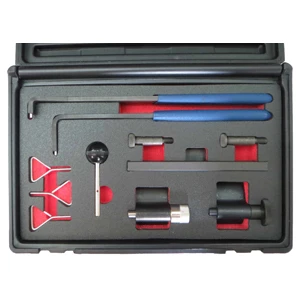
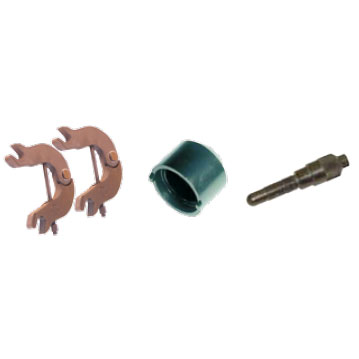
Begin with comprehensive service information for the specific engine. Timing marks, tensioner adjustment procedures, and special tool requirements vary significantly between manufacturers and even between engine variants within the same vehicle platform. Honda J35 engines, for example, require specific procedures for setting the tensioner that differ from J32 or J37 variants.
Support the engine properly before removing motor mounts—many timing belt jobs require removing the front engine mount for access. Use an appropriate engine support bar or floor jack with a block of wood to protect the oil pan. Never work under a vehicle supported only by a jack without proper jack stands in position.
Mark timing positions clearly before disassembly. While following manufacturer timing marks is standard procedure, adding your own reference marks with paint pens provides additional verification insurance. Photograph the timing setup before removal for reference during reassembly.
Inspect all driven components during belt replacement. Beyond the water pump and tensioner, check the crankshaft and camshaft seals for leakage. Oil contamination will destroy a new belt quickly, making seal replacement during initial service far more cost-effective than repeating the entire job for a $15 seal later. Check the harmonic balancer for wobble or separation—a failing balancer will misalign the timing belt and cause premature failure.
Follow tensioner adjustment procedures exactly as specified. Under-tensioning allows the belt to jump teeth under load, while over-tensioning accelerates wear on both the belt and bearing components. Hydraulic tensioners typically require releasing a locking pin and allowing the tensioner to self-adjust against belt tension. Spring-loaded tensioners may require specific torque values or positioning procedures.
Rotate the engine through at least two complete revolutions by hand after installation and verify that all timing marks still align correctly. This critical step identifies any assembly errors before starting the engine. If marks don’t realign perfectly, the belt is incorrectly installed—starting the engine in this condition on an interference engine will cause immediate valve damage.
Double-check your work. Verify that no tools remain in the engine bay, all covers are properly secured, all electrical connectors are reattached, and all fluids are at proper levels if any were drained during the procedure. One Reddit commenter humorously mentioned being off by one tooth during a roadside replacement—a mistake that’s easily avoided with proper procedure but costly to correct.
Professional Recommendations and Risk Management
When customers ask about extending timing belt intervals, technicians face an ethical responsibility to provide honest risk assessment rather than enabling potentially destructive decisions.
For non-interference engines, the risk profile is fundamentally different. A belt failure means a tow and a roadside or shop replacement, but no engine damage. If a customer with a confirmed non-interference engine wants to extend intervals, document the discussion, explain the breakdown risk, and let them make an informed decision. Some owners of older, lower-value vehicles with non-interference engines deliberately run belts to failure since the replacement cost is identical whether done preventively or after failure.
For interference engines, the recommendation is unambiguous: follow or exceed manufacturer intervals. The catastrophic failure risk far outweighs any short-term savings from delayed service. When customers resist this recommendation, quantify the risk in concrete terms. Show them examples of valve damage from failed belts. Provide written estimates comparing the preventive service cost to the potential repair cost. Document their decision to decline recommended service in writing.
The age-based interval deserves equal emphasis with mileage. A seven-year-old vehicle with only 40,000 miles still needs timing belt service on most engines with belt-driven timing systems. The rubber compound degrades with time regardless of use. Heat cycling from even occasional operation, ozone exposure, and simple aging all contribute to material breakdown.
For vehicles approaching the service interval but not yet due, consider offering inspection services during other maintenance. Removing the timing cover for visual inspection adds minimal time to oil change services or other engine work, providing customers with actual belt condition data rather than purely preventive recommendations. Photographic documentation of belt condition creates powerful justification for recommended service.
Special consideration applies to vehicles with unclear service history. Used vehicle buyers often inherit timing belt uncertainty. When service records don’t definitively prove replacement, assume the original belt remains installed and recommend immediate service on higher-mileage examples. The cost of unnecessary belt replacement is minimal compared to the risk of driving an interference engine with an unknown-condition belt.
Timing Belts vs. Timing Chains: Understanding the Difference
Several Reddit commenters mentioned timing chains as an alternative, and understanding this distinction helps customers make informed vehicle purchasing decisions and maintenance plans.
Timing chains are metal chains similar to bicycle chains that perform the same function as timing belts but with dramatically different service requirements. Chains typically last the engine’s lifetime with proper maintenance, requiring replacement only after severe wear or oil starvation damage. Many modern engines use chains specifically to eliminate the periodic replacement requirement of belts.
However, chains aren’t maintenance-free. They require proper oil changes with appropriate oil specifications to maintain the chain and tensioner hydraulics. Neglected oil changes can cause chain stretch, tensioner failure, and guide wear. Some engines—particularly certain Ford EcoBoost and GM Ecotec variants—have developed reputations for premature chain stretch even with proper maintenance.
Chain-equipped engines use oil-fed hydraulic tensioners that can fail, producing the characteristic rattle at startup mentioned by several commenters. This noise indicates immediate attention is required—a failed tensioner can allow the chain to skip timing just like a loose belt, with the same catastrophic results on interference engines.
Toyota, for example, switched from timing belts to chains on many engines starting in the mid-2000s. The 2008+ Corolla uses a chain-driven 2ZR-FE engine rather than the belt-driven engines in earlier models. This change eliminated the periodic belt replacement requirement but introduced different maintenance considerations around oil quality and change intervals.
When customers compare vehicles, the timing system represents a significant long-term cost consideration. A vehicle requiring timing belt service every 100,000 miles will need this service two or three times during a typical ownership period, adding $1,500-2,500 to total ownership costs. Chain-equipped engines eliminate this expense but may present other maintenance challenges.
Quick Reference Checklist: Timing Belt Service Decision Matrix
- Verify engine type: Confirm whether the engine is interference or non-interference using manufacturer documentation
- Check service history: Locate documented proof of previous timing belt replacement with mileage and date
- Calculate time and mileage: Determine both years since last replacement and miles accumulated—service is due when either limit is reached
- Inspect for warning signs: Listen for unusual rattling at startup, check for oil leaks near timing covers, look for coolant leaks from water pump
- Plan comprehensive service: Include tensioner, idler pulleys, seals, and water pump in the service scope
- Use quality parts: OEM or premium aftermarket parts only—timing belt failure from cheap components costs far more than the initial savings
- Verify tool availability: Ensure you have all required special tools before beginning work
- Document timing marks: Photograph original timing setup and mark components before disassembly
- Check driven components: Inspect crankshaft seal, camshaft seals, and harmonic balancer during service
- Verify timing after installation: Rotate engine two complete revolutions by hand and confirm all marks realign before starting
Frequently Asked Questions
Can I replace just the timing belt without replacing the water pump and tensioner?
Technically yes, but it’s false economy. The labor to access the timing belt represents 70-80% of the total job cost. Water pumps and tensioners wear on the same schedule as the belt. Replacing them during initial service costs perhaps $200 more than belt-only service, while repeating the entire job six months later for a failed water pump costs another $600+ in labor alone. Replace all components during scheduled service.
How do I know if my engine is interference or non-interference?
Consult your vehicle’s service manual, search online databases like Gates or Dayco timing belt catalogs (which list interference status), or contact the manufacturer. Don’t rely on general assumptions—some engines within the same family use different designs. Honda’s J35 V6 is interference; some older Toyota 4-cylinders are non-interference. Verify your specific engine before making service decisions.
What happens if the timing belt breaks while driving?
On non-interference engines, the engine stops immediately but sustains no damage beyond possibly bent pushrods (on older pushrod engines). You’ll need a tow and timing belt replacement. On interference engines, valves and pistons collide, causing bent valves, damaged pistons, broken valve guides, and potentially cracked cylinder heads. Repair costs typically range from $2,500 to $6,000+ depending on damage severity.
Can I inspect my timing belt without removing it?
Partial inspection is possible by removing the timing cover, but you can’t fully assess belt condition without removal. Surface cracking, glazing, and obvious damage are visible with the cover off, but internal cord damage and tooth wear require hands-on examination. If the vehicle is at or near the service interval, plan for replacement rather than inspection-only service.
Is it safe to buy a used vehicle with unknown timing belt history?
You can buy the vehicle, but factor immediate timing belt service into your purchase decision if service records don’t document recent replacement. On higher-mileage examples (over 100,000 miles) with no proof of timing belt service, assume immediate replacement is necessary and negotiate accordingly. The cost is predictable; the risk of ignoring it is not.
Why do some manufacturers specify different intervals for the same engine?
Operating conditions influence interval recommendations. Severe service schedules (frequent short trips, extreme temperatures, dusty conditions, trailer towing) may call for earlier replacement than normal service schedules. Some manufacturers also update recommendations based on field experience—check for Technical Service Bulletins (TSBs) that may modify original intervals for your specific engine and model year.
Engine Repair Tools for Timing Belt Service
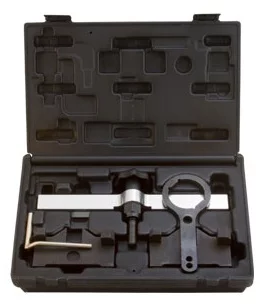
Proper timing belt replacement requires the right tools and components to ensure precise work and avoid costly mistakes. Our Engine Repair Tools selection includes everything needed for professional-grade timing belt service.
- Timing belt tensioners, pulleys, and water pump components
- Engine support bars and specialty tools for motor mount removal
- Seal and gasket removal tools for comprehensive belt service

The Toolsource Technical Team blends decades of real-world automotive service experience with up-to-date technical research. Our writers collaborate with professional mechanics, shop owners, and diagnostic specialists to deliver practical, workshop-ready guidance you can trust.


Follow us on social media