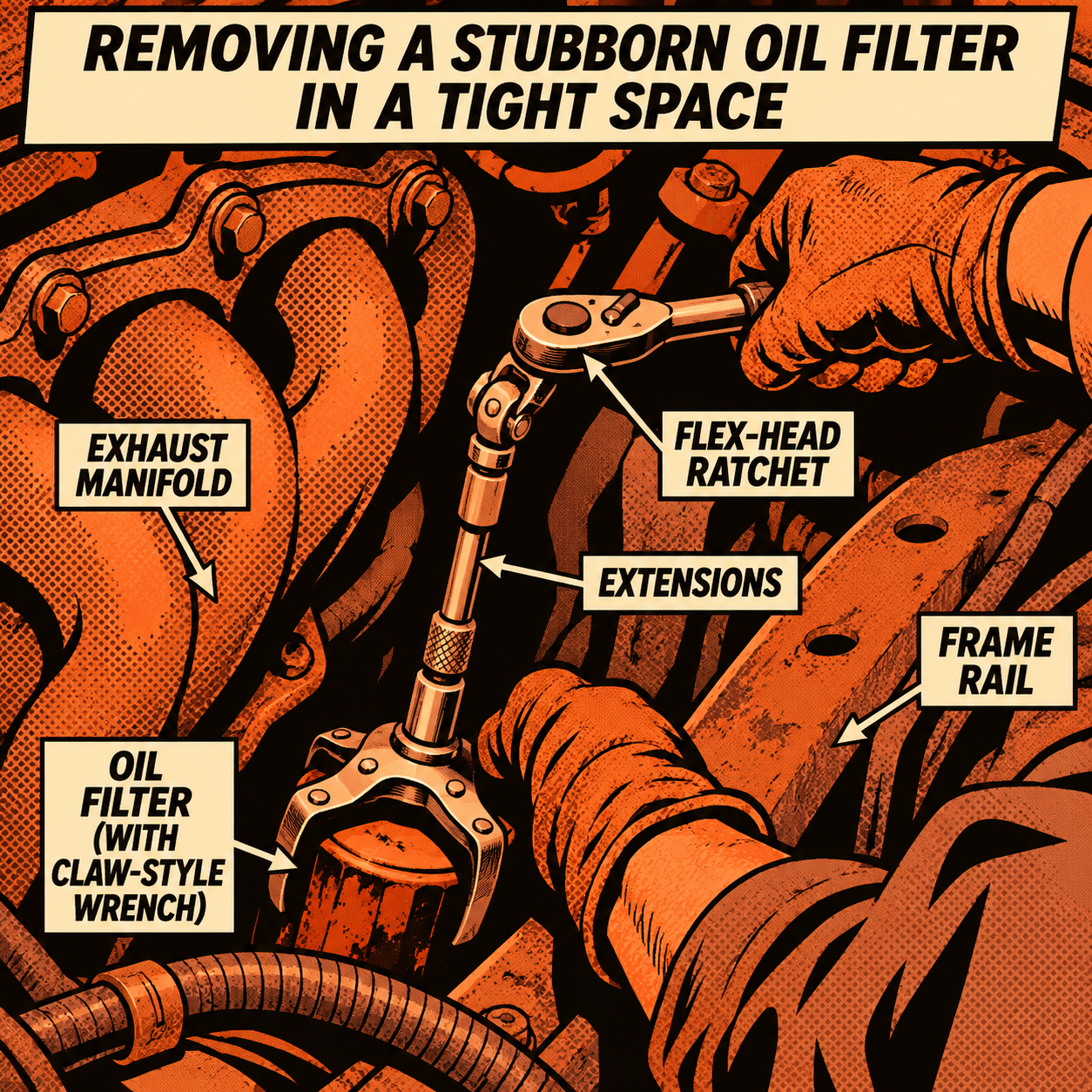
Every tech who’s spent time under the hood has a story about an oil filter that seemed designed by someone who never had to change it. Whether it’s a filter buried behind a skid plate, drowning in a “ring of fire” of exhaust manifolds, or requiring a sway bar to be dropped just to get a wrench in, bad filter placement costs shop time and makes a mess that eats into labor margins. None of this is going away — engine platforms get shared across vehicle lines, packaging constraints win out over service access, and cost-cutting rarely favors the tech doing the oil change. What follows is a rundown of the worst offenders, the tools and techniques that actually help, and how to keep the cleanup from eating your whole ticket.
Why Filter Placement Gets This Bad
Oil filter location is usually one of the last things decided in an engine’s design process, and it’s rarely decided by anyone thinking about a tech’s access. A few recurring causes show up across brands:
- Cross-platform engines. The same engine block gets dropped into multiple chassis with different frame rails, subframes, and accessory layouts. What’s an easy top-access filter in one application becomes a blind reach-around in another.
- Emissions and crash-structure packaging. Catalytic converters, exhaust manifolds, and crash-rated front structures all compete for the same real estate as the filter. The filter usually loses.
- No budget to revisit a mature platform. Once a chassis is in production, engineering changes to improve filter access rarely clear the cost-benefit bar, even when techs are losing 10-20 minutes per oil change to it.
- Dry-sump and high-capacity systems. Performance cars (Porsche, for example) often have multiple drain points and large oil capacities, which changes the whole procedure, not just the filter swap.
Understanding the “why” doesn’t make the job faster, but it does explain why the fix is almost always a workaround on the tech’s side rather than a redesign on the manufacturer’s side.
Vehicle-Specific Trouble Spots Every Tech Should Know
Some platforms show up often enough in the bay that it’s worth knowing the quirks before you’re under the vehicle guessing:
- Ford Tremor/F-150 and Police Interceptor Utility: On some of these, the filter isn’t visible at all. You remove the front skid plate and reach around the frame with 10-12″ of extensions and a filter tool that grips the end, not the sides. Tremor’s metal front panels limit you to one-arm access, so a flex-head ratchet with a claw-style socket is close to mandatory.
- Ford/Dacia/Renault sway bars: A handful of these platforms route the sway bar directly under the filter or pan. Dealerships commonly drop the four sway bar bolts and let it hang for the duration of the service rather than fighting around it — it adds a couple minutes but saves a bigger cleanup.
- Toyota/Subaru “ring of fire”: Filters mounted close to the exhaust manifold mean any drips burn off and smoke, and splash guards nearby complicate cleanup. Older Toyota V6s and GM SUVs have similar top-access-only filters positioned over hot components.
- Porsche 718/911 and other dry-sump cars: Multiple drain points (crankcase, oil tank, cooler) and large oil volume mean the real challenge isn’t just the filter — it’s getting the system hot and thoroughly drained so the refill is accurate. Some require a scan tool to set oil level correctly afterward.
- VW/Audi longitudinal platforms (Passat, Touareg): Filters positioned near the strut tower or requiring removal from the top while draining from the bottom, sometimes forcing you to move the coolant reservoir out of the way first.
- Maserati (certain V8 models): Notorious for dumping oil across the subframe and lower control arm no matter how careful the approach, often requiring a full pressure wash with brake cleaner afterward.

2 Pc. 1/4", 3/8" Dr. 90T Full Polish Locking Flex Head Ratchet
Mfg: GearWrench
Part #: 81274T

6 Pc 12 Point Offset, Flex Head Ratcheting Wrench attachment set
Mfg: VIM Tools
Part #: NORA150XL

GearWrench 81275T 90T Cushion Grip Flex Head Ratchet Set
Mfg: GearWrench
Part #: 81275T
Tools and Techniques for Blind and Awkward Filters
When you can’t see the filter, feel and the right tool matter more than brute force:
- Claw-style filter wrenches that grip the end of the filter (not the sides) are essential for reach-around jobs like the Ford Interceptor and Tremor-bodied trucks. A flex-head ratchet paired with the right length of extensions lets you work around frame rails without losing socket engagement.
- Adjustable/extending filter wrenches help when you need to dial in the exact angle and diameter blind — useful on Rangers and Broncos, where filters sit in the wheel well.
- OEM-specific tools exist for a reason. Renault/Dacia makes a spanner-driven tool specifically for their oddly shaped filters; using a generic strap wrench on these is a good way to crack the housing.
- Relocation kits. For shops that do volume work on a chronically bad platform, an oil filter relocation kit (remote filter mount with braided line) is a legitimate fix — no fabrication required, and it turns a 20-minute blind reach into a 2-minute top-side swap.
- Drop-and-hang over full removal. On vehicles where a component like a sway bar blocks access, removing just the mounting bolts and letting it hang is almost always faster than extracting it completely — treat it the same as a skid plate you’d unbolt and swing down.
Containing the Mess
Even with the right tool, filters mounted near exhaust components, frame rails, or tight valley locations will drip somewhere you don’t want them to. A few field-proven habits:
- Pre-shape a containment path. A cut-open plastic bottle, a folded aluminum sheet, or an old license plate bent into a trough can redirect drips into your drain pan instead of onto the subframe or exhaust shield.
- Collapsible funnel pouches (sold for this exact problem) pack flat, extend to reach around obstructions, and are reusable — worth keeping a couple in the tool box for engines with known drip-prone filter housings.
- The “crank and kill” trick for stubborn housings. On some V8s where the filter housing stays full no matter how you drain the pan, draining the oil pan first, then bumping the engine over for a second or two (lubrication is still present momentarily) can push residual oil out of the filter housing before you crack it open, cutting down drip volume significantly. Only use this on engines you know won’t be damaged by a few seconds of reduced-oil cranking.
- Post-service cleanup budget. If a specific model reliably needs a brake-clean rinse and pressure wash afterward, build that time into the labor estimate up front rather than eating it on every ticket.
Deciding When to Push Back on a Job
Not every oil change is worth doing the same way every time. A few shops have drawn a hard line on certain models (like specific Maserati V8s) where no amount of technique prevents a guaranteed mess and cleanup time that isn’t reflected in flat-rate pay. That’s a business decision, not a skill issue — know your shop’s policy on labor time for problem platforms, and flag repeat offenders to whoever writes the estimates so the next tech isn’t surprised.
Quick Reference Checklist
- Look up the filter location and known access tricks before starting (Mitchell/ALLDATA) if the platform is unfamiliar
- Stage the right tool: claw wrench, extensions, flex-head ratchet, or OEM spanner tool
- Drop sway bars/skid plates at mounting bolts only — don’t fully remove unless required
- Pre-place a drip diverter (cut bottle, license plate, collapsible funnel) before cracking the filter
- Drain fully and let it sit hot on high-capacity/dry-sump systems before refilling
- Budget extra cleanup time on known problem platforms rather than absorbing it silently


FAQs
Why do so many modern vehicles have hard-to-reach oil filters?
Mostly shared engine platforms across multiple vehicle chassis, plus emissions and crash-structure components competing for the same space. Service access is rarely prioritized once a platform is locked in.
Is it safe to drop a sway bar just for an oil change?
Yes, when you’re only removing the mounting bolts (typically four) and letting it hang rather than fully disassembling the linkage. This is standard practice at some dealerships for exactly this reason — reinstall and torque the bolts to spec when done.
What’s the best tool for a filter I can’t see or reach directly?
A claw-style or end-grip filter wrench combined with a flex-head ratchet and the right extension length. These let you engage and turn the filter by feel when you don’t have a clear line of sight.
How do I stop oil from draining onto the exhaust or frame?
Pre-stage a drip diverter — a cut plastic bottle, bent sheet metal, an old license plate, or a collapsible funnel pouch — positioned to redirect oil into your drain pan before you crack the filter or drain plug loose.
Are oil filter relocation kits worth it?
For a shop doing frequent oil changes on a known problem platform, yes. A remote filter mount with a braided line turns a blind, messy reach-around into a simple top-side swap, and installation generally doesn’t require fabrication.
Why do some high-capacity or dry-sump cars need a scan tool after an oil change?
Certain performance platforms calculate oil level electronically rather than relying solely on a dipstick, especially when oil needs to circulate through a thermostat and cooler before the level reading stabilizes. A scan tool command resets or confirms the correct fill level.
Get the Right Tools for the Job
Handling an awkward filter placement is easier when you have the right tool in hand. Browse our Automotive Oil Change Tools selection to find claw-style wrenches, filter extensions, drain pans, and other equipment that make quick work of even the trickiest filter swaps.
- Claw and end-grip filter wrenches for blind reaches and tight spaces
- Extension sets and flex-head ratchets for hard-to-access locations
- Drain pans, drip containment, and cleanup essentials

The Toolsource Technical Team blends decades of real-world automotive service experience with up-to-date technical research. Our writers collaborate with professional mechanics, shop owners, and diagnostic specialists to deliver practical, workshop-ready guidance you can trust.


Follow us on social media