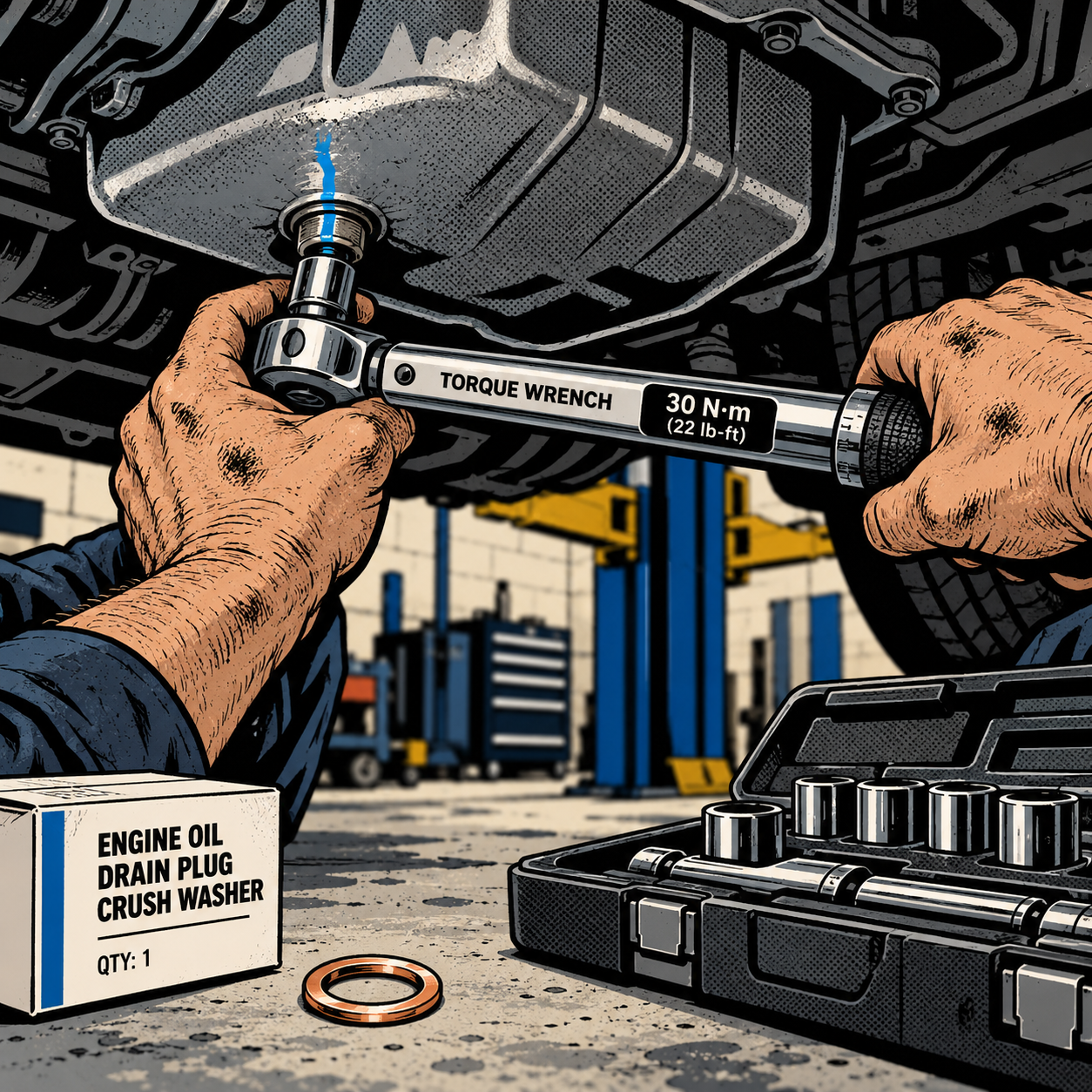
If you’ve ever pulled a vehicle in for an oil change and found a smear of blue, yellow, or white paste around the drain plug, you’re not alone — and it’s not a leak, not caulk, and not something gone wrong. In the vast majority of cases it’s marking compound: either torque seal or anti-tamper paste applied by the last shop to service the vehicle. Misreading this goop causes more wasted diagnostic time and unnecessary customer anxiety than almost any other routine oil change finding. This guide breaks down what the stuff actually is, how to tell the benign version from the one that’s hiding a real problem, and how to handle it correctly the next time you’re under a car.
What That Colored Goop on the Drain Plug Actually Is
There are three substances that commonly show up around a drain plug, and they look similar to an untrained eye but serve completely different purposes:
Torque seal (paint stripe): A brittle paint marker, often applied as a single stripe across the bolt head and surrounding surface. Its job is purely visual — if the bolt rotates even slightly, the stripe breaks or the two halves no longer line up. This is standard practice in aviation and motorsports and has carried over into dealership and quick-lube service.
Anti-tamper / marking compound: A soft, waxy or putty-like paste (often blue or yellow) applied around the base of the plug after it’s torqued down. It hardens slightly but stays easy to scrape off with a fingernail or screwdriver tip. Walmart, Hyundai dealerships, and many independent lube shops use this routinely.
RTV silicone sealant: An actual sealant meant to stop leaks at a gasket surface. This should almost never appear on a standard crush-washer or gasketed drain plug, and if it’s present in quantity (especially fully encircling the plug shoulder), it’s a different situation entirely — more on that below.
The quickest field test: try to scrape a small amount off with a plastic scraper or fingernail. Torque seal and tamper compound flake or peel away easily. True RTV silicone is rubbery, bonds more aggressively, and typically shows up in a continuous bead rather than a partial smear.
Torque Seal vs. Tamper Seal vs. RTV — Telling Them Apart
Technicians disagree on terminology more than on function, so it helps to focus on pattern and placement rather than color:
- Pattern: Torque seal is usually a thin painted line crossing from the bolt head onto the adjacent surface. Tamper compound is typically a partial ring or dab around the base of the plug, not a full 360-degree seal.
- Coverage: If the marking only covers part of the plug’s circumference — say the bottom half, with a visible gap at the top — that’s consistent with a quick dab of anti-fraud compound, not an attempt to seal anything.
- Texture after removal: Compound crumbles or lifts in one piece. Silicone sealant stretches, strings, and leaves a thin film that needs solvent or a razor to fully clean off the sealing surface.
If you’re stocking your own bay with a proper marking product rather than guessing with leftover paint, pick something designed for the job rather than nail polish or a paint pen that could react with oil or heat.
PRODUCT_SEARCH: torque seal paint marker for bolts and drain plugs


Why Shops Apply Anti-Tamper Marking in the First Place
This practice exists almost entirely to resolve disputes, and it protects the customer as much as the shop. The scenario it guards against: a vehicle’s engine fails weeks or months after a service visit, and the owner (or someone else) claims the shop under-filled it, cross-threaded the plug, or otherwise caused the failure. Insurance fraud involving staged drain-plug removal and oil loss is common enough that most shops now document every drain plug the same way — torque it to spec, then mark it.
From a liability standpoint, an intact tamper mark at the time of a complaint proves the plug was never touched after it left the shop, which clears the shop of blame. A broken mark does the opposite — it tells the next tech, and potentially an insurance adjuster, that someone opened that plug after the fact. This is why a shop that finds a broken seal during a warranty claim will often decline responsibility outright, and why some shops get understandably cautious if a customer disputes service after a mark shows evidence of tampering.
None of this means the compound provides any physical security. A $20–$100 fluid extractor pulled through the dipstick tube can drain most of the oil without ever touching the plug, seal or no seal. The marking is a documentation tool, not a lock.
Red Flags: When the Goop Is Hiding a Real Problem
The concerning scenario — and the one that generates the most forum threads — is when a drain plug has stripped threads in the oil pan, and instead of repairing the pan (helicoil, oversized plug, or pan replacement), someone tries to paste the plug in place and call it done. This is a real failure mode, and it’s worth knowing the difference:
- Full-circumference coverage: If the compound or sealant fully encircles the plug shoulder with no gaps, rather than a partial dab, treat it as suspicious. A legitimate anti-tamper mark doesn’t need to form a complete seal.
- Thick or rubbery buildup: A thin smear is marking compound. A visible bead or glob thick enough to look like it’s doing structural work suggests someone used it to compensate for a loose or stripped plug.
- Active seepage: True anti-tamper compound has nothing to do with leak prevention. If there’s any oil wetness around the plug along with the goop, the plug itself isn’t sealing properly regardless of what the paste is for.
- Plug spins with resistance but won’t seat: If removal reveals the threads feel loose, cross-threaded, or won’t hold torque on reinstall, the pan needs a proper repair — not more sealant.
If any of these are present, don’t just clean it up and move on. Pull the plug, inspect the pan threads directly, and quote the appropriate repair (thread insert, oversized self-tapping drain plug, or pan replacement) rather than re-applying the same band-aid.
How to Properly Remove and Reapply Marking During an Oil Change
Treat the compound as a non-issue in terms of removal difficulty — if a tech is hesitant to break a tamper seal because they don’t recognize it, that’s a training gap, not a legitimate reason to turn a customer away.
- Confirm the pattern matches typical marking compound (partial coverage, soft/flaky texture) before assuming anything is wrong.
- Remove the plug normally with the correct socket or drain tool — no special handling is required.
- Inspect the crush washer or sealing washer and the pan threads while the plug is out. Replace the washer; don’t reuse a crushed one.
- Torque the plug to the manufacturer’s spec with a torque wrench, not by feel.
- Apply fresh marking compound or a torque seal stripe across the bolt head and adjacent pan surface once torque is confirmed.
- Log the service, including a note that the drain plug was marked, in the repair order.
PRODUCT_SEARCH: oil drain plug tools torque wrench and crush washers
Quick Checklist
- Scrape-test the goop — flakes off easily = marking compound; rubbery/stringy = possible sealant
- Check coverage — partial dab is normal; full 360° ring warrants a closer look
- Inspect for active oil seepage separate from the marking itself
- Pull the plug and inspect pan threads directly if anything looks off
- Reinstall with a new crush washer, torque to spec, then remark
- Document the service and marking on the repair order


Drain Plug Socket Audi A4 & A6, VW Passat - 16mm
Mfg: Assenmacher Specialty Tools
Part #: 6300X-16

FAQs
Is the blue or yellow goop on my drain plug a sign of a leak?
No. In the overwhelming majority of cases it’s anti-tamper marking compound or torque seal, applied after the plug was tightened to document that it hasn’t been touched since. It has no sealing function.
Why would a shop do this to my car without telling me?
It’s standard procedure at many dealerships and quick-lube chains, used to protect against fraudulent claims (e.g., someone draining oil to fake an engine failure). Most shops don’t call it out specifically because it’s routine, similar to a sticker reminder for the next service interval.
Should I be worried if my shop didn’t know what the marking was?
It’s a reasonable yellow flag. Any tech working on drain plugs regularly should recognize torque seal or anti-tamper compound on sight. A shop that refuses to touch a plug because of unfamiliar paste may lack experience with common dealership and quick-lube practices.
How can I tell if it’s actually sealant hiding stripped threads?
Look for full coverage around the entire plug shoulder rather than a partial smear, a thick or rubbery texture instead of a thin flaky layer, and any oil wetness nearby. If in doubt, have the plug pulled and the pan threads inspected directly.
Does removing the tamper seal void anything?
No — it’s not a warranty seal in the legal sense, and it’s expected to be broken at the next service. It only matters as documentation if there’s a dispute about whether the plug was tampered with between visits.
What should I use to remark the plug after an oil change?
A purpose-made torque seal paint marker or anti-tamper marking compound, applied in a thin, visible stripe or partial dab after torquing to spec — not generic paint, nail polish, or excess RTV sealant.
Essential Oil Change Tools
Proper drain plug service requires more than a wrench. Torque wrenches, crush washers, and marking compound are just as important as the drain plug itself. Check our automotive oil change tools to fill any gaps in your kit.
- Torque wrenches and drain plug sockets for spec-compliant fastening
- Crush washers and drain plug gaskets for proper sealing
- Torque seal and anti-tamper marking compound for service documentation

The Toolsource Technical Team blends decades of real-world automotive service experience with up-to-date technical research. Our writers collaborate with professional mechanics, shop owners, and diagnostic specialists to deliver practical, workshop-ready guidance you can trust.


Follow us on social media