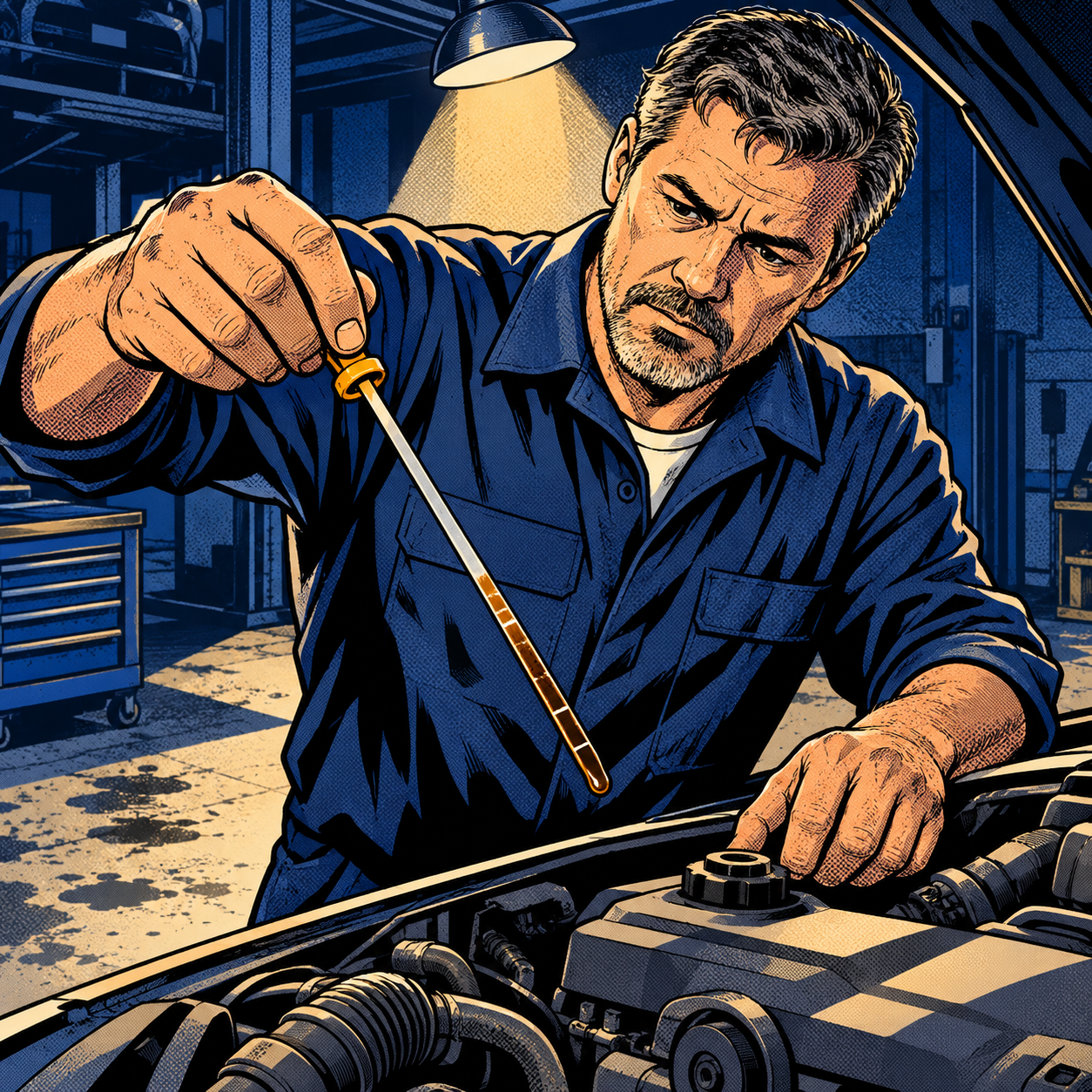
Every shop has heard both sides of the oil change argument: the customer who swears by 3,000-mile intervals no matter what the owner’s manual says, and the one who runs full synthetic to 10,000 miles because the dealer sticker told them to. Neither position is wrong on its own — but the real-world failures techs actually see on the lift rarely come down to “I changed it at 5,000 instead of 3,000.” They come down to neglected fluid checks, ignored warning signs, and people trusting a shop to do work it didn’t actually do. Here’s what’s worth knowing before you set a blanket interval or write one off as overkill.
Why the “3,000 vs. 10,000” Debate Misses the Point
Modern full synthetic oils genuinely hold up past 3,000 miles. Most manufacturers spec 7,500–10,000 mile intervals for a reason: additive packages, tighter tolerances, and better filtration have changed since the conventional-oil era when 3,000 miles was the standard. Sticking to 3,000 miles on synthetic in a daily driver isn’t dangerous, it’s just not cost-efficient — you’re paying for oil life you aren’t using.
That said, interval length isn’t the variable that correlates with catastrophic failure. Severe duty — short trips, stop-and-go traffic, towing, extreme temperatures, or infrequent long-distance driving that never lets the engine fully burn off condensation — degrades oil faster than mileage alone suggests. The manufacturer’s “normal” interval assumes normal conditions. If a customer’s driving pattern is mostly five-minute trips, recommend the severe-duty interval in their manual, not the headline number on the oil cap.
The practical advice for a service writer: ask about driving habits before quoting an interval, and don’t treat 3,000 miles as a universal safety margin or 10,000 miles as a universal green light. Both can be correct depending on the vehicle and the owner.
How Skipped Oil Changes Actually Destroy Engines
The mechanism matters more than the mileage number. Oil that goes too long without a change — especially under heat cycling and short-trip condensation — breaks down and forms sludge. Sludge doesn’t just reduce lubrication; it physically clogs the small oil passages that feed variable valve timing (VVT) solenoids. Once a solenoid sticks, the engine can throw timing-related codes, run rough, lose power, or rattle on startup.
The repair path on a sludge-related VVT failure is predictable and it adds up fast: diagnosis, replacement of one to four solenoids depending on the engine, then an oil system flush — frequently two consecutive oil changes with a flush additive to clear residual sludge before it re-contaminates the new solenoids. That combination routinely lands in the $1,000–$1,500 range on common four-cylinder engines, which is the kind of bill that makes “I’ll just stretch the interval” look like a bad trade for a $40–$80 oil change.
This is also why a flush-and-replace job isn’t optional corner-cutting — reinstalling a new solenoid into a still-sludged system just restarts the clock on the same failure.


75-00 75 Series Synthetic Striper Brush, #00 Brush, Wood Han
Mfg: Mack Brush Company
Part #: 75-00
Overheating Does More Damage, Faster, Than Old Oil
If sludge is the slow failure, overheating is the fast one. A stuck-closed thermostat, a low coolant level, or a burst hose can take an otherwise healthy engine from fine to blown head gasket in a matter of hours of driving — sometimes before the temp gauge is even obviously pegged, especially if nobody’s watching it. The repair contrast is stark: a thermostat is a $30–$60 part, but a blown head gasket repair with machining (milling heads or the block) commonly runs $3,000–$4,000+, and that’s before factoring in a warped head on an engine that wasn’t designed to run hot.
Practical takeaway for the bay: coolant system checks deserve at least as much attention in a routine inspection as oil condition. A 2-minute visual check of coolant level, hose condition, and reservoir color catches problems that an oil change interval debate never will. Encourage customers to actually watch the temp gauge, not just the fuel light — most daily drivers never look at it until the car is already in trouble.
Verify the Work After Any Service, Not Just Your Own
A theme that comes up constantly from experienced techs: check fluid levels after any service, including — maybe especially — after a quick-lube or dealer oil change. Overfilled or underfilled oil, a drain plug not torqued correctly, or a transmission fluid mix-up during a multi-fluid service are all real, documented mistakes. The fix is simple and costs nothing: pop the hood and check the dipstick before leaving the lot, and glance underneath for fresh drips in the days after.
This applies whether the work was done in-house or by a quick-lube chain. A rushed tech on a 15-minute oil change is far more likely to misjudge a fill level than cause a sludge problem — and an overfilled crankcase can aerate oil and cause its own pressure issues, while a drastically underfilled one starves bearings.
What Actually Belongs in a Maintenance Routine
Strip the debate down to what consistently prevents expensive repairs, regardless of which oil interval a given owner follows:
- Check oil level and condition at every fuel stop or at least monthly — don’t wait for the dash light
- Follow the severe-duty interval in the owner’s manual if the vehicle sees mostly short trips or stop-and-go driving
- Inspect coolant level and hose condition every oil change — this catches overheating risks before they become head gasket repairs
- Flush/replace brake fluid on the manufacturer’s schedule — it absorbs moisture over time regardless of mileage
- Verify fluid levels after any shop visit, including oil changes, before leaving the lot
- Rotate and inspect tires for uneven wear, which flags alignment or suspension issues early
- Keep dated receipts or a digital log — it supports warranty claims and resale value, and helps a new mechanic spot a pattern fast
When “Low Maintenance” Specs Are a Marketing Decision, Not a Guarantee
Some “lifetime fluid” claims — transmission fluid being the most common example — are written with a particular ownership timeline in mind, not literally the physical lifespan of the component. That doesn’t mean the fluid needs to be changed on a fixed aggressive schedule either; plenty of vehicles run well past 150,000–200,000 miles on original transmission fluid when the vehicle is otherwise well cared for. The point isn’t to distrust every manufacturer spec, it’s to recognize that “lifetime” and “never needs service” aren’t always the same claim, and a transmission fluid check (not necessarily a change) belongs in a long-term ownership conversation, especially past 100,000 miles.


Samson 27 GAL WASTE OIL SUCTION UNIT W/TRANSPARENT CHAMBER
Mfg: Samson Corporation
Part #: 3721
FAQs
Is 3,000 miles ever still the right interval?
Only for conventional (non-synthetic) oil or vehicles under severe duty — frequent short trips, towing, extreme heat, or heavy stop-and-go. Most full-synthetic daily drivers are fine well past that.
What are the warning signs of a sludge-related VVT problem?
A rattling or ticking noise on cold start, a check engine light with a timing or VVT-related code, rough idle, or a noticeable loss of power — especially on a vehicle with a history of extended oil change intervals.
Can a VVT solenoid flush actually fix sludge damage?
It can clear accumulated sludge enough to restore normal oil flow and solenoid function if caught early. If sludge has already damaged internal components or clogged passages beyond the flush’s reach, more extensive disassembly may be needed.
How often should coolant and hoses be inspected?
Visually check level and hose condition at every oil change; have the system pressure-tested if you notice any coolant loss without a visible puddle, since slow leaks often show up as overheating before they show up as a stain on the driveway.
Does an overfilled oil crankcase actually cause damage?
Yes — overfilling can cause the crankshaft to churn the oil into foam, reducing lubrication pressure to bearings and other components. It’s a real risk after rushed services, not just a theoretical one.
Is keeping paper receipts worth it if I track maintenance digitally?
Yes, when possible. A dated receipt is more useful than a memory of “I think it was last spring” if a warranty dispute comes up, and it adds resale value independent of whatever app or log you use day to day.
Recommended Oil Change Tools
Staying on top of oil changes and fluid checks requires the right equipment. Browse our Automotive Oil Change Tools to ensure every service — whether in your own garage or verifying shop work — is done correctly.
- Oil drain pans, wrenches, and filter sockets for efficient fluid removal and installation
- Dipsticks and fluid-level checking tools to verify proper fill before leaving the shop
- Fluid disposal and recycling equipment for safe handling and environmental compliance

The Toolsource Technical Team blends decades of real-world automotive service experience with up-to-date technical research. Our writers collaborate with professional mechanics, shop owners, and diagnostic specialists to deliver practical, workshop-ready guidance you can trust.


Follow us on social media