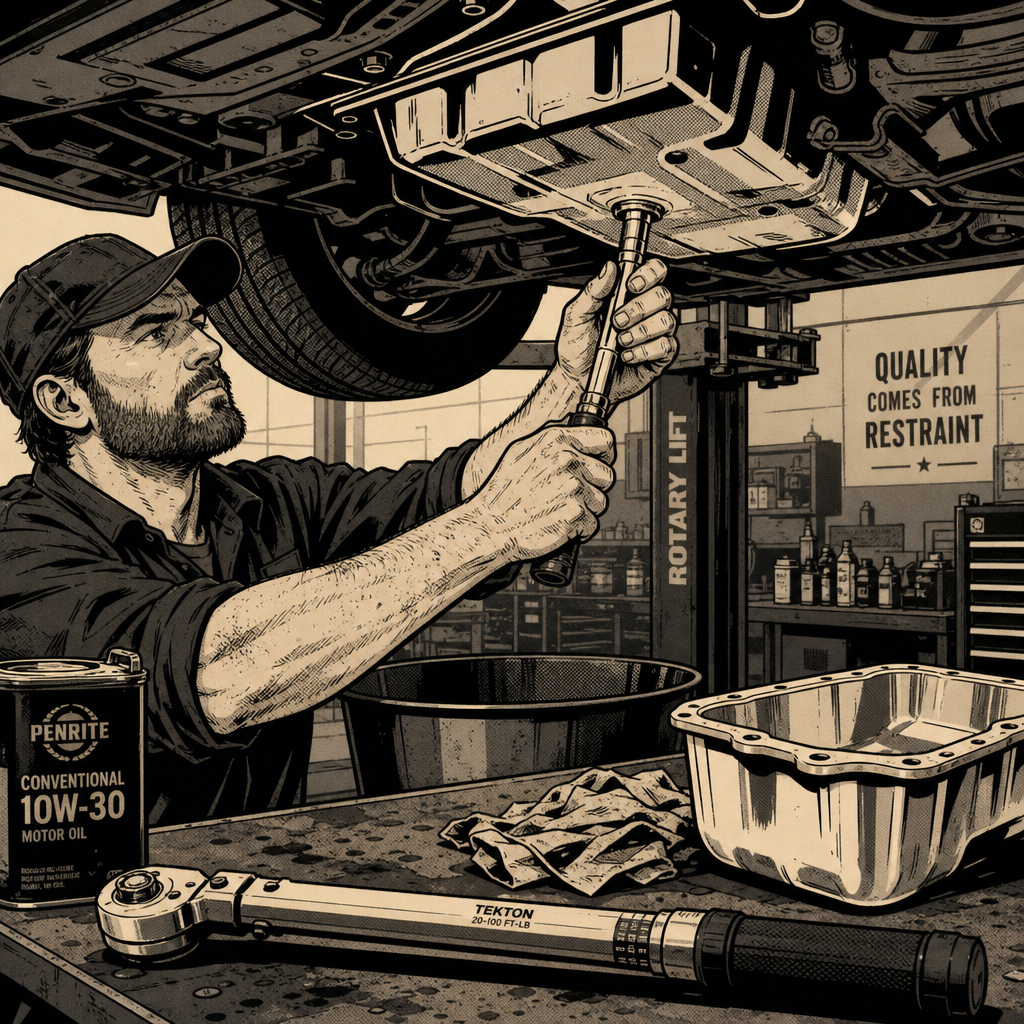
If you’ve touched a late-model Nissan Rogue, Sentra, or Altima with a QR25 engine, you’ve probably already had the conversation: “We might need to replace the oil pan today.” Insert-style drain plug threads — a metal helical insert pressed into a plastic or soft-aluminum pan — have turned a five-minute part of the oil change into a coin flip. Techs are split roughly 50/50 on getting the plug back out cleanly, and the failure isn’t really about skill. It’s a design that fails under normal torque applied by a normal tool, repeatedly, over the life of the vehicle. This post walks through why these threads fail, how to pull oil safely without touching the plug at all, the technique shops actually use when they do have to go in from below, and what to keep in stock so the job doesn’t stall for three weeks waiting on a backordered pan.
Why Insert-Style Threads Strip So Easily
The problem isn’t usually the current tech’s wrench. It’s cumulative. Every time that plug goes in, whoever installs it is fighting against the previous person’s torque, the condition of the crush washer or O-ring, and whatever clamping force the insert can actually hold before it spins in the plastic or aluminum around it. A lube tech who “cranks it in there” once is often enough to start loosening the insert’s grip permanently, even if the plug seats fine that visit. The next tech who comes along to remove it applies completely reasonable force and the insert spins free with the plug, because the bond between insert and pan was already compromised.
This is also why blame is hard to assign. You can use a correctly sized socket, a torque wrench set to spec, and still get a spinning insert, because the real damage was done one or two oil changes earlier. Several Nissan dealer techs have reported that a single overzealous lube tech can be traced through a string of comebacks — every pan that tech touched eventually needs replacement, regardless of who services it next.
Top-Side Evacuation: Skip the Plug Entirely
The lowest-risk option, and the one Nissan itself eventually recommended in a technical service bulletin, is to stop removing the drain plug altogether. A fluid evacuator pulls oil out through the dipstick tube under vacuum, leaving the drain plug — and its fragile insert — completely undisturbed. Quick-lube operations that handle high volumes of these vehicles have in some cases adopted a blanket policy: no draining from below on these pans, full stop, because the liability of a failed insert outweighs the time saved. It won’t get every drop (you’ll leave a bit more residual oil than a full gravity drain), but for a vehicle with known insert problems, that tradeoff is easy to justify to a customer and to your own warranty exposure.
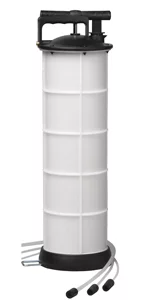


Zeeline by Milton 6-Gallon Professional Fluid Evacuator
Mfg: Zeeline fmr National-Spenser
Part #: ZE6EV
If You’re Draining From Below, Use the Right Touch
Plenty of shops still pull these plugs successfully — the key is matching force to the fastener, not to habit. A few things that consistently work in the field:
- Break the plug loose with hand tools when possible; save the impact for plugs that are genuinely stuck, not as a default move.
- If you do reach for an impact, use short, barely-there pulses on the trigger — just enough to flinch the anvil, not a sustained burst. Techs describe this as “the ugga, not the dugga.”
- Twist-removal sockets designed for damaged fasteners can salvage a plug whose hex is already rounding off, buying you one more use before the pan needs replacing.
- Have a stock replacement pan (and, on superseded designs, the correct plug) on hand before you start, so a failure doesn’t turn into a parts-chase that strands the car.
None of this guarantees success on a pan that’s already been overtightened past its limit. Know that going in, and tell the customer up front that there’s a real chance this oil change turns into a pan replacement.
Stock the Updated Parts, Not Just the Old Ones
Several of these platforms have gone through a running design change: the original pressed-in metal insert was replaced with a pan that uses a one-time-use plastic plug, VW-style. If you’re ordering a replacement pan, confirm you’re getting the current revision — not a reissued version of the same problematic insert design. Even then, treat the plastic plug itself as consumable. It’s not just the O-ring that’s single-use; reinstalling the same plastic plug has led to leaks shortly after an oil change on more than one documented job. Budget roughly an extra few dollars per oil change for a fresh plug on these vehicles and you avoid a comeback that costs far more in goodwill and labor.
Some technicians would rather see manufacturers go back to all-metal pans and plugs entirely, and it’s hard to argue with the simplicity of that position — plastic components near the bottom of the engine, exposed to road debris and heat cycling, introduce failure modes that steel pans and OEM-torque-spec drain plugs rarely had. Valve covers get more of a pass since they’re not sealing hot oil directly against road hazards, but a drain pan is a different story.
Torque Specs, Not Gut Feel
Several manufacturers have had to revise torque specs downward for these inserts after widespread failures — in some cases issuing a bulletin telling techs to torque lower than the original factory number. That’s a strong signal: if the OEM is walking back its own spec, “snug plus a quarter turn” is not a safe substitute for a torque wrench on these specific pans. A light coat of thread locker on the plug threads (not the sealing surface) has also helped some shops reduce comebacks from under-torqued plugs without risking over-tightening the insert.
If your shop services a lot of these vehicles, a Fumoto-style quarter-turn drain valve is worth considering as a customer upsell or fleet standard. Once installed, it replaces the repeated thread-and-unthread cycle that causes insert wear in the first place — you open a lever and attach a hose instead of torquing a plug every visit. Concerns about road debris snapping the valve off are largely overstated in practice; anything with enough force to shear a precision-machined valve would likely puncture the pan itself regardless. Fleet and heavy-equipment operators have used these valves for years specifically because they eliminate this exact failure mode.
Checklist: Before You Touch an Insert-Style Drain Plug
- Check service history for prior oil changes and signs of overtightening on the last plug.
- Default to top-side evacuation on known problem platforms, especially high-mileage units.
- If draining from below, break the plug loose by hand first; use short impact pulses only if needed.
- Have a replacement pan and the correct (current-revision) plug on hand before starting.
- Torque to the latest OEM spec with a calibrated wrench — not the original factory number if it’s been revised.
- Replace one-time-use plastic plugs every service; don’t reinstall the old one.
- Brief the customer up front on the risk and the shop’s no-fault policy if the insert fails.

Drain Plug Socket Audi A4 & A6, VW Passat - 16mm
Mfg: Assenmacher Specialty Tools
Part #: 6300X-16

VIM Tools 3/8" XZN Drain Plug Socket 16mm for Audi & VW
Mfg: VIM Tools
Part #: XZN116MH

Frequently Asked Questions
Is a stripped oil pan insert the technician’s fault?
Usually not. Because clamping force is cumulative across services, the insert is often already compromised by a prior overtightening before the current tech ever touches it. Showing a customer the old vs. new pan, or bringing in another tech to confirm the known failure pattern, is a common and effective way to defuse disputes.
Should I always use an evacuator instead of pulling the plug?
On platforms with a documented insert-failure history, yes — many shops and quick-lube chains have made this a blanket policy. On vehicles without a known issue, a normal gravity drain is still fine as long as torque is controlled.
What torque should I use if the OEM has issued a bulletin lowering the spec?
Use the revised spec from the current bulletin, not the original factory manual value. Manufacturers that walked back their torque numbers did so because the original spec was directly causing insert failures.
Can a stripped insert be repaired instead of replacing the whole pan?
In some cases a heli-coil or thread-repair insert can restore the threads, but on pans known for this failure, replacement with the current-revision pan is usually more reliable long-term, especially if the surrounding material is plastic.
Are plastic one-time-use drain plugs really necessary to replace every time?
Yes. Shops that reused them have seen leaks show up shortly after the service. The plug material itself, not just the O-ring, degrades with each torque cycle.
Are Fumoto-style drain valves safe for daily-driven vehicles?
Long-term users, including fleet and heavy-equipment operators, report no issues with road debris damaging these valves. The scenarios where damage is severe enough to compromise a Fumoto valve would typically damage a stock pan just as badly.
Recommended Tools
Proper tools are essential for safe, controlled drain plug removal. Explore Automotive Oil Change Tools to find the equipment you need to prevent stripped threads and handle compromised fasteners.
- Calibrated torque wrenches for precise fastener control
- Damaged-fastener sockets and extraction tools
- Oil evacuators for top-side drainage

The Toolsource Technical Team blends decades of real-world automotive service experience with up-to-date technical research. Our writers collaborate with professional mechanics, shop owners, and diagnostic specialists to deliver practical, workshop-ready guidance you can trust.


Follow us on social media