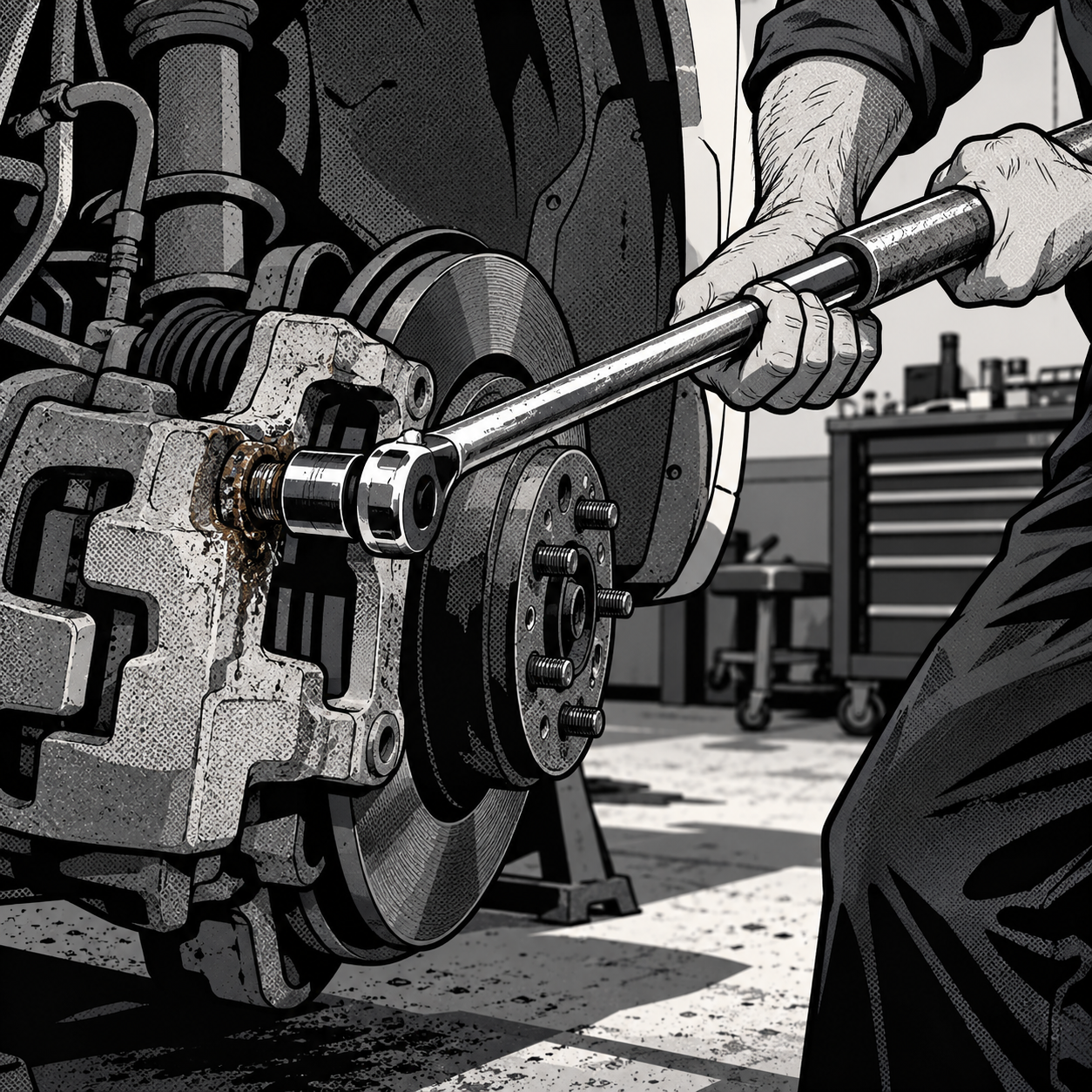
Every brake job eventually turns up a bolt that refuses to move. Caliper slide pins and bracket bolts are notorious for this because many manufacturers apply red thread-locking compound (Loctite or patchlok) at the factory, and the bolt lives through thousands of heat cycles from the brakes themselves. Add in road salt, moisture, and dissimilar metals corroding together, and you get a fastener that feels welded in place. The instinct is to grab whatever ratchet is closest and lean on it, but that’s exactly how people strip sockets, snap bolts, or hurt a hand when a tool slips. Here’s a practical, step-by-step escalation path for breaking these bolts loose without turning a routine pad-and-rotor job into a parts-store emergency run.
Why These Bolts Seize in the First Place
Before grabbing bigger tools, it helps to know what you’re actually fighting. Caliper bracket bolts and slide pins are rarely over-torqued from the factory — most are spec’d in the 30-80 ft-lb range depending on the vehicle, which a quality breaker bar should handle without drama. What makes them feel like they were tightened with a 4-foot cheater bar is usually one of three things:
- Factory thread locker: Red (high-strength) Loctite or patchlok coatings are common on caliper hardware and essentially glue the threads together until broken free.
- Corrosion: Steel bolts in aluminum or cast-iron brackets corrode at the interface, especially in rust-belt climates or on vehicles that see a lot of road salt.
- Heat cycling: Brakes get hot and cool down thousands of times over a vehicle’s life, which can work bolts tighter against corrosion and varnish buildup.
Knowing which of these you’re dealing with changes your approach — a loctite’d bolt usually breaks free with a sharp, sudden force, while a corroded one benefits more from penetrating oil and patience.
Match the Tool to the Bolt
The single most common mistake is trying to break a stubborn bolt with undersized tools — a small 1/4″ or 3/8″ drive ratchet, a short handle, or a compact “multi-tool” style wrench. These are fine for routine fastener work but don’t have the leverage or structural strength for a seized bolt, and pushing them past their limit is how ratchets crack or teeth strip inside the mechanism.
Step up methodically:
- Use the right drive size. A 1/2″ drive ratchet and socket set handles the vast majority of caliper hardware. For genuinely stubborn bolts (old crank pulley bolts, rusted suspension fasteners), move to 3/4″ drive tools — they’re built for substantially higher torque.
- Get a real breaker bar. A dedicated breaker bar (not a ratcheting mechanism) is solid steel with no gears to shear, and a longer handle multiplies your leverage safely.
- Add a cheater pipe when needed. Sliding a length of pipe over a breaker bar handle is a long-standing shop trick for extra leverage. Keep the joint between bar and pipe roughly 45 degrees from horizontal so if the bolt breaks free suddenly, your hand doesn’t slam into anything, and never cheater-bar a ratchet’s gear mechanism — only solid breaker bars are rated for it.
If you only own one ratchet and it’s undersized for the job, it’s genuinely worth the $20-40 to pick up a proper breaker bar before you’re stuck mid-job with a bolt half broken loose and a damaged tool.
===PRODUCT_SEARCH_1===
No products found for "1/2 inch drive breaker bar set"
Leverage and Positioning Matter As Much As Tool Size
Bigger isn’t the only variable — how you apply force matters just as much. A few things that make leverage safer and more effective:
- Get the tool square. A socket or wrench that’s even slightly cocked on the bolt head will round it off under high torque. Confirm full engagement before you push.
- Push, don’t just pull. Where possible, position yourself to push down or away from your body rather than pulling toward yourself. If the bolt breaks free suddenly, you want your body moving away from the car, not toward it.
- Brace the other end. On bolts you can access from both sides, holding the nut or bolt head stationary with a second wrench while you work the other side prevents the whole assembly from just spinning in place.
- Don’t overdo the cheater pipe. More leverage means more torque transferred to the bolt — past a certain point you’re not breaking the seizure, you’re shearing the bolt. If a 2-foot breaker bar plus a short cheater pipe doesn’t move it, that’s usually the signal to change technique, not add more pipe.
Penetrating Oil, Heat, and the Hammer Trick
For bolts seized by corrosion rather than thread locker, brute force alone often isn’t the fastest or safest path. A few proven techniques:
- Penetrating oil first. A quality penetrating fluid applied to the bolt threads and given time to wick in (ideally 30-60 minutes, longer for badly corroded hardware) can make a dramatic difference. Reapply if you have the time to let it sit overnight.
- Controlled heat. Gently warming the area around a seized bolt causes the surrounding metal to expand and can crack corrosion loose. This has to be done carefully around brake lines, rubber components, and anything flammable — it’s not appropriate for every situation, but it’s a legitimate shop technique when applied with care.
- Shock, don’t strain. Instead of slow, steady pressure, a sharp impact often breaks a seized bolt free faster and more safely than straining against it. With a box-end wrench or socket fully seated on the bolt, a few firm strikes with a hammer on the end of the wrench handle delivers a shock load that breaks corrosion bonds without the slow, building torque that shears bolts. Many technicians find this clears a seized bolt in a few taps when steady leverage alone wasn’t doing it.
- Work it back and forth. Once it breaks loose even slightly, loosening and re-tightening a few times while adding more penetrating oil helps work it the rest of the way out instead of forcing it straight through binding threads.
When to Bring In an Impact Wrench
If hand tools and penetrating oil aren’t cutting it, an impact wrench is often the safer next step rather than continuing to add leverage. The rapid hammering action of an impact delivers the same “shock rather than strain” principle as the hammer trick, but with far more consistent and controllable force.
- A mid-power electric or cordless impact handles the majority of stuck caliper hardware.
- For truly stubborn fasteners — old crank bolts, rusted suspension hardware, anything with 200,000+ miles on it — a 1/2″ or 3/4″ drive pneumatic impact with real torque output may be needed.
- An impact with a flex-joint or wobble extension can help in tight spaces where a straight socket won’t fit squarely on the bolt.
- Always wear eye protection when using an impact on old hardware — sockets and extensions occasionally fail under the sudden torque, and corroded bolts can shed debris.
Impacts are also simply safer than a long cheater pipe in a cramped wheel well, where a sudden release of a bolt under heavy leverage can send your hand into the rotor, fender, or ground.
===PRODUCT_SEARCH_2===
When to Just Cut Your Losses and Replace the Bolt
Sometimes the right call isn’t a bigger tool — it’s accepting the bolt has to go. Caliper slide pins and bracket bolts are inexpensive, commonly available for a few dollars each from a dealer or parts store. If a bolt has already been heated, hammered, and impacted without result, continuing to escalate force risks snapping it off inside the bracket or caliper — which turns a simple bolt replacement into an extraction job with a tap-and-die set or helicoil. Once you’re applying 4-5x the rated torque spec with no movement, it’s often faster and cheaper to drill it out or cut it off and install new hardware than to keep fighting it.
Quick Checklist: Breaking Free a Seized Caliper Bolt
- Confirm socket/wrench is fully seated and square on the bolt head
- Apply penetrating oil and let it sit (30+ minutes minimum)
- Use a properly sized breaker bar — not an undersized ratchet
- Add a cheater pipe for extra leverage if needed, positioned to push away from your body
- Try sharp hammer taps on a seated wrench before adding more leverage
- Step up to an impact wrench if hand tools stall out
- Know when to stop escalating and replace the bolt instead
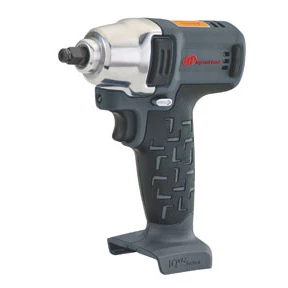
IQV12 Series 3/8 Inch Drive 12V Cordless Impactool Wrench - Tool
Mfg: Ingersoll Rand
Part #: W1130

IQV12 Series 3/8 Inch Drive 12V Cordless Impactool Wrench Kit w
Mfg: Ingersoll Rand
Part #: W1130-K2
FAQs
Why do caliper bolts feel so much tighter than their torque spec?
Most are rated well under 100 ft-lbs, but factory thread locker and years of corrosion can make them feel far tighter than the actual torque spec, since you’re breaking an adhesive or rust bond rather than just overcoming friction.
Is it safe to use a cheater pipe on a ratchet?
No — cheater pipes belong on solid breaker bars, not ratcheting mechanisms. The internal gears in a ratchet aren’t built for the torque a cheater pipe generates and can shatter under load.
Will heating a caliper bolt damage nearby parts?
It can, if not done carefully. Keep heat away from brake lines, rubber boots, and wiring, and use the minimum heat needed to loosen the corrosion bond.
What size impact wrench do I need for stuck caliper bolts?
A mid-power 1/2″ drive electric or cordless impact handles most caliper hardware. Reserve 3/4″ drive pneumatic impacts for exceptionally stubborn bolts like old crank pulley fasteners.
Do I need to remove the slide pins if they aren’t seized?
No — if the slide pins themselves move freely, you can often pull the caliper off the bracket with the pins still installed and only need to address bracket bolts separately.
What should I do if a bolt snaps off?
Stop and assess before drilling blind. A broken bolt flush or below the surface typically needs to be drilled and extracted, or the hole re-tapped; going slowly with a center punch and the correct size drill bit reduces the risk of damaging the threads in the bracket itself.
Shop Brake System Tools
Breaking stuck caliper bolts safely requires the right tools and approach. Our Brake System category stocks breaker bars, impact wrenches, sockets, and specialty extensions designed for brake work.
- Breaker bars and ratchets in multiple drive sizes
- Impact wrenches and flex-joint extensions for confined spaces
- Socket sets and specialty tools for caliper and bracket work

The Toolsource Technical Team blends decades of real-world automotive service experience with up-to-date technical research. Our writers collaborate with professional mechanics, shop owners, and diagnostic specialists to deliver practical, workshop-ready guidance you can trust.


Follow us on social media