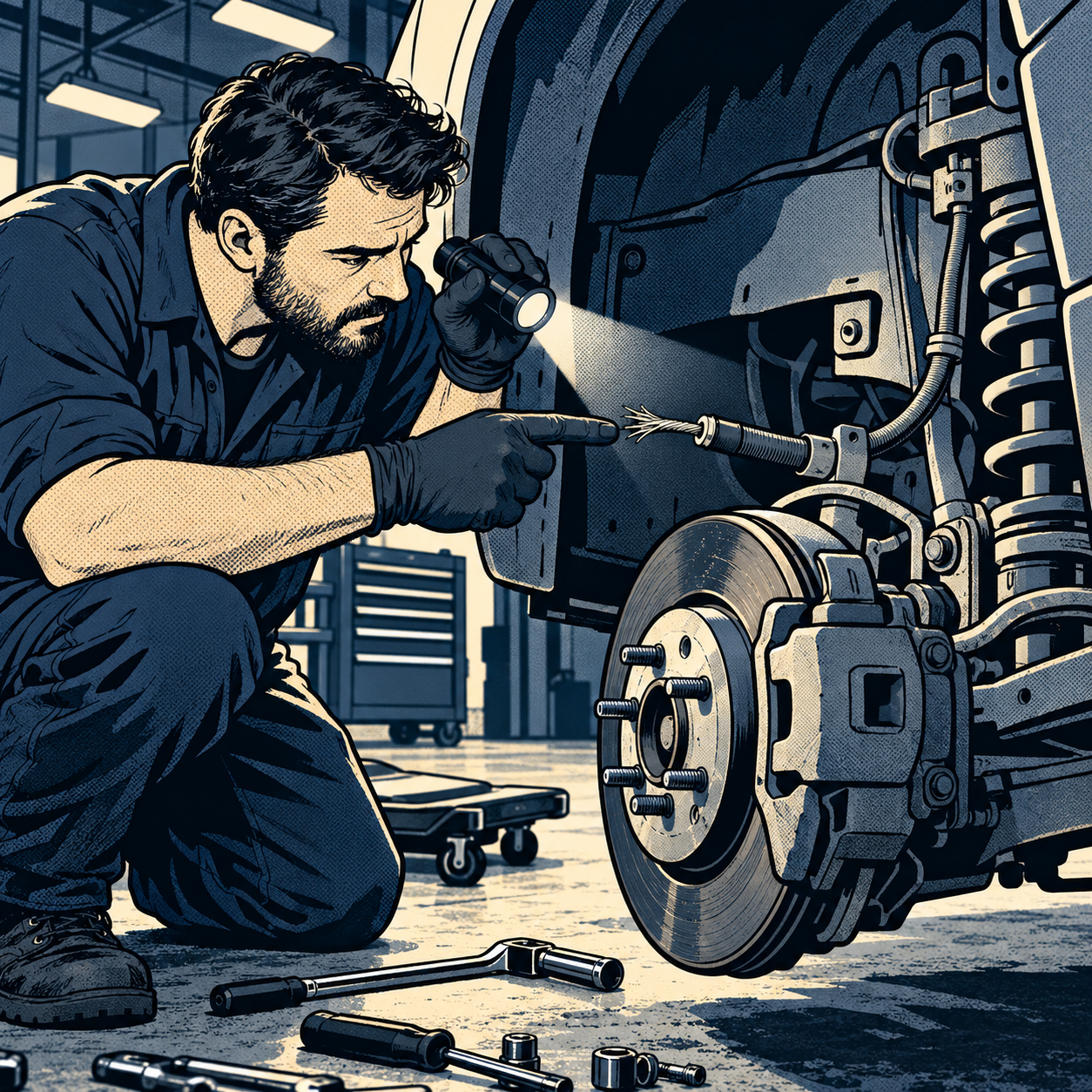
Pull a wheel or drum off an older vehicle and find a frayed stub of cable sheathing where the parking brake cable should be, and the diagnosis is almost always the same: someone cut it. Whether it was a previous tech working around a seized cable or a DIYer who got stuck mid-job, a severed parking brake cable is one of the most common “what did this do” discoveries in the bay. This guide covers how to confirm what you’re looking at, why cables get cut in the first place, and how to properly replace and adjust the system so the parking brake actually holds again.
How to Identify a Cut or Missing Parking Brake Cable
Before assuming the worst, confirm what component you’re actually looking at. On most vehicles the parking brake cable runs from the lever or pedal, through a conduit (the metal-and-rubber sheathing), back to an equalizer, and out to the rear wheels where it connects to either a drum brake actuator arm or a caliper-mounted parking brake lever. If you’re staring at a wheel well and see a short length of outer casing with no cable inside, or a clean/angled cut rather than a frayed break, that’s not corrosion failure — that’s a deliberate cut.
- Clean, angled cut end = cut with pliers or a cutting tool, almost always intentional
- Frayed, rusted, broken strands = corrosion failure or cable snapped under load
- Empty conduit with nothing routed through it = cable was removed entirely, not just cut at one point
- No resistance when pulling the lever/pedal = cable is disconnected somewhere in the run
Trace the full cable run from the lever back to the wheel before ordering parts. Sometimes only one side is cut; the other side may still be intact and functional, which changes whether you need one cable or a full set plus the equalizer.
Why Parking Brake Cables Get Cut in the First Place
This almost never happens for no reason. The most common scenario: a parking brake cable or the brake shoe/caliper it actuates seizes from rust, the parking brake gets stuck “on,” and the vehicle won’t move. Rather than fight a corroded cable that won’t release through normal adjustment, a cable gets cut to free the car — often in a parking lot, roadside, or a shop trying to get the vehicle drivable again without a full repair right then. It’s a quick fix to a stuck-brake emergency, not a permanent repair, and it’s frequently left that way because the parking brake isn’t required for daily driving (unlike the hydraulic brakes).
Other causes worth ruling out:
- Rodent or wasp/nest damage to the cable housing over time (if you find insect nests inside the conduit, that’s a sign the cable has been open and unused for a long while)
- Cable rubbing through on a sharp edge, suspension component, or exhaust heat shield over years of flex
- Impact damage from road debris, curb strikes, or off-road use
Knowing the cause matters because if the original failure was a seized shoe/caliper, simply installing a new cable without freeing up the stuck mechanical parts will just lead to the same cable getting stuck or snapped again.
Before pulling parts, it helps to have the right cable puller, line wrench set, and cable lubricant on hand — check current stock and pricing with a quick search: parking brake cable replacement kit.

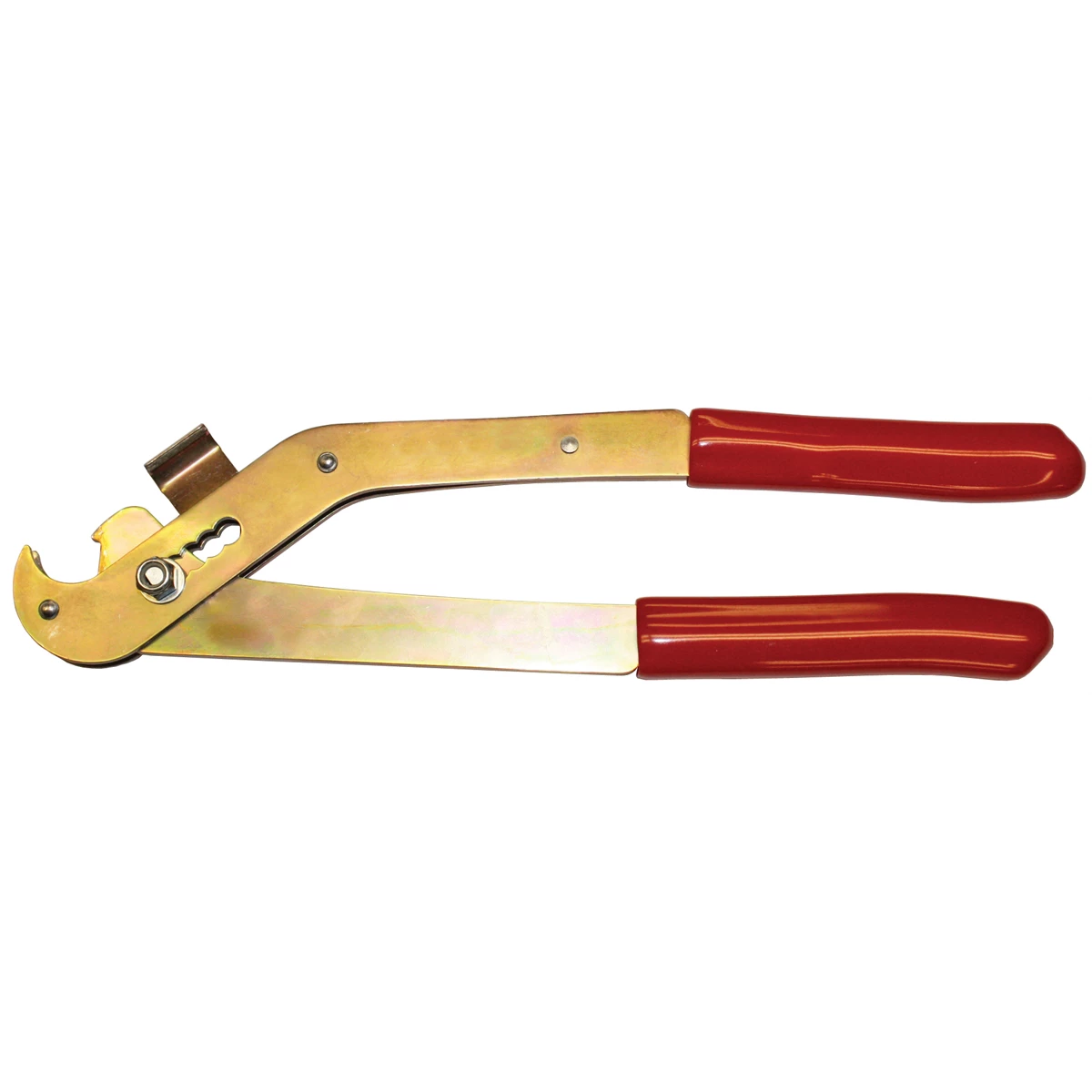
14" Heavy Duty Parking Brake Cable Coupler Removal Pliers
Mfg: Schley Products, Inc
Part #: 10500

Parking Brake Cable Retaining Clip Remover/Installer
Mfg: Mopar Essential Tools
Part #: 9289
Tools and Parts Needed for the Job
Parking brake cable jobs are generally straightforward mechanically but can be stubborn due to rust. Gather these before starting:
- OEM or quality aftermarket parking brake cable(s) — front, rear, or full set depending on what’s damaged
- Penetrating oil, applied well ahead of time to any rusted fittings, retaining clips, or conduit ends
- Cable pliers or a cable cutter (for removing the old cable cleanly if it’s still partially intact)
- Retaining clip pliers or a flathead/pick set for popping cable end fittings out of their mounting brackets
- A jack, stands, and the usual wheel-off tools
- Brake cleaner and high-temp grease or anti-seize for the new cable’s moving contact points
- A torque wrench if the job involves removing a caliper or drum hardware along the way
If the original failure involved a seized drum brake shoe or caliper parking brake mechanism, budget time (and possibly parts) to service that component too — shoes, hardware kits, or a caliper parking brake actuator assembly.
Step-by-Step: Replacing the Cable
The exact routing and connection points vary by vehicle, but the general sequence holds across most drum and disc-with-integrated-parking-brake setups:
- Release tension first. Back off the parking brake adjustment at the lever/pedal or equalizer so you’re not fighting cable tension while disconnecting ends.
- Remove the wheel and drum or caliper access as needed to reach the cable’s wheel-end connection.
- Disconnect the cable end from the actuator arm (drum brakes) or parking brake lever (rear disc calipers), typically a clip, pin, or spring-loaded hook.
- Free the conduit from its mounting brackets along the frame/body, noting routing and any retaining clips — take a photo before removal if routing isn’t obvious.
- Disconnect the other end at the equalizer or lever assembly, and pull the old cable/conduit as one piece.
- Route the new cable following the same path, seating it in every bracket and clip the factory used — skipped brackets cause rattling, binding, or premature wear.
- Reconnect both ends, apply a light coat of high-temp grease at pivot and contact points, and reinstall the wheel/drum.
- Adjust the system per the vehicle’s procedure before road testing.
If the cable was cut because the wheel-end hardware was seized, address that hardware now — new cable, same seized shoe or caliper, same failure down the road.
Testing and Adjusting After Installation
A new cable installed loose or mis-adjusted will feel fine in the shop and fail on a hill. After installation:
- Adjust equalizer or cable tension per the service manual spec — most drum systems use a self-adjuster or a threaded equalizer nut; disc systems with integrated parking brakes often self-adjust through normal use of the lever/pedal after a reset procedure.
- Apply and release the parking brake 8-10 times to seat cables and allow any self-adjusters to take up slack.
- Check that the lever/pedal travel matches spec (often a specific number of clicks or a travel distance) — too few clicks to engage means too much slack; brake dragging with the lever released means over-tightened.
- Road test on a safe grade at low speed to confirm the parking brake actually holds the vehicle, not just that the lever moves.
- Recheck for drag by spinning the wheel by hand after release — it should turn freely with no cable-induced resistance.
Quick Checklist
- Confirm it’s actually a cut cable, not corrosion failure or a missing section
- Trace the full run and identify how many cables need replacement
- Inspect and free up any seized shoe/caliper hardware that caused the original cut
- Route the new cable through every original bracket and clip
- Grease pivot points, reconnect both ends, reinstall wheel
- Adjust tension to spec and cycle the brake 8-10 times
- Road test on a grade to confirm actual holding power, not just lever feel
Once the cable itself is sorted, it’s worth stocking adjustable brake tools and cable lubricants for the next seized-cable call that comes through the bay: brake service tools and cable repair supplies.


Frequently Asked Questions
Is it safe to drive with a cut parking brake cable?
Yes, for normal driving, since the parking brake is separate from the hydraulic service brakes that handle everyday stopping. However, you lose your emergency/backup brake and your ability to safely park on a grade or hold the vehicle with a manual transmission, and in many regions a functioning parking brake is required to pass inspection.
Why would a cable be cut instead of just replaced on the spot?
Usually because the vehicle was stuck with the parking brake engaged and needed to move immediately — cutting the cable is the fastest way to release a seized brake roadside or in a lot, with the intention (not always followed through on) of doing a proper repair later.
Can I just reconnect a cut cable instead of replacing it?
No — once cut, the cable is shortened permanently and the strands at the cut point are usually frayed or compromised. Splicing a parking brake cable is not a safe repair; always replace the full cable.
Do I need to replace both sides if only one cable is cut?
Not necessarily. If the other side’s cable and wheel-end hardware are in good condition and move freely, replacing just the damaged side and reconnecting the equalizer is usually fine. Inspect the intact side closely, though — if one side seized badly enough to get cut, the other side may be close behind.
How do I know if the problem was the cable or the brake hardware behind it?
Before installing a new cable, manually actuate the wheel-end lever or actuator arm by hand (with the cable disconnected). If it’s stiff, rusted, or won’t return freely, the shoes, caliper parking brake mechanism, or hardware need service — not just the cable.
What does it mean if I find a spider nest or insect debris inside the cable conduit?
It means that section of the brake system has been open and unused for a significant period, reinforcing that the cut was likely an old “quick fix” rather than a recent repair, and that a full inspection of the parking brake system is overdue.
Recommended Brake System Tools
Parking brake cable replacement requires specialty tools to complete safely and properly. Browse our Brake System selection for tools and supplies needed for cable work and general brake service.
- Cable pullers, extractors, and specialty pliers
- Brake adjusters and spreader tools for drum and disc systems
- Penetrating oils, anti-seize compound, and brake cleaner

The Toolsource Technical Team blends decades of real-world automotive service experience with up-to-date technical research. Our writers collaborate with professional mechanics, shop owners, and diagnostic specialists to deliver practical, workshop-ready guidance you can trust.


Follow us on social media