Every shop has a brake job that becomes shop legend — the one where the pad backing plate is gone, the caliper is grinding on the rotor hat, or the customer swears the car “still stops fine.” Techs trade these stories constantly, usually with a mix of disbelief and dark humor, because the pattern repeats: a car limps in on pads that are long past worn, and somebody has to decide what to do about it. This post pulls together the practical lessons behind those stories — how to inspect, document, and communicate brake damage that’s gone past routine wear and into genuine safety-failure territory.
Recognizing When “Worn Pads” Are Actually a Failure
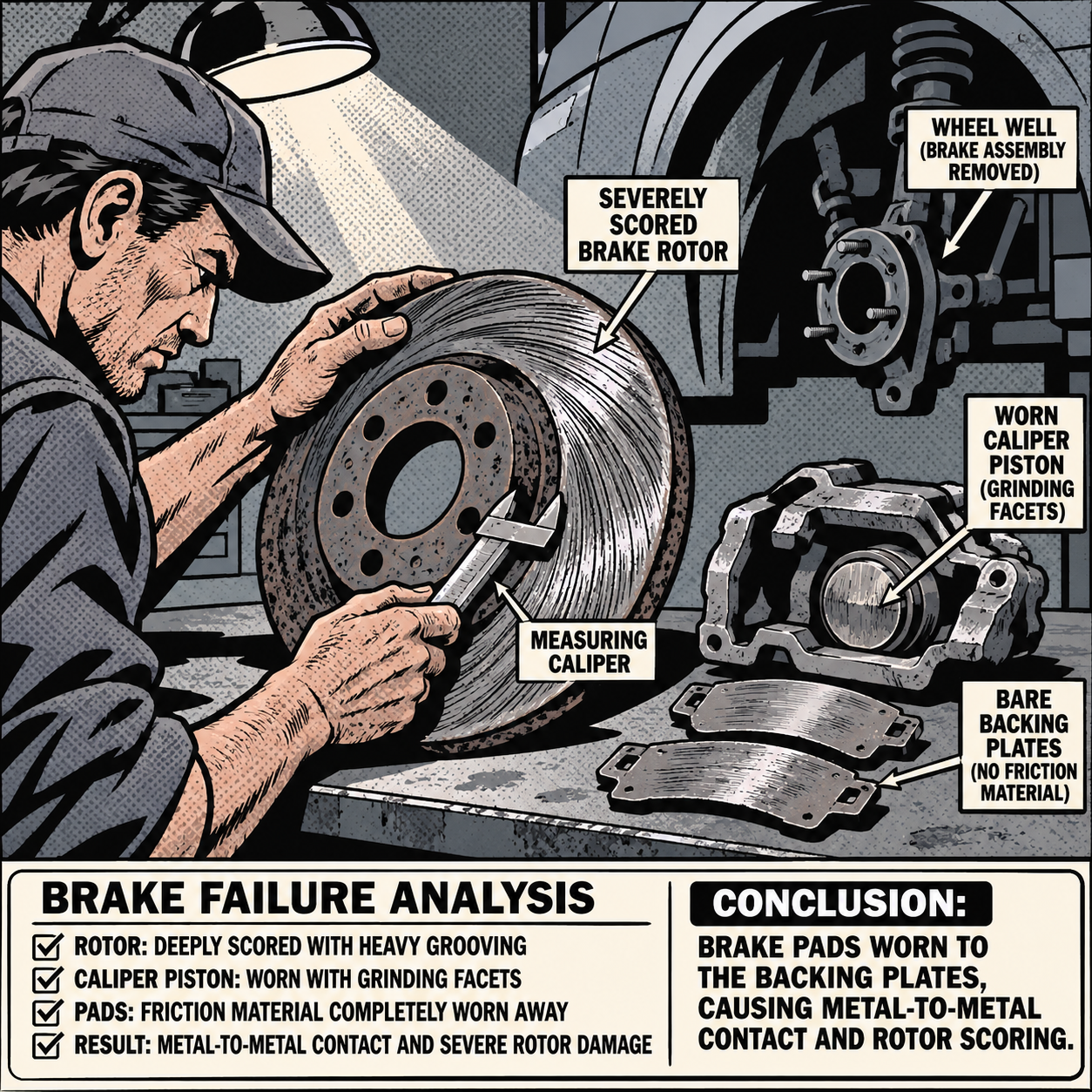
There’s a meaningful difference between a pad that’s thin and a pad that’s gone. Thin pads still have friction material and a backing plate doing their job. A failed pad means the friction material is gone and the backing plate — or in the worst cases, the caliper piston or bracket itself — is contacting the rotor directly. That’s not a maintenance item anymore; it’s a structural failure of the braking system on that corner.
Signs you’re looking at failure rather than routine wear:
- Visible metal-on-metal scoring on the rotor face, often in a spiral or arc pattern matching caliper travel
- A caliper piston or bracket showing wear facets — the piston itself grinding a groove
- Pad backing plates with no friction material left, sometimes bent or partially sheared
- A rotor that’s visibly thinner on one side, tapered, or has a lip you can catch a fingernail on
- Grinding, clunking, or a pulsing brake pedal that gets worse under hard stops
Any one of these on its own warrants a full teardown and inspection of the hub, caliper, and bracket — not just a pad slap. If the caliper has been riding on the rotor long enough to wear a groove into the piston or housing, assume the caliper is compromised and needs replacement, not just cleaning and lubing the slide pins.

Documenting Damage Before You Touch Anything
Before any parts come off, photograph the wheel off, the rotor, the caliper, and the pad remains — all four corners, not just the bad one. This protects the shop in three ways: it proves the condition the vehicle arrived in, it gives you something concrete to show the customer instead of just a verbal description, and it creates a record if there’s ever a dispute about what was found versus what was “upsold.”
Practical documentation habits:
- Shoot wide shots showing the wheel/tire for context, then close-ups of the damage
- Include a measuring tool (caliper or ruler) in at least one shot of pad thickness or rotor thinning
- Photograph both sides of an axle, even if only one side looks bad — matched wear is common, and mismatched wear is itself diagnostic
- Keep photos attached to the repair order, not just on a personal phone, so they survive if the customer calls back in six months
This is also the point where a lot of shops find a
Tools for Brake Assessment & Repair
Proper diagnosis of brake failure requires accurate measurement and inspection. Our Brake System category includes the measurement tools and components needed for complete pad, rotor, and caliper evaluation.
- Brake pad and rotor measurement tools for precise wear assessment
- Inspection equipment for detailed caliper and component evaluation
- Quality replacement components for brake system repairs

The Toolsource Technical Team blends decades of real-world automotive service experience with up-to-date technical research. Our writers collaborate with professional mechanics, shop owners, and diagnostic specialists to deliver practical, workshop-ready guidance you can trust.


Follow us on social media