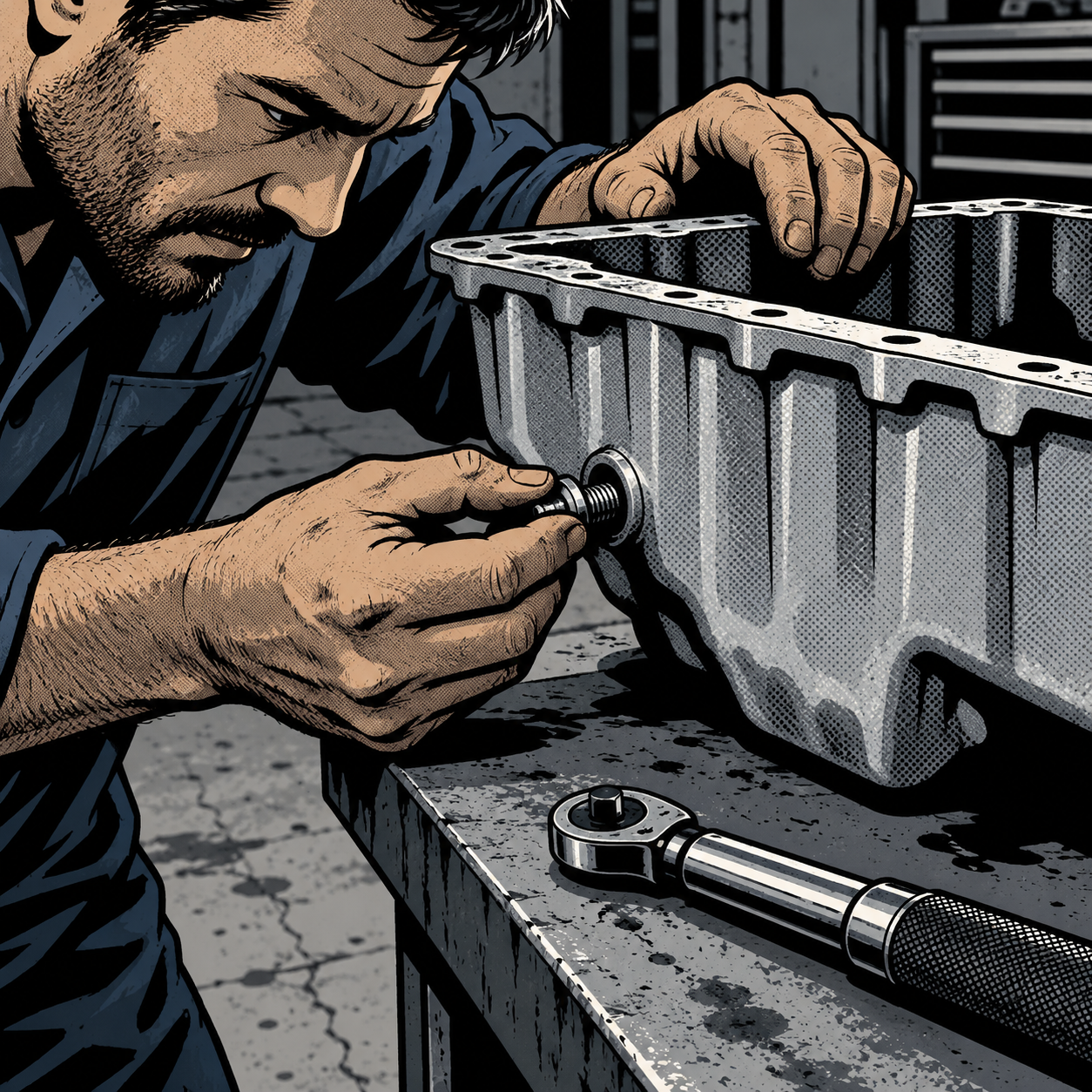
A drain plug that comes out stiff the whole way, never loosening into a free spin, is telling you something before you even get the pan open: the threads are already compromised. That one detail separates a routine oil change from a comeback dispute over who owes for a new oil pan. The following is a practical breakdown of how to read the warning signs, figure out who actually caused the damage, repair it without defaulting to a full pan replacement, and document the job so you’re not the one holding the bag for a predecessor’s mistake.
Read the Plug Before You Blame Yourself
A healthy drain plug behaves in a predictable way: it takes real torque to break loose, then spins out easily by hand for the last few turns, and it threads back in with a smooth, consistent resistance that builds gradually until it seats. If a plug fights you the entire way out, with no point where it goes slack and spins freely, that is not normal wear. It almost always means a previous tech cross-threaded it, ran it in with an impact gun, or wound tape or sealant around a bolt with already-damaged threads to get it to “hold” long enough to get the car out the door.
The same logic applies on installation. If the plug threads in and then stops abruptly with no gradual buildup of resistance, or if it never feels like it’s biting into clean threads, stop immediately. Don’t force it to a torque number and hope it holds. A plug that bottoms out against stripped or deformed threads can back out on the road, and at that point it’s not a comeback, it’s a seized engine and a much bigger argument about liability.
Figure Out Who Actually Damaged the Threads
Before any repair conversation happens, establish whether the damage is new or pre-existing. A few questions settle this quickly:
- Did the plug require excessive, sustained force to break loose, with no “free” point before full removal?
- Does the plug look re-used, re-threaded, or does it have tape, sealant, or a mismatched thread pitch compared to OEM spec?
- Is there visible metal shaving or galling in the pan threads, consistent with a plug being forced in at an angle?
- Does the service history show a recent oil change by another shop, quick-lube chain, or the owner?
If the answer points to prior work, the damage was done before the vehicle ever got to you. That distinction matters for billing and for your own standing with a supervisor or shop owner. It also matters for the customer, who may have a legitimate claim against whoever changed the oil last. Keep notes on what you observed and when, because “the plug was already stripped when I got it” is a much stronger position when it’s backed by specifics rather than a general claim after the fact.
Product search: oil pan drain plug thread repair insert kit

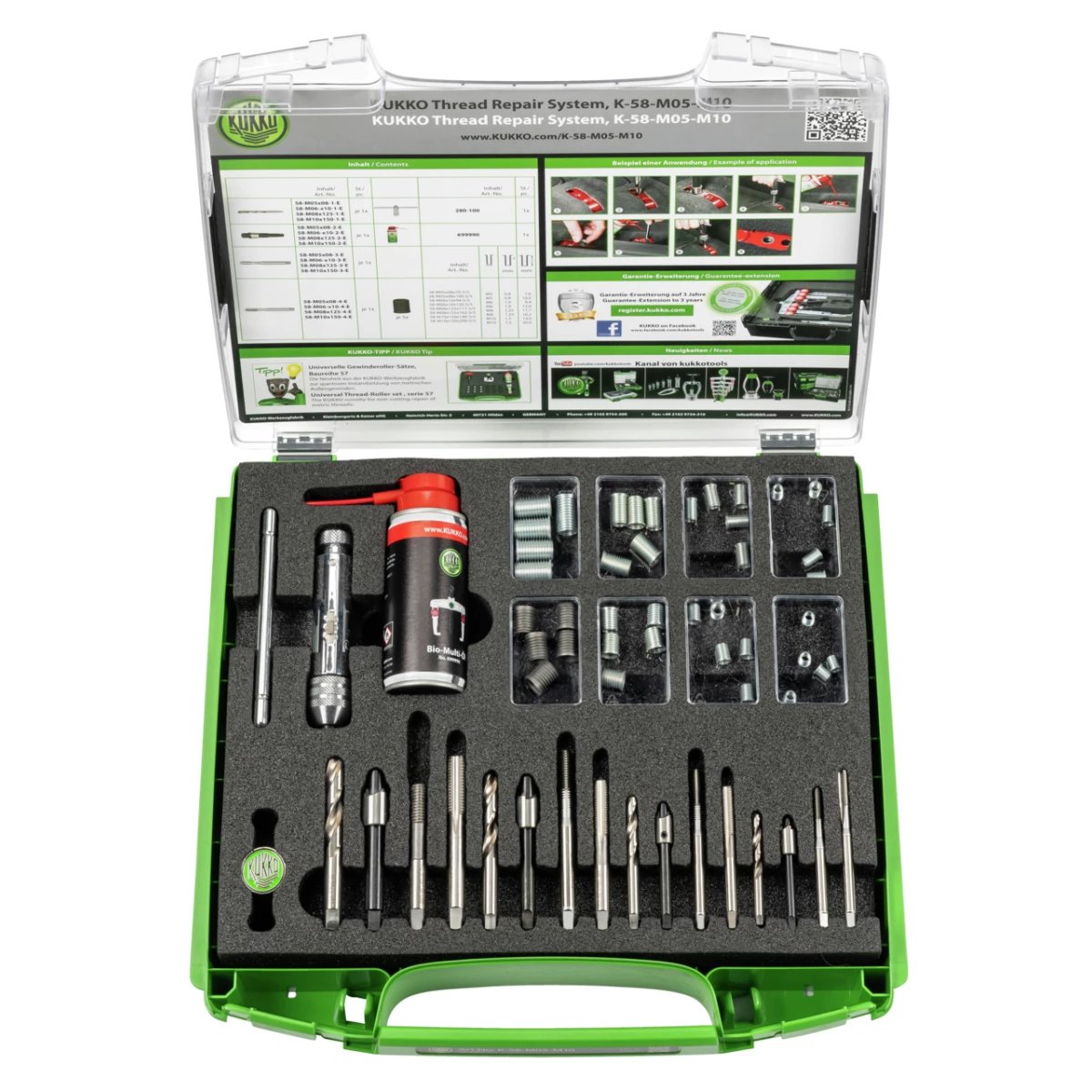
KUKKO-Thread-Repair-Set (M5x7,6, M5x10, M6x9,4, M6x12, M8x11,7
Mfg: Kukko Quality Tools Inc
Part #: K-58-M05-M10

Repair Options Short of Replacing the Pan
A stripped drain plug hole does not automatically mean a new oil pan. Depending on how much usable metal is left around the damaged threads, there are several standard fixes, roughly in order of cost and invasiveness:
- Oversize drain plug: Many common thread sizes have an oversize replacement plug available that cuts fresh threads into the slightly enlarged hole. M12 can often be reamed to 1/2-inch, and some M14 holes can accept an oversize plug without a separate tap.
- Re-tap to the next standard size: If there’s enough meat in the pan casting, the hole can be drilled and tapped to a larger thread size, then fitted with a correctly sized plug. This is a common shop-floor fix and far cheaper than a pan.
- Thread repair insert (time-sert style): An insert is pressed or threaded into the oversized, retapped hole and gives you back the original thread size on the inside. These are generally preferred over traditional helicoils for drain plugs because there’s no fragile tang to break off, and they can be installed with thread-locking compound for extra holding power.
- Helicoil: Works in a pinch and is widely available, but the insertion tang has to be snapped off cleanly, and a sump pan under oil pressure and heat cycling is not the most forgiving place for it to go wrong.
- Pan replacement: Reserved for cases where the threads are torn out badly enough that there isn’t enough surrounding material to retap or insert, or where the pan is cracked, warped, or otherwise compromised.
Oddball thread sizes are the main complication. A typical parts store may not stock an M13 or M15 oversize plug, so check with your tool supplier or a specialty fastener source before assuming a repair isn’t possible. In many cases a pan that looks doomed can be saved with the right kit and twenty extra minutes of work.
Torque Specs and Reinstallation Technique
Going in on feel is how these problems get created in the first place, and it’s also how they get blamed on the wrong person. Drain plug torque specs vary by vehicle and plug size, commonly in the 20-35 ft-lb range, but always pull the actual spec for the vehicle rather than relying on memory. Overtightening by “feel” is the single most common cause of stripped threads and cross-threading, especially when an impact gun is used to run the plug home instead of hand-threading it first.
Best practice for reinstallation:
- Start the plug by hand to confirm it threads in straight and smoothly for at least two or three full turns before any tool touches it.
- Finish to the manufacturer’s torque spec with a calibrated torque wrench, not an impact gun and not “snug plus a quarter turn.”
- Replace the crush washer or sealing gasket every time; a reused washer is a common source of weeping leaks that get mistaken for thread problems.
- If a plug ever stops abruptly well short of expected torque, back it out and inspect before forcing it further.
Using a torque wrench on every drain plug, and being known for it, removes most of the ambiguity when something does go wrong later. It’s a cheap habit that pays for itself the first time someone questions your work.
Document the Job So the Blame Lands Correctly
The number one mistake in these situations isn’t the stripped thread, it’s letting a vehicle leave the shop without flagging the issue. If a plug comes out abnormally tight, or won’t seat properly on reinstall, that goes on the work order before the car goes anywhere, and the customer gets told at that visit, not after a comeback. A quick note describing the resistance felt on removal, any visible damage, and the repair performed protects the next tech, the shop, and the customer’s ability to pursue the party actually responsible.
If a senior tech or service writer is available, loop them in the moment something feels off rather than pushing through and hoping it works out. Catching a problem before the vehicle leaves is a non-issue; catching it after the customer is back with a knocking engine is an entirely different, far more expensive conversation.
Product search: drain plug torque wrench and oil service tools
Quick Checklist: Stripped Drain Plug Threads
- Plug resisted the entire way out with no free-spin point? Suspect pre-existing cross-threading.
- Inspect the plug and pan threads for tape, sealant, galling, or mismatched pitch before reinstalling anything.
- Stop and flag a senior tech or advisor before forcing a plug past abnormal resistance.
- Check if an oversize plug, re-tap, or thread insert can avoid a full pan replacement.
- Always torque to spec with a wrench, never by feel or impact gun.
- Replace the crush washer and document findings on the work order before the vehicle leaves.

Drain Plug Socket Audi A4 & A6, VW Passat - 16mm
Mfg: Assenmacher Specialty Tools
Part #: 6300X-16

VIM Tools 3/8" XZN Drain Plug Socket 16mm for Audi & VW
Mfg: VIM Tools
Part #: XZN116MH

FAQs
How do I know if the drain plug threads were already damaged before I touched them?
The clearest sign is resistance that never lets up during removal, there’s no point where the plug goes from “tight” to “free spin.” Visible galling, tape residue, or a mismatched thread pitch on the plug are additional confirmation.
Can a stripped oil pan always be fixed without replacement?
Not always, but often. If there’s enough surrounding material, an oversize plug, re-tap, or thread insert can restore a reliable seal for a fraction of the cost of a new pan. Severely torn threads or a cracked/warped pan are the cases that require replacement.
What’s the difference between a thread insert and a helicoil for a drain plug?
A helicoil is a coiled wire insert that restores the original thread size but relies on a tang that must be snapped off cleanly. A solid thread insert (time-sert style) is a one-piece sleeve with no removable tang, generally considered more robust for a component that sees regular removal, heat, and vibration like a drain plug.
What torque should I use on an oil drain plug?
It varies by vehicle and plug size, often 20-35 ft-lb, but always confirm the manufacturer spec rather than going by feel. Overtightening is the most common cause of stripped threads.
Who is responsible for paying to repair stripped drain plug threads?
If the damage is shown to predate the current service, for example the plug resisted abnormally on removal, the shop or technician who last serviced the vehicle is typically responsible, not the technician who discovers it. Documentation at the time of service is what supports that determination.
What should an apprentice do if a drain plug feels wrong during an oil change?
Stop immediately and get a senior technician or service advisor involved before continuing. Pushing through an abnormal-feeling plug to finish the job is how a minor pre-existing issue turns into a disputed repair bill.
Recommended Tools
Proper technique and the right tools prevent most drain plug issues. See our Automotive Oil Change Tools for torque wrenches, fasteners, and thread repair kits.
- Calibrated torque wrenches for precise drain plug installation
- Drain plugs, crush washers, and replacement fasteners
- Thread repair kits and oversize plug solutions

The Toolsource Technical Team blends decades of real-world automotive service experience with up-to-date technical research. Our writers collaborate with professional mechanics, shop owners, and diagnostic specialists to deliver practical, workshop-ready guidance you can trust.


Follow us on social media