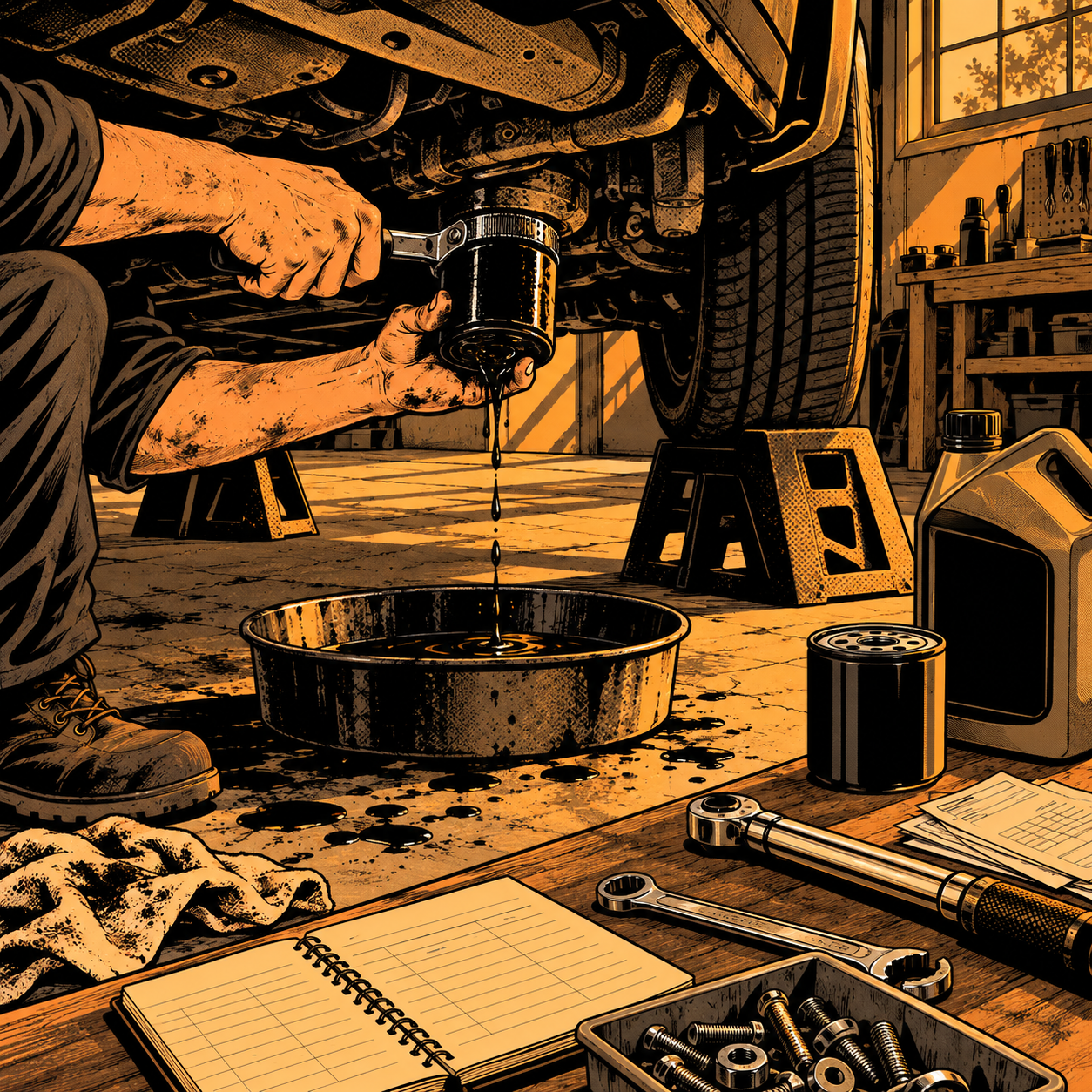
A persistent myth keeps circulating among DIY owners: if your oil changes and fluid services aren’t reported to Carfax, your manufacturer’s warranty is at risk. It isn’t true, and believing it leads people to either pay for unnecessary dealership service or panic when a private seller’s Carfax report shows “gaps.” What actually protects a warranty claim is documentation — receipts, invoices, and records showing the right service was performed with the right parts and fluids, on time. Here’s what technicians and service advisors who actually process these claims say matters, and how to build a record set that holds up.
Why Carfax Has Nothing to Do With Warranty Coverage
Carfax is a vehicle history aggregator built from whatever data sources choose to report to it — some dealerships, some state DMV records, some insurance data. It is not a legal record of maintenance, and it is not comprehensive. Independent shops, mobile mechanics, and virtually all DIY work never get reported to Carfax at all, which means the majority of properly maintained vehicles on the road have “gaps” in their Carfax history that mean nothing.
Manufacturers know this. Warranty administrators and dealership service departments do not pull up a Carfax report to decide whether a claim is valid. A missing Carfax entry is not evidence of neglect, and a present Carfax entry is not proof of proper service either — Carfax has no way to verify that the correct oil spec or filter was actually used. Treating it as a maintenance ledger misunderstands what the product is: a marketing and resale tool, not a compliance record.
What the Law Actually Requires for Warranty Claims
In the U.S., the Magnuson-Moss Warranty Act governs this directly. It prohibits manufacturers from requiring that maintenance be performed at the dealership or with OEM parts in order to keep a warranty valid, and it does not require any particular third-party reporting service. What it does allow is for a manufacturer to deny a specific claim if it can show that a failure was directly caused by improper or missing maintenance — and the burden of making that connection falls on the manufacturer, not the owner.
In practice, this means the owner’s job is simple: be able to show that required services happened, on roughly the correct schedule, with parts and fluids meeting factory spec. That evidence can come from a dealership, an independent shop, or the owner’s own garage. There is no requirement that it be reported anywhere beyond the owner’s own files.


12 Pt Triple-Square Tamper-Proof VW/Audi Drain Plug Wrench
Mfg: CTA Manufacturing Corp.
Part #: 2039
Building a DIY Paper Trail That Holds Up
Since the receipt is the actual legal evidence, the goal is to make every DIY service produce one that looks indistinguishable from a shop invoice in terms of the information it contains. A handwritten note on a shop towel won’t cut it if a claim is contested; a dated, itemized record will.
For every service, keep:
- Date and odometer reading at time of service
- Receipts for the specific oil, filter, coolant, or fluid purchased, showing the brand and spec (e.g., 0W-20 API SP/ILSAC GF-6)
- A simple log entry noting what was done — oil and filter change, brake fluid flush, etc. — tied to that purchase
- Photos of the old part, drain plug torque, or fluid fill level if you want extra backup (not required, but useful for contested claims)
Spreadsheets, a dedicated notebook, or a maintenance-tracking app all work. What matters is that the record is contemporaneous (made at the time, not reconstructed later) and that it ties a dated purchase to a dated service on a specific vehicle.
What Belongs on Every Maintenance Receipt
Whether you’re buying from a parts store, an online retailer, or paying an independent mechanic, make sure the receipt or invoice captures these details before you file it away:
- Vehicle identification — VIN or plate, so the receipt can’t be disputed as belonging to another car
- Service date and mileage — needed to show the service happened within the manufacturer’s interval
- Parts and fluids used — brand, viscosity/spec, and quantity, matching or exceeding OEM requirements
- Labor description — “oil and filter change,” “60k mile transmission service,” etc., not just a dollar total
- Your name or shop name — for self-performed work, your own name as the installer is acceptable
If you’re buying parts for a DIY job, keep the original purchase receipt stapled or scanned together with your service log entry. A pile of unlabeled parts-store receipts with no connection to a specific service date is far weaker evidence than a log entry with the receipt attached as backup.
How Dealership Techs Actually Process Warranty and Goodwill Claims
When a warranty or goodwill claim comes in, the service writer and technician are generally looking for one thing: a receipt or invoice indicating the service was performed with the correct fluids and parts, within a reasonable window of the recommended interval. They are not cross-referencing Carfax, and they are not requiring dealership stamps. A legible invoice from an independent shop, or a self-prepared log with attached parts receipts, is treated the same as a dealership service record for this purpose.
Where claims get denied is when there’s no record at all, when the interval was clearly missed by a wide margin, or when the fluid/part used doesn’t meet the specified standard (e.g., using a non-approved oil spec on an engine with a documented history of oil-related failures). The absence of a Carfax entry is never cited as the reason for a denial — the absence of any owner-provided proof is.
Keeping Records Long-Term
Paper receipts fade and get lost, so build redundancy into your system. Scan or photograph every receipt and log entry and store copies in cloud storage, not just on your phone. Some owners also upload DIY receipts into their own Carfax or similar vehicle-history account — not because it’s required for warranty purposes, but because it helps resale value by showing a documented history to future buyers. That’s a separate benefit from warranty protection, and worth doing, but it doesn’t replace keeping your own originals.
A simple, durable approach: a dedicated folder (physical or cloud) per vehicle, organized by date, with each entry containing the service log note and the matching purchase receipt. Revisit it after every service rather than trying to reconstruct history later.
Warranty-Proof Service Record Checklist
- Date and odometer reading logged at time of service
- Receipt showing correct fluid/part spec saved with the log entry
- Vehicle VIN or plate referenced on the record
- Labor/service description written in plain terms (not just a total cost)
- Copies backed up digitally, separate from the vehicle itself
- Records kept current after every service, not reconstructed after the fact


FAQs
Does not reporting an oil change to Carfax void my warranty?
No. Carfax reporting has no legal connection to warranty validity. What matters is whether you can produce your own proof of service if a claim is ever questioned.
Can I perform my own maintenance and still keep a factory warranty?
Yes. The Magnuson-Moss Warranty Act prohibits manufacturers from requiring dealership service to maintain warranty coverage, as long as the work meets the specified intervals and part/fluid standards.
What if the manufacturer disputes my claim and I have no receipts?
Without documentation, you’re relying on the manufacturer’s discretion. This is the scenario that actually risks a denial — not a Carfax gap. Keep receipts from day one to avoid this situation entirely.
Is a handwritten log enough, or do I need itemized receipts?
A handwritten log is a good start, but pair it with the actual purchase receipts for oil, filters, and fluids. The combination of a dated log entry and a matching receipt is much stronger than either alone.
Do independent shop invoices count the same as dealership invoices?
Yes. Dealership techs who process warranty and goodwill claims confirm that a legible independent-shop invoice showing correct parts and fluids is treated the same as a dealership record.
Should I still upload my DIY receipts to Carfax?
It can help with resale value by showing documented history to future buyers, but it’s not required for warranty protection. Keep your own originals regardless of whether you also upload them.
Recommended Tools for DIY Oil Changes
Performing your own maintenance correctly—with the proper tools and fluids—is the foundation of a defensible service record. When you’re ready to change your own oil or service fluids, the Automotive Oil Change Tools category has what you need to do the job safely and to spec.
- Drain plug and filter wrenches for controlled, leak-free removal
- Torque wrenches for setting fasteners to manufacturer specification
- Catch pans and disposal containers for fluid handling and compliance

The Toolsource Technical Team blends decades of real-world automotive service experience with up-to-date technical research. Our writers collaborate with professional mechanics, shop owners, and diagnostic specialists to deliver practical, workshop-ready guidance you can trust.


Follow us on social media