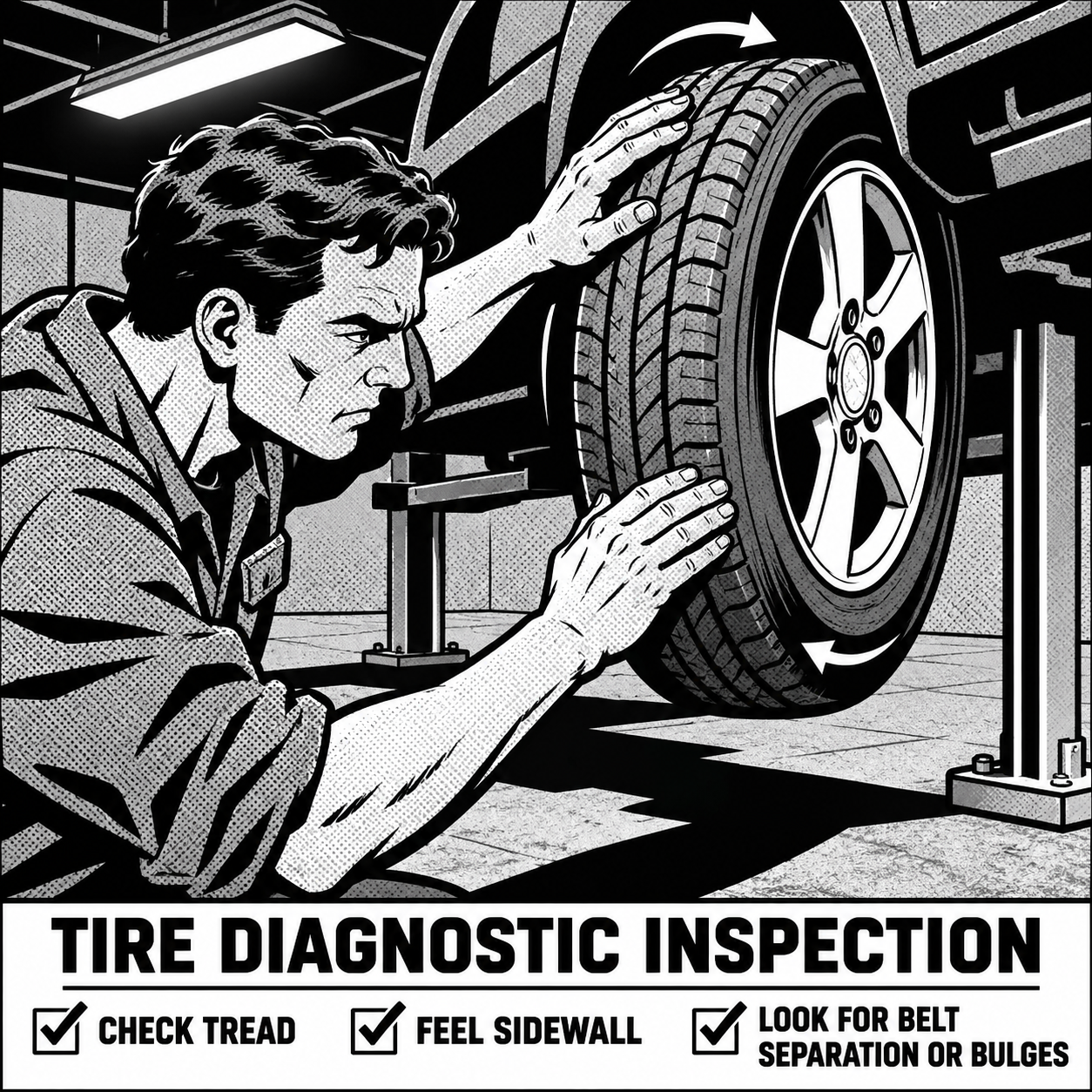
A customer rolls in saying the steering wheel shakes once they hit 55-65 mph, and the comment section of every car forum immediately splits into ten different guesses. In the bay, though, this complaint has a fairly short list of real culprits, and they tend to show up in a predictable order of likelihood. Working through them systematically — instead of jumping straight to axles or tie rods — saves diagnostic time and keeps you from sending a customer home with a parts bill that didn’t fix anything. Here’s a practical sequence for isolating the cause, based on what actually shows up on the lift.
Start With Tire Balance — and Verify the Work
Speed-sensitive shake that shows up in a specific RPM/MPH window is the signature of an out-of-balance wheel-and-tire assembly. This is the correct first step, but it’s also the step most likely to have already been “done” poorly by someone else. If a customer says they already had the wheels balanced and the shake didn’t go away, don’t take that at face value — re-check it yourself before moving on.
- Remount each wheel and rebalance from scratch. Don’t assume the static weights are correct; pull them and start over rather than just adding counterweight on top of old ones.
- Check for leftover stick-on or clip-on weights that were never removed — a second shop “correcting” a balance by adding weight against old weights is a common reason a car still shakes after a supposed fix.
- Watch how much weight it takes to balance each wheel. A properly mounted tire on a straight wheel typically needs well under 100 grams. If a wheel needs significantly more than that, something else is wrong — bead seating, a damaged wheel, or a defective tire — not just an imbalance that a few extra grams will solve.
Move to Road Force Balancing and Wheel Inspection
If a standard balance doesn’t resolve the shake, or if it took excessive weight to balance a wheel, the next step is a road force (or “match”) balance, not another static balance on the same machine. Road force balancing applies load to the tire the way the road does and will catch radial force variation that a static balance completely misses — this is the test that catches a tire with an internal belt problem even when the tread looks fine from the outside.
- Road force balance all four tire/wheel assemblies.
- Identify which wheels pull the highest force readings and move those to the rear axle, where force variation is less noticeable to the driver.
- Visually and physically check each wheel for bends, cracks, or out-of-round rims — a bent wheel can produce a shake even when the balance numbers look acceptable.
- Check for mud, corrosion, or debris packed behind the wheel on the hub face; it throws off balance even after a correct service.
{{PRODUCT_SEARCH_1}}
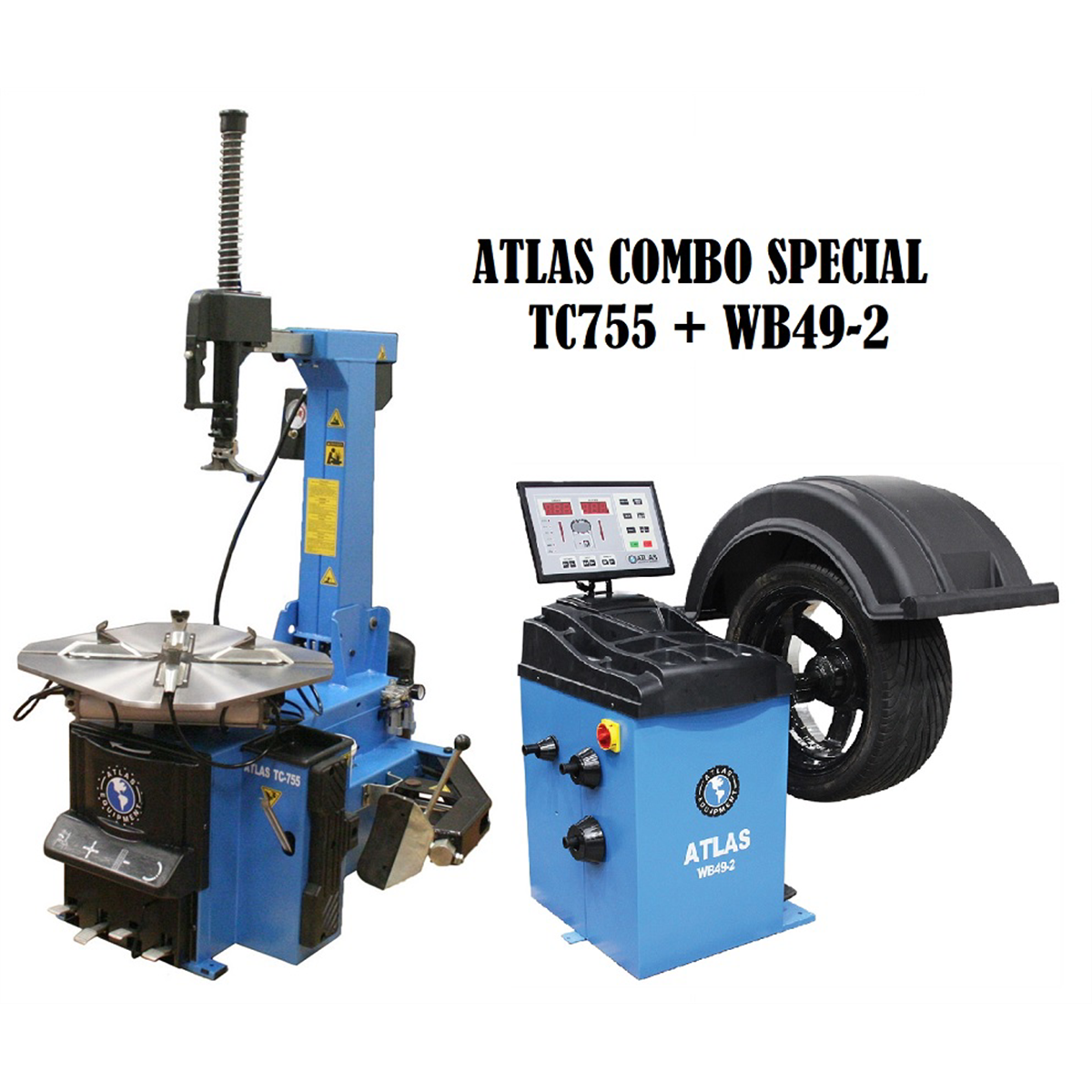
Atlas TC755 Tire Changer & WB49-2 Wheel Balancer Combo
Mfg: Atlas Automotive
Part #: TCWB-COMBO3

Atlas TC221-WB11 Tire Changer & Wheel Balancer Combo
Mfg: Atlas Automotive
Part #: TCWB-COMBOEC-FPD

Inspect Tires for Separated Belts and Hidden Damage
A tire can look completely normal and still have a separated or shifted belt underneath the tread. This is one of the most commonly missed causes because it doesn’t show up on a quick visual check — you have to spin the tire slowly on a lift or balancer and watch/feel for a subtle high spot, bulge, or out-of-round section as it rotates.
- Spin each tire slowly by hand or on the balancer and look for any visible bulge, flat spot, or waviness in the sidewall or tread.
- Run a hand around the full circumference of the tread and sidewall feeling for a bump that isn’t visually obvious.
- Check tread wear patterns for cupping or scalloping, which points toward a worn suspension component rather than the tire itself.
- If a shake progressively worsens over weeks, treat it as a possible tire failure in progress and address it before the customer drives on it — a thrown belt can progress to a blowout.
Rule Out CV Axles, Wheel Bearings, and Tie Rods
If tires and wheels check out clean, move to driveline and suspension components. These failures often mimic a balance problem because they’re also speed-sensitive, but they have distinct symptoms once you know what to check for.
- CV axles: Inspect both CV boots for tears, cracks, or missing clamps. A torn boot lets grease escape and contamination in, which accelerates joint wear; a worn inner or outer joint commonly causes a vibration that appears in a specific speed range and can mimic a balance issue almost exactly. On front-wheel-drive vehicles, this is a very common root cause when everything else checks out fine.
- Wheel bearings: A failing wheel bearing often produces vibration or a steering wheel shake that gets worse with speed and may change with slight steering input or when loading the suspension side to side. Check for play, roughness when rotating the hub by hand, and any humming or growling that increases with road speed.
- Tie rods and suspension bushings: Loose tie rod ends or worn ball joints introduce play that shows up as shake or wander at speed. Check for free play with the wheels off the ground and inspect boots for damage.
Don’t Overlook Heat-Related Brake Failures
This one is less common but serious enough to check for, especially if the shake is severe or came on suddenly rather than gradually. A seized or dragging caliper piston keeps the pad in constant contact with the rotor, generating far more heat than normal braking. That heat transfers through the rotor into the hub, lug nuts, and wheel — and sustained high heat can actually loosen lug nuts through thermal expansion and cause a wheel to become unseated on the hub.
- After a test drive, check each wheel’s temperature (an infrared thermometer works well) and compare side to side — a rotor or caliper running noticeably hotter than its counterpart points to a dragging caliper.
- Check for discoloration, scoring, or glazing on the rotor face consistent with excess heat.
- Re-torque all lug nuts to spec and verify none are loose before returning the vehicle.
- If this is the cause, stop driving the vehicle until it’s repaired — a wheel coming loose at highway speed is a safety failure, not just a comfort complaint.
Confirm With an Alignment and a Second Set of Eyes
Once you’ve addressed balance, road force, tire condition, and the obvious driveline/suspension suspects, finish with an alignment check. A bad alignment won’t usually cause a steering wheel shake on its own, but it can produce uneven, accelerated tire wear that creates the bumps and irregularities that do cause a shake — and it’s cheap insurance to rule out while the car’s already on the rack. If the shake persists after all of this, get a second technician to drive the car and independently go through the sequence; a second set of hands catches things the first tech missed, and it’s far better than sending a customer away with the problem unresolved.
Quick Reference Checklist
- Rebalance all four wheels from scratch — remove old weights, don’t stack on top
- Road force balance and reposition wheels with highest force to the rear
- Inspect wheels for bends and tires for hidden belt separation
- Check CV boots, wheel bearing play, and tie rod/ball joint play
- Check rotor and lug nut temperature after a drive for dragging caliper signs
- Re-torque lug nuts and verify alignment before returning the vehicle
{{PRODUCT_SEARCH_2}}


Homak Manufacturing Automotive Diagnostic Service Tool Cart
Mfg: Homak Tool Storage
Part #: OB06019020
FAQs
Why does my car shake only above a certain speed?
Most balance-, tire-, and bearing-related vibrations are speed-sensitive because the force they generate scales with rotational speed. Below a threshold speed the force is too small to feel; above it, it becomes noticeable in the steering wheel or seat.
I already had my tires balanced — why is it still shaking?
A standard balance isn’t always done correctly, and old weights are sometimes left on and added to rather than removed. If the shake persists after a balance, have a different shop redo it from scratch and perform a road force balance rather than another static balance.
Can a bad wheel bearing really cause this much shaking?
Yes. A worn front wheel bearing commonly produces a vibration that intensifies with speed and can feel very similar to a tire or balance problem. Check for bearing play and listen for humming or growling that changes with speed.
Is it safe to keep driving if the steering wheel is shaking badly?
No. Severe, sudden, or worsening shake can indicate a tire about to fail, a loosening wheel, or a failing suspension/driveline component. Pull over, inspect what you can, and have the vehicle towed or diagnosed before continuing to drive it.
How do I know if it’s the tire versus the wheel?
Swap the suspect tire onto a different wheel (or rotate wheels front to back) and retest. If the shake moves with the tire, suspect the tire; if it stays with the position, suspect the wheel, hub, or a suspension component at that corner.
What’s the difference between a standard balance and a road force balance?
A standard balance only corrects for weight distribution around the wheel. A road force balance applies simulated load to detect force variation caused by internal tire defects or an out-of-round wheel — problems a standard balance machine can’t see.
Shop Tire Tools, Wheels & Suspension
Systematic diagnosis requires the right equipment on hand. Our Tire Tools, Wheels & Suspension category carries wheel balancers, tire inspection tools, and suspension diagnostics gear you’ll need to isolate the cause.
- Wheel balancing machines (standard and road force)
- Tire removal, mounting, and inspection equipment
- Suspension, bearing, and CV joint tools

The Toolsource Technical Team blends decades of real-world automotive service experience with up-to-date technical research. Our writers collaborate with professional mechanics, shop owners, and diagnostic specialists to deliver practical, workshop-ready guidance you can trust.


Follow us on social media