A customer comes in with a complaint that sounds simple on paper: the car shakes somewhere around 60-65 mph, smooths out above and below that window, and there’s no noise or pull under braking. Nine times out of ten this is a wheel balance problem, but “balance problem” is a wider category than most shops treat it as. Before you reach for a control arm or blame a set of wheel locks, there’s a specific sequence worth running — because the comments from techs who’ve chased this for 20 years all point the same way: most vibration comebacks are caused by rushed or careless balancing, not mystery parts.
Narrow Down the Vibration Pattern First
Before touching a balancer, get the complaint pinned down with the customer or from a test drive. Three questions separate balance issues from everything else:
- Does it track with road speed, not engine RPM? If the vibration frequency changes with speed and not with gear or RPM, you’re looking at a wheel/tire assembly issue, not a driveline or engine mount.
- Is there a defined speed band where it’s worst? Classic imbalance vibration peaks in a 5-10 mph window and tapers off on either side of it. That’s the frequency of wheel rotation lining up with the resonant frequency of the suspension. A vibration that just gets steadily worse the faster you go is more consistent with a bent wheel, separated tire belt, or driveline angle problem.
- Does it change under braking? If the vibration is present cruising but changes character when the brakes are applied, look at rotors and hub face runout. If it’s identical whether you’re on the throttle, coasting, or braking lightly, stay focused on the wheel and tire assembly.
Once you’ve confirmed it’s speed-dependent and brake-independent, you can move straight into balance diagnostics instead of guessing.
Check Wheel Balance and Weight Placement Before Anything Else
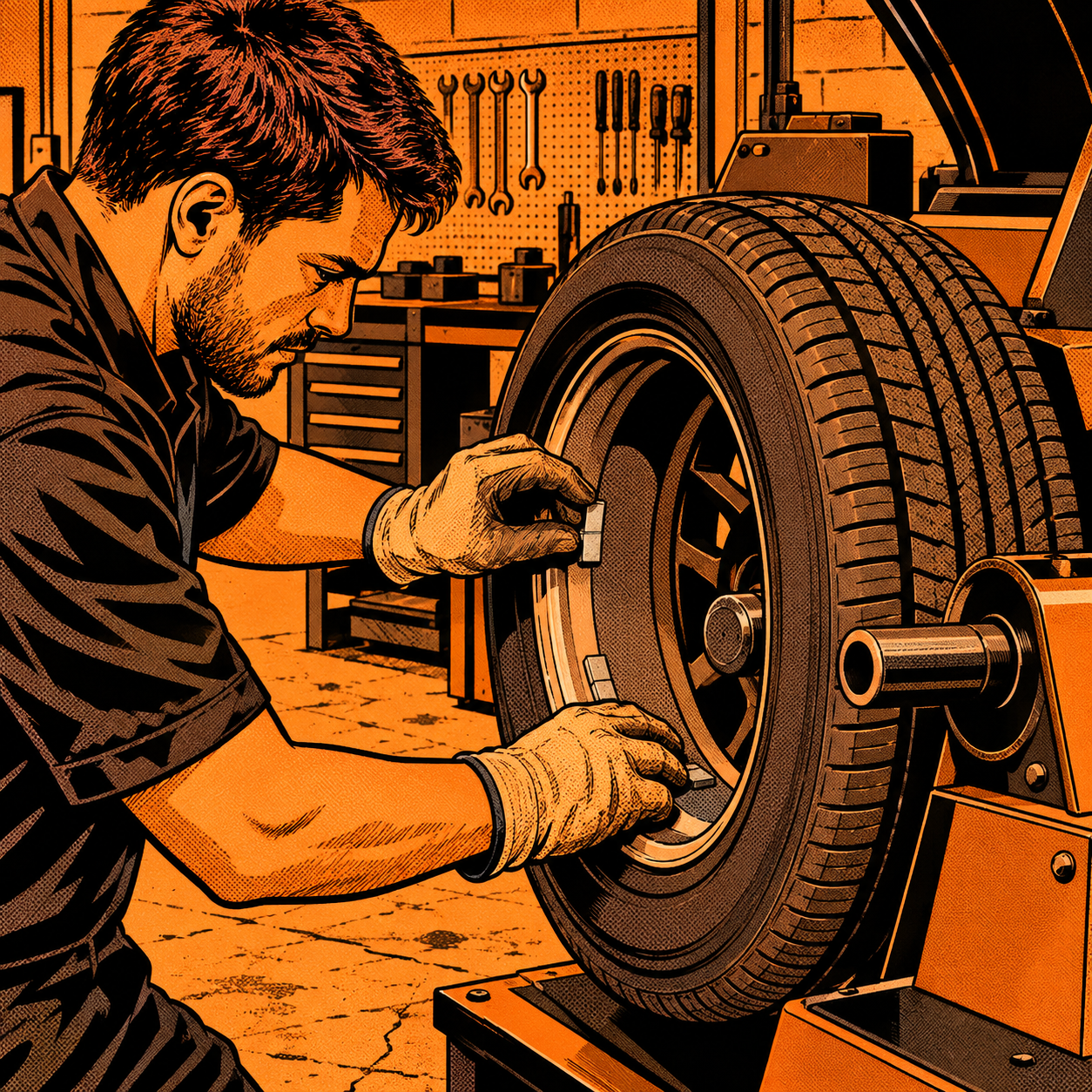
This is the step that gets skipped the most, and it’s the one experienced techs call out repeatedly: a huge share of “unexplained” vibration comebacks trace back to a sloppy original balance job. Specific things to check when you pull a wheel that’s already been “balanced”:
- Weight distribution. Pull the old weights and weigh them. If one side of a wheel is carrying significantly more weight than the other side of the same wheel (for example 8 oz versus 5 oz), that’s a red flag for a counter-balanced wheel — a tech chasing a bad spin reading by adding weight in the wrong place instead of finding the actual high spot.
- Stick-on weight placement. Adhesive weights placed carelessly, bunched up, or stuck where they’ll get knocked loose by curb contact will throw a wheel out again within a few hundred miles.
- Yellow dot alignment. The yellow dot on a tire marks the lightest point and is meant to be lined up with the valve stem (the heaviest point on most wheels) during mounting. It’s not a guarantee of a good balance on its own — on a cheap tire it can be meaningless or even misleading — but ignoring it on a quality tire and wheel combination removes a free head start.
- Re-spin after any suspicion. If you inherited a vibration complaint from another shop’s work, don’t trust their balance reading. Pull every wheel and rebalance from scratch rather than just adding a touch-up weight to an existing job.

Atlas Automotive Equipment Wheel Balancer Cone Kit, 36MM Center
Mfg: Atlas Automotive
Part #: ATWB-CONEKIT-36MM


Tire Mechanic's Resource Premium TMR Wheel Weight Starter Kit
Mfg: The Main Resource
Part #: STK3
Move to Road Force Balancing When Standard Balance Doesn’t Hold
A standard balancer measures static and dynamic imbalance and can true up a wheel that’s actually round. It can also balance an egg-shaped tire perfectly in terms of weight distribution while the tire still rolls like an oval — which shows up on the road as vibration a static balance can’t fix. That’s the problem a road force (force-variation) balancer is built for.
- A road force machine presses a weighted roller against the spinning tire to simulate load on the road and measures how much the radial force varies through each rotation.
- If the reading is above the vehicle manufacturer’s spec, the fix is “force matching” — rotating the tire relative to the wheel to cancel out the wheel’s low spot against the tire’s high spot, the same logic some techs apply manually at speed by swapping a tire’s position on the rim.
- If force matching can’t bring the assembly within spec, the tire itself is the problem — out-of-round from the factory or from a manufacturing defect — and needs to be replaced, not rebalanced again.
- Trucks and passenger cars have different force-variation specs, so don’t apply a car number to a 3/4-ton truck tire or vice versa.
If a customer has already had two or three balance attempts with no improvement, skip straight to the road force machine instead of repeating the same static balance a fourth time.
Inspect for Bent, Reconditioned, or Damaged Wheels
When vibration shows up right after an insurance claim, body shop repair, or “reconditioned” wheel purchase, treat the wheel itself as a suspect before blaming the install. Reconditioned wheels that have been straightened, welded, or had cracks repaired frequently will never hold a clean balance, no matter how skilled the tech is or how many times it’s re-spun. Spin the bare rim on the balancer without the tire mounted — this isolates wheel runout from tire runout and will reveal a bent or out-of-round wheel immediately. If the rim alone reads bent, no amount of rebalancing with the tire on will solve it; the wheel needs to be replaced.
Don’t Overlook Centering Rings and Wheel Locks
Two smaller but real contributors worth ruling out:
- Hub-centering mismatches. Some aftermarket or replacement wheels that otherwise bolt up to a vehicle are lug-centric rather than hub-centric — meaning the lug nuts, not the center bore, are what centers the wheel on the hub. These wheels require centering/hub rings to seat correctly. Without them, the wheel can sit slightly off-center on the hub even though every lug is torqued properly, producing a vibration that looks exactly like a balance issue but isn’t fixed by rebalancing.
- Wheel locks. Quality wheel locks (McGard and similar brands) are manufactured to match the weight of a standard lug nut specifically so they don’t introduce imbalance. A lock would need to weigh well over what a standard lug does — more than roughly a kilogram in extreme cases — before it could cause a meaningful vibration at speed. If a customer is convinced their locks are the culprit, the fastest way to settle it is objective: weigh a lock against a standard lug nut on a kitchen or parts scale, or swap in four known-good standard lugs and road test. Don’t rebalance a wheel without its locks installed if the customer runs locks daily — balance it in the condition it’ll actually be driven in.
Rule Out Suspension and Driveline Contributors
If balance, road force, wheel condition, and centering are all clean and the vibration persists, broaden the inspection:
- Check control arm bushings and other suspension bushings, especially if the vehicle was recently on a flatbed, jacked incorrectly, or dropped onto a wheel at an odd angle — a hard jolt to one corner can affect components beyond the obvious impact point.
- Confirm there’s no debris — a rock or chunk of road debris wedged between a rotor and caliper/backing plate can produce a speed-related vibration that mimics balance.
- If the vibration is isolated to braking, inspect rotors for thickness variation or warping rather than chasing a balance issue further.
- On vehicles with a driveshaft, check driveline angles and U-joints, particularly after a ride-height change or suspension work.
Quick diagnostic checklist:
- Confirm vibration tracks with road speed and is independent of braking
- Pull wheels and check existing weight placement/distribution
- Rebalance from scratch — don’t trust a prior shop’s numbers
- Run a road force balance and force-match if variation is out of spec
- Spin bare rims to check for bend/runout independent of the tire
- Verify centering rings are present on lug-centric aftermarket wheels
- Weigh wheel locks against standard lugs if they’re suspected
- Inspect bushings, rotors, and driveline if the wheel/tire checks out clean


AME Liquid Tire Balance, Case, twelve bottles per
Mfg: AME International
Part #: 26140
FAQs
Will wheel locks cause a vibration at highway speed?
Not under normal circumstances. Quality locks are made to match standard lug nut weight for exactly this reason. Suspect locks only if they’re an unusually heavy aftermarket design, and confirm with a scale rather than a guess.
Why does vibration only show up in a narrow speed range?
That’s the signature of a balance issue — the wheel’s rotational frequency matches the suspension’s resonant frequency at that speed, amplifying a small imbalance into a noticeable shake. It typically peaks in a 5-10 mph band and fades on either side.
What’s the difference between standard balancing and road force balancing?
Standard balancing corrects weight distribution so the assembly spins smoothly. Road force balancing additionally measures how round the tire rolls under simulated load and allows force-matching the tire to the wheel, catching problems a static balance can’t.
Can a reconditioned wheel ever balance correctly?
Sometimes, but a wheel that’s been straightened, welded, or repaired after a bend is far more likely to never hold a clean balance. Spin the bare rim to check runout before assuming the tire or install is at fault.
Do I need centering rings on every aftermarket wheel?
Only on lug-centric wheels, where the lug nuts rather than the center bore locate the wheel on the hub. Hub-centric wheels that match the vehicle’s bore diameter don’t need them. Check the wheel manufacturer’s fitment spec before installing.
If balance and road force both check out fine, what else should I look at?
Move to control arm bushings, rotor thickness variation, debris between the rotor and caliper, and driveline angle/U-joints, especially if the vehicle recently had suspension work or any kind of impact.
Equipment for Wheel Diagnosis
A thorough vibration diagnosis depends on having the right diagnostic equipment available. Our Tire Tools, Wheels & Suspension selection includes balancers, road force machines, and inspection equipment to support this workflow.
- Wheel balancers (static and dynamic)
- Road force balancing machines
- Tire weights, centering rings, and suspension tools

The Toolsource Technical Team blends decades of real-world automotive service experience with up-to-date technical research. Our writers collaborate with professional mechanics, shop owners, and diagnostic specialists to deliver practical, workshop-ready guidance you can trust.


Follow us on social media