A red oil pressure light on the dash is one of the few warnings that genuinely means “stop the vehicle now,” not “deal with this at the next service interval.” Customers routinely confuse it with an amber oil-change reminder or a low-oil-level light, and that confusion costs engines. This guide breaks down what the light actually indicates, how to walk a customer or yourself through the correct response, and how to diagnose the failure once the vehicle is safely in the bay — because the difference between a bad sensor and a starved oil pump is the difference between a $40 part and a replacement engine.
Red vs. Amber: Know What You’re Actually Looking At
Before any diagnosis starts, confirm which light actually illuminated. Most driver confusion happens here, and it changes the urgency of everything downstream.
- Red oil can/pressure icon: Oil pressure has dropped below the switch’s threshold — commonly somewhere in the 7-10 psi range, though it varies by manufacturer and sensor. This is a “shut off the engine immediately” condition, not a “drive gently to a shop” condition.
- Amber/yellow oil level icon: On vehicles with electronic oil level monitoring, this indicates low oil quantity, not necessarily loss of pressure. Still worth addressing promptly, but it isn’t an emergency in the same way.
- Service/maintenance reminder: Usually a wrench icon, unrelated to real-time pressure or level.
Pull the owner’s manual or service information for the specific light graphic before assuming severity — some vehicles use a similar icon for both level and pressure warnings, and a blinking versus solid light can mean different things on the same platform.
What to Tell a Customer the Moment the Light Comes On
If a customer calls while driving, or a technician is road-testing and the light trips, the response is the same every time: get off the throttle, pull over as soon as it’s safe, and shut the engine off. Running an engine for even five to seven minutes with no oil pressure is enough time to score bearings, especially under load or at higher RPM where lubrication demand is highest. Idling makes it somewhat more survivable than driving, but it’s still not safe.
A few points worth clarifying for customers and new techs alike:
- Shutting the engine off while rolling is fine — turn the key to the position that kills the engine without engaging the steering lock (ACC on most keyed ignitions). Full “lock” position disables power steering assist and can lock the wheel if turned too far.
- Putting the vehicle in neutral does nothing to stop bearing wear by itself — the engine is still turning and still lacks pressure until it’s actually shut off.
- Expect to lose power steering assist and brake booster vacuum once the engine stops, so the customer needs to be ready for heavier steering and pedal effort while coasting to a stop.
- Do not restart the engine to “see if it’s better” or to move it a short distance unless absolutely necessary — every restart is another unlubricated cycle.
[PRODUCT_SEARCH: digital oil pressure gauge kit]


Universal Digital Pressure Gauge with Remote Read
Mfg: Waekon Industries
Part #: 48165
Diagnosing the Cause: Sensor, Pump, Strainer, or Filter
Once the vehicle is in the shop, resist the urge to jump straight to “it’s probably the pump.” Work through it in order of least to most invasive:
- Check oil level and condition first. Pull the dipstick, check for correct level, and look at the oil’s appearance. Milky oil suggests coolant intrusion; metallic sheen or glitter in the oil is a red flag for bearing or component wear already in progress.
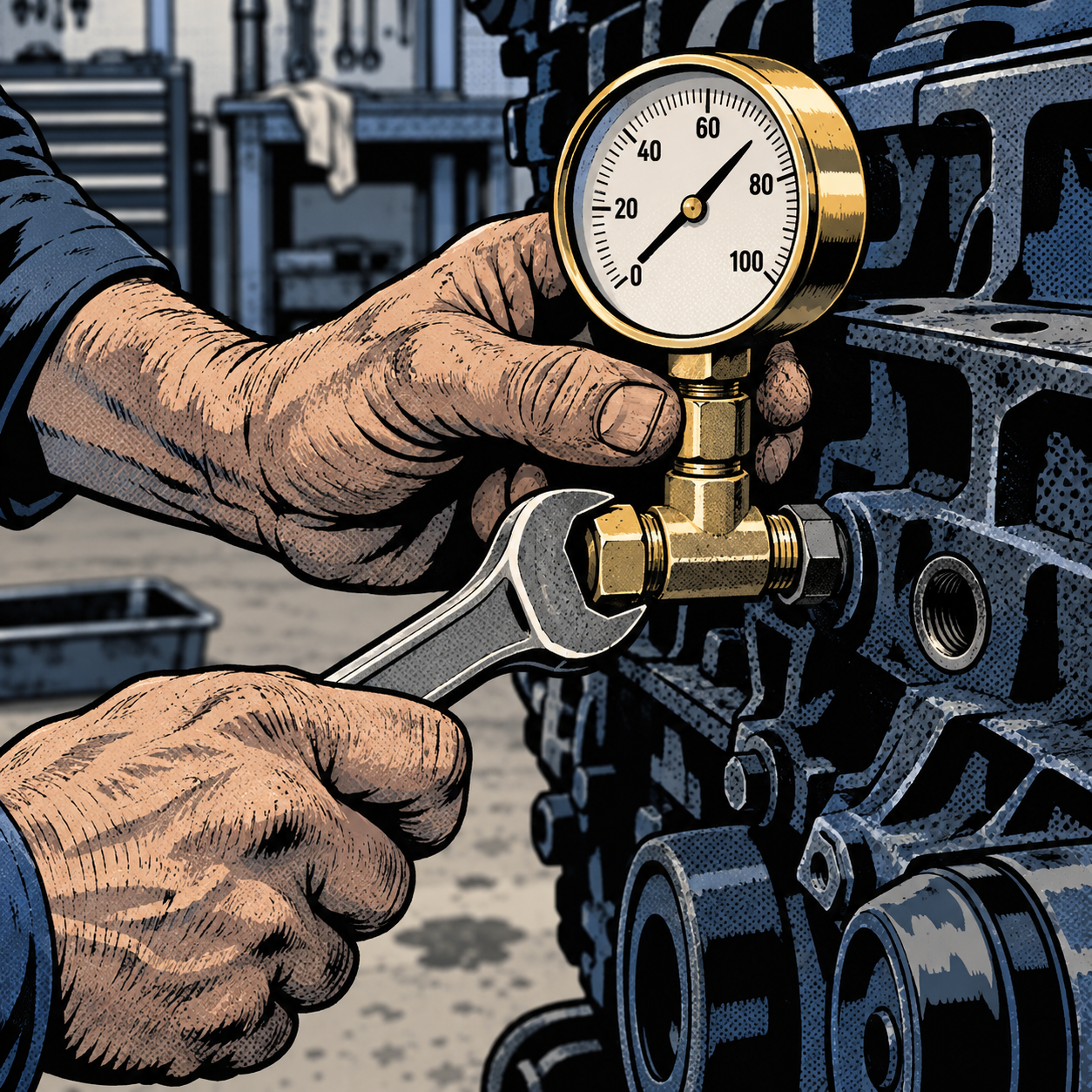
- Verify with a mechanical gauge. Don’t trust the dash light or even the OEM sensor in isolation — tee in a mechanical oil pressure gauge at idle and at a moderate RPM. This immediately tells you whether the complaint is a true pressure loss or a wiring/sensor fault. If mechanical pressure reads normal, the fix is almost certainly the sensor or its wiring, which is the best-case outcome.
- Inspect the oil filter. A collapsed, dented, or severely clogged filter can restrict flow enough to drop pressure even with a healthy pump and adequate oil level. This is a commonly overlooked cause — a filter that’s been crushed by a dropped axle or suspension component, or one that’s simply overdue, can mimic a pump failure.
- Check the pickup tube and strainer. On engines with known debris issues (see below), the oil pump strainer can become partially or fully blocked, starving the pump of supply even though the pump itself is mechanically fine.
- Pressure-test or inspect the pump. If mechanical gauge readings are low and the strainer/filter are clear, the pump itself (or its drive mechanism) is the suspect. On some platforms this requires dropping the pan or timing cover.
Document each step. If this is a warranty or comeback situation, a clear sequence of checks — level, gauge reading, filter condition, strainer condition — protects both the shop and the customer from disputes about what actually failed.
Wet-Belt Engines Need Special Attention
A growing number of small-displacement turbo engines (notably some 1.0-1.2L three-cylinder designs) run a timing belt in an oil bath inside the engine rather than a traditional chain or dry belt. These “wet belt” designs have a documented failure pattern: belt material degrades over time and sheds fragments into the oil. Those fragments migrate to the oil pump strainer, partially block it, and starve the pump of adequate supply — triggering exactly the kind of sudden, severe pressure-light event described above.
If you’re working on a known wet-belt platform and the customer reports a red oil pressure light with no prior leak or consumption history, move the strainer and belt inspection higher in your diagnostic order. Finding belt debris in the strainer or pan sludge is close to a smoking gun. These engines often require pan removal to properly inspect the strainer and pump pickup — don’t skip this step just because the pump “sounds fine” on the bench.
Assessing Damage After a Low-Pressure Event
Once the root cause is fixed, the harder question is whether the engine survived with acceptable wear. There’s no single bolt-on test that definitively answers this, so use a layered approach:
- Drain and inspect the oil. Metallic glitter, especially copper or bronze-colored flakes, points to bearing material in the oil. Fine black grit is more consistent with normal wear or belt debris than bearing failure.
- Cut open the old filter. This is cheap insurance — unfold the filter media and look for embedded metal particles that the filter caught before they recirculated.
- Listen for a rod or main bearing knock at idle and under light load, particularly a knock that changes with RPM or disappears briefly under load (oil pressure momentarily covering the clearance).
- Check oil pressure at operating temperature against spec once repairs are complete. Pressure that’s low-normal rather than rock solid can indicate bearing clearances have already opened up, even without an audible knock yet.
- Set expectations with the customer. If the engine ran without pressure for more than a minute or two at anything above idle, there’s a real chance of latent bearing damage that won’t show up for weeks or months. Be upfront that a clean inspection today doesn’t guarantee long-term reliability.
Quick Reference Checklist
- Confirm it’s the red pressure light, not an amber level or service reminder
- Shut the engine off immediately if still running — do not restart to relocate the vehicle
- Check oil level and condition before anything else
- Verify true pressure with a mechanical gauge before condemning the pump
- Inspect filter condition and pickup strainer for blockage or debris
- On wet-belt engines, treat strainer/belt debris as the leading suspect
- Cut open the old filter and drain oil to check for metal before returning the vehicle
[PRODUCT_SEARCH: engine oil pump and timing belt service kits]


HPW 2040 OEP Hot Pressure Washer 230 Volt 60 Hertz 1 Phase
Mfg: Jenny Products
Part #: HPW2040OEP
14-HP 30Gal 2-Stage Mount Air Compressor Ele Start
Mfg: BelAire - IMC
Part #: 4152021985
Frequently Asked Questions
Can a red oil pressure light be just a bad sensor?
Yes, and it’s a common outcome — but you can’t assume it. Confirm with a mechanical gauge before telling a customer the engine is fine, since a false “all clear” on a genuine pressure loss leads straight to a failed engine.
How long can an engine run with no oil pressure before it’s damaged?
There’s no safe number, but running time above idle in the range of a few minutes is widely considered enough to cause bearing wear or failure. Shorter exposure at idle is more survivable, but still not guaranteed safe.
Is it safe to put the car in neutral and coast instead of shutting it off?
Neutral alone doesn’t stop the damage — the engine keeps turning and lacks pressure until it’s actually shut off. The safer sequence is coast, then shut the engine off as soon as it’s safe to do so.
Will I lose power steering and brakes if I shut the engine off while driving?
Yes, both power steering assist and brake booster vacuum drop off once the engine stops. The driver needs to be prepared for heavier steering and firmer pedal pressure while bringing the vehicle to a stop.
What’s the most overlooked cause of a sudden oil pressure light?
A clogged or physically damaged oil filter. It’s easy to focus on the pump or sensor and skip inspecting the filter itself, but a collapsed or severely restricted filter can drop pressure even with a healthy pump and correct oil level.
How do I know if an engine has bearing damage after a low-pressure event?
Drain the oil and check for metallic glitter, cut open the old filter to look for trapped particles, and listen for a knock that varies with RPM. None of these alone is conclusive, but together they give a reasonable picture of whether damage occurred.
Engine Repair Tools
Diagnosing oil pressure issues and completing repairs requires the right diagnostic equipment and replacement components. Our Engine Repair Tools section carries the gauges, pump kits, and service parts needed for this work.
- Mechanical oil pressure gauges and test kits
- Oil pump and timing belt service kits
- Filter housings and strainer assemblies

The Toolsource Technical Team blends decades of real-world automotive service experience with up-to-date technical research. Our writers collaborate with professional mechanics, shop owners, and diagnostic specialists to deliver practical, workshop-ready guidance you can trust.


Follow us on social media