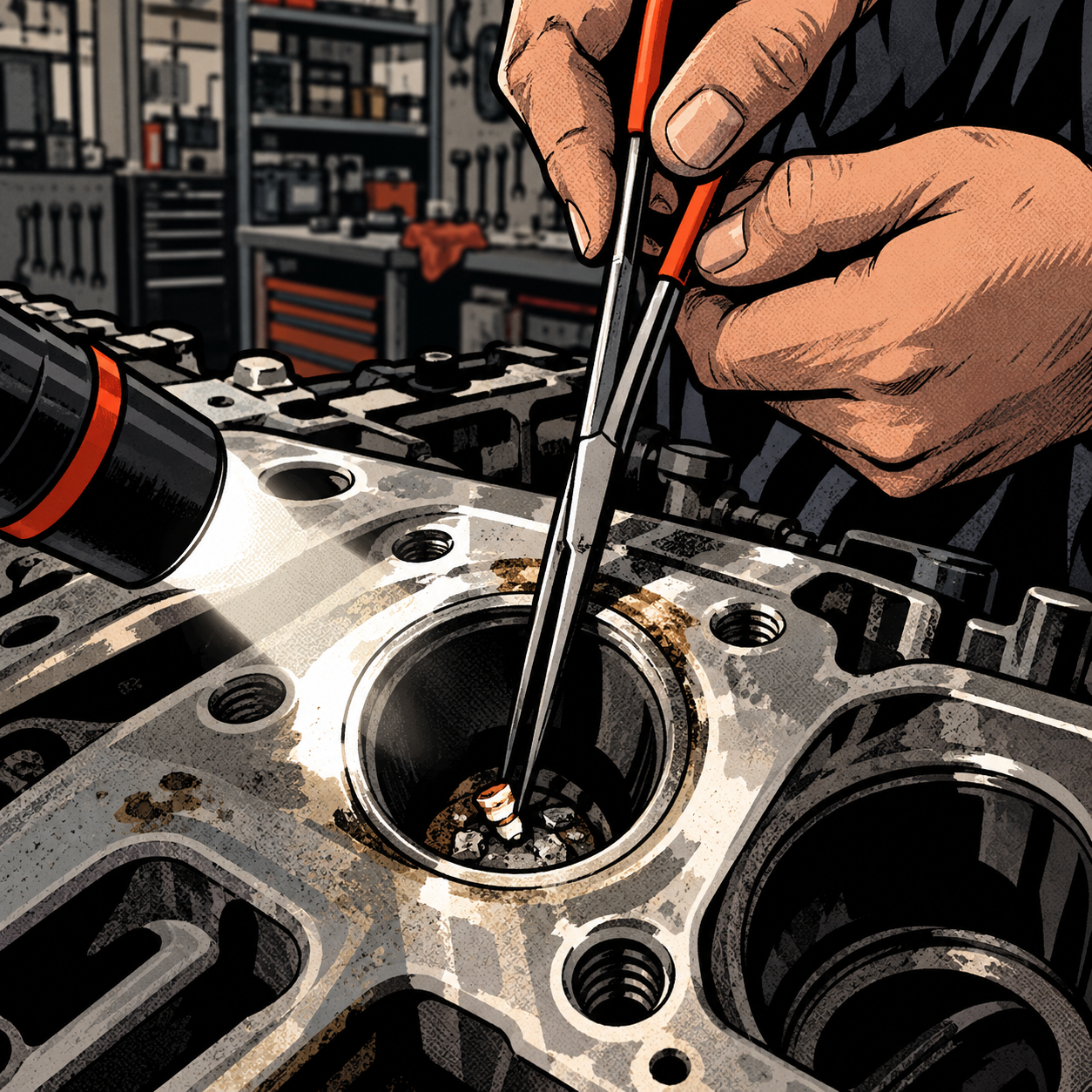
Every tech eventually gets the call: a spark plug snapped on removal, a ceramic insulator shattered, or a chunk of boot or resistor broke off and dropped straight down into the plug well — sitting right on top of the piston with the cylinder wide open below it. The instinct to panic is understandable, but this is a common, well-documented problem with a handful of reliable fixes. The right approach depends on what broke, whether it’s magnetic, and how deep it sits. Below is a practical breakdown of the tools and techniques technicians actually reach for, in the order that tends to work with the least risk of pushing debris further down.
Understand What You’re Dealing With Before You Reach for a Tool
Before grabbing anything, get a flashlight and borescope (or phone camera on a stick) down the well and identify the debris. This matters because your retrieval method depends on it:
Ceramic insulator chips are brittle, non-magnetic, and often sit loose — they respond well to vacuum or a grabbing tool, but crumble if you clamp down hard. A broken spark plug shell or electrode tip is metal and may be magnetic depending on the alloy. A chunk of boot, resistor, or coil material is soft and non-magnetic, and usually needs a mechanical grab rather than a magnet.
Also confirm the piston is not at top dead center for that cylinder if you can help it — having the piston lower in the bore gives debris somewhere to rest besides directly in the path of the valves, and reduces the odds of something getting wedged between the piston crown and cylinder wall.
Start With Vacuum and Compressed Air
This is the lowest-risk first attempt and costs nothing if you already own a shop vac or a can of electronics duster. Tape a long, narrow extension — a section of vinyl tubing or a cut-down straw — to the end of the shop vac hose so it reaches all the way to the bottom of the well. Run the vacuum continuously while you work, not just at the end.
If the debris won’t budge with vacuum alone, use a compressed air blow gun or a canned duster to loosen it, with the vacuum hose already in position to catch pieces as they get knocked free. Blowing without a vacuum running tends to just relocate the problem instead of removing it, so always pair the two. This combination works especially well for ceramic insulator fragments, which are light enough to get pulled or blown upward but can dust into smaller pieces if left to sit.


Use Precision Grabbing Tools for Anything You Can See
When a piece is intact and visible but too deep for fingers, a long, slender grabbing tool is the next step up. Technicians consistently point to the same category of tools here:
Forceps and hemostats. Straight or curved forceps in the 10–12 inch range (sold for first aid use, or as pet-feeding tongs for reptile keepers) are a favorite because they’re thin enough to pass between the plug well walls and the debris, they lock closed under spring tension so you don’t need to maintain grip strength, and they’re inexpensive enough to keep a dedicated set in the toolbox. Hemostats offer the same benefit in a smaller package for tighter wells.
Long needle-nose pliers. A 10–12 inch pair of skinny needle-nose pliers from a hardware store or a premium tool brand will do the same job as forceps, with slightly more grip force if the debris is wedged rather than loose.
Double-jointed pliers. These articulate at a second pivot point, letting the jaws angle sideways to reach debris that’s sitting off to one side of the well rather than dead center.
Circlip (snap-ring) pliers. If a tool or socket extension itself is stuck in the well — rather than loose debris — pliers designed to open outward can grip the inside wall of the stuck tool and pull it free, the same way they’d expand a circlip.
Work slowly with any of these. Jerky movements can shatter brittle ceramic into smaller, harder-to-reach pieces or knock debris further down instead of out.
Try a Magnet — But Only on Ferrous Debris
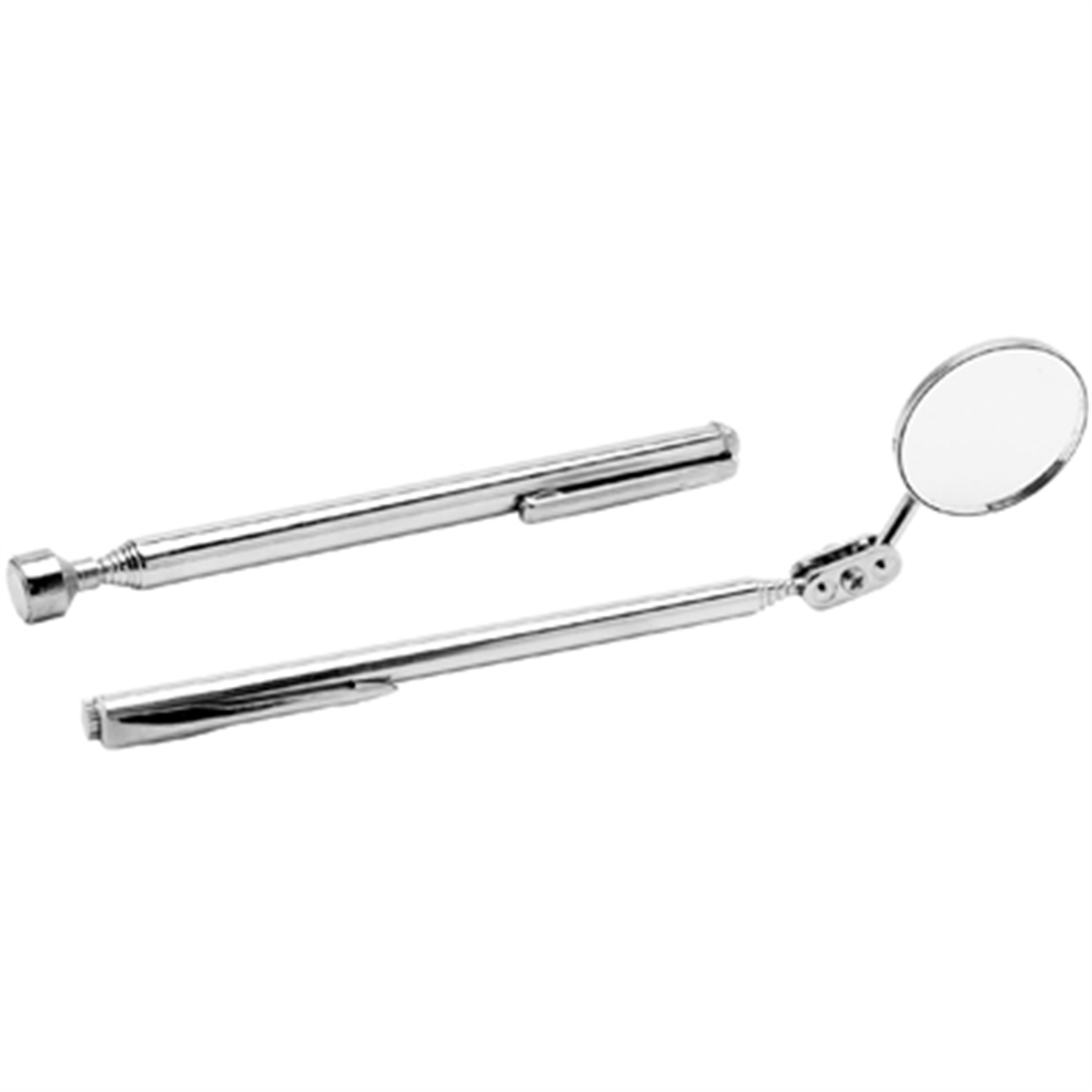
If the broken piece is metal and magnetic, a flexible magnetic pickup tool is often the fastest fix. For debris sitting deeper than a standard pickup tool reaches, run a length of stiff, ferrous wire (a straightened wire coat hanger or brake line works) down the well, then hold a strong magnet — a rare-earth magnet performs noticeably better than a basic ceramic one — against the top of the wire outside the well. The magnetic field transfers down the wire enough to hold the debris against the wire’s tip long enough to lift it out.
This trick only works if both the wire and the debris are ferrous (iron or steel based) — it won’t do anything for aluminum, ceramic, or plastic components, and most spark plug electrodes use nickel or precious-metal alloys that may have weak or no magnetic response. Test the magnet against the actual plug or part before relying on this method.
When to Pull the Valve Cover or the Plug Itself
If vacuum, air, forceps, and magnets all fail — or the debris has worked its way somewhere you can’t see or reach through the plug hole — stop forcing it and open up the engine instead. Pulling the valve cover gives direct visual and physical access to the top of the cylinder head and is often faster than another twenty minutes of blind fishing. If the plug itself is still partially threaded in and just has debris sitting on top of it, removing the plug fully (carefully, to avoid pushing the debris in deeper) is usually the right next move — you can vacuum and inspect with the hole fully open rather than working around a mostly-intact plug.
If you’re already in there because a valve cover gasket was leaking, treat this as the opportunity to address both issues at once rather than putting the cover back on and discovering a second leak later.
{{PRODUCT_SEARCH_1}}
Preventing a Repeat
Most of these situations trace back to one of a few root causes: over-torqued or corroded plugs that shear on removal, extended service intervals that let insulators degrade, or using the wrong reach/thread plug for the application. After any retrieval, inspect the remaining plugs in that engine for similar wear, confirm you’re using the correct plug gap and torque spec, and apply anti-seize or dielectric grease appropriately on reinstall (check the plug manufacturer’s guidance — not all plugs call for anti-seize on the threads). A new set of plugs and a torque wrench is cheap insurance against doing this again on cylinder two.
Quick Reference Checklist
Keep this short kit in the toolbox for plug-well emergencies:
- Flashlight or borescope to confirm what you’re dealing with before touching anything
- Shop vac with a narrow hose extension taped on
- Compressed air blow gun or canned duster
- 10–12 inch forceps or hemostats
- Long, skinny needle-nose pliers (and double-jointed pliers if available)
- Flexible magnetic pickup tool plus a spare length of stiff ferrous wire
- Replacement spark plug and a torque wrench, in case the original is now scrap
{{PRODUCT_SEARCH_2}}

Buy Mayhew Tools 29895 Stud Extractor and get 37900 Spark Plug T
Mfg: Mayhew Tools
Part #: 81471
FAQs
Will leftover debris damage the engine if I can’t get it all out?
Loose metal or ceramic debris sitting in a cylinder can score the cylinder wall, damage the piston crown, or get caught between the valve and seat when the engine runs. Don’t crank or start the engine until the well is confirmed clear.
Is it safe to use compressed air without a vacuum running?
You can, but you risk just relocating the debris to another spot in the well or blowing it past the plug threads into the cylinder. Always have a vacuum hose positioned to catch what the air dislodges.
Will a magnet work on a broken ceramic spark plug insulator?
No. Ceramic is non-magnetic. A magnet only helps with ferrous metal fragments — use forceps, hemostats, or vacuum for ceramic pieces instead.
What’s the real difference between forceps and hemostats for this job?
Both lock closed under spring tension so you don’t need continuous grip strength, but hemostats are generally shorter and better suited to tighter spaces, while longer straight forceps reach deeper wells on V6/V8 engines with recessed plugs.
Should I replace the spark plug after fishing debris out of the well?
In almost every case, yes. If the plug broke or shattered, it’s no longer serviceable. Even if the debris came from elsewhere (a boot or resistor), inspect the plug itself for cracks before reinstalling it.
When should I stop trying tools and just pull the valve cover?
If you’ve made two or three careful attempts with vacuum, air, and a grabbing tool with no progress, or if the debris has moved somewhere you can no longer see, stop. Continued blind attempts risk pushing debris further in. Opening the valve cover for direct access is faster and safer at that point.
Recommended Engine Repair Tools
The techniques in this guide call for a range of specialized tools — from inspection equipment to precision grabbers to magnetic pickups. Stock your toolbox with the Engine Repair Tools needed to handle spark plug extraction, debris retrieval, and cylinder head inspection efficiently and safely.
- Forceps, hemostats, and needle-nose pliers for precision grabbing and retrieval
- Borescopes, flashlights, and inspection mirrors for visual assessment
- Magnetic pickup tools, torque wrenches, and replacement spark plugs for completion

The Toolsource Technical Team blends decades of real-world automotive service experience with up-to-date technical research. Our writers collaborate with professional mechanics, shop owners, and diagnostic specialists to deliver practical, workshop-ready guidance you can trust.


Follow us on social media