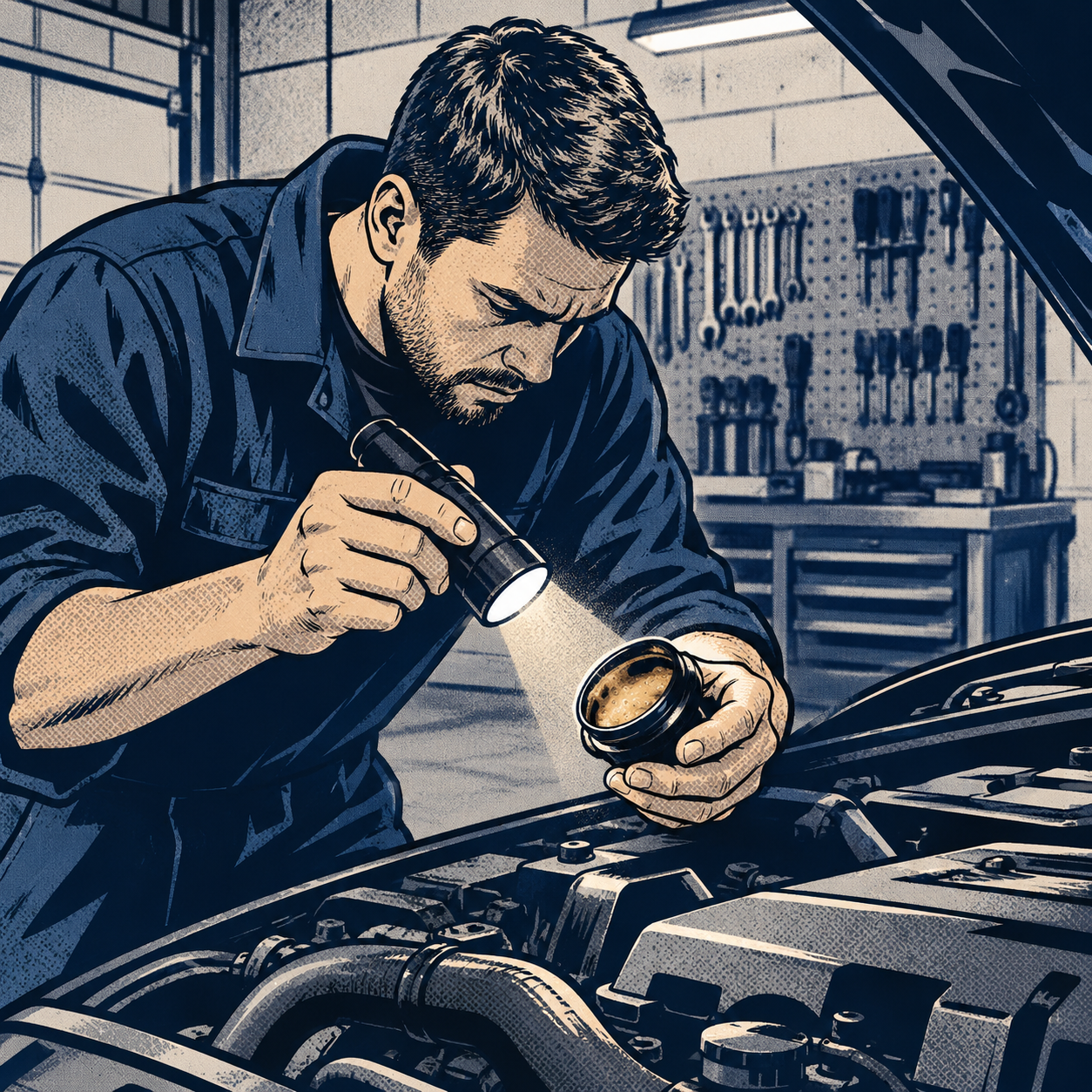
Every service bay has heard the same panicked question: “Is this coolant overflow a blown head gasket, or is my car just doing what it’s supposed to do?” The honest answer is that most of what customers photograph and post online — a little coolant weeping from an overflow tube, a puff of white vapor on a cold morning — is normal thermal behavior. But some of it isn’t, and the difference between a $15 radiator cap and a $2,000+ head gasket job comes down to a handful of specific checks you can walk a customer or a junior tech through in under ten minutes.
How a Head Gasket Actually Seals the Engine
A head gasket isn’t sealing one joint — it’s simultaneously sealing four separate volumes against each other: the combustion chamber, the coolant jacket, the oil galleys, and the outside atmosphere. Where it fails determines what you’ll see, which is why “head gasket symptoms” aren’t one consistent picture.
Break it down by which two volumes are communicating:
- Combustion chamber to coolant jacket — this is the classic case, and it shows up as bubbles in the radiator or reservoir, often worse at idle or under load, and a tendency to overheat.
- Coolant jacket to oil galley — this produces the dreaded “milkshake,” a tan, frothy sludge under the oil cap or on the dipstick. This is the most serious failure mode and can lead to total engine loss if the engine is run very long with oil that’s lost its lubricating properties.
- Coolant jacket to atmosphere — an external leak, usually visible as crusty residue or active dripping at the head-to-block mating surface.
- Combustion chamber to atmosphere — a compression leak with no fluid involvement at all, sometimes just a misfire or odd exhaust note.
All four are technically “head gasket failures” and all require the same repair — pulling the head and replacing the gasket — but they are not equally urgent. A tiny external coolant seep is an annoyance. Oil-coolant cross-contamination is a get-it-off-the-road-now problem.
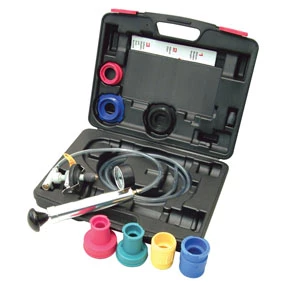

Heavy Duty Cooling System Pressure Test Kit
Mfg: OTC Tools and Equipment
Part #: ZTSE2384
Reading Symptoms Correctly: Bubbles, Milkshake, and Smoke
Before assuming the worst, separate what you’re actually seeing from what you’re assuming. A few occasional bubbles rising in a reservoir when you first start a cold engine can just be air working its way out of the system after a top-off — that’s normal and should settle within a few minutes of idling. Bubbles that persist continuously, especially increasing with RPM or load, are a different story and point toward combustion gas intrusion.
White smoke from the tailpipe is one of the most commonly misread symptoms. On a cold morning, condensed water vapor in the exhaust looks identical to “coolant burning off” smoke and will clear up within a minute or two of the engine warming up. Thicker, persistent white-blue smoke that doesn’t clear, especially paired with a sweet smell, is coolant actually entering the combustion chamber — that’s a head gasket or possibly a cracked head or intake manifold gasket.
It’s also worth remembering that small combustion leaks can be genuinely asymptomatic for a long time. Vehicles have run for weeks with a minor combustion-to-coolant leak showing no symptom beyond slowly dropping coolant level, no visible bubbling, no smoke, no overheating. That’s why a “no bubbles, no milkshake” check isn’t a 100% clearance — it’s a strong indicator, not a guarantee, which is exactly why a dedicated test matters when the stakes are high (used car purchase, pre-trip inspection, etc.).
Shop Engine Repair Tools
Accurate head gasket diagnosis depends on having the right diagnostic equipment and repair tools. Browse our Engine Repair Tools selection to find what you need for compression testing, coolant system inspection, gasket removal, and head resurfacing.
- Compression testers and leak-down kits for combustion chamber diagnostics
- Coolant system pressure testers and temperature gauges
- Gasket scrapers, head bolts, and resurfacing supplies

The Toolsource Technical Team blends decades of real-world automotive service experience with up-to-date technical research. Our writers collaborate with professional mechanics, shop owners, and diagnostic specialists to deliver practical, workshop-ready guidance you can trust.


Follow us on social media