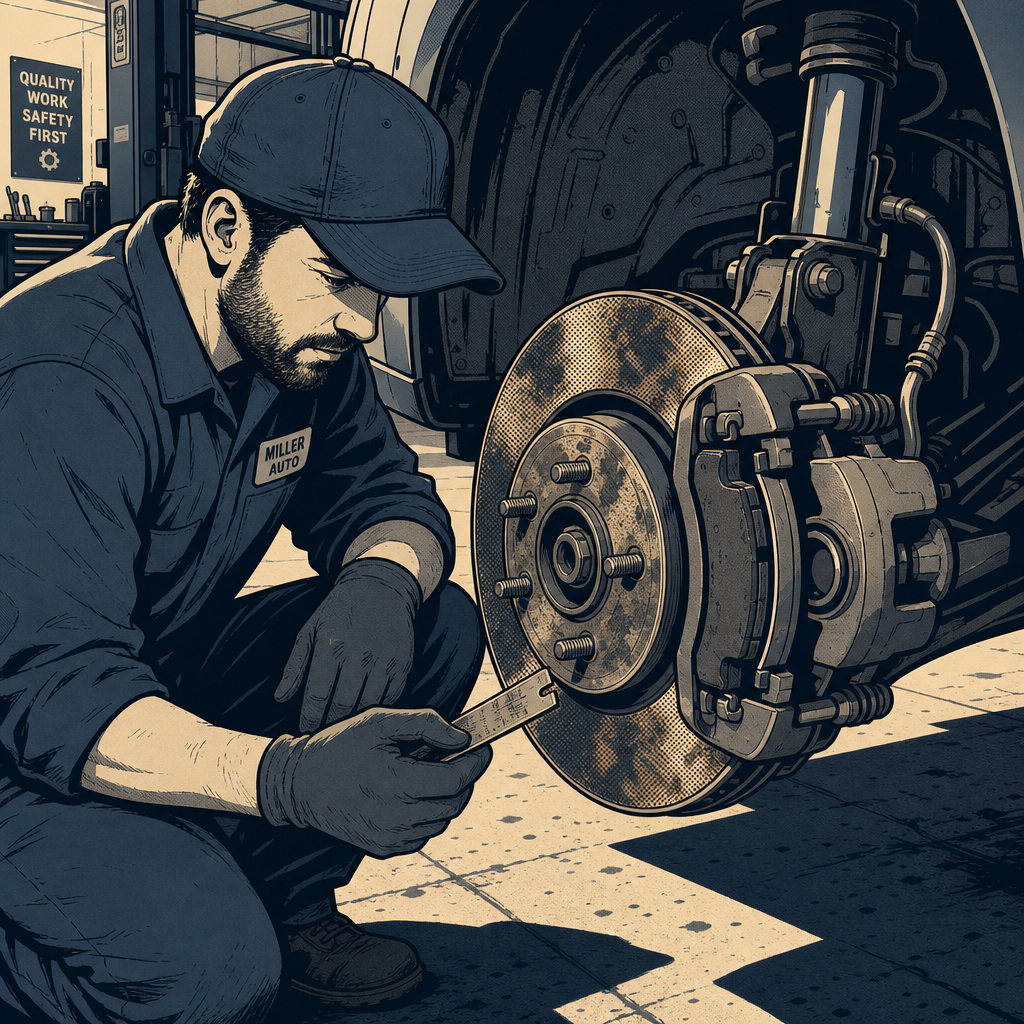
It’s one of the more confusing comebacks on the brake side of the shop: a customer’s rear pads are worn to the wear indicator (or worse, metal-on-metal) while the fronts still have 70-80% pad life left. On most vehicles the fronts do the majority of the stopping work and should wear faster, so when the pattern reverses, it’s worth a second look before you just slap on rotors and pads and send the car out the door. Sometimes it’s a genuine mechanical fault — a seized caliper piston or slide pin — and sometimes it’s a byproduct of how the vehicle’s electronic brake system or the driver’s habits distribute braking force. This post walks through how to tell the difference, what to check first, and when uneven wear is actually normal.
Recognizing the Symptom: What Uneven Wear Actually Looks Like
Before diagnosing anything, document the actual wear pattern. Pull all four corners and compare pad thickness side to side and front to rear. A few things to note on the inspection sheet:
- Front pad thickness (inner and outer pad, both sides) versus rear pad thickness (inner and outer pad, both sides)
- Rotor condition — surface rust on the fronts is a strong tell that they aren’t being worked hard, since rust forms during the miles between hard brake applications
- Whether the wear is even side-to-side on each axle (uneven side-to-side wear on the same axle points to a caliper problem on that specific wheel, not a system-wide bias issue)
- Mileage and time since the last brake service — pads wear from use, not from calendar time, so a car that sees mostly gentle stops over 80,000 miles can show completely different wear than one that’s seen the same mileage in stop-and-go city driving
If the fronts show light surface rust and the rears are worn out, that’s consistent with the fronts genuinely not doing much work — not necessarily broken, but underused. If the front pads look glazed, unevenly tapered, or the caliper drags when you spin the wheel by hand, that’s a mechanical problem, not a bias issue.
Ruling Out Mechanical Causes: Seized Calipers, Pins, and Pistons
This is the first thing to physically check, because it’s the most common actual failure behind a front brake that isn’t doing its share of work. With the wheel off:
- Spin the rotor by hand before and after a firm brake pedal press. It should drag noticeably after the pedal is applied and spin freely once released. A caliper that never drags at all means the piston isn’t extending — check for a stuck piston or a collapsed/blocked brake line (rubber flex lines can delaminate internally and act as a one-way check valve).
- Pull the caliper and inspect the slide pins. Dry, corroded, or bent slide pins prevent the caliper from centering over the rotor, which typically causes the outboard pad to wear faster than the inboard — but if pins are frozen solid, the caliper may not clamp at all.
- Check the piston boot for tears and the piston itself for corrosion or resistance when compressed. A piston that’s partially seized will apply reduced or inconsistent clamping force even though the pedal feels normal.
- Confirm each front caliper is getting fluid and bleeding normally — air or a restriction in one line will make that wheel underperform even with a perfectly good caliper.
If one front wheel shows normal wear and the other doesn’t, it’s almost always isolated to that caliper, pin, or line — not a system-wide electronic issue. Uneven wear on just one side rules out ABS/EBD logic, since those systems don’t typically play favorites between left and right on a straight stop.
Electronic Culprits: EBD, ABS Modules, and Adaptive Cruise Control
If both front calipers move freely, both pistons compress and extend properly, and there’s no side-to-side discrepancy, look at the vehicle’s electronic brake force distribution (EBD) and any driver-assist systems before condemning parts.
- EBD behavior: Most modern vehicles use EBD to shift braking bias toward the rear during light, controlled stops to reduce nose-dive and improve stability, then shift more force to the front only during harder braking events. A driver who consistently brakes gently and early may rarely generate a stop hard enough to fully engage the front circuit, so the rears end up doing proportionally more work over the life of the pads.
- Adaptive cruise control / traffic jam assist: On several makes, the ACC/TJA system primarily applies rear brakes for small speed corrections, reserving front braking for driver-initiated or higher-deceleration stops. Ask the customer whether they use ACC regularly — heavy ACC users on some platforms show accelerated rear pad wear as a documented, normal characteristic.
- Proportioning valve or ABS/HCU fault: On older or non-EBD vehicles, a stuck or miscalibrated proportioning valve, or an ABS hydraulic control unit fault, can route more pressure to the rear circuit than intended. Check for stored ABS codes and inspect the proportioning valve if the vehicle has a standalone one rather than electronic distribution.
None of these are “broken” in the sense of a repair being required — they’re often just how the system is designed to behave under light braking. That said, an ABS/HCU fault or a genuinely stuck proportioning valve should still be diagnosed with a scan tool and repaired if codes are present.
Diagnostic Steps: Confirming Whether the Front Brakes Actually Work
Once you’ve inspected the hardware and ruled out an obvious mechanical seizure, verify actual front brake performance with a test rather than a visual pad-thickness comparison alone:
- With the vehicle safely up on a lift, apply the brakes firmly by hand (or have a second tech press the pedal) and confirm each front caliper clamps down with comparable, firm resistance when you try to spin the wheel.
- Road test with a controlled, moderate-to-firm stop from around 25-30 mph in a safe, empty area. Note whether the vehicle pulls to one side (indicating one front caliper is underperforming) or stops without excessive nose-dive delay.
- Check for heat after the test drive — a front rotor and caliper that were doing real work will be noticeably warmer than one that wasn’t engaging.
- Pull codes with a scan tool, specifically looking at ABS/EBD/traction control modules for stored or pending faults, even if no dash light is on.
- If available, check live data for individual wheel brake pressure or ABS wheel speed sensor activity during a test stop to see if the system is actually modulating all four corners as expected.
If the front calipers clamp firmly, get warm after a drive, and there’s no pull or ABS fault code, the wear pattern is very likely explained by driving style, EBD bias, or ACC usage rather than a defect — no repair needed beyond routine pad replacement.
Fixing It: Repair and Verification After Service
If you do find a mechanical fault, address the root cause, not just the symptom:
- Seized piston: rebuild or replace the caliper — don’t just lubricate a piston that’s already corroded internally, since it will likely stick again.
- Seized or worn slide pins: clean, inspect the caliper bracket bushings, and replace pins/bushings as a set with proper high-temp brake grease. If the bushings are worn or torn, replace them too.
- Collapsed brake line: replace the flex line; don’t attempt to repair it, and bleed the full circuit afterward.
- Stuck proportioning valve: replace as an assembly if it’s a standalone component; on vehicles with electronic EBD, this is usually integrated into the ABS module and requires module-level diagnosis, not a standalone part swap.
After any front brake repair, always bed the new pads and rotors properly and do a final test stop to confirm even clamping and no pull before releasing the vehicle.
Quick Checklist
- Compare pad thickness and rotor condition at all four corners, not just the axle with the complaint
- Spin each front wheel by hand with and without brake pressure applied to check for caliper drag
- Inspect slide pins, caliper pistons, and boots for seizing or corrosion
- Check for stored ABS/EBD codes even with no dash light on
- Ask about ACC/adaptive cruise usage and typical driving style
- Confirm even front clamping and no pull with a controlled test stop before returning the vehicle


FAQs
Is it normal for rear brake pads to wear out faster than front pads?
On some vehicles, yes. Electronic brake force distribution biases light stops toward the rear, and heavy adaptive cruise control use on certain platforms relies mainly on rear braking for minor speed corrections. If front calipers test fine mechanically and there’s no ABS fault code, this pattern can be a normal characteristic of that vehicle rather than a defect.
How can a driver tell if their front brakes have lost stopping power?
The clearest way is a controlled emergency stop from a moderate speed (around 25-40 mph) in a safe, empty area. If the vehicle takes noticeably longer to stop than expected, pulls to one side, or the pedal feels different than normal, that points to a real front brake problem worth inspecting immediately.
Should I reuse front pads and rotors if they still have plenty of life left?
Only after confirming the calipers, pistons, and slide pins are functioning correctly and the rotors are within spec for thickness and runout. If the front hardware tests fine, reusing pads with adequate remaining life is reasonable and can be returned or credited if purchased unnecessarily.
Can a bad ABS module cause uneven front-to-rear brake wear?
Yes. Since EBD logic typically lives in the ABS/hydraulic control unit on modern vehicles, a fault there can skew brake force distribution between axles. Always check for stored codes, even without a warning light, when uneven wear can’t be explained by caliper hardware or driving habits alone.
What’s the difference between a seized caliper and a seized slide pin as the cause?
A seized piston typically results in that wheel getting little or no braking force at all, since the pad can’t be pushed against the rotor. Seized or dry slide pins usually cause uneven wear between the inboard and outboard pad on the same caliper, because the caliper can’t float and center properly, rather than eliminating clamping force entirely.
Does using adaptive cruise control a lot actually wear out rear brakes faster?
On vehicles where ACC and traffic jam assist are programmed to primarily use rear brake application for automated speed adjustments, frequent ACC use over many miles can accelerate rear pad wear relative to the front. This has been reported as a known behavior on some makes and isn’t necessarily a sign of a fault.
Recommended Tools for Brake Diagnosis
Accurate diagnosis of uneven brake pad wear requires the right inspection and service tools. Our Brake System category supplies the equipment needed to inspect calipers, measure pad and rotor wear, and test brake performance.
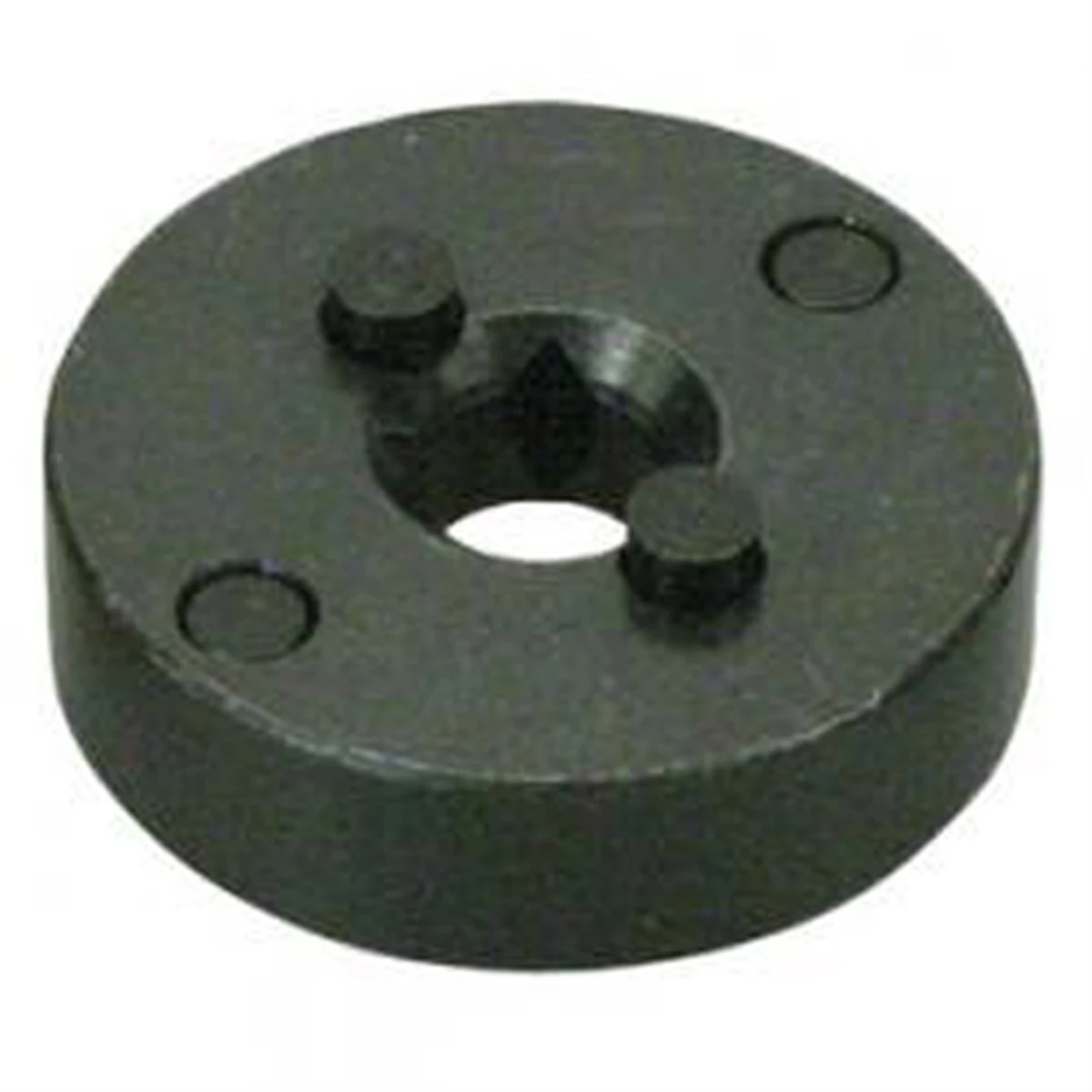
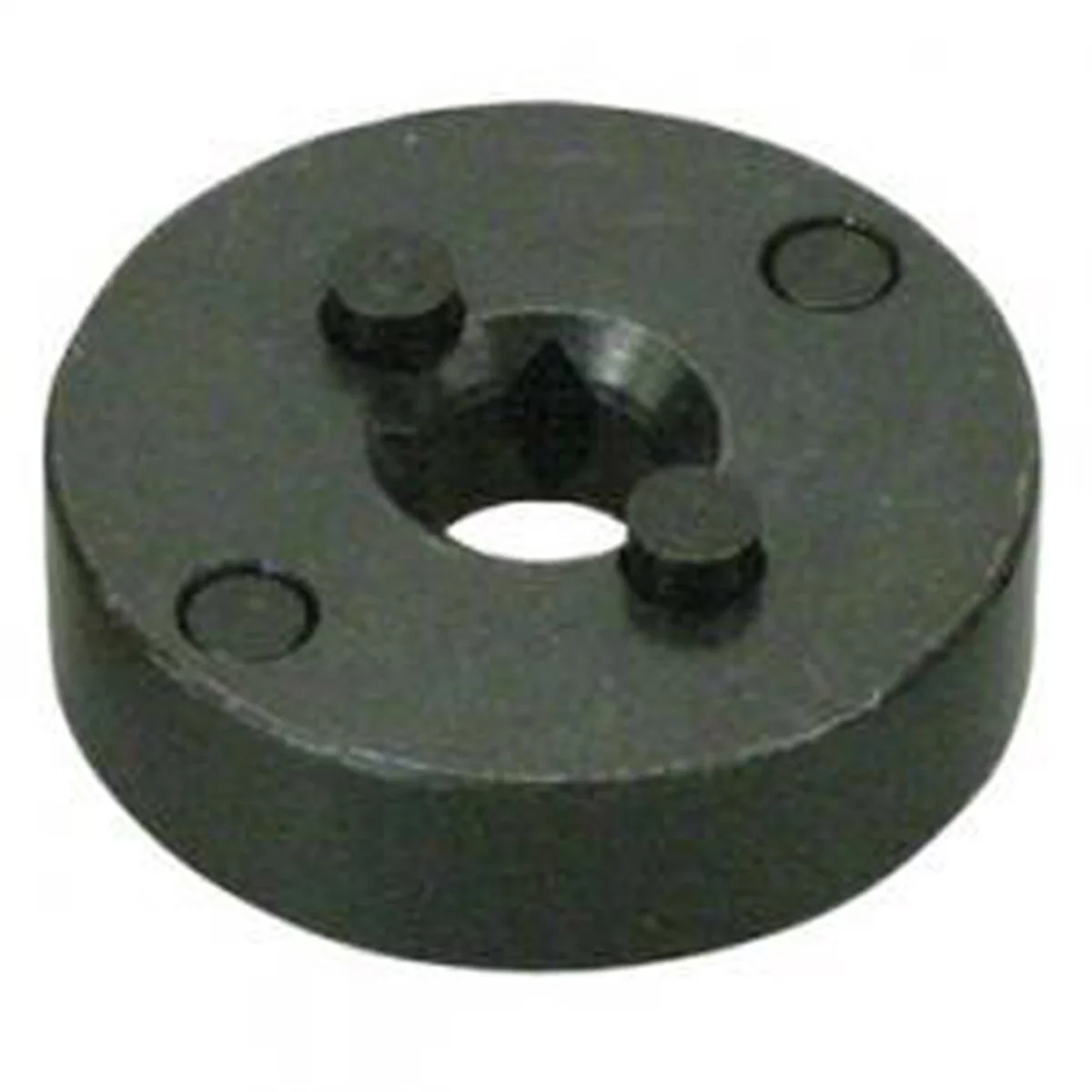
- Caliper slide pin and piston service tools for hardware inspection and repair
- Brake pad and rotor gauges for accurate wear documentation
- Brake fluid testing and system service equipment

The Toolsource Technical Team blends decades of real-world automotive service experience with up-to-date technical research. Our writers collaborate with professional mechanics, shop owners, and diagnostic specialists to deliver practical, workshop-ready guidance you can trust.


Follow us on social media