Every shop has seen it: a customer drives in with a front end that’s bouncing, knocking, or visibly hopping down the road, and they genuinely had no idea anything was wrong. Social media is full of dashcam clips of cars “dribbling” like a basketball on the highway, wheels bouncing independently of the body, or a car limping along at a strange diagonal angle. These aren’t just internet curiosities — they’re textbook examples of advanced suspension failure, and they show up on your lift more often than most techs would like. This guide breaks down how to recognize the symptoms, isolate the failed component, and avoid the common mistakes that turn a straightforward strut job into a comeback.
Recognizing the Symptoms Before the Teardown
Most of these failures don’t happen overnight. By the time a customer notices something is wrong, the damage is usually severe. Listen for the complaints that should trigger an immediate suspension inspection:
- Visible wheel hop or “galloping” at speed, especially over the smallest bump — this is a classic sign of a collapsed or missing strut with the spring unseated or broken.
- Steering wheel wobble or shimmy that gets worse with speed, often paired with a knocking sound from the front corner.
- A persistent knock from the front end on bumps, dips, or braking — this points to a failed strut mount, a broken coil spring end, or a worn control arm bushing/ball joint.
- The car tracking diagonally or “dog-tracking” down the road while still staying roughly in its lane — this is far more serious and usually indicates a bent or snapped trailing arm, a bent axle flange, or a severe thrust angle problem.
- Uneven ride height side to side, which almost always means a broken spring or a strut that has lost all internal pressure.
Don’t dismiss any of these as “just a bad bushing.” A customer who says the car “drives fine, just a little noise” is often one pothole away from a structural suspension failure at highway speed.
What’s Actually Failing Underneath
When you get the car on the lift, there are a handful of usual suspects, and they often fail together rather than in isolation:
- Collapsed or blown struts. Once the internal valving or seal fails, the strut stops damping altogether. Without resistance, the spring and wheel are free to bounce unchecked — this is exactly what produces that dramatic wheel-hop effect people film on the highway.
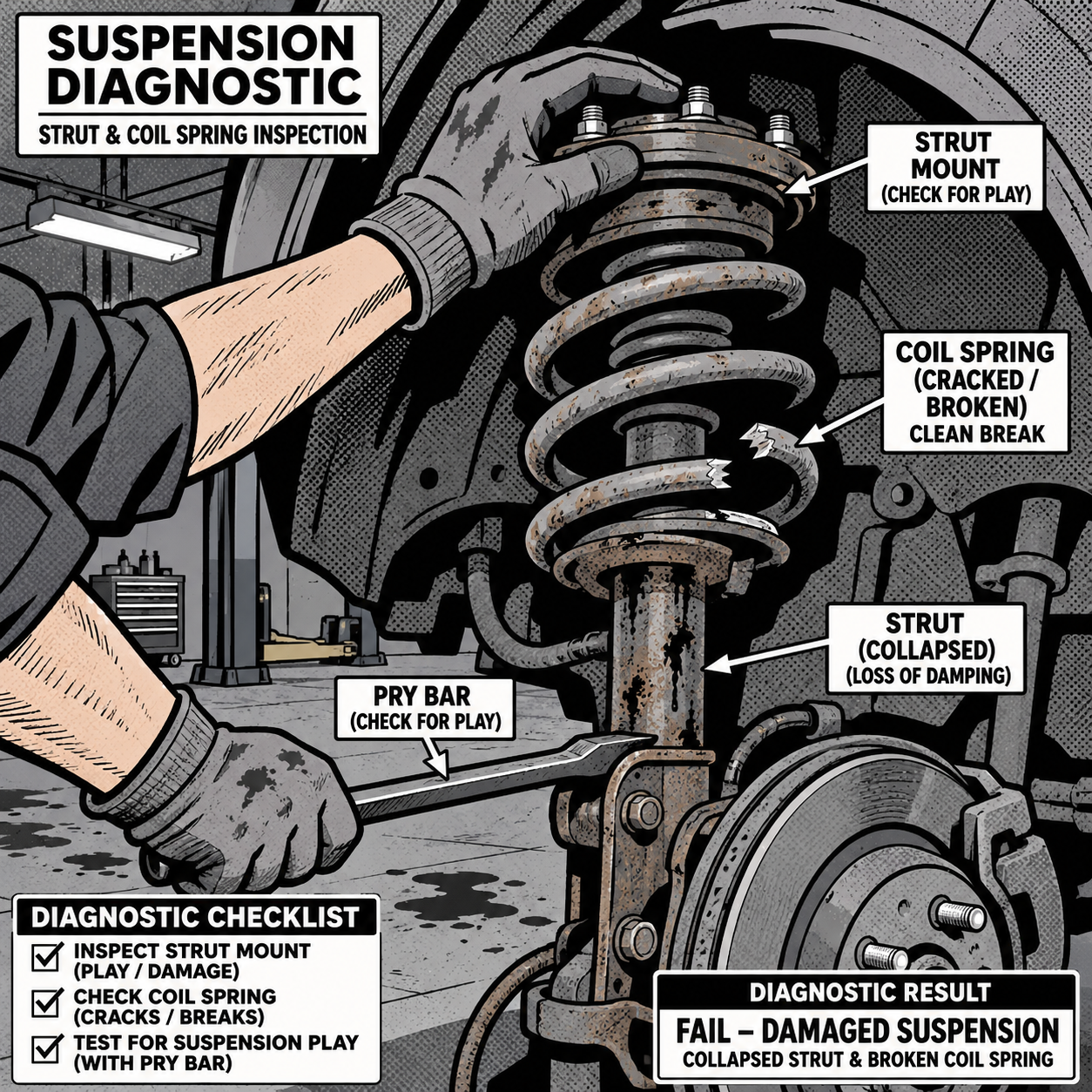
- Broken coil springs. A cracked or snapped spring coil changes ride height instantly on that corner and removes the spring’s ability to control wheel travel. Combined with a dead strut, the wheel has almost nothing holding it to a controlled path.
- Missing or failed strut mount isolators/bearings. If there’s no proper seat for the spring or no pressure retained in the assembly, the whole strut can shift out of position under load — sometimes enough that the strut effectively “checks out” while the car is still moving.
- Worn or failed control arms and bushings. These allow excess lateral and fore-aft movement, contributing to knocking and alignment problems even if the strut itself is fine.
- Bent or snapped trailing arms, or a bent axle flange. This is the root cause behind a car visibly driving sideways or diagonally while still moving forward — it throws off the thrust angle so badly that the rear axle is no longer tracking parallel to the front.
In many of the worst cases, it’s not one isolated part — it’s a strut that failed months ago, followed by a spring that cracked under the resulting abuse, followed by control arm and bushing wear from the uncontrolled wheel movement. Treat a severely degraded corner as a full-system inspection, not a single-part swap.
PRODUCT_SEARCH_PLACEHOLDER_1

Single Action Automotive Coil Spring Compressor Tool Kit
Mfg: S & G Tool Aid
Part #: 62500


A Practical Diagnostic Workflow
When a vehicle comes in with these symptoms, work through it methodically rather than jumping straight to a strut quote:
- Visual inspection first. With the car on the ground, check ride height side-to-side and front-to-rear. A noticeably lower corner is your first clue to a broken spring or collapsed strut.
- Bounce test each corner. Push down firmly on each fender and release. A healthy strut resists and settles in one bounce. A dead strut offers little resistance and the corner oscillates.
- Inspect the spring visually and by hand. Look for cracked coils, shiny wear marks from coils rubbing together, or a spring that’s sitting unevenly in its perch. Broken springs frequently show a clean fracture at a coil end.
- Check the strut mount and bearing. With the wheel off the ground, grab the tire at 9 and 3 o’clock and rock it to feel for play in the mount, and check for a seized or binding strut bearing with the wheel turned.
- Move to control arms, bushings, and ball joints. Use a pry bar under load or a dial indicator to check for excess play. Torn rubber bushings and loose ball joints both contribute to the knocking and wandering complaints.
- If the car tracks diagonally, go straight to the rear. Inspect trailing arms, axle flanges, and subframe mounting points for bending or cracking before you even think about an alignment. An alignment rack will confirm a severe thrust angle, but it won’t tell you why — that’s a hands-on inspection.
- Check tire condition and tire belts. A separated belt inside the tire can mimic some of these symptoms (vibration, pulling) independent of the suspension, so don’t assume suspension is the only cause of a shake.
The Diagonal-Driving Case: Thrust Angle Failures
One of the more alarming failure modes isn’t bouncing — it’s a car that drives forward while visibly angled, like it’s crabbing sideways down the lane. This is a thrust angle problem, and it’s more serious than a worn strut because it affects directional control, not just ride comfort. The common causes are a snapped or badly bent trailing arm, a bent axle flange, or a subframe that has shifted from impact damage. Poor alignment and loose or worn rear axle mounting hardware can produce a milder version of the same symptom.
This is not a “drive it until the part comes in” repair. A vehicle with a confirmed thrust angle failure should not be driven on the road, let alone the highway, until the bent or broken component is identified and replaced. Flag this clearly for the customer and document it — this is a liability issue as much as a mechanical one.
Repair Pitfalls That Create Comebacks
A surprising number of suspension failures on the road aren’t first-time problems — they’re failed repairs. Watch for these patterns, both in your own shop’s work and when inheriting a prior repair:
- Parts removed but not replaced. It happens more than anyone wants to admit — a bad shock or strut gets pulled during a diagnostic or parts swap and the new unit never goes back in before the car leaves the lot.
- Bargain aftermarket parts that don’t fit correctly. Struts, mounts, and control arms with loose tolerances or incorrect bushing durometer can fail prematurely or introduce noise and alignment issues even when “properly” installed.
- Skipping the alignment after suspension work. Any strut, control arm, or trailing arm replacement should be followed by an alignment check — thrust angle issues in particular won’t self-correct.
- Reusing worn mounting hardware. Struts and control arms are only as good as the bolts, bushings, and mounts they’re installed with. Reusing a stretched bolt or a cracked mount undermines the whole repair.
Quick Pre-Delivery Checklist
- Ride height even side-to-side and front-to-rear
- No excess play in bounce test at any corner
- Springs free of cracks, uneven seating, or coil-to-coil contact wear
- Control arms, bushings, and ball joints within spec play
- No bent trailing arms, axle flanges, or subframe damage
- Alignment performed and thrust angle within spec after any suspension repair
- All removed components confirmed replaced before the vehicle leaves
PRODUCT_SEARCH_PLACEHOLDER_2


Frequently Asked Questions
Is it safe to drive a car with a collapsed strut?
No. A collapsed strut lets the wheel bounce uncontrolled, which degrades braking, steering response, and tire contact with the road. It should be repaired before the vehicle is driven beyond getting it to the shop.
Can a broken spring damage other suspension parts?
Yes. A broken spring changes load distribution and allows excess wheel travel, which accelerates wear on the strut, control arm bushings, and ball joints on that corner.
What’s the difference between a bad strut and a bad spring?
A strut controls damping (how the wheel settles after a bump); a spring controls ride height and load support. A failed strut causes bouncing and poor control; a broken spring causes sagging and uneven ride height. They often fail together.
What causes a car to drive diagonally down the road?
This is typically a severe thrust angle problem caused by a bent or snapped trailing arm, a bent rear axle flange, or significant subframe damage — not a simple alignment issue.
Should I always replace struts and springs in pairs?
Replacing both struts (or both springs) on an axle together is standard practice to maintain even handling and ride height, even if only one side has visibly failed.
Can cheap aftermarket suspension parts cause fitment problems?
Yes. Lower-cost aftermarket struts, mounts, and control arms can have looser tolerances or incorrect geometry that lead to poor fit, premature wear, or noise even after a correct installation procedure.
Shop Suspension Tools & Parts
Once you’ve diagnosed the failure, repair requires the right parts and tools. Find everything you need in our Tire Tools, Wheels & Suspension section.
- Struts, springs, and shock assemblies with mounts and bearings
- Control arms, bushings, ball joints, and fasteners
- Alignment equipment and suspension service tools

The Toolsource Technical Team blends decades of real-world automotive service experience with up-to-date technical research. Our writers collaborate with professional mechanics, shop owners, and diagnostic specialists to deliver practical, workshop-ready guidance you can trust.


Follow us on social media