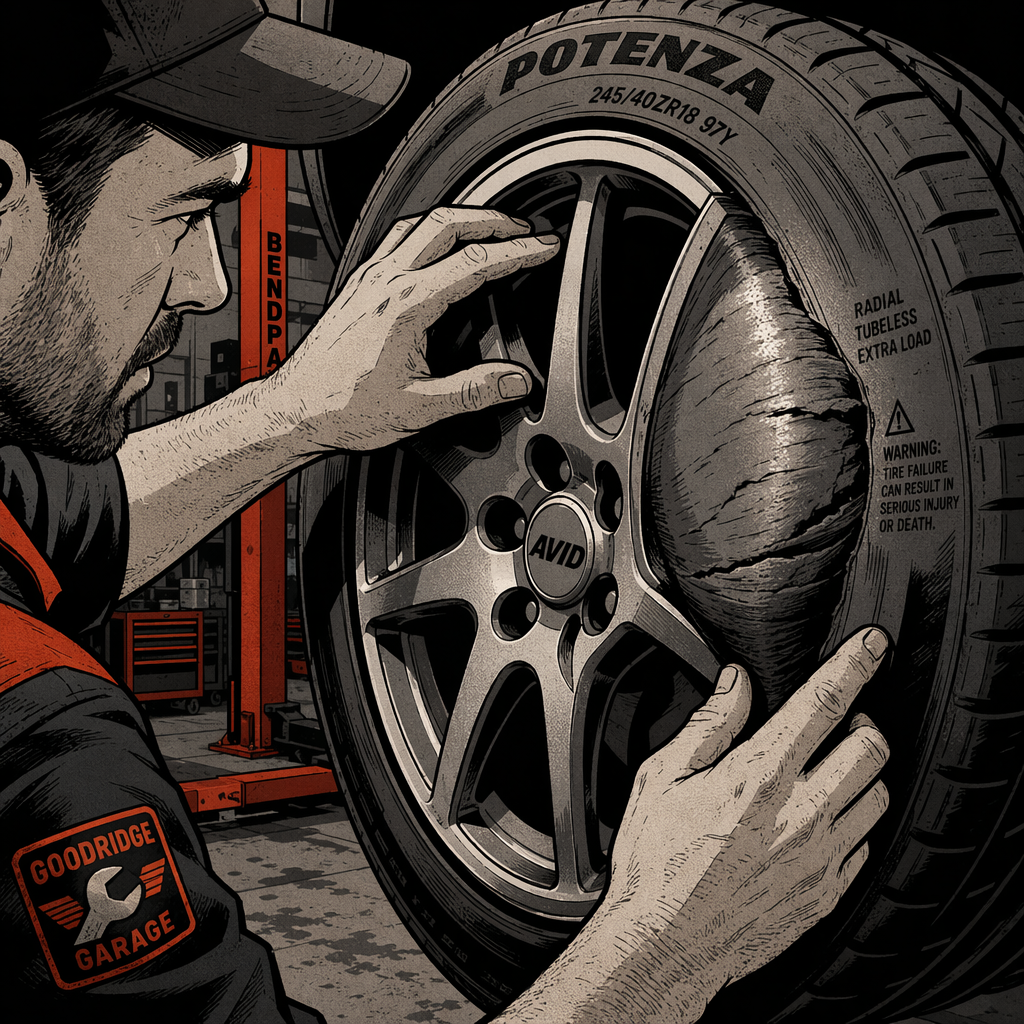
A hard curb strike can look like cosmetic scuffing from a few feet away and turn out to be a tire with its internal structure torn open. Customers bring these in all the time thinking a plug or a wheel balance will fix it, when the real story is a sidewall that’s one pothole away from a blowout. This guide walks through how to inspect curb-impact damage systematically, decide whether the tire is driveable even for a short distance, and check the components around it that absorb the same hit.
First, Get the Vehicle Off That Tire Safely
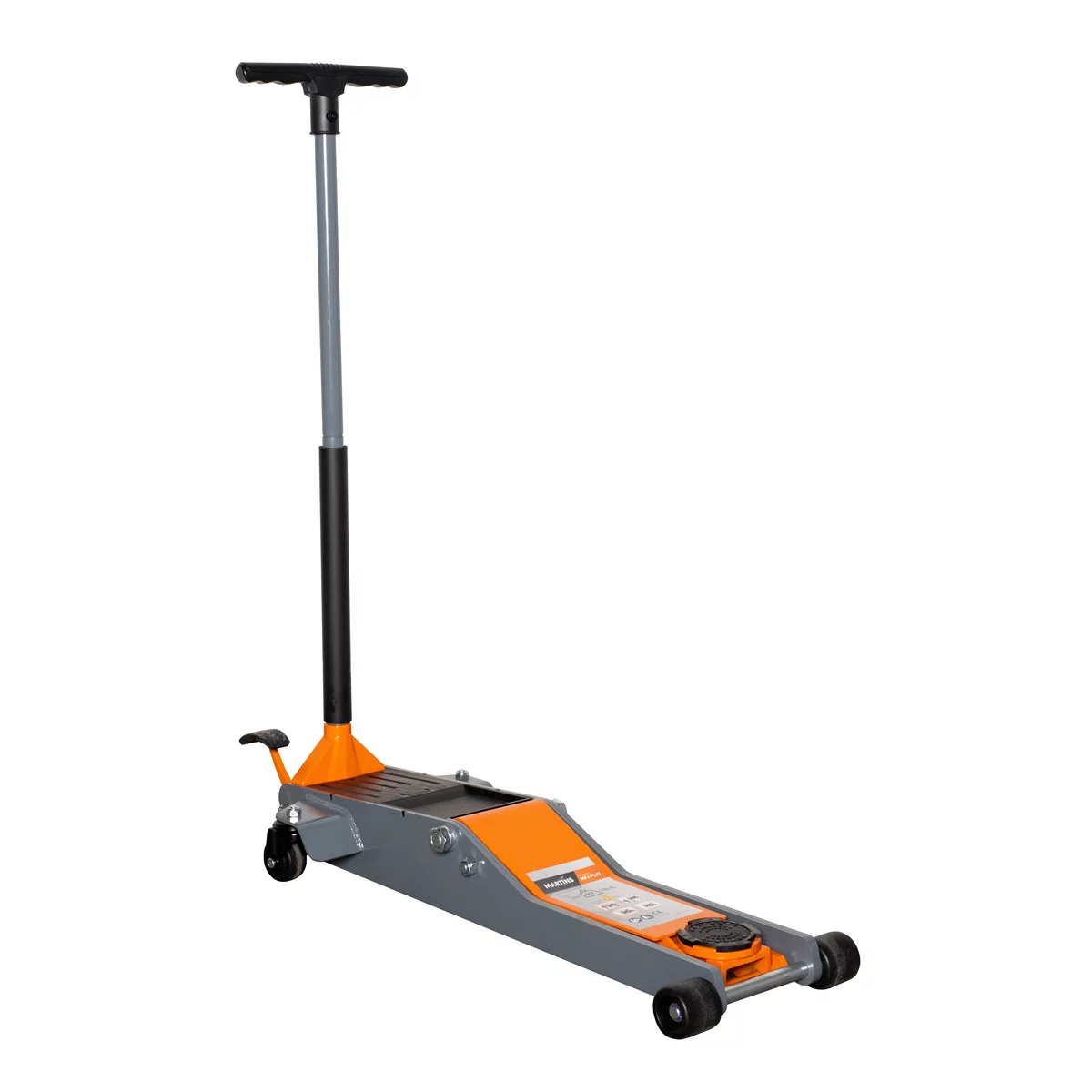
Martin Tools 2-Ton - Professional Long Reach Floor Jack
Mfg: Martin Tools
Part #: MFJ-PL2T
Before any inspection, stop driving on a tire you suspect is compromised. If a customer or technician needs to move the vehicle at all, the only acceptable trip is a slow, straight-line pull into a bay or onto a lift — not a drive to a second location. If the vehicle is in a parking lot or on the side of the road, swap to the spare or have it towed rather than let anyone put miles on a tire with visible structural damage. A tire that’s already failing internally can hold air right up until it doesn’t, and there’s no reliable way to predict whether that happens on the next mile or the next hundred.
Set the expectation with the customer early: a curb strike severe enough to deform the sidewall is not a “drive it until payday” situation. Frame it in terms they’ll act on — a blowout at speed can mean loss of control, not just an inconvenient walk to the shoulder.
Reading the Damage: Bulges, Cords, and Belts
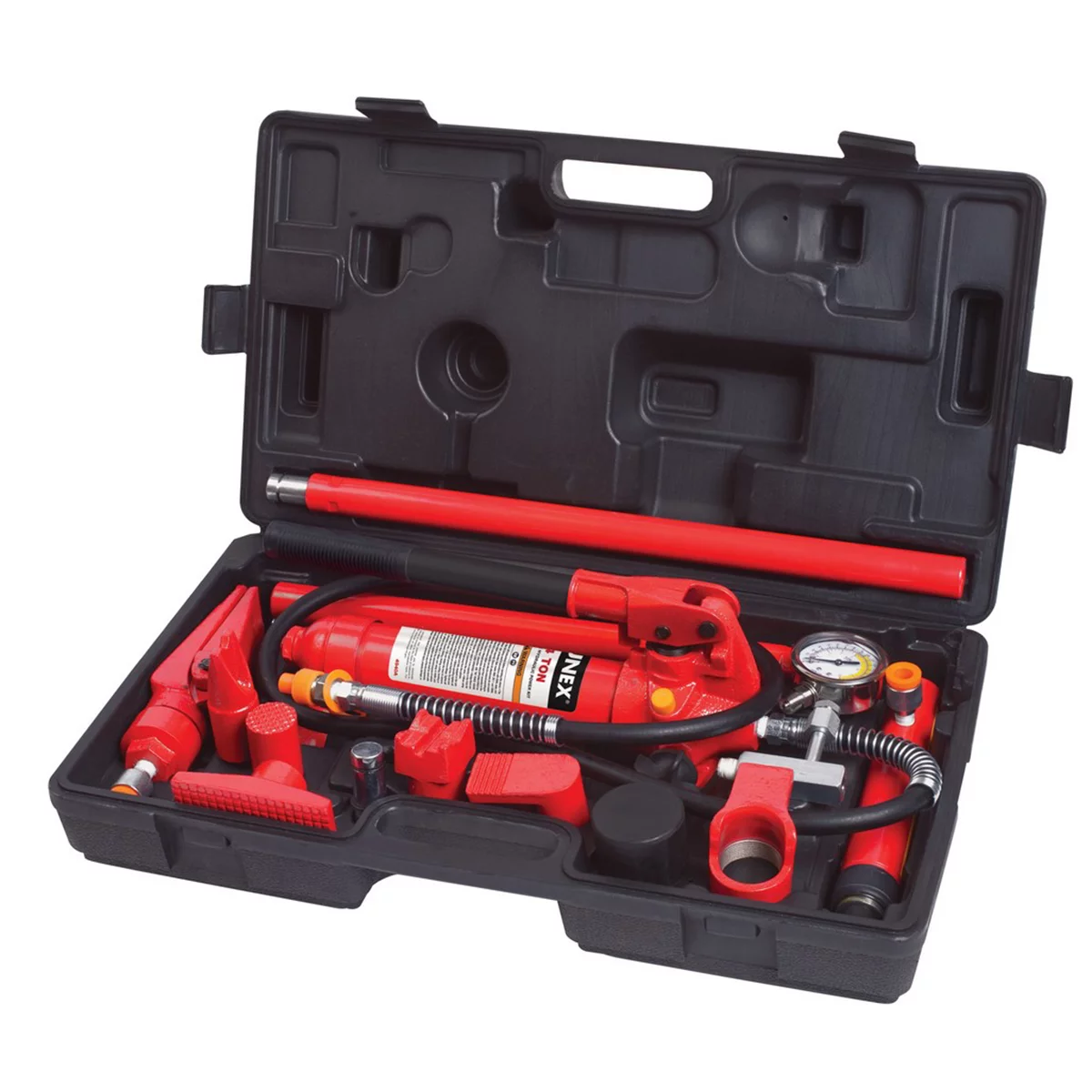
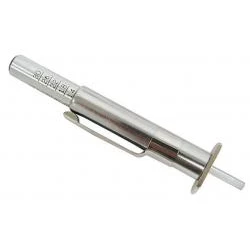
Work through the tire in a fixed sequence so nothing gets missed, especially on the back side facing the curb, which is easy to skip during a quick lot inspection.
- Sidewall bulge or bubble — indicates the internal plies have separated from the rubber. This alone is a mandatory replacement; there is no repair for it.
- Visible cords — the fabric or steel reinforcement layer showing through worn or torn rubber. If cords are visible anywhere, sidewall or tread, the tire is done. Cords are what hold the air pressure; once they’re exposed or severed, the rubber alone won’t hold.
- Exposed steel belts — a step past cords, and non-negotiable. If belts are showing, treat the tire as already failed structurally, even if it’s still holding air.
- Cuts, gouges, or splits — measure depth if you can safely do so. Anything that penetrates to the belt package is a replacement, not a plug-and-patch candidate.
A useful rule to pass on to customers: sidewall damage is never repairable the way a tread puncture might be. The sidewall flexes constantly and has no separate reinforcing layer the way the tread does, so any structural compromise there is terminal for that tire.
[PRODUCT_SEARCH: tire tread depth and sidewall inspection gauge]
No products found for “tire tread depth and sidewall inspection gauge”
Check the Wheel Before You Write Up Just a Tire
A strike hard enough to damage the tire’s cords usually transferred significant force into the wheel too. Pull the tire (or get it on a lift where you can see the wheel clearly) and check for:
- Bent or cracked rim flange, especially on the side that contacted the curb
- Out-of-round condition — spin the wheel on the balancer or by hand and watch for wobble
- Hairline cracks near the lug holes or spokes on alloy wheels, which can be easy to miss without good light
- Air leaks at the bead seat caused by a bent lip, even if the wheel looks fine visually
A bent wheel that gets a new tire mounted on it without correction will re-damage the new tire or produce a persistent vibration complaint that brings the customer back annoyed. Flag wheel damage as its own line item, not an assumed pass just because the tire is the obvious failure.
Inspect Suspension and Check Alignment
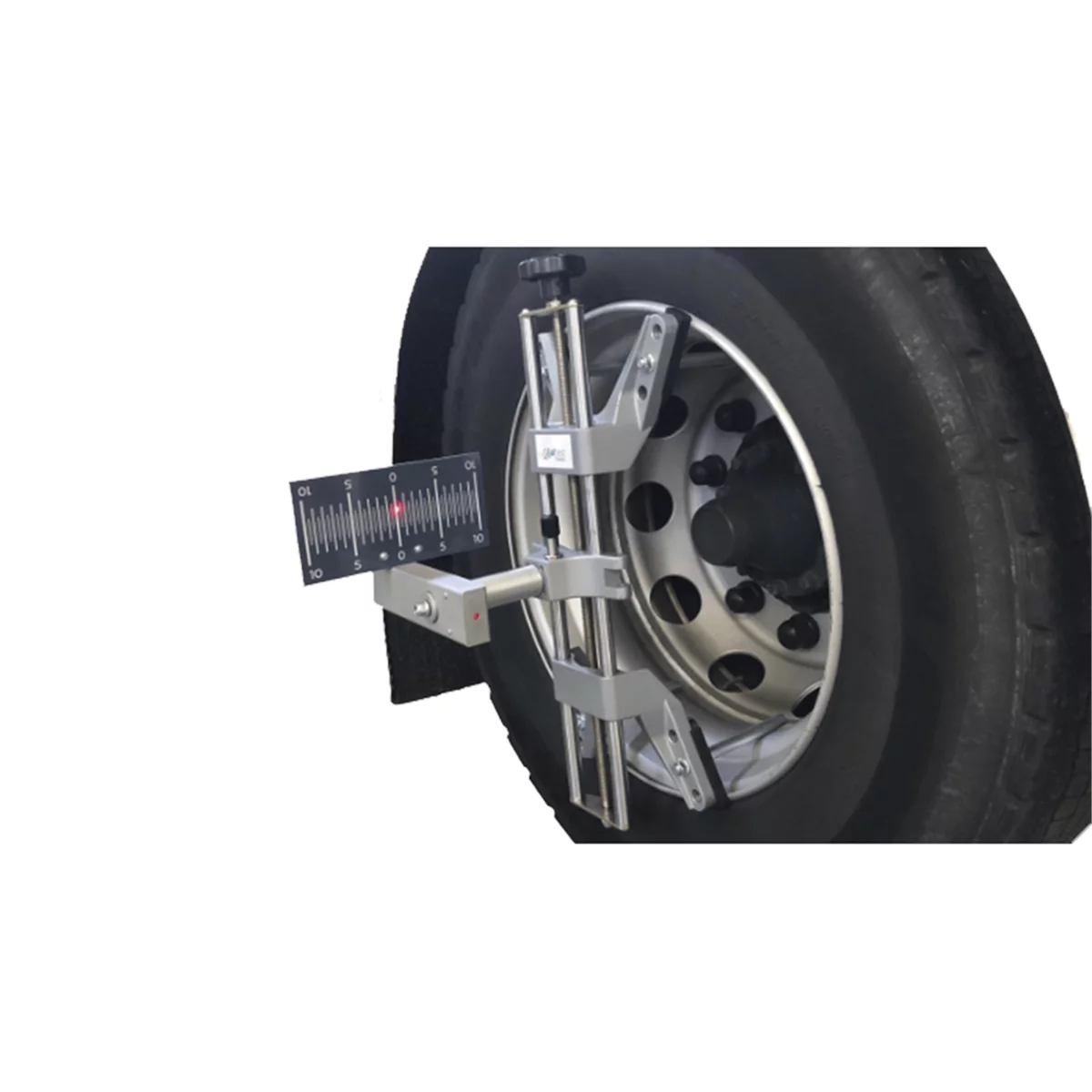
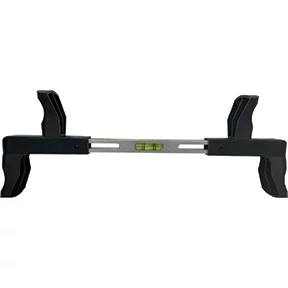

Curb impacts load the suspension and steering components on that corner instantly and unevenly — this is a different failure mode than gradual wear, so a standard multi-point inspection can miss it if you’re not specifically looking for impact signs. Check:
- Tie rod ends and ball joints for play, since a sharp lateral hit is exactly the kind of load that can crack a boot or loosen a joint
- Strut or shock mounts and the strut housing itself for visible bending
- Control arm bushings on that side for tearing
- Steering wheel centering and any new pull or drift the customer mentions
Follow with an alignment check regardless of whether anything looks visibly bent. A curb strike is one of the most common causes of toe and camber going out of spec without any obvious broken part, and a customer driving away with new tires on a knocked-out alignment will just wear the new set unevenly. If the alignment reads within spec, document it — it protects the shop if a tire wear complaint comes back later, and it rules out suspension damage as the explanation for any pull the customer reports.
Single-Tire Replacement on AWD and Some AWD-Adjacent Systems
Before quoting a one-tire replacement, confirm the drivetrain. Many AWD systems are sensitive to circumference differences between tires because the system is constantly comparing wheel speeds across axles; a new tire paired with three worn ones can cause the same rolling diameter mismatch that drives premature transfer case or differential wear. Manufacturer guidance varies — some allow a tread-depth difference within a set tolerance, others effectively require replacing in axle pairs or as a full set. Check the specific tolerance for that vehicle before assuming a single replacement is acceptable, and put the recommendation in writing if the customer chooses to go with just one tire against that guidance.
Quick Curb-Strike Inspection Checklist
- Full visual and tactile sweep of the tire, including the curb-facing sidewall, for bulges, cords, or belts
- Wheel check for bends, cracks, out-of-round spin, and bead seat leaks
- Tie rods, ball joints, strut mounts, and bushings on the impacted corner
- Alignment check even with no visible suspension damage
- Drivetrain type confirmed before recommending single-tire vs. set replacement
- Spare tire condition and pressure verified if it was used to get the vehicle in
[PRODUCT_SEARCH: alignment and suspension inspection tools]
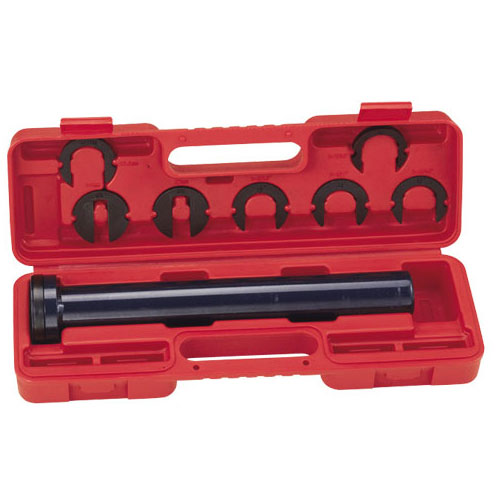
Inner Tie Rod Tool Set with FREE OIL FILTER WRENCH
Mfg: Genius Tools
Part #: AT-4808
ID: 131094
The Brake Force for 0-5.000", 0-125mm Rotors and Ball Joints
Mfg: Central Tools
Part #: 6479A
ID: 112185
Frequently Asked Questions
Can a curb-damaged tire be plugged or patched instead of replaced?
Only if the damage is limited to a small tread puncture well away from the sidewall and shoulder. Any sidewall bulge, exposed cord, or visible belt is not repairable — the structural layers responsible for holding pressure and shape are compromised, and no patch restores that.
How far can a customer drive on a tire showing cords?
Effectively zero planned distance. Treat it as already failed. If the vehicle needs to move, that’s what the spare is for; do not send it out on the damaged tire even for a short trip.
Does curb damage always mean the wheel needs to be checked too?
Not always, but it’s common enough that skipping the wheel check is a mistake. Any impact hard enough to tear tire cords transferred real force into the wheel, so it should be inspected as a matter of course, not just when it looks bent.
Is an alignment check necessary if nothing looks visibly bent?
Yes. Toe and camber can shift from a curb strike without any part being visibly damaged. An alignment check is a fast way to confirm the suspension geometry is still in spec, and it gives you a documented baseline either way.
Can I replace just one tire on an all-wheel-drive vehicle after a curb strike?
It depends on the manufacturer’s tolerance for tread depth and diameter mismatch across the drivetrain. Some AWD systems can handle a single new tire within a small tolerance; others require pairing or a full set to avoid drivetrain strain. Check the specific vehicle’s guidance before quoting the job.
What’s the fastest way to tell a customer their tire is unsafe to drive on?
Show them directly — point out the bulge or exposed cord and explain that the reinforcing layer holding the air in is compromised. A visual explanation next to the tire is usually more convincing than a verbal warning alone, and it documents that the condition was disclosed.
Recommended Tools
A thorough curb-strike inspection requires the right equipment on the bay floor. Our Tire Tools, Wheels & Suspension selection includes everything needed for systematic damage assessment.
- Tire tread depth gauges and sidewall inspection tools
- Wheel balancing and alignment equipment
- Suspension and steering component inspection tools
Essential Tire Repair & Inspection Tools
Now that you know how to inspect curb damage, equip yourself with the right tools to handle tire maintenance and emergency repairs. Browse our full catalog of tire care products designed to keep your vehicle roadworthy.
- Digital Tire Pressure Gauges – Precise PSI readings for safe inflation checks
- Portable Tire Repair Kits – Emergency patches and plugs for quick roadside fixes
- Hydraulic Jacks & Stands – Professional-grade equipment for safe tire removal

The Toolsource Technical Team blends decades of real-world automotive service experience with up-to-date technical research. Our writers collaborate with professional mechanics, shop owners, and diagnostic specialists to deliver practical, workshop-ready guidance you can trust.


Follow us on social media