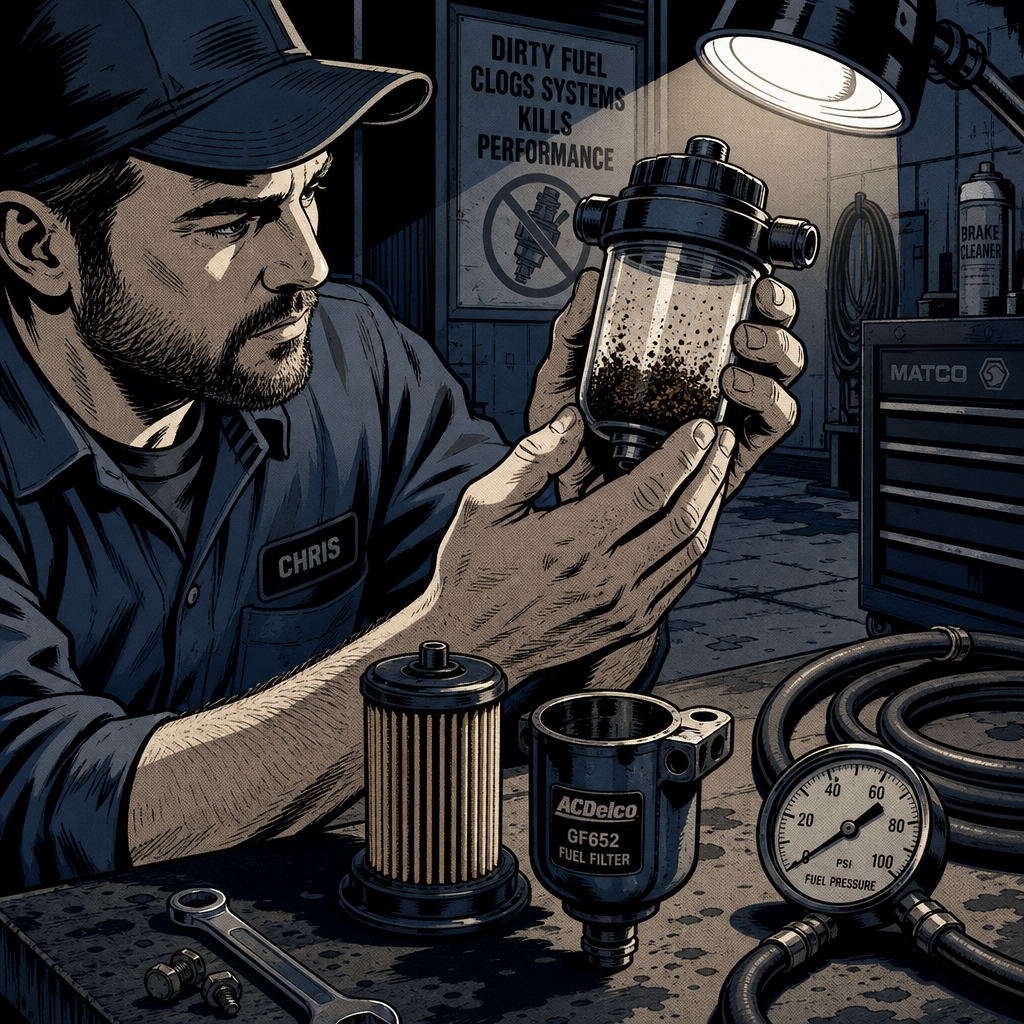
Every shop has heard some version of it: “It ran fine, I filled up the tank, and now it either won’t start or runs terrible.” The instinctive customer explanation is almost always “bad gas” — and it’s almost always wrong. Gasoline doesn’t meaningfully degrade in two weeks, or even two months, sitting in a sealed tank. If you’re chasing fuel quality on a vehicle that was filled up recently, you’re burning diagnostic time in the wrong place. This post walks through the failure points that actually cause post-refueling stalls and hard starts, how to isolate them with basic shop tools, and how to avoid the comeback that happens when “bad gas” gets written on the ticket instead of the real cause.
Why “Bad Gas” Is Rarely the Real Answer
Set expectations correctly before you touch a wrench. Properly stored gasoline in a closed tank — car or portable canister — stays usable for months, often longer, especially with today’s fuel stabilizer additives already blended in at the pump. Degradation from oxidation and moisture absorption is a slow process measured in months to a year-plus for sealed storage, not days or weeks. The exception is fuel stored in a shallow, open, or poorly sealed container, where high air contact accelerates moisture pickup — but that’s a fuel-can problem, not a daily driver problem.
If a customer’s symptom appeared right after a fill-up and the previous tank was only a couple weeks old, don’t write “fuel contamination” on the estimate without evidence. Pull a fuel sample and look at it — contaminated or water-laden fuel is visibly darker, hazy, or has a distinct sour/tangy smell compared to fresh gasoline. If the sample looks and smells normal, move on to the systems that actually cause this exact symptom pattern: hard start or stall immediately following a fill-up.
Test the EVAP Purge Solenoid for a Stuck-Open Condition
This is the number one mechanical explanation for a car that cranks fine but won’t fire — or cranks unusually long — right after refueling. Filling the tank pressurizes the fuel vapor and can trigger an EVAP purge event. If the purge solenoid is stuck open (rather than closed until commanded), raw fuel vapor floods straight into the intake manifold through the purge line. That pushes the air-fuel mixture far outside the ~14.7:1 ratio needed for combustion, and the engine either won’t light off or cranks excessively long while it clears the excess vapor.
To confirm this on the vehicle:
- Pull codes first — a stuck-open purge solenoid frequently sets a stored EVAP code (P0441, P0446, P0455, or a purge flow code) even if the MIL isn’t currently on. Check freeze-frame data for conditions matching a recent fill-up.
- With the engine off, locate the purge solenoid (between the charcoal canister and intake) and disconnect the vapor line to the intake manifold, capping or plugging the manifold port.
- Have someone fill the tank (or simulate pressure) while the line is disconnected, then reconnect it before starting. If the car starts normally with the line disconnected during/after fueling, but struggles when connected, you’ve isolated a stuck-open purge solenoid or a solenoid that isn’t holding vacuum/seal correctly.
- Bench test or swap the solenoid — most purge solenoids are normally closed and should only open under scan tool command or specific engine conditions. If it’s passing vapor with no power applied, replace it.


Check for Tank Sediment and Fuel Pickup Contamination
A second, less obvious pattern: stalling that seems to resolve itself after the car sits, then returns once it’s driven or refueled again. This points less at the fuel itself and more at debris or sediment being stirred up in the tank and pulled toward the fuel pickup or filter. A fill-up adds turbulence and volume to the tank, which can kick loose sediment that’s settled at the bottom — same mechanism seen in boats that stall in rough water after running fine at idle.
Steps to check this:
- Inspect the in-line fuel filter (if accessible/replaceable) for debris, rust flakes, or a fine dark residue.
- Check fuel pressure at idle and under load with a gauge — a partially clogged filter or failing pump often shows normal pressure at idle that drops under demand or after the tank is disturbed.
- If the vehicle has a history of running low on fuel regularly, suspect pickup screen contamination — running a tank near empty repeatedly pulls in more sediment and can starve the pump of cooling fuel flow, shortening pump life.
- For vehicles with a return-style or in-tank strainer, dropping the tank to inspect the sock/strainer is warranted if filter and pressure tests come back marginal.
This pattern (stall → rest → runs fine → stall again after driving or fueling) is a strong argument for a mechanical/contamination cause over a fuel-quality one — actual bad fuel doesn’t “self-correct” after sitting.
Diagnose the Source of Exhaust Smoke Before Assuming Fuel
If the customer also reports smoke, don’t lump it in with the stalling complaint automatically — smoke color and behavior narrow the cause fast:
- White smoke that’s thin and dissipates almost instantly: often just condensation/water vapor on a cold start, especially in cooler weather. Normal.
- Dense white smoke with a sweet smell that persists: coolant entering the combustion chamber — check for a blown head gasket, cracked head, or intake gasket leak. Pull the coolant reservoir cap and check for combustion gases bubbling into it, and check oil for a milky consistency.
- Blue-white or gray smoke: oil burning — worn valve seals, rings, or a turbo seal leak if the vehicle is turbocharged.
- Smoke with a distinct 2-stroke or “oily gas” smell: if a customer topped off with fuel from a shared can or canister that was previously used for a 2-stroke tool (trimmer, chainsaw), oil-mixed fuel in the tank is a real and specific cause of smoke — worth asking directly where the fuel came from.
Has the engine overheated recently, and what’s the oil change interval been? Both questions narrow coolant-intrusion vs. oil-consumption causes quickly, and both are unrelated to how old the gasoline is.
Confirm With a Test Drive and Data Log
Once you’ve inspected the EVAP purge circuit and fuel delivery components, verify with the vehicle running. Log live data (fuel trims, O2 sensor activity, purge duty cycle) through a fill-up cycle if the symptom is reproducible. Short-term fuel trims swinging rich immediately after a fill-up strongly supports a purge solenoid issue; trims going lean or fluctuating under load supports a fuel delivery/contamination issue instead. Don’t clear codes until you’ve captured this data — freeze frame and trim history are often the fastest way to confirm the fix before the car leaves the bay.
Quick Diagnostic Checklist
- Pull stored/pending codes and check freeze-frame timing against the fill-up
- Visually inspect a fuel sample for color, clarity, and odor
- Disconnect the EVAP purge line and retest a fill-up/start cycle
- Check fuel filter condition and fuel pressure at idle and under load
- Identify smoke color/smell and correlate with coolant and oil condition
- Log live data through a reproducible fill-up cycle before clearing codes
XGrid XC3: 240W USB-C to USB-C Cable with E-Marker Chip - 10
Mfg: NOCO Genius USA
Part #: XC3B

XGrid XC2: 240W USB-C to USB-C Cable with E-Marker Chip - 6-
Mfg: NOCO Genius USA
Part #: XC2B
Frequently Asked Questions
Can gasoline really go bad in two weeks?
No. Sealed fuel in a vehicle tank or a proper storage container stays stable for months. Two-week-old fuel is not a credible root cause for a stalling or no-start complaint.
Why would a car take an unusually long time to crank after refueling?
Extended cranking right after a fill-up is a classic sign of a stuck-open EVAP purge solenoid flooding the intake with fuel vapor, pushing the air-fuel ratio too rich to combust until the excess clears.
Is it safe to keep driving with a suspected stuck-open purge solenoid?
Short-term, yes, but expect rough idle, poor fuel economy, and repeat hard-start events, especially after every fill-up. Replace the solenoid promptly — it’s a low-cost part relative to the drivability issues it causes.
Could a fouled fuel filter cause the same symptoms as a purge issue?
Yes, but the pattern differs — filter/contamination issues tend to show up as stalling under load or after driving, and often affect fuel pressure readings, whereas purge solenoid issues concentrate specifically around start-up after refueling.
What EVAP codes should I check first?
Start with P0441 (incorrect purge flow), P0446 (vent control malfunction), P0455 (large leak detected), and any manufacturer-specific purge solenoid circuit codes.
Does running the tank low regularly cause these problems?
It can contribute — running near-empty repeatedly increases the odds of pulling sediment into the pickup and can reduce fuel pump cooling, so it’s worth flagging to the customer even if it’s not the primary cause this time.
Recommended Fuel System Tools
Pinpointing whether the issue is EVAP, fuel delivery, or contamination requires the right tools. Our Automotive Fuel System Tools selection covers pressure testing, EVAP diagnostics, and fuel system access.
- Fuel pressure test gauges for idle and load readings
- EVAP purge solenoid diagnostic adapters and vacuum test equipment
- Fuel line disconnect and tank access tools for filter and pickup inspection

The Toolsource Technical Team blends decades of real-world automotive service experience with up-to-date technical research. Our writers collaborate with professional mechanics, shop owners, and diagnostic specialists to deliver practical, workshop-ready guidance you can trust.


Follow us on social media