White and pearl-white vehicles show up in the shop with peeling roof paint far more often than any other color, and customers almost always assume whoever last touched the car caused it — a windshield installer’s masking tape, a car wash brush, a parking lot tree branch. In the overwhelming majority of cases, the real cause is a manufacturing defect: titanium dioxide pigment reacting with UV light and breaking down the primer or e-coat underneath. Knowing how to diagnose that correctly, document it, and quote the right repair path saves arguments with customers and protects your shop from eating a respray that should have been a manufacturer warranty claim.
Why White Paint Fails More Than Other Colors
Titanium dioxide (TiO2) is the pigment that makes automotive white paint white, and it’s also a photocatalyst. Under prolonged UV exposure, it generates free radicals that attack the resin binders in the coat below it — usually the primer or electrocoat (e-coat) layer — breaking the chemical bond between layers. This is distinct from a scratch or chip; it’s a chemical adhesion failure that starts at the bond line and works outward, which is why you see sheet-like flaking rather than chipped edges.
A few manufacturing variables make it worse:
- Single-stage paint: Many Japanese-market white finishes from the 2000s–2010s (certain Honda, Toyota, Hyundai, Kia, Nissan, and Infiniti models) used single-stage paint — color and gloss in one coat, no clear coat on top — which several owners and shops report is more prone to UV-driven breakdown than base-coat/clear-coat systems.
- Thin film build: Thinner primer/e-coat layers degrade faster. Manufacturers known for heavier paint systems (older Lexus and Mercedes-Benz models are frequently cited) show far less of this failure.
- Pearl vs. solid white: True pearl white uses an added pearl mid-coat, which generally performs better than solid single-stage white, though it’s not immune.
- Environmentally compliant formulations: The shift to water-based, lower-VOC paint systems is widely associated with reduced adhesion durability compared to older solvent-based systems, even though it’s safer for paint shop workers.
Roofs fail first and worst because they take the most direct, sustained UV exposure of any exterior panel.
Diagnosing Delamination vs. Damage
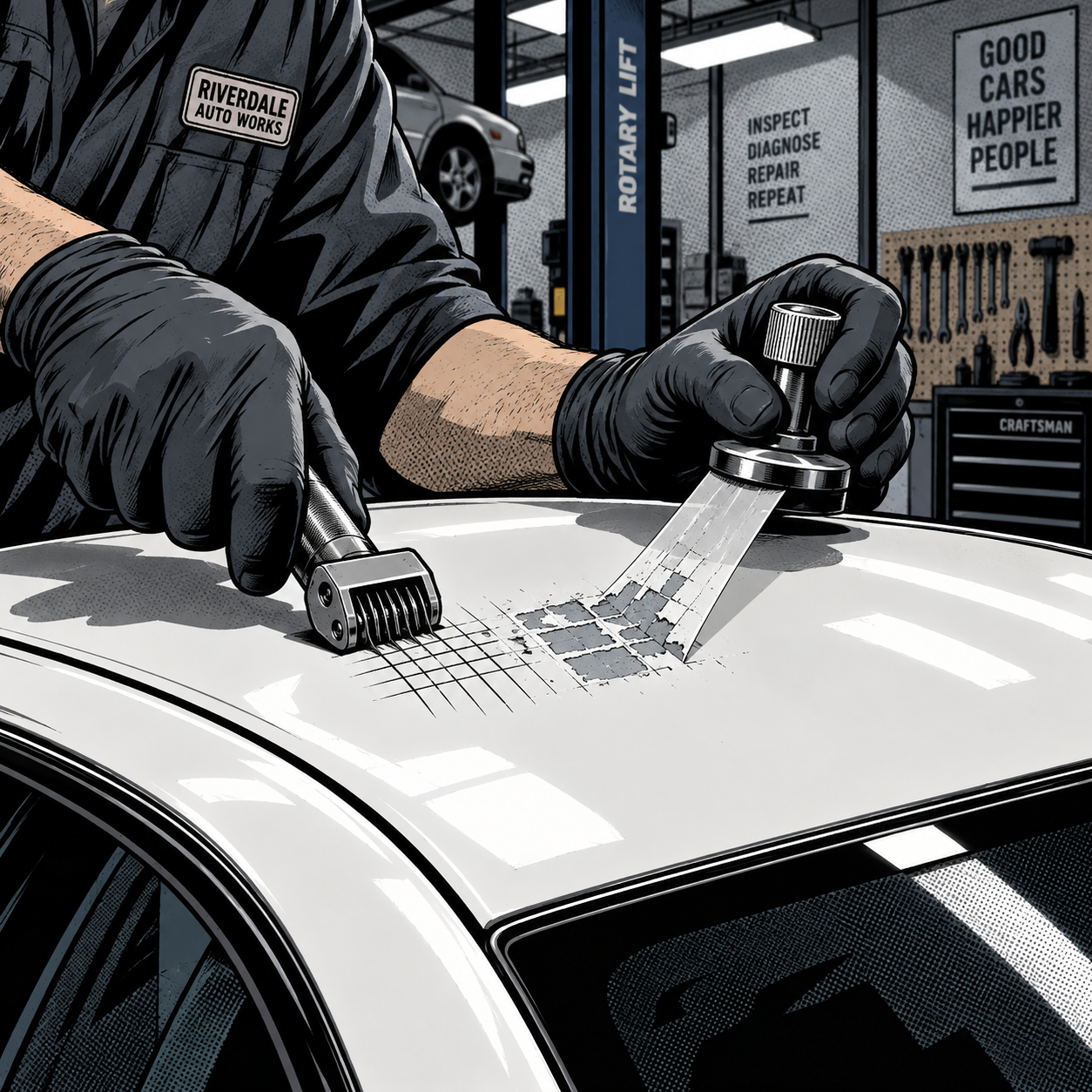
Before quoting anything, confirm what you’re actually looking at. Properly bonded OEM paint is extremely difficult to remove with ordinary tape — body shops test adhesion by scoring the paint in a cross-hatch pattern and applying aggressive, high-tack tape, then checking how much lifts. If a customer’s paint came off from ordinary masking tape, a car wash, or light contact, that paint had already lost adhesion; the removal method is just what exposed it.
Steps to confirm delamination on the vehicle in front of you:
- Inspect the exposed layer at the edge of the peeling area. If you see a gray or off-white sealer/e-coat layer rather than bare metal or bare plastic, that’s consistent with primer-to-basecoat or e-coat-to-primer separation, not surface damage.
- Check if the flaking is sheet-like and spreading from a point, rather than a localized chip with sharp, contained edges.
- Compare against known problem areas — roof, hood, and trunk lid (highest UV exposure) are the most common failure points.
- Look up the VIN against open TSBs or paint-related recalls for that make/model/year. Hyundai, Honda, Infiniti, and several Kia and Toyota models have had documented white-paint adhesion issues, and some automakers have issued extended “goodwill” paint warranties or TSBs addressing it.
- Photograph the failure pattern before any repair — insurers and manufacturers will want to see progression, not just the current state.
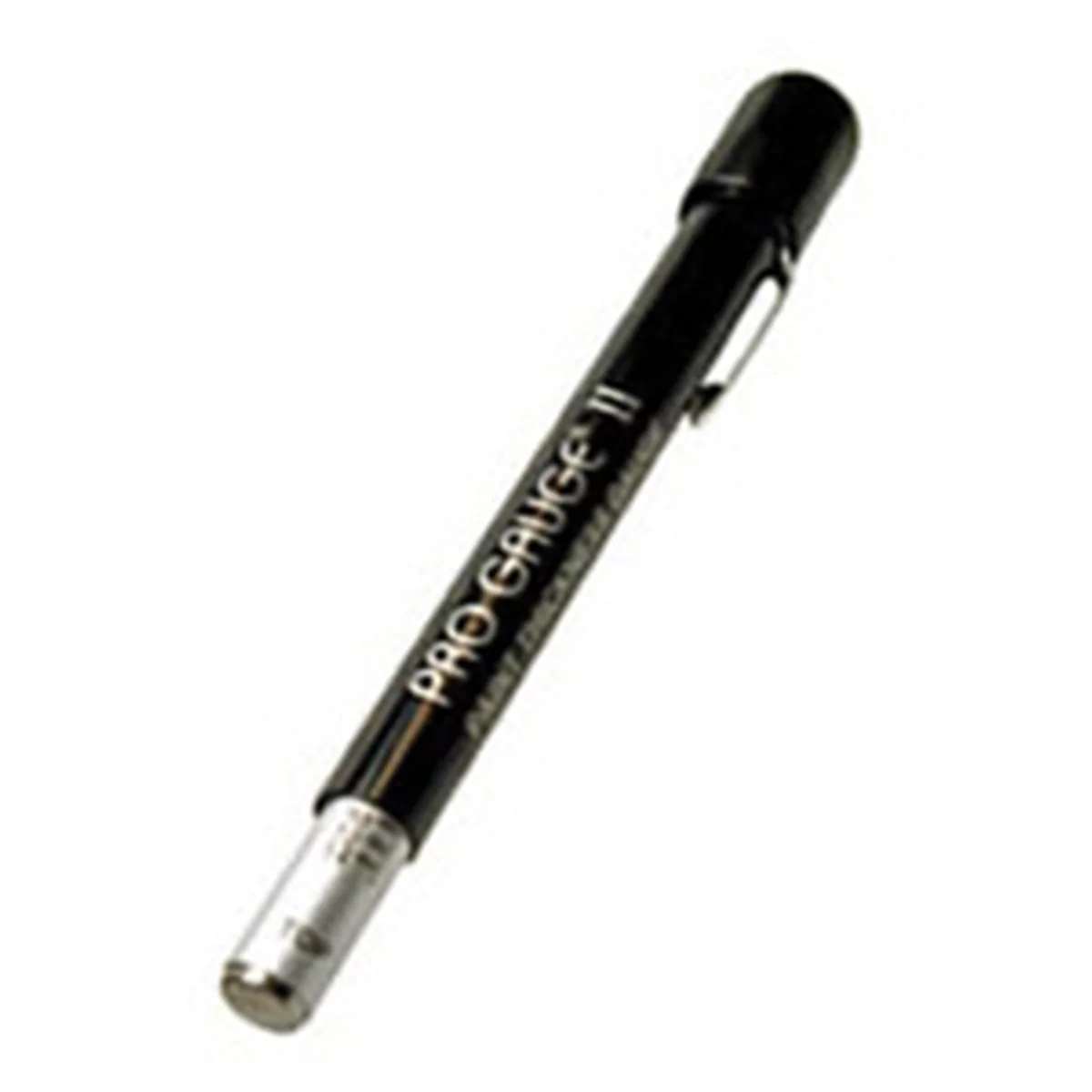
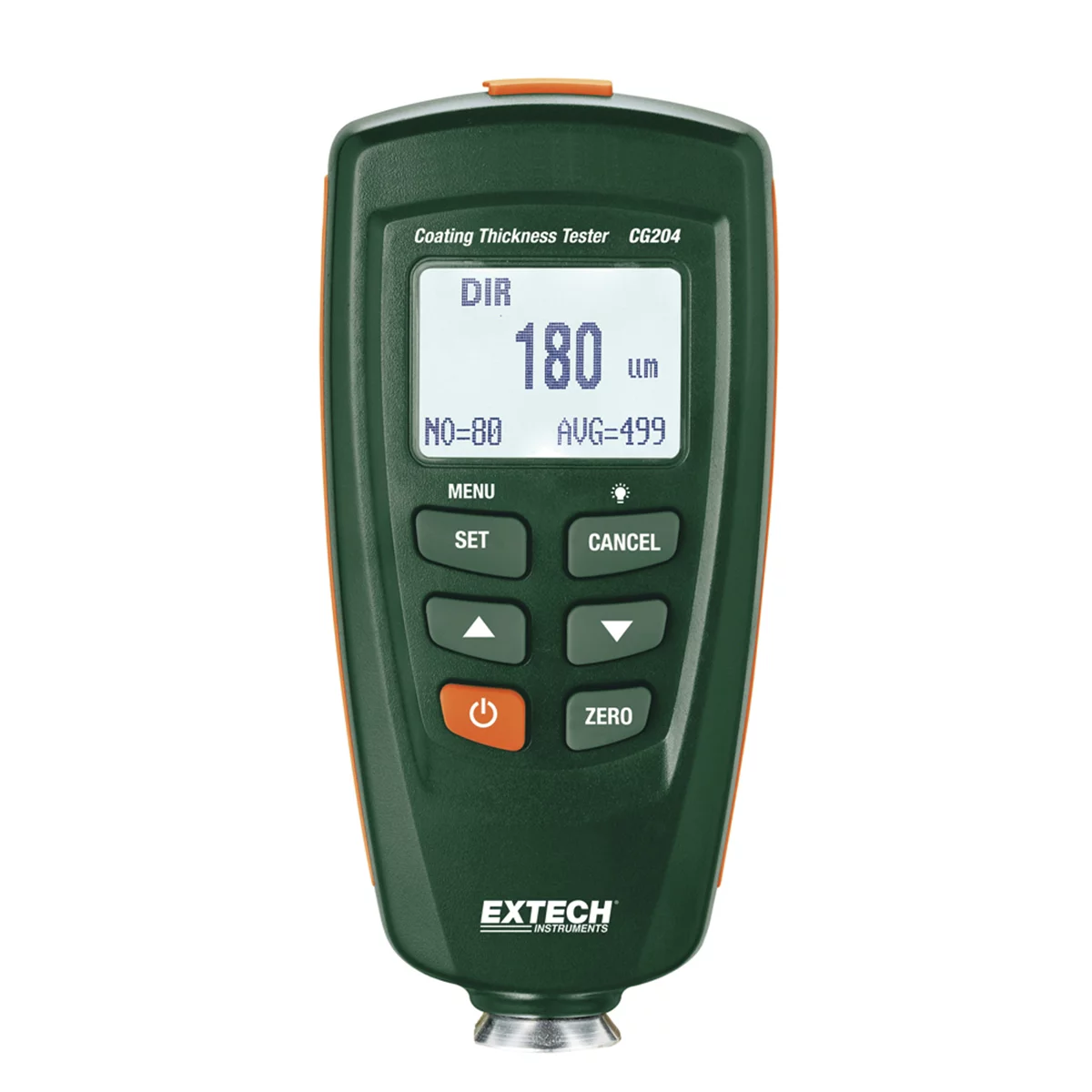
If you need to physically verify adhesion strength on a questionable panel, a cross-hatch cutter and a calibrated pull test give you objective, defensible data instead of a guess.
[[PRODUCT_SEARCH_1]]

Repair Options and What They Actually Cost
Once delamination is confirmed, there are three realistic repair tiers. Walk customers through all three — most don’t know a full respray isn’t the only option.
- Spot touch-up: For small, contained peeling, light sanding (around 240 grit) to remove loose material, a thorough degrease, and a color-matched touch-up paint can get a roof looking acceptable for well under $50 in materials. This won’t match factory gloss up close but is often invisible from normal viewing distance, especially on white.
- Panel respray: For a roof or hood with widespread but single-panel failure, a proper strip-back to sound substrate, correct primer, basecoat, and clear coat gives a durable, factory-adjacent finish. This is a job for a body shop with a spray booth — DIY panel resprays on horizontal surfaces are hard to blend invisibly.
- Full respray: If delamination is spreading across multiple panels (common once one area fails, since the same batch of paint was likely applied the same way across the car), a full respray is the only way to stop recurring flaking elsewhere down the line.
Whichever tier you recommend, confirm the surface is fully sound before painting. Painting over an area adjacent to active delamination just moves the problem a few inches and shortens the life of the new paint.
Documenting a Manufacturer or Insurance Claim
Because this is frequently a manufacturing defect rather than wear-and-tear, it’s worth pointing customers toward a claim before they pay out of pocket:
- Dealer/manufacturer first: Have the customer get a service writeup from a franchised dealer referencing the paint failure. Some manufacturers have extended paint warranties specifically for this issue (Honda and Hyundai have both had extended coverage for white paint delamination on certain models) — a dealer can check for an active TSB or goodwill program tied to the VIN.
- Insurance comprehensive claim: If a dealer won’t help and the vehicle is out of any extended coverage, a comprehensive claim is an option, though expect the insurer to treat it as wear-related unless there’s documentation of a sudden, specific triggering event.
- Third-party liability claims (e.g., glass installers, detailers): If the peeling appeared after a windshield replacement, detail, or wrap removal, don’t assume the vendor caused it — but don’t rule it out either until you’ve confirmed the paint was sound beforehand. If there’s no prior documentation of paint condition, it’s difficult for either side to prove causation. This is exactly why the adhesion check above matters: it gives you (and the customer) objective grounds instead of a dispute based on timing alone.
In practice, a vendor like a glass shop applying standard automotive masking tape is very unlikely to be liable — that tape is not aggressive enough to remove properly bonded paint, and shops can point to this as a defense.
Preventing Recurrence After Repair
Once a panel is repaired, UV exposure is still the root cause, so protecting the new paint matters more than on a car with no history of this issue.
- Apply a UV-resistant sealant or ceramic coating to the repaired panel and ideally the whole car — it won’t stop photocatalytic breakdown inside the paint itself, but it reduces surface UV load and slows the clock.
- Wax or seal at least twice a year, more on vehicles that live outdoors full-time.
- Park under cover when possible; roofs and hoods take the brunt of cumulative UV dose.
- Avoid aggressive clay bars or compounding on panels with any known adhesion history — mechanical stress can accelerate existing delamination.
[[PRODUCT_SEARCH_2]]
Quick Diagnostic Checklist
- Identify paint system: single-stage, base/clear, or tri-coat pearl
- Inspect exposed layer at peel edges for gray/off-white sealer or e-coat
- Confirm sheet-like spreading pattern vs. localized chip or scratch
- Run a cross-hatch adhesion test on adjacent “good” paint if condition is disputed
- Check VIN against open TSBs or extended paint warranty programs
- Photograph and document before any repair work begins
- Quote spot, panel, and full-respray options separately
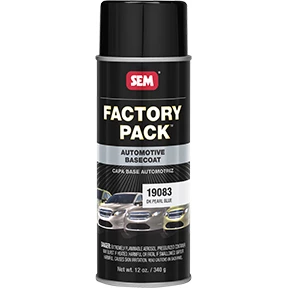
Factory Pack Automotive Basecoat FORD DX Dk Blue Pearl 16 Oz Aer
Mfg: Sem Products
Part #: 19083
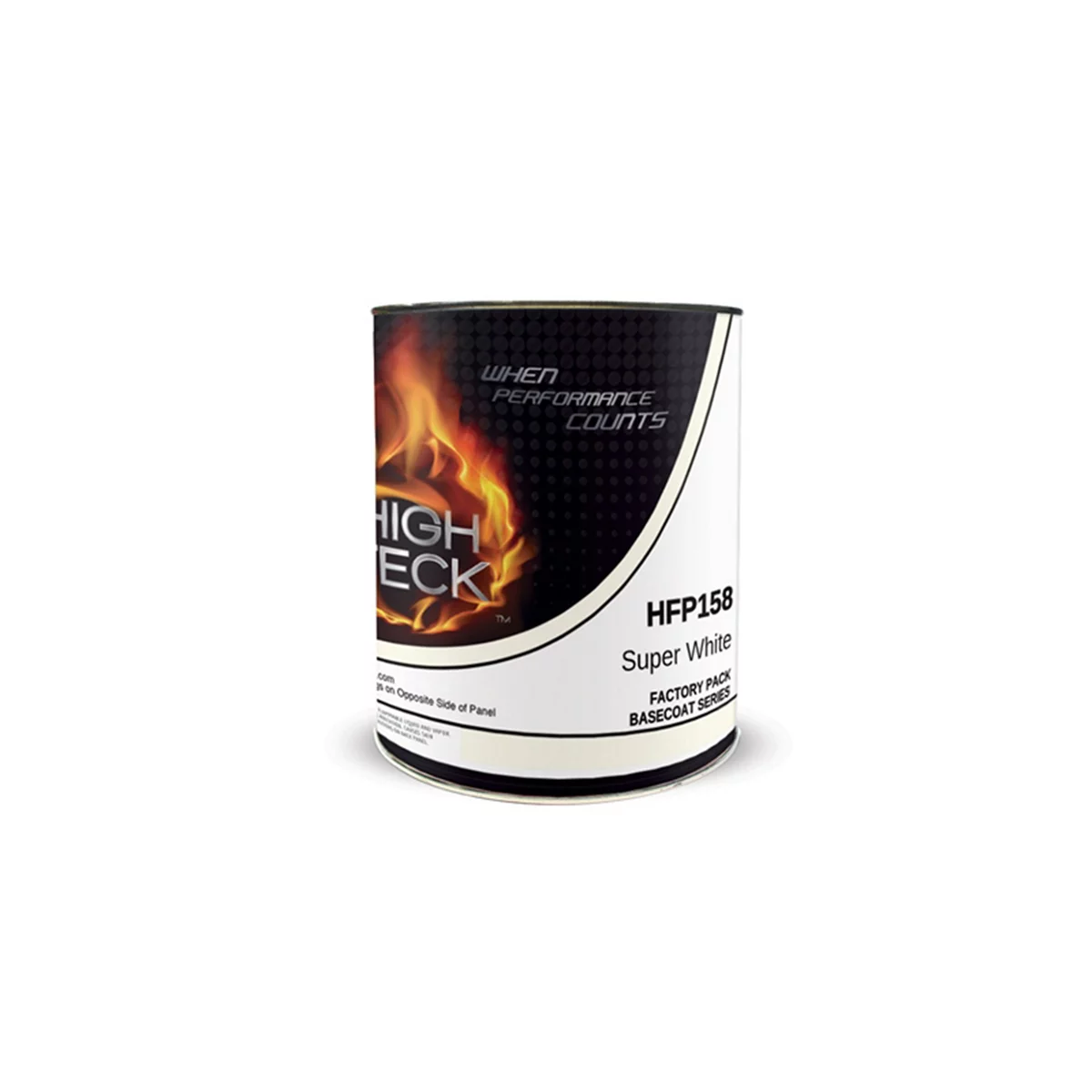
HFP158-1 Series HFP National Rule Urethane Basecoat, 1 gal,
Mfg: High Teck Products
Part #: HFP158-1
Frequently Asked Questions
Can masking tape really cause paint to peel like this?
Properly bonded OEM clear coat and basecoat will not lift from standard automotive masking tape. If tape removal pulled paint off in sheets, the paint had already lost adhesion to the layer below — the tape just revealed it.
How do I know if my car has single-stage or base/clear paint?
Single-stage paint has color and gloss combined in one layer with no separate clear coat on top. A body shop or paint supplier can confirm this from the VIN’s paint code, or you can check by looking for a visible clear layer in a chip or scratch cross-section.
Is white paint delamination covered under warranty?
Sometimes. Several manufacturers have issued technical service bulletins or extended goodwill paint warranties for specific model years with known white-paint adhesion problems. Check with a franchised dealer and reference the VIN — coverage varies widely by manufacturer and model year.
Can I just touch up the peeling area myself?
For small areas, yes — light sanding, a thorough degrease, and a color-matched touch-up paint will make it far less noticeable, especially on white. It won’t perfectly match factory gloss up close, but it’s a reasonable low-cost option while you pursue warranty or insurance options.
Will a ceramic coating stop delamination from happening again?
Not entirely. Ceramic coatings reduce surface UV exposure and can slow the rate of future breakdown, but they don’t change the underlying chemistry of titanium dioxide reacting with UV through the paint film. Think of it as mitigation, not a cure.
Why does this seem to happen mostly to white and pearl white cars?
The titanium dioxide pigment used to make paint white is UV-reactive and can degrade the primer or e-coat beneath it over time. Other factors — single-stage formulations, thinner film builds, and water-based paint systems — compound the effect on certain makes and model years.
Shop Paint & Body Supplies
Repairing and protecting white paint from future delamination requires proper materials and diagnostic tools. Find what you need in our Paint & Body selection.
- Color-matched touch-up paints, primers, and basecoats for all repair tiers
- Surface preparation supplies and diagnostic tools for adhesion assessment
- UV-protective sealants and ceramic coatings for prevention

The Toolsource Technical Team blends decades of real-world automotive service experience with up-to-date technical research. Our writers collaborate with professional mechanics, shop owners, and diagnostic specialists to deliver practical, workshop-ready guidance you can trust.


Follow us on social media