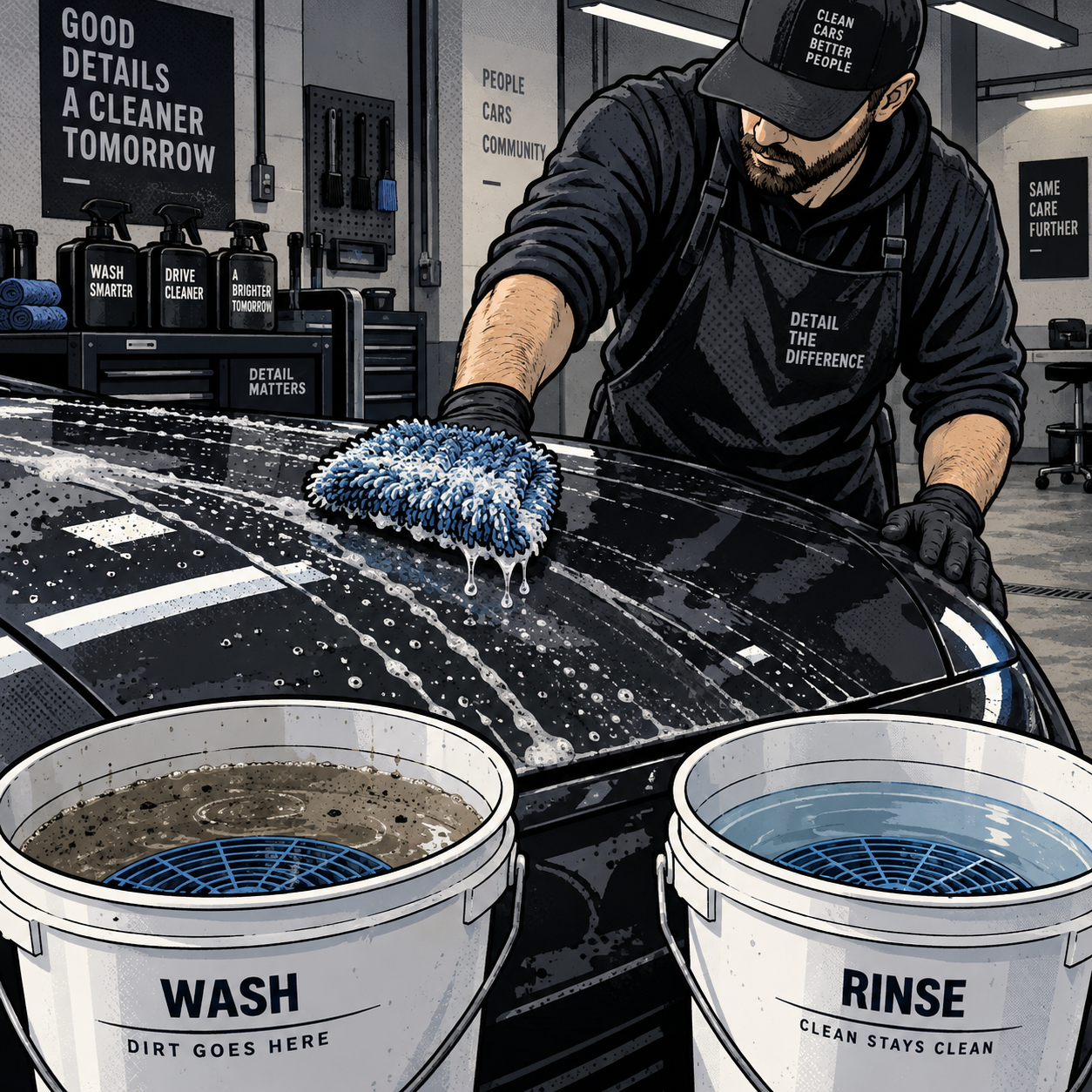
Rinseless wash concentrates — Optimum No Rinse (ONR) being the category-defining product — let a technician wash a vehicle using two five-gallon buckets and a few gallons of water instead of a hose, pressure washer, and a driveway full of runoff. They work by suspending dirt in a lubricating, surfactant-rich solution so it can be safely wiped away rather than rinsed off. Done correctly, the technique is fast, water-conscious, and gentle on coatings and film. Done sloppily — wrong dilution, dirty mitts, no lubrication check — it’s one of the easier ways to put fine swirls into a dark paint job. This guide walks through the setup, dilution math, wash sequence, and the mistakes that cause most of the complaints you’ll see online.
What Rinseless Wash Is Actually Doing
A rinseless wash concentrate is a blend of surfactants and polymers designed to encapsulate dirt particles so they lift off the paint and suspend in the wash solution instead of grinding against the clear coat as you wipe. The “encapsulation” marketing term gets joked about a lot, but the mechanism is real: a properly diluted solution reduces friction between the mitt, the dirt, and the paint far more than plain water ever could. That’s why the product works without a rinse step — the lubricating film does the job water and a pressure rinse normally handle.
Rinseless wash is best suited for:
- Shops or mobile detailers in water-restricted areas or HOAs that prohibit runoff
- Maintenance washes on vehicles that are already in decent condition
- Indoor or shaded bay washing where a hose isn’t practical
- Quick touch-up washes between full details
It is not a replacement for a full decon wash on a heavily soiled vehicle, and it is not meant to be sprayed on at full strength as a wipe-down product for daily driving grime — that’s a separate “quick detailer” dilution, not the wash dilution.
Getting the Dilution Ratio Right
This is where most bad outcomes start. Manufacturer-listed ratios are a starting point, not gospel — adjust based on how dirty the vehicle is:
- Standard wash dilution: roughly 1 oz of concentrate per 2 gallons of water for a lightly to moderately dirty vehicle.
- Heavily soiled vehicle: double the concentrate (roughly 2 oz per 2 gallons) to increase lubricity and encapsulation capacity.
- Waterless/spray wipe-down dilution: a much stronger mix, closer to 1 oz per 16-32 oz of water, used only for very lightly dusted panels wiped with a dedicated spray bottle — not the bucket wash.
Measure with an actual ounce pump or marked container rather than eyeballing it. Under-diluting on the strong side for a full wash wastes product and leaves residue; over-diluting removes the lubricating cushion that keeps the mitt from dragging grit across the clear coat. If you’re unsure which concentration a product on your shelf calls for, check the label dilution chart before mixing — formulas vary enough between brands that “eyeballing it like last time” isn’t reliable.
{{PRODUCT_SEARCH_1}}
The Two-Bucket Rinseless Method
Rinseless washing still uses the two-bucket principle, just without a hose refilling either bucket:
- Bucket 1 (wash): mixed rinseless solution at the appropriate dilution with a grit guard in the bottom.
- Bucket 2 (rinse/dump): plain water, also with a grit guard, used to rinse the mitt between panels.
- Work top-down, one panel at a time. Dip the mitt in the wash bucket, wash a single panel with light pressure and straight-line motion (not circular scrubbing), then swirl the mitt against the grit guard in the rinse bucket before redipping in the wash bucket.
- Wipe the panel dry immediately with a clean, plush microfiber towel using the same straight-line technique — don’t let the solution air-dry on the paint, since it will leave spotting.
- Swap to a fresh microfiber towel and a clean section of mitt (or flip/rotate the mitt) once it starts feeling gritty. A mitt loaded with grit is the single biggest cause of marring in this method.
- Replace both buckets of solution when the wash bucket looks visibly dirty — stretching one batch across a filthy vehicle is a common shortcut that causes swirls.
For wheels, door jambs, and lower rocker panels — the dirtiest zones — use a separate mitt or designated wash section and wash those last, never first, to avoid cross-contaminating the solution used on hoods and doors.
Full Decon Wash: When Rinseless Isn’t Enough On Its Own
A “full decon wash” — referenced loosely in detailing circles as the real multi-step process — is the correct move when a vehicle has bonded contamination: iron particles, tar, tree sap, or heavy industrial fallout that a surface wash won’t lift. The sequence:
- Pre-soak/snow foam or rinseless pre-wash pass to loosen loose dirt before any mitt contact.
- Iron remover applied to wheels and lower panels, left to dwell and react (you’ll see the purple “bleeding” reaction on contaminated areas), then agitated and removed.
- Rinseless or traditional wash to remove the remaining surface dirt and chemical residue.
- Clay bar or clay mitt pass with a clay lubricant to pull out bonded contaminants the chemicals didn’t touch — paint should feel glass-smooth afterward, not gritty.
- Final wipe-down with a rinseless solution or isopropyl alcohol mix if you’re prepping for coating, wax, or sealant application.
Skipping straight to a rinseless wash on a vehicle that actually needs decon work is how people end up with a “clean” car that’s still covered in bonded rail dust and iron particles under the clear coat — it’ll look fine until you run a hand over the paint and feel the texture.
Common Mistakes and Troubleshooting
- Streaking or hazing after drying: usually under-diluted solution or letting the panel air-dry instead of immediately wiping it down.
- Swirls appearing after repeated rinseless washes: dirty mitts, skipped rinse-bucket step, or reusing the same wash section on a heavily soiled car for too many panels.
- Solution smells off or looks murky fast: you’re overloading one batch of solution across too large or too dirty a vehicle — mix fresh buckets per wash, not per week.
- Spotting on dark paint in direct sun: rinseless wash should be done in the shade or indoors, same as a traditional wash — solution flash-drying in sun leaves mineral spotting regardless of dilution.
- Product used as an all-purpose spray: rinseless concentrate at wash-strength dilution is not an interior cleaner, tire dressing, or glass cleaner — stick to the labeled quick-detailer dilution for anything other than the paint wash itself.
Quick Reference Checklist
- Mix fresh solution at the correct dilution for soil level (light vs. heavy)
- Set up two buckets with grit guards — wash and rinse
- Wash top-down, one panel at a time, straight-line motion
- Rinse mitt in bucket two between every panel
- Dry each panel immediately with a clean microfiber towel
- Wash wheels/rockers last with a dedicated mitt
- Run a decon pass (iron remover + clay) before coating or sealant work
{{PRODUCT_SEARCH_2}}



FAQs
Is rinseless wash safe for ceramic coatings and PPF?
Yes, when diluted and applied correctly. The lubricating film is gentle enough for coated and film-protected surfaces, but you still need clean mitts and towels — coatings reduce friction, they don’t eliminate the risk of marring from gritty tools.
Can I use rinseless wash on a daily driver that’s really dirty?
You can, but increase the concentrate ratio for heavy soiling and expect to change your wash bucket more than once. If the vehicle hasn’t been washed in months or has heavy road grime, a traditional hose rinse or pre-rinse pass first will reduce the load on the mitt.
How is this different from a waterless wash spray?
Waterless wash is a stronger, ready-to-use dilution meant for wiping dust off an already-clean, lightly soiled vehicle directly from a spray bottle — no bucket, no water. Rinseless wash is a weaker, bucket-diluted solution meant to replace a full hose-and-rinse wash on a dirtier vehicle.
Do I need a pressure washer at all if I switch to rinseless?
Not for routine washing, but a pressure washer or hose rinse is still useful for the initial pre-rinse on heavily soiled vehicles and for rinsing wheels, which load up with brake dust and grit faster than paint does.
How often should I replace my wash mitt when using rinseless products?
Rinse and inspect it after every wash, and retire it once the fibers feel matted or you can’t rinse the grit out in the second bucket — typically every few months with regular use, sooner if used on consistently dirty vehicles.
Can rinseless wash concentrate double as a clay lubricant?
Yes — many techs dilute it to a slightly stronger ratio and use it as a clay bar lubricant since it provides the same slip and encapsulation properties needed for safe claying.
Recommended Tools
Rinseless wash performance depends on clean mitts, fresh solution, and quality towels. Find what you need in our Paint & Body selection.
- Rinseless wash concentrates and pre-wash solutions
- Wash mitts, grit guards, buckets, and microfiber towels
- Iron removers, clay bars, and decontamination products

The Toolsource Technical Team blends decades of real-world automotive service experience with up-to-date technical research. Our writers collaborate with professional mechanics, shop owners, and diagnostic specialists to deliver practical, workshop-ready guidance you can trust.


Follow us on social media