If a modern repair shop quoted you a blank stare — or a polite “we don’t do that here” — after you rolled in with a carbureted classic, you’re not imagining a problem with the industry. It’s real, it’s widespread, and it has nothing to do with the car being “too hard” to fix. It has everything to do with how the trade trains technicians, how shops bill labor, and how much risk a modified, undocumented engine carries for whoever touches it last. Understanding why will save you time, money, and frustration — and point you toward the people who can actually help.
The Skills Gap Is Real, Not an Excuse
Fuel injection and onboard diagnostics took over new car production by the early-to-mid 1990s, and most dealership and chain-shop technicians working today were trained entirely in that world. They learn to read codes, follow flowcharts, and swap sensors based on scan tool data. Points, condensers, dwell angles, vacuum advance curves, and jetting a carburetor simply aren’t part of that curriculum anymore, and most techs have never had a reason to learn them on the job.
That’s a genuine, two-track skill set — diagnosing a modern CAN-bus vehicle and diagnosing an analog, mechanically-timed engine draw on almost none of the same muscle memory. A tech with twenty years of dealership experience can be excellent at their job and still have zero hands-on time with a distributor. This isn’t a knock on either skill set; it’s just a reflection of what the job has required for the last three decades.
Why Shops Say No Even When a Tech Knows How
Plenty of individual technicians privately own and wrench on classics themselves. The business reason shops still decline the work comes down to billing and liability, not ability. Modern shop workflows are built around predictable diagnostic time: plug in a scanner, get a code, follow the procedure, quote the job, order the part same-day. A carbureted car with fifty years of backyard repairs, no accurate wiring diagram, and an unknown parts history breaks every part of that model. Diagnostic time balloons, parts sourcing turns into a research project, and there’s no guarantee the estimate holds.
Modification makes it worse. Once an engine has been built or altered, nobody at the shop can say what spec it was supposed to meet. If something breaks after a shop touches it — even something unrelated — the shop is often blamed, fairly or not. Most shops that have been burned by this once simply adopt a blanket policy: stock classics, maybe; modified classics, no. It’s a liability decision, not a skill decision.


Diagnose the Basics Yourself Before You Call Anyone
Carbureted engines run on three systems: fuel, air, and spark. Before paying anyone’s diagnostic rate, work through those three in order — it’s the same sequence an experienced classic-car tech would use, and it resolves a large share of no-start, rough-idle, and stalling complaints without a shop visit at all.
- Spark: Pull a plug wire, check for a strong blue spark at idle and under cranking. Check point gap/dwell if the distributor is a points-type, or verify condition on an electronic ignition conversion.
- Fuel: Confirm the fuel pump is delivering adequate volume and pressure at the carb inlet, check the filter, and look for a flooded or starved bowl.
- Air: Check for vacuum leaks at the base gasket, manifold, and vacuum-operated accessories; confirm the choke is opening and closing correctly.
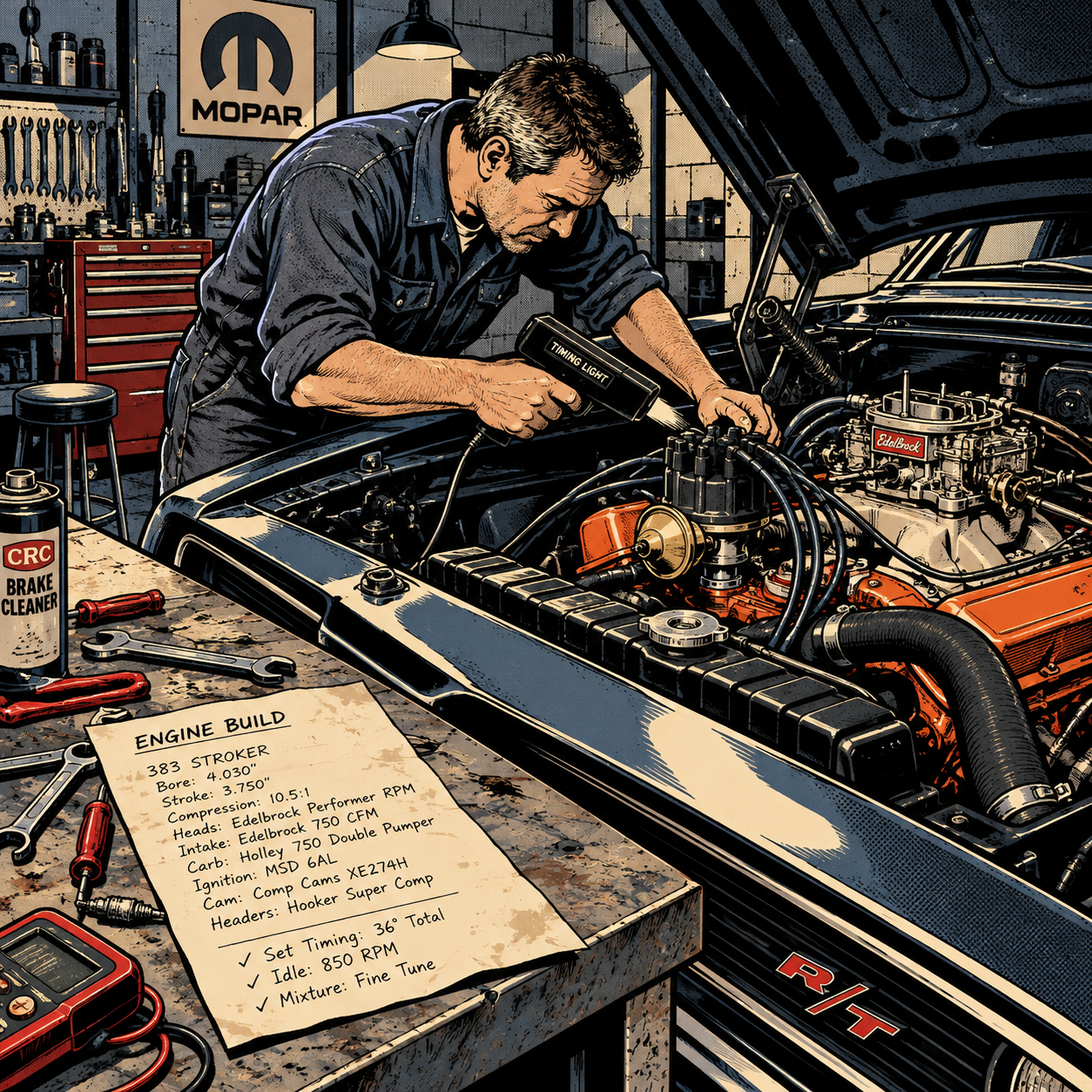
- Timing: Verify initial and total timing with a timing light against factory (or your builder’s) spec, and confirm vacuum advance is functioning if equipped.
Most of this requires a timing light, a vacuum gauge, basic hand tools, and a factory service manual or the military’s widely available TM 9-8000 general engine reference. None of it requires a scan tool, because there’s no computer to talk to.
Build a Paper Trail for Any Modifications
If the engine has been modified at all — different carb, different cam, different ignition, converted to run on a different fuel — a shop’s first question will be “what exactly was done, and by whom?” Vague answers like “it’s been built up” tell a technician nothing and immediately raise the price, because now they’re paying themselves to reverse-engineer your car before they can even start diagnosing it.
Put together a build sheet: carburetor model and jetting, ignition type and curve, cam specs, compression ratio, fuel type, and the name of whoever did the work. If you bought the car already modified, track down whatever history is available — registration records, prior owner contacts, parts receipts, forum posts about the build. A documented car gets faster, cheaper service than an undocumented one, every time, because the diagnostic guesswork disappears.
Finding a Shop That Will Actually Take the Job
You’re not looking for “a mechanic.” You’re looking for a classics/muscle car specialty shop, a speed shop that builds carbureted engines, or an independent tech who personally owns and maintains vehicles from the same era. These shops price differently because the job is different — expect hourly rates well above standard retail labor, often with a multi-hour diagnostic minimum before any repair work starts. That’s not price gouging; it’s the real cost of research time, specialty parts sourcing, and the risk of inheriting someone else’s unknown repairs.
Good places to find these shops: local car clubs for your specific make or model (Impala, Mustang, Panther platform, etc.), regional cruise-in and car show contacts, swap meets, and classic-car-focused forums. Owners of the same model often already know who in the area is reliable, and a referral from another owner carries more weight than a cold search. Be prepared to drive or tow — specialty shops frequently pull in cars from well outside their immediate area because there simply aren’t many of them.
Checklist: Before You Call a Shop
- Confirm spark, fuel delivery, and vacuum integrity yourself first
- Verify ignition timing against spec with a timing light
- Write up a build sheet covering every known modification
- Gather any prior repair receipts or build history
- Search local car clubs/forums for a specialist referral before calling a general shop
- Ask upfront about the diagnostic-time minimum and hourly rate


Cal-Van Ignition Point Files 693 - Precision Engine Tool
Mfg: Cal-van Tools
Part #: 693
Frequently Asked Questions
Why won’t my local dealership or chain shop even look at a carbureted car?
Their technicians are trained and equipped for computer-diagnosed vehicles, their shop software and billing are built around scan-tool workflows, and a pre-OBD or modified engine doesn’t fit either. It’s a business and training mismatch, not a reflection on your car.
Is it true that modified classics are harder to get serviced than stock ones?
Yes. A stock carbureted engine at least has a known factory spec a technician can diagnose against. A modified one has no baseline — the shop has no way to know what “correct” looks like until they research the specific build, which adds billable time before any actual repair begins.
What should I expect to pay for diagnostic time on a classic?
Specialty shops commonly charge noticeably more per hour than standard retail rates and quote a multi-hour minimum for electrical or driveability diagnosis, especially with little documentation. That reflects research and parts-sourcing time, not just wrench time.
Can I learn to maintain a carbureted engine myself without prior experience?
Yes — these engines are mechanically simpler than modern ones in terms of the number of subsystems, and good video and written references exist for points, timing, and carb adjustment. A factory service manual, a basic tool set, a timing light, and patience cover most routine maintenance.
How do I find a shop that specializes in classic or modified cars?
Start with make/model-specific car clubs, local car shows, and classic-car forums. Owners of the same vehicle usually already know who’s reliable in the area, and referrals are far more reliable than a general search.
Does owning a classic car mean I have to do my own wrenching?
Not necessarily, but you should expect to either learn basic diagnostics yourself or budget for specialty-shop rates. Few general shops will take on the liability and time cost, so plan ownership around one of those two paths from the start.
Diagnostic Tools for Classic Carburetors
The diagnostic approach in this article requires only a few essential tools and a systematic process. Check out our Automotive Diagnostic Tools selection to find what you need for spark, fuel, and timing checks.
- Timing lights for verifying ignition timing against factory specifications
- Vacuum gauges and testers for diagnosing manifold and accessory vacuum leaks
- Fuel pressure gauges to measure delivery at the carburetor inlet

The Toolsource Technical Team blends decades of real-world automotive service experience with up-to-date technical research. Our writers collaborate with professional mechanics, shop owners, and diagnostic specialists to deliver practical, workshop-ready guidance you can trust.


Follow us on social media