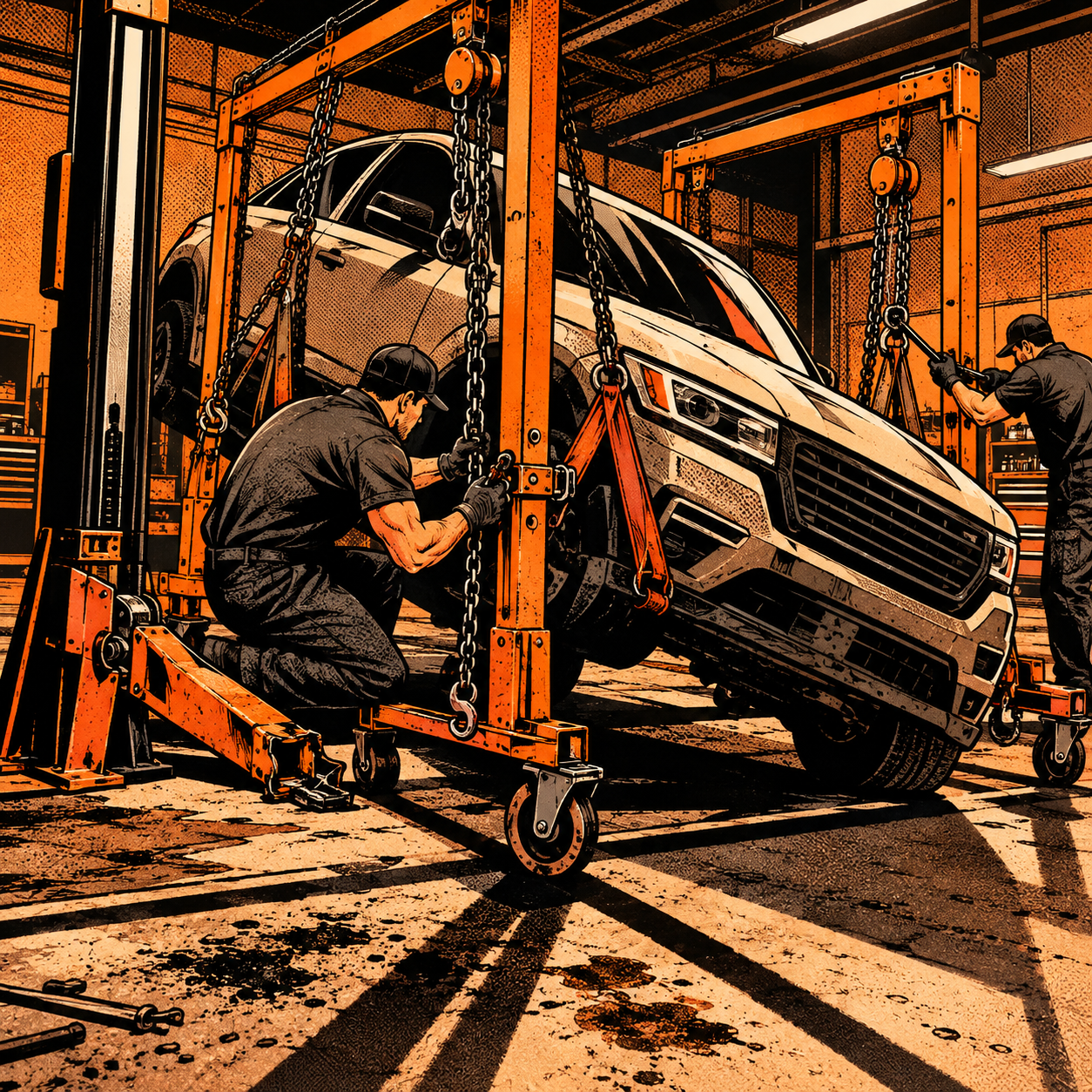
A two-post lift that fails mid-lift turns a routine job into one of the more dangerous situations a shop can face: a multi-thousand-pound vehicle balanced unevenly, partially supported, with no safe way to simply “finish lowering it” without risking a shift, a fall, or a rollover. These failures are rare enough that most technicians have never dealt with one, which is exactly why a calm, sequenced response matters more than speed. This guide lays out how to assess the scene, which recovery methods are actually safe, and how to avoid turning a fixable equipment problem into a totaled vehicle.
Recognize What Kind of Failure You’re Dealing With
Not all lift failures are the same, and the right response depends on exactly how the vehicle is currently supported. Before anyone touches a tool, walk around the vehicle and lift and answer three questions:
- Is the vehicle resting on anything other than the lift arms (a wheel on the ground, a block of wood, a curb)? Partial ground contact changes the physics of the problem entirely.
- Did one side of the lift drop, tilt, or buckle, or did an arm or pad simply slip out from under the vehicle?
- Are the lift’s mechanical safety locks still engaged on any post, and is the hydraulic system still holding pressure on the side that hasn’t failed?
Take photos from multiple angles immediately, both for your own reference as you plan a recovery and in case this becomes an insurance or warranty claim against the lift manufacturer. Clear the area of bystanders and anything that isn’t directly needed for the recovery — a shifting vehicle in a confined bay is not a spectator event.
Stop, Don’t Improvise, and Call for Help First
The single most common mistake in these situations is trying a quick fix alone — jacking one corner, pulling a strap, or attempting to rock the vehicle back into position. A vehicle that’s partially supported on a damaged lift can shift suddenly and without warning, and once it starts moving there is often no way to stop it. Before you do anything else:
- Call a rigging company or heavy-recovery specialist. This is a load-bearing, multi-point problem, which is exactly what riggers and vehicle-extraction crews deal with routinely. They can evaluate whether portable gantry cranes with chain falls are needed on all four corners before anything else is attempted.
- Call an experienced flatbed tow operator as a backup plan. A skilled operator can sometimes winch the low end onto the bed and let the rest of the vehicle come off the lift under control, but this only works cleanly if the vehicle is relatively stable and the operator has handled odd extractions before. Ask directly about their experience with vehicles on lifts, not just wrecks.
- Consider your local fire department’s non-emergency line. Vehicle cribbing, stabilization, and extrication are standard training skills for many departments, and a precariously suspended vehicle is a legitimate safety concern they may be willing to respond to, especially if it doubles as a training exercise for their crew.
Get more than one opinion before committing to a method. The gap between “this goes fine” and “this gets much worse” is almost entirely a function of who shows up and whether they take the time to support all four corners before anything is moved.
Product search: query=”portable gantry crane chain hoist”, context=”mid-article”


Steel Lifting Chain for Floor Crane - 1/4 Inch
Mfg: OTC Tools and Equipment
Part #: 31609
Stabilize Before You Lift: Why All Four Corners Matter
The core engineering problem with a partially failed lift is that the vehicle is often supported at only two or three points instead of four, which means its center of gravity is doing a balancing act. Any recovery plan needs to replace that missing support before weight is transferred anywhere else. In practice this means:
- Using portable rolling gantries or engine hoists positioned at each corner, with straps or chain falls attached to solid structural points — subframe, hub, or designated lift points, never suspension components not rated for it.
- Lightly tensioning all four points first, then raising the low corner slowly while helpers keep tension even on the other three. The goal is to bring the vehicle level before anything else happens, not to lift it high.
- Pre-positioning blocks or cribbing where the frame will eventually rest, so if something has to come down in a controlled way, it lands on something other than bare metal or concrete.
Avoid removing wheels as part of a stabilization plan unless you have no other option — pulling a wheel means a person has to work directly under or beside an unstable load, which is one of the higher-risk tasks in this entire process.
Using the Lift’s Pressure Relief Valve the Right Way
If the failure is isolated to one side of a two-post lift and the hydraulic system on that side is still intact, the lift’s built-in pressure relief valve can sometimes offer a controlled way down — but only after the vehicle has been cross-supported by jacks, blocks, or a gantry. Before touching any valve or hydraulic line:
- Check the lift manufacturer’s manual for the correct manual-release or relief-valve procedure. Every lift brand handles this slightly differently.
- Confirm all mechanical safety locks are disengaged before attempting a controlled descent — a lift fighting its own lock can bind unpredictably.
- If there’s no accessible relief valve, hydraulic lines should only be loosened a drop at a time, never fully opened, and only by someone who can immediately re-tighten if the descent speeds up.
- Have a second person watching the opposite side at all times, ready to call a stop if anything shifts.
This approach works best as a secondary stabilization step alongside a forklift, gantry, or jack supporting the vehicle from below — not as a standalone fix on its own.
After the Vehicle Is Down: Inspect Before You Trust the Lift Again
Once the vehicle is safely off the lift, don’t assume the problem is isolated to the one component that visibly failed. Have the lift inspected by the manufacturer or a certified lift technician before it’s used again, and document everything — serial numbers, maintenance history, photos of the failure — in case this turns into a warranty or liability claim. Lift failures during a lift (rather than while parked at height) often point to a hydraulic, cable, or locking-mechanism issue that can recur if not fully diagnosed.
Quick Checklist for a Lift Failure Response
- Clear the area and photograph the scene from all angles before touching anything
- Identify exactly what is and isn’t supporting the vehicle right now
- Call a rigging company, experienced flatbed operator, or fire department — get a second opinion before acting
- Stabilize all four corners with gantries, hoists, or jacks before attempting to level or lower the vehicle
- Use the lift’s pressure relief valve only after cross-support is in place, and only per the manufacturer’s procedure
- Have the lift fully inspected before returning it to service
Product search: query=”shop lift safety equipment jack stands cribbing”, context=”end-article”


Frequently Asked Questions
Is it safe to try to lower a vehicle myself if only one side of the lift failed?
Only if the vehicle is already stable and supported at all contact points — otherwise, attempting a solo fix on an unevenly supported vehicle risks a sudden shift. Get a second set of hands and, ideally, a rigging or recovery professional involved first.
Will a regular tow truck work for this, or do I need something specialized?
A flatbed is strongly preferred over a hook-and-chain truck, and the operator’s experience matters as much as the equipment. Ask specifically whether they’ve handled vehicles stuck on lifts or in similarly precarious positions before they arrive.
Should I call my insurance company before or after the vehicle is recovered?
Contact them as early as possible, ideally before any recovery attempt, especially if you suspect equipment failure rather than operator error. Many insurers can dispatch a recovery vehicle equipped to handle non-standard extractions, and early documentation helps any later claim.
What’s the risk if I just let the lift down slowly without extra support?
If the vehicle is only resting on two or three stable points, “slowly” doesn’t prevent a sudden shift once the center of gravity crosses a tipping threshold. Cross-support at all four corners is what actually controls the descent, not the speed of the valve.
How can I tell if this was operator error or an equipment failure?
Check whether the mechanical safety locks were engaged, review the lift’s maintenance and inspection history, and look for signs of a snapped cable, cracked weld, or hydraulic leak. A manufacturer or certified lift inspector can usually pinpoint the cause, which matters for warranty and liability purposes.
What should shops do to prevent this from happening again?
Follow the manufacturer’s inspection schedule, never exceed rated load capacity, confirm arm pads and locking pins are correctly seated before every lift, and retire or service any lift showing early warning signs like uneven travel, unusual noise, or slow response on one side.
Recommended Lifting Equipment
Safe recovery from a lift failure depends on having the right equipment to support a vehicle at all four corners. Proper lifting equipment—gantries, hoists, jacks, and rigging hardware—gives you the stability and control needed for this critical work.
- Portable gantries and engine hoists for multi-point support
- Hydraulic jacks and jack stands for stabilization and cribbing
- Heavy-duty straps and chain falls for securing and tensioning loads

The Toolsource Technical Team blends decades of real-world automotive service experience with up-to-date technical research. Our writers collaborate with professional mechanics, shop owners, and diagnostic specialists to deliver practical, workshop-ready guidance you can trust.


Follow us on social media