Few service bay conversations happen more often than “there’s water dripping under my car and I’m worried something’s wrong.” In the overwhelming majority of cases, that puddle is simply air conditioning condensate doing exactly what it’s designed to do. But “probably normal” isn’t a diagnosis, and a tech who waves off every drip without a quick check will eventually miss the one that’s actually a coolant leak, a cracked evaporator housing, or a plugged drain backing up into the cabin. Here’s how to confirm condensate drainage in under a minute, know when to dig deeper, and clear a clogged drain tube the right way.
Why the A/C System Produces Water in the First Place
The evaporator core sits in the HVAC housing behind the dash, and its job is to get cold — cold enough that humidity in the cabin air condenses on its fins the same way a cold glass of iced tea sweats on a summer day. That water collects in the bottom of the evaporator housing and exits through a rubber or plastic drain tube that routes it to the underside of the vehicle, usually somewhere near the firewall, floor pan, or front passenger footwell area from below. On a humid day with the A/C cranked, it’s completely normal to see a steady drip or even a small puddle form under a parked car within a few minutes. The same thing happens when the defrost setting is used in winter — defrost runs the compressor and dehumidifies the windshield using the same evaporator, so the drip isn’t exclusive to “summer A/C weather.”
Confirming It’s Condensate and Not a Real Leak
A visual and tactile check takes seconds and should be standard before any diagnosis is written up:
- Color and clarity: Condensate is clear to slightly cloudy, like tap water. Coolant is usually green, orange, pink, or yellow and feels slightly slick. Engine oil is amber to black and leaves an oily sheen. Transmission fluid is typically red or brown.
- Smell: Condensate has no real odor beyond maybe a faint musty note from the evaporator housing. Coolant smells sweet. Gasoline and oil are self-evident.
- Location: Condensate drips are centered roughly under the firewall/dash area, not under the engine, transmission, or front of the radiator support.
- Touch test: Rub a drop between your fingers. Water evaporates clean and leaves no residue. Coolant and oil leave a film.
- Puddle size relative to run time: A/C condensate volume scales with humidity and runtime — it can be a few drops or, in very humid climates, a continuous trickle that forms a noticeable puddle over 30-60 minutes of idling. That alone isn’t abnormal, even though it surprises customers.
If all five checks point to water, you’re done — no further diagnosis needed. Document it on the repair order as “confirmed normal A/C condensate drainage” so the customer has a record and doesn’t come back worried about the same drip next month.


When the Drain Tube Is Clogged Instead of Just Draining
Condensate becomes a real complaint when it’s not making it outside the vehicle. A clogged or kinked drain tube forces water to back up in the evaporator housing until it overflows — often into the front passenger floorboard, under the carpet, or into the blower motor housing. Common causes:
- Debris, leaves, or dust packed into the drain tube opening underneath the vehicle
- A collapsed, pinched, or disconnected tube (common after aftermarket work near the firewall or after rodent damage)
- Algae or mildew buildup inside the tube restricting flow, especially on vehicles that sit often in humid climates
- A tube that was never reconnected after a previous evaporator or heater core job
Signs pointing to a clog rather than normal drainage: musty odor from the vents, damp or wet carpet on the passenger side with the engine off, water stains on the floor pan insulation, or a customer report of water “coming out of the dash” rather than from underneath the car.
Clearing a Clogged A/C Drain Tube
This is a straightforward job that avoids an evaporator-housing removal in most cases:
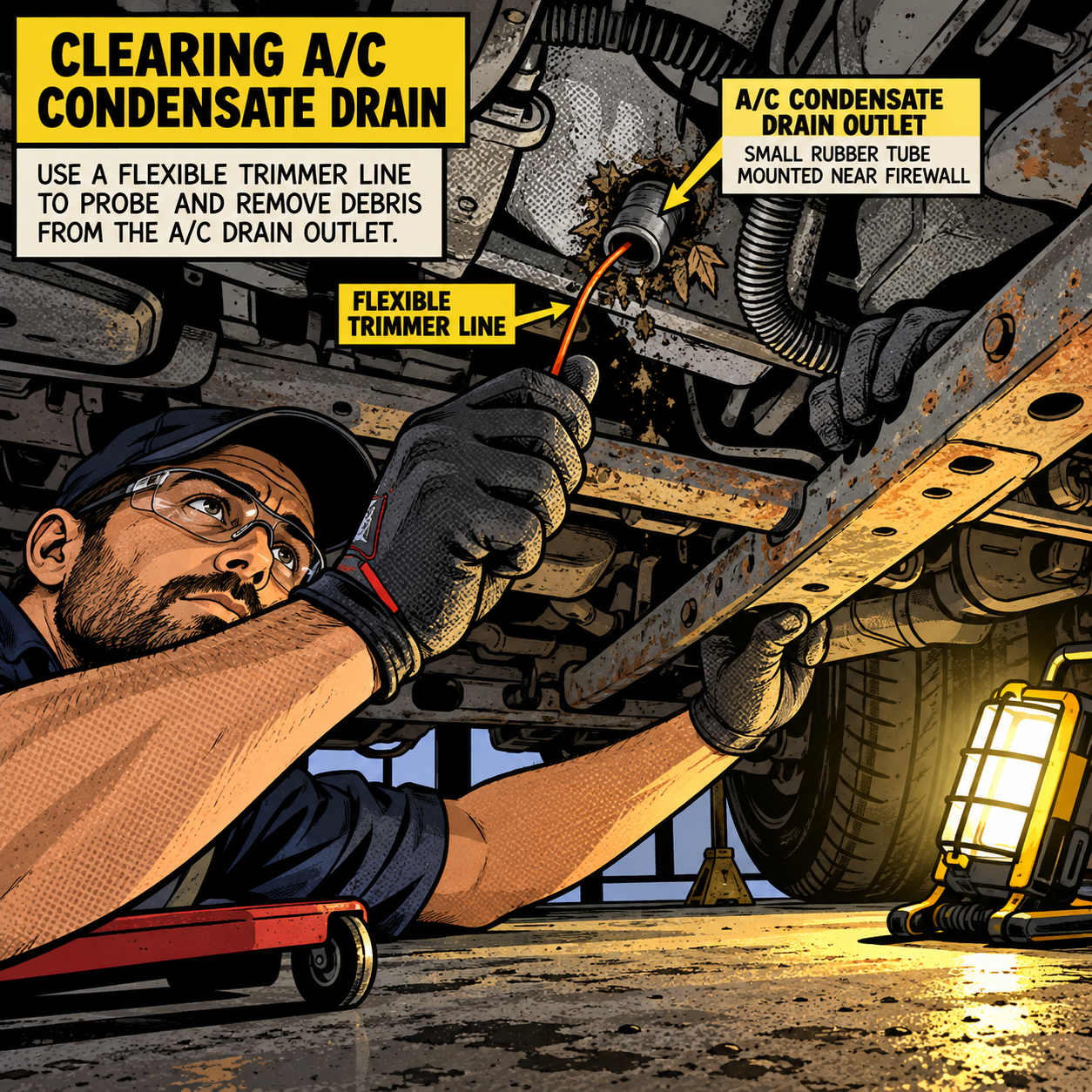
- Locate the drain outlet underneath the vehicle — typically a small tube or grommet near the firewall, passenger side. Consult the service manual if it’s hidden behind a splash shield.
- Inspect visually first. Clear any obvious debris, mud dauber nests, or leaves blocking the opening by hand.
- If the blockage is internal, use a length of trimmer line, a soft wire, or a shop vacuum on the drain opening to dislodge debris. Avoid rigid picks that can puncture the tube.
- For stubborn clogs, low-pressure compressed air blown into the tube from below (in short bursts) can push the obstruction out or clear it into the housing where it drains normally afterward.
- Run the A/C on max with the blower on high for 10-15 minutes and confirm steady, even drips resume at the outlet.
- If water still isn’t draining, the tube may be disconnected at the evaporator housing itself — this usually requires removing the lower dash panel or glove box to reseat it.
Search for products: “AC evaporator condensate drain tube cleaning tool kit”
When a Drip Isn’t Condensate: Real Problems to Rule Out
Condensate gets blamed for plenty of unrelated leaks because customers assume “water near the A/C” means A/C. Check for these before closing the ticket:
- Heater core leak: Coolant-colored fluid, sweet smell, often accompanied by a foggy windshield with a chemical odor when the heat is on.
- Cracked evaporator housing or drain pan: Water intrusion even with the A/C off, often tied to recent collision repair or aftermarket accessory installation that pierced the housing.
- Sunroof or cowl drain backup: Water inside the cabin after rain, unrelated to A/C use — trace the path to the headliner or A-pillar instead of the dash.
- Windshield or door seal leak: Water appears regardless of A/C status and tracks along the A-pillar or door sill.
- Turbo or intercooler condensate (on some turbocharged/diesel platforms): Can pool near the intake and get mistaken for cabin A/C drainage; location under the engine bay rather than the firewall is the tell.
Checklist: A/C Condensate Quick-Diagnosis
- ☐ Fluid is clear, odorless, and leaves no residue
- ☐ Drip location is centered under the firewall/dash, not the engine or transmission
- ☐ Puddle size is proportional to A/C runtime and ambient humidity
- ☐ No wet carpet, musty smell, or interior water intrusion reported
- ☐ Drain tube is connected, unkinked, and clear when inspected from underneath
- ☐ Repair order notes “confirmed normal condensate” or documents the clog/repair performed
Search for products: “automotive HVAC diagnostic tools”


Frequently Asked Questions
Is it normal for a car to drip water after running the A/C?
Yes. Clear, odorless water dripping from underneath the firewall area after A/C use is condensate from the evaporator core and is expected, especially in humid conditions.
Why does my car still drip water when the A/C is off?
Residual condensate can continue draining for several minutes after shutoff as it works through the housing and tube. If dripping continues for hours or the puddle keeps growing, suspect a clogged drain backing up or a separate fluid leak.
Does the A/C drain in winter too?
Yes. The defrost setting runs the compressor and dehumidifies the windshield using the same evaporator core, so a drip under the firewall during defrost use is normal year-round.
How much water is too much?
Volume varies widely with humidity and runtime — a continuous trickle during heavy A/C use in a humid climate isn’t abnormal by itself. What matters is whether the fluid is clear and odorless and whether it’s draining outside the vehicle rather than pooling inside.
What’s the most common cause of a clogged A/C drain tube?
Debris and dust accumulation at the outside opening, algae/mildew growth inside the tube, or a disconnected/kinked tube from prior dash or HVAC work.
Can a clogged drain damage the vehicle?
Yes — if condensate backs up instead of draining, it can soak carpet and padding, promote mold growth, and in some vehicles reach the blower motor or electrical connectors under the dash. It’s worth clearing promptly once interior wetness is confirmed.
Tools for A/C Service and Diagnosis
Whether you’re confirming normal condensate drainage or clearing a clogged drain tube, the right diagnostic and service tools make the work faster and more reliable. Our Auto Air Conditioning Tools collection includes everything needed for HVAC system work.
- Drain cleaning kits and tube clearing tools
- HVAC diagnostic and leak detection equipment
- Evaporator housing and compressor service tools

The Toolsource Technical Team blends decades of real-world automotive service experience with up-to-date technical research. Our writers collaborate with professional mechanics, shop owners, and diagnostic specialists to deliver practical, workshop-ready guidance you can trust.


Follow us on social media