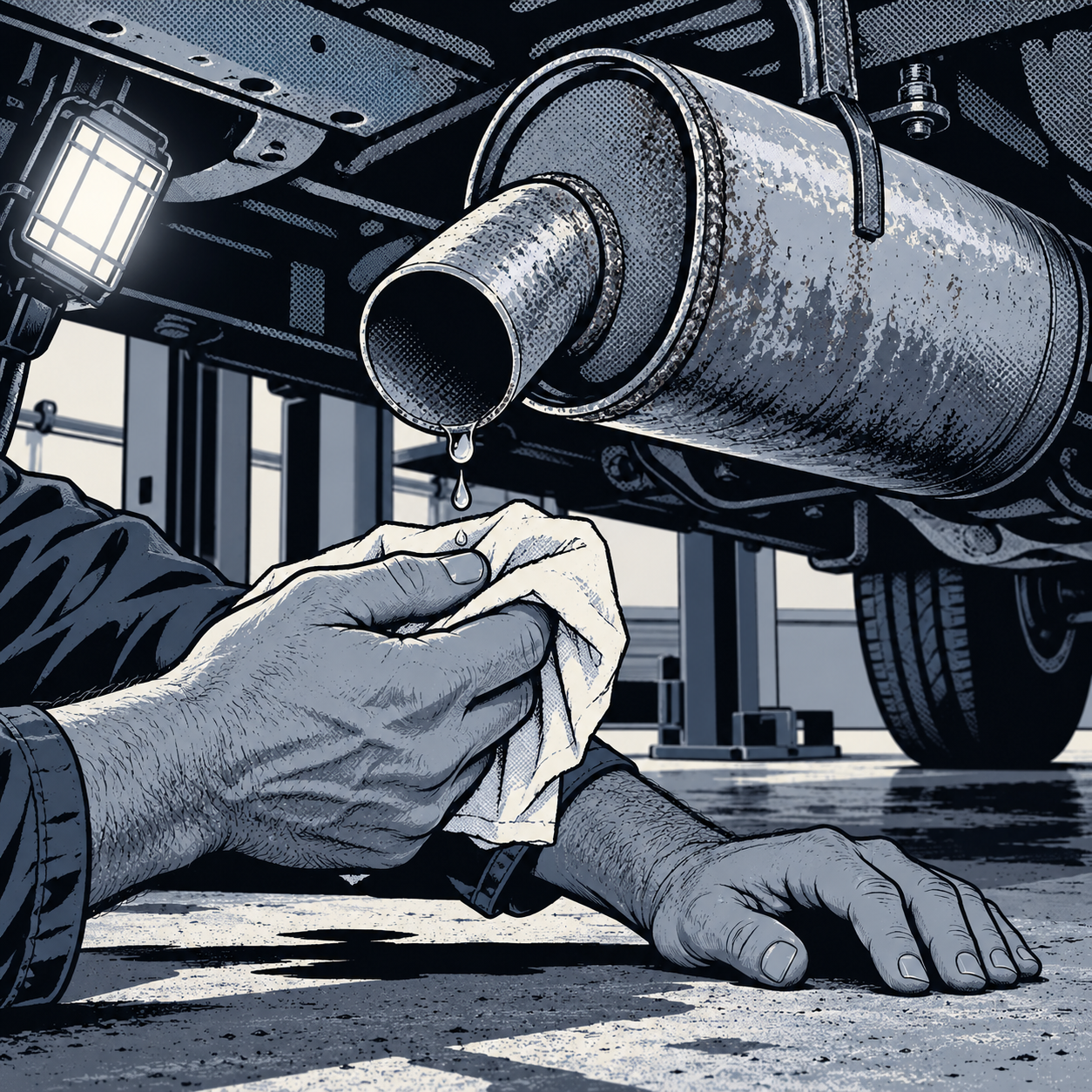
Every service writer has fielded the same worried phone call: “There’s water pouring out of my exhaust, is something wrong?” In the vast majority of cases the answer is no — it’s basic combustion chemistry doing exactly what it’s supposed to do. But that same symptom can also be the first visible sign of a blown head gasket or a cracked intake manifold. Knowing how to tell the difference in under five minutes, with tools most shops and DIYers already own, saves a lot of unnecessary teardown and a lot of unnecessary panic. Here’s how to work through it like a tech instead of guessing.
Why Combustion Produces Water in the First Place
Gasoline and diesel are hydrocarbons. When they burn in the presence of oxygen, the two byproducts of complete combustion are carbon dioxide and water vapor — that’s just the stoichiometry of the reaction. At a near-perfect air-fuel ratio, roughly a gallon of water is produced for every gallon of fuel burned. That water leaves the combustion chamber as vapor, traveling through the exhaust manifold, catalytic converter, pipes, and muffler on its way out.
The catch is temperature. A cold exhaust system — especially right after startup — is well below the dew point of that vapor, so it condenses back into liquid water inside the pipes and muffler, the same way a cold drink sweats on a humid day. As the system heats up over a few minutes of driving, the pipe walls warm past the condensation point and the water stays vaporized long enough to exit as invisible steam, or visible steam in cold weather. This is why you’ll see the most dripping on cold mornings, during short trips, and during extended idling, and almost none after a sustained highway run.
What Normal Condensation Looks and Smells Like
Before assuming a problem, characterize what’s actually coming out. Normal exhaust condensation is:
- Clear to slightly gray or sooty-tinted, never a distinct color
- Odorless or faintly smelling like exhaust, not sweet
- Thin and watery, not slick or oily to the touch
- Most noticeable at startup and during the first few minutes of driving, tapering off as the system warms
If what you’re seeing matches that description, you’re done — no repair needed, and telling a customer to “warm the car up” longer to prevent it is actually counterproductive, since extended idling is exactly what produces more pooled condensate, not less.
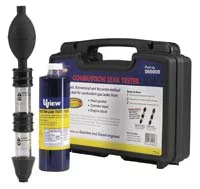

CPS Products Vacufill Jr. with Universal Radiator Coolant System
Mfg: CPS Products
Part #: 580000

The Quick Field Test: Finger, Paper Towel, and Smell
When there’s any doubt, run the same test techs have used for decades: dab a bit of the liquid on your fingertip or a white paper towel and check for a sweet smell and a slightly oily, slippery feel. Coolant (ethylene glycol) has a distinct sweet odor and leaves a faint residue when it dries; plain condensation evaporates clean and odorless. If the paper towel test is inconclusive, let a few drops dry completely on a dark surface — coolant tends to leave a slightly colored or slightly tacky ring, where water leaves nothing.
If you get a positive hit for coolant, don’t stop there — pull the coolant reservoir cap and check the level, and watch for a white, sweet-smelling vapor cloud (not clear steam) at the tailpipe during a cold start, which is a classic head-gasket or intake-gasket symptom. This is also the point where a basic combustion leak test — using a chemical block tester or a cylinder leak-down kit — earns its keep, because visual inspection alone won’t confirm combustion gases are getting into the cooling system.
[Product search: coolant block leak tester combustion gas detector]
Checking and Clearing the Muffler Weep Hole
Most mufflers have a small factory-drilled weep hole on the underside specifically to let accumulated condensate drain out instead of pooling and rusting the muffler from the inside. If that hole is clogged with road grime, undercoating overspray, or rust scale, water has nowhere to go and will sit in the muffler, sometimes backing up enough that you get a sudden “fire hose” discharge of water when the vehicle finally accelerates and the trapped liquid gets pushed out all at once. That’s startling to see but isn’t itself a failure — it’s a drainage problem.
To check it:
- With the vehicle safely on a lift or ramps and the exhaust cold, locate the weep hole on the bottom of the muffler (usually toward the rear)
- Confirm the muffler is installed with that hole facing down, not rotated out of position during a prior repair
- Probe the hole with a thin wire, pick, or small drill bit to clear any blockage
- Run the engine a few minutes and verify water drains steadily rather than collecting
This five-minute check resolves a surprising number of “my exhaust is dripping excessively” complaints, especially on vehicles that spend a lot of time idling, like work trucks running equipment in the morning.
Driving Patterns That Make It Worse
Idle time and short-trip driving are the two biggest amplifiers of visible exhaust water. A vehicle that idles for 30–45 minutes at a stretch, or one that only ever makes 2-mile trips, never gets the exhaust system hot enough for long enough to fully vaporize and expel the condensate, so it just keeps accumulating. Rough rule of thumb from the field: expect roughly a gallon of condensate produced per hour of idling, more in cold or high-humidity conditions. None of this is harmful to a modern exhaust system in the short term, but repeated cycles of cold, wet idling followed by shutdown is exactly how mufflers and pipes rust from the inside out over the years.
If a customer’s driving pattern is mostly short hops or heavy idle time, the practical advice is simple: once a week or so, give the vehicle a solid 15–20 minutes at highway speed. That fully heat-cycles the exhaust, drives out accumulated moisture, and helps the catalytic converter stay efficient too.
When to Stop Calling It Normal
Escalate to a real diagnostic — compression test, cooling system pressure test, or combustion leak test — if any of the following show up alongside the water:
- White, persistent exhaust smoke that doesn’t clear after the engine warms up
- A sweet smell at the tailpipe or in the cabin
- Dropping coolant level with no visible external leak
- Overheating, rough idle, or a check engine light
- Oil that looks milky or has a mayonnaise-like consistency on the dipstick or cap
Any of those point toward a blown head gasket, a cracked cylinder head, or a failed intake gasket letting coolant into the combustion chamber — a different repair entirely from “it’s just condensation.”
Quick Checklist
- Liquid is clear, odorless, and tapers off after a few minutes of driving → normal, no action
- Liquid smells sweet or feels oily/slick → test for coolant contamination
- Excess pooling or a sudden gush on acceleration → check and clear the muffler weep hole
- Persistent white smoke, sweet cabin smell, or dropping coolant → run a compression or block test before anything else
- Mostly short trips or heavy idling → recommend a weekly highway drive to fully heat-cycle the exhaust
[Product search: exhaust system repair tools muffler and pipe kits]


FAQs
Is water dripping from my exhaust pipe bad for my car?
No, in normal amounts it’s a harmless byproduct of combustion. Problems only arise if the weep hole is blocked and water pools, accelerating internal rust, or if the water is actually coolant.
How can I tell if it’s coolant and not condensation?
Coolant smells distinctly sweet and leaves a faint residue when it dries; plain condensation is odorless and evaporates clean. A paper towel test is a fast first check, followed by a cooling system pressure test or combustion leak test if you’re still unsure.
Why does my truck drip more water after idling for a long time?
Idling never gets the exhaust system hot enough to fully vaporize combustion water, so it keeps condensing and accumulating. Extended idle time, especially in cold weather, produces noticeably more than normal driving.
Should I let my car idle longer to warm it up and prevent this?
No — that makes it worse, not better. Idling produces more condensate than it clears. Driving at normal speed heats the exhaust system faster and more evenly than idling does.
What is the weep hole on a muffler, and why does it matter?
It’s a small factory drain hole on the underside of the muffler that lets accumulated water escape. If it gets clogged with debris or rust, water pools inside the muffler instead of draining, which can accelerate internal corrosion.
Could water from the exhaust mean a blown head gasket?
It can, but only alongside other symptoms — persistent white smoke, a sweet smell, dropping coolant level, overheating, or milky oil. Isolated water drips with none of those signs are almost always just condensation.
Shop Exhaust & Muffler Tools
The diagnostics outlined above—from clearing muffler weep holes to preparing for compression testing—require solid exhaust inspection and repair tools. Browse our Exhaust & Muffler Tools selection for everything from basic clearing picks to complete repair kits.
- Muffler weep hole clearing and inspection equipment
- Exhaust pipe and manifold repair systems
- Diagnostic tools for compression and combustion testing

The Toolsource Technical Team blends decades of real-world automotive service experience with up-to-date technical research. Our writers collaborate with professional mechanics, shop owners, and diagnostic specialists to deliver practical, workshop-ready guidance you can trust.


Follow us on social media