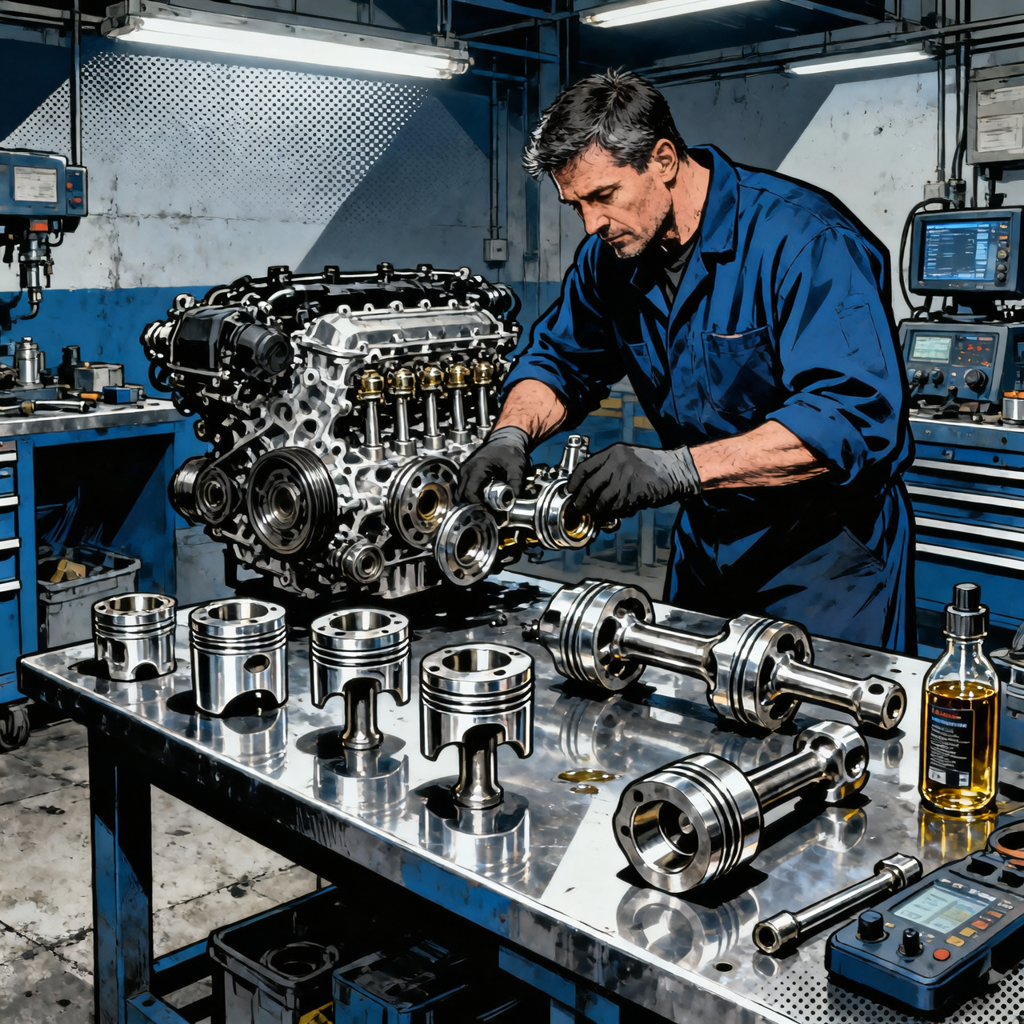
High-mileage gas engines that see lots of short trips, idling, or extended intervals often suffer from ring-land varnish and carbon that lock oil control rings. The symptom set is familiar: rising oil consumption, blue smoke on decel, fouled plugs, and elevated blow-by. Valvoline Restore & Protect (R&P) is a full-synthetic, API SP/GF-6 oil formulated with a boosted detergent/dispersant package to dissolve and carry away piston/ring deposits gradually over multiple oil change intervals—without behaving like an aggressive solvent flush. This guide summarizes when to use it, how to service vehicles with it, how to choose filters and intervals, and how to verify results.
What Restore & Protect Is (and Isn’t)
- It’s a detergent-forward synthetic oil designed to target ring land and piston deposits over time. It leverages elevated calcium/magnesium detergents and dispersants to loosen deposits and suspend them for filtration and drain-off.
- It’s not a 10-minute flush or kerosene/solvent blend. You run it as your normal fill for several oil changes. Cleaning is progressive, which reduces the risk of dislodging large debris that could overwhelm the filter.
- Intended for gasoline engines that specify API SP/ILSAC GF-6. It is different from heavy-duty diesel “restore” oils. Do not substitute heavy-duty diesel restore products in passenger gasoline engines.
- Viscosity options are conventional North American grades (e.g., 0W-20, 5W-20, 5W-30, 10W-30). If your engine requires an ACEA/Euro-approved oil (e.g., VW/Audi, BMW, MB) or a specific low-SAPS spec, verify approvals before use. When in doubt, follow OEM specs.
- Not a fix for mechanical wear. It can free stuck oil control rings and reduce blow-by, but it won’t repair worn rings, tapered cylinders, or hardened valve stem seals.
- Warranty note: Stay within the owner’s manual viscosity and approvals while under warranty. Many engines list alternate viscosities for different markets/temperatures; use only what’s permitted for your vehicle and climate.
When to Use It: Symptoms and Diagnostics
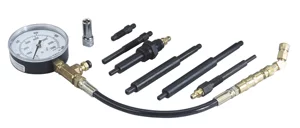
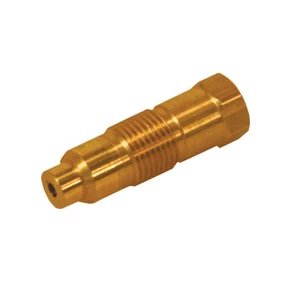
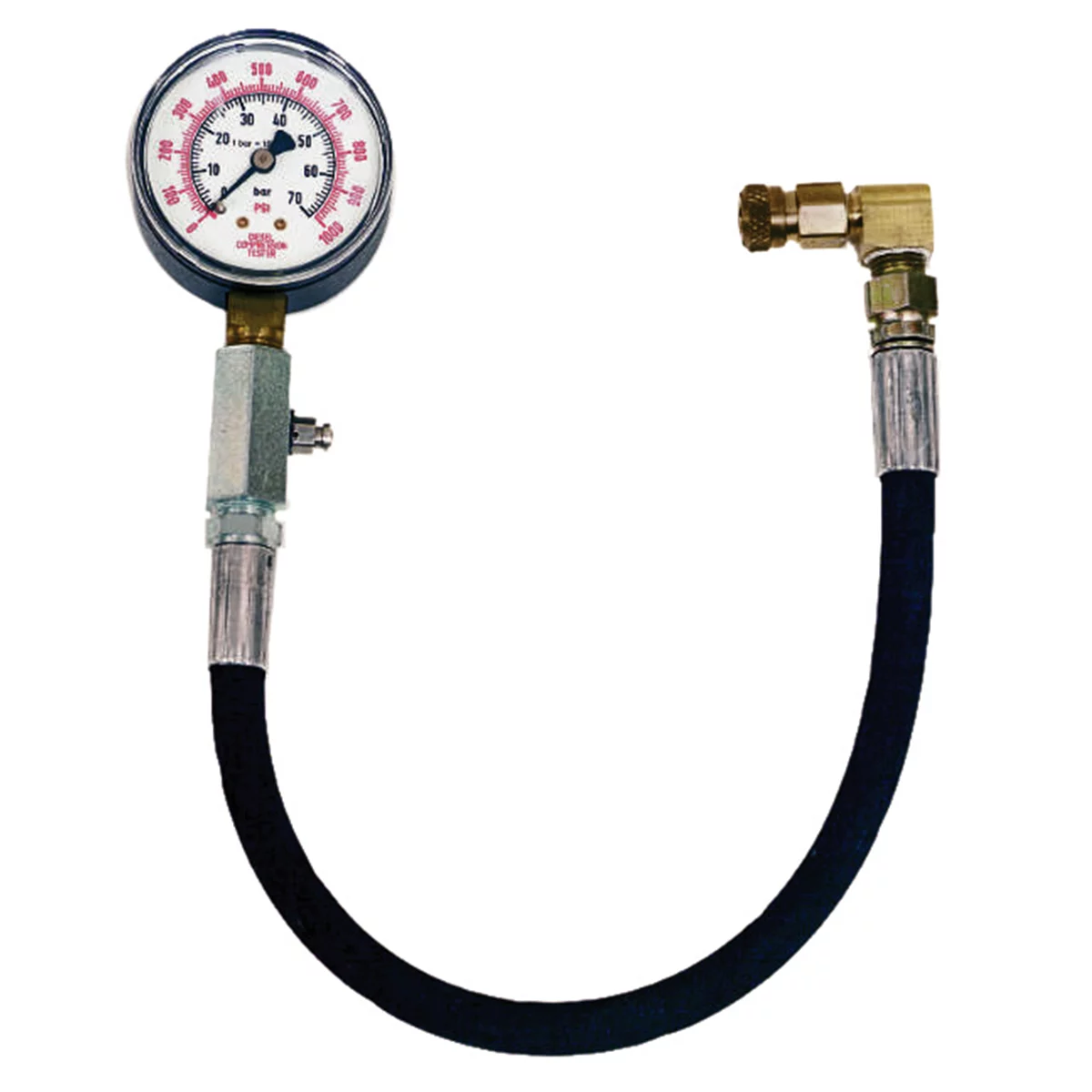
Restore & Protect makes the most sense when the complaint points to deposit-driven ring issues. Establish a baseline before you start so you can quantify improvement.
Common symptoms of deposit-driven oil consumption
- Oil consumption exceeding OEM guidelines (e.g., >1 qt/1,000 mi).
- Blue smoke during decel or after extended idle (oil pulled past rings or guides).
- Fouled plugs, especially oil-fouled on certain cylinders.
- Elevated crankcase pressure/blow-by (oil cap “dance,” dipstick tube puffing).
- Heavy varnish under the oil cap; dark, sticky deposits on visible valvetrain areas.
- Rough cold start that improves warm (rings sealing poorly until thermal expansion).
Baseline diagnostics (recommended)
- Measure consumption accurately: Fill to the top mark, log odometer, recheck at 500–1,000 mi intervals. Note driving conditions.
- PCV system check: Inspect/replace the PCV valve and hoses. Stuck PCV can mimic ring problems by elevating crankcase pressure.
- Borescope: Through spark plug holes, inspect piston crowns and visible ring lands for carbon/lacquer. Note cylinder-to-cylinder differences.
- Compression and leak-down: Low compression that improves with a wet test suggests ring sealing issues. Leak-down location (crankcase hiss) indicates path.
- Intake tract and throttle body: Excess oil film can come from PCV ingestion; differentiate from turbo seal leaks (if applicable).
- Tailpipe and O2/AFR trims: Persistent blue smoke and negative long-term trims may correlate with oil ingestion.
How to Run a Restore & Protect Service Correctly
This procedure is designed to maximize cleaning while minimizing risk to the lubrication system.
- Confirm specs: Verify the engine allows API SP/GF-6 oil in the target viscosity. If OEM calls for an ACEA/Euro spec, decide accordingly (out of warranty, consider trade-offs or use an approved oil).
- Pre-service inspection: Address misfires, coolant leaks, fuel dilution, intake leaks, and especially PCV faults before starting. Severe fuel dilution undermines detergent effectiveness.
- Select a high-capacity filter: Use a synthetic-media extended-life oil filter with robust debris-holding capacity and efficiency (e.g., 99% @ 20–30 microns). A high-capacity filter helps during the initial cleaning intervals.
- Warm the engine fully and drain hot oil. Inspect the drainplug and pan for metallic debris. Replace crush washer if applicable.
- Fill with Restore & Protect at the correct viscosity. Replace the filter. Prime as needed (e.g., pre-fill larger filters when appropriate).
- Reset the oil life monitor and apply an under-hood service label noting “R&P Cycle 1/4” with date/mileage.
- Run shorter intervals initially: For known heavy consumers or visible deposit engines, use 3,000–5,000 mi (5,000–8,000 km) OCIs for the first 3–4 cycles. Severe-service vehicles (short trips, towing, dusty) should favor the low end.
- Monitor consumption and blow-by: Log top-offs; check for dipstick cleanliness and color changes. A gradual reduction in consumption over the first two cycles is common when rings free up.
- Mid-cycle filter check (optional): On engines with severe sludge history, consider an early filter swap at 1,500–2,000 mi during the first cycle. Top back to full. This is typically optional—most systems handle the load—but is a low-cost precaution.
- Repeat for 3–4 oil changes: Valvoline positions the treatment to achieve substantial piston deposit removal after multiple OCIs. After cycle 3 or 4, re-baseline via leak-down/compression and borescope if available.
Note: Avoid combining R&P with solvent flushes or engine flush additives. You want the detergents and dispersants to work steadily, and your filter to handle suspended material normally.
Optional Complementary Procedures (Use With Caution)
On engines with severe oil control ring sticking, a controlled ring soak can accelerate deposit softening. This procedure is for trained technicians; misuse can hydrolock an engine or foul catalytic converters and O2 sensors.
Ring soak overview
- Choose a suitable cleaner: A strong PEA/aromatic solvent-based top-end cleaner formulated for piston/ring deposits. Follow product directions. Do not use kerosene or household solvents.
- Disable ignition and fuel, remove spark plugs. Bring each piston near mid-stroke (reduces pooling).
- Measure carefully: Add a small, specified volume per cylinder (often 15–30 ml). Do not overfill.
- Soak period: Allow several hours to overnight. Periodically rotate the engine by hand to work cleaner into ring packs.
- Evacuation: With plugs out, place shop towels over plug holes and crank to expel residual fluid. This step prevents hydrolock on restart.
- Install new plugs if fouled-prone, re-enable ignition/fuel, start and run to operating temp (expect smoke). Shut down and change oil and filter immediately to remove dissolved contaminants.
This approach can complement R&P on the first cycle for severe cases. Always verify the converter and O2 systems are protected per product guidance.
PCV service and oil separation
- PCV valve/hoses: Replace sticky PCV valves and brittle hoses. Verify clean metering orifice on integrated systems.
- Catch can (where appropriate): On performance DI/turbo engines, a baffled catch can in the correct PCV circuit can reduce oil ingestion under transient vacuum. Route per engine’s PCV logic and monitor for freezing in cold climates.
Choosing Filters, Intervals, and Viscosity
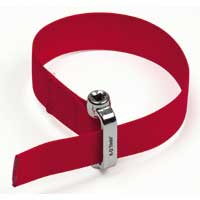

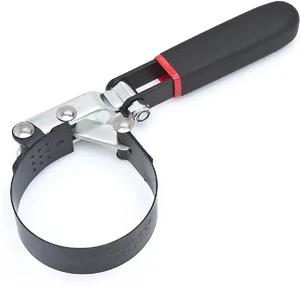
Swivoil Oil Filter Wrench 2-7/8 to three and one four inchch
Mfg: GearWrench
Part #: 3083
Filter selection
- Media: Synthetic or synthetic-blend media with high single-pass efficiency (≥99% @ 20–30 µm) and strong capacity.
- Construction: Metal endcaps or proven fiber endcaps, silicone ADBV, and a bypass valve set to OEM spec range.
- Service plan: For the first 1–2 cycles, plan conservative intervals and consider mid-cycle filter swap only on engines with known sludge history.
Intervals
- Initial cleaning: 3–5k miles per OCI for 3–4 cycles, depending on severity and duty cycle.
- After recovery: Resume your normal severe-service interval per OEM. Avoid extended drains while actively cleaning.
Viscosity guidance
- Follow the owner’s manual. Some engines list multiple acceptable viscosities (e.g., 0W-20/5W-30) based on region or temperature. Choose within the allowed range.
- Under warranty: Do not deviate from specified grades or approvals.
- Out of warranty and consuming oil: If the manual permits, stepping to the next higher viscosity may reduce consumption. Don’t exceed ambient temperature guidance.
Results You Can Expect and How to Verify
With deposit-driven oil consumption, many techs observe:
- Reduced top-offs over the first two OCIs as oil control rings free up.
- Less blue smoke on decel and after idle.
- Smoother idle and improved fuel economy as compression rings seal consistently.
- Cleaner dipstick and visible valvetrain surfaces as varnish dissolves.
Not every engine responds. If consumption does not improve after 2–3 cycles—and leak-down/compression remain poor—suspect mechanical wear (ring/cylinder, valve stem seals) or non-ring causes (turbo seals, external leaks).
Verification methods
- Consumption log: Compare baseline to cycles 2–4. Target meaningful reduction (e.g., from 1 qt/1,000 mi toward 1 qt/3,000–5,000 mi or better, depending on engine condition).
- Borescope: Track piston crown and ring land cleanliness each OCI. Look for lacquer lifting and carbon reduction.
- Compression/leak-down: Improved uniformity and reduced crankcase hiss suggest better ring sealing.
- Blow-by check: Manometer at dipstick tube (if applicable) or qualitative cap “dance” reduction; ensure PCV is functional.
- Plug inspections: Less oil fouling and reduced ash deposits over time.
Common Pitfalls and How to Avoid Them
- Topping off only: Adding R&P just for makeup oil is safe but slows results. Full fills for multiple OCIs clean more effectively.
- Mixing with flush chemicals: Avoid concurrent solvent flushes. Let R&P’s additive system work gradually.
- Ignoring PCV faults: A stuck PCV will mask progress and can increase consumption regardless of oil choice.
- Overextending intervals while cleaning: Don’t stretch drains during deposit removal. Keep to conservative OCIs until consumption stabilizes.
- Spec mismatches: Engines that require ACEA/Euro approvals, low-SAPS oils, or motorcycle wet-clutch compatibility may not be suitable. Always follow OEM requirements.
- Expecting it to fix wear: It won’t repair worn guides, seals, or cylinders. Use test data to decide when mechanical repair is required.
Quick Checklist
- Verify OEM oil spec/viscosity; fix PCV issues first.
- Install high-capacity synthetic-media filter.
- Fill with Restore & Protect; label as Cycle 1/4.
- Run 3–5k OCI; log consumption and performance.
- Repeat for 3–4 cycles; optionally borescope/measure leak-down.
- Return to normal severe-service interval once stabilized.
FAQs
Will Restore & Protect clog the oil filter?
It is formulated to clean progressively so that contaminants are dispersed and captured over time. In practice, modern synthetic-media filters have ample capacity for the load generated by gradual deposit dissolution. For engines with known sludge history, a precautionary mid-cycle filter change on the first interval is reasonable but not usually required. Always use a quality, high-capacity filter.
How many oil changes until I see results?
Some reduction in consumption can appear within the first 1–2 OCIs. Significant piston/ring deposit cleanup is typically positioned across 3–4 consecutive OCIs at 3–5k miles each, depending on severity and duty cycle. Continue using it as your regular fill thereafter if desired.
Can I just top off with Restore & Protect?
Yes, but results will be slower. Full drains and fills ensure the detergent package concentration reaches the intended level and the entire sump is on the same additive chemistry. Use full fills for best results.
Is there a European-spec version with ACEA approvals?
As of this writing, R&P is primarily offered in North American grades without broad ACEA/Euro approvals. If your vehicle requires specific ACEA or OEM approvals (VW, Mercedes-Benz, BMW, etc.), use an approved oil to maintain compliance, especially under warranty.
Will Restore & Protect fix valve stem seals or worn rings?
No. It can free stuck rings and reduce oil burning caused by deposits. It cannot repair hardened valve stem seals, worn guides, or cylinder wear. Use compression/leak-down, borescope, and smoke observations to differentiate.
Is it safe for turbocharged and GDI engines?
Yes, it meets API SP/GF-6, which includes LSPI protection and timing chain wear limits. Many techs report benefits on TGDI engines with deposit-related consumption. Still, follow OEM drain intervals and ensure the PCV system and turbo oil feed/return are healthy.

The Toolsource Technical Team blends decades of real-world automotive service experience with up-to-date technical research. Our writers collaborate with professional mechanics, shop owners, and diagnostic specialists to deliver practical, workshop-ready guidance you can trust.


Follow us on social media