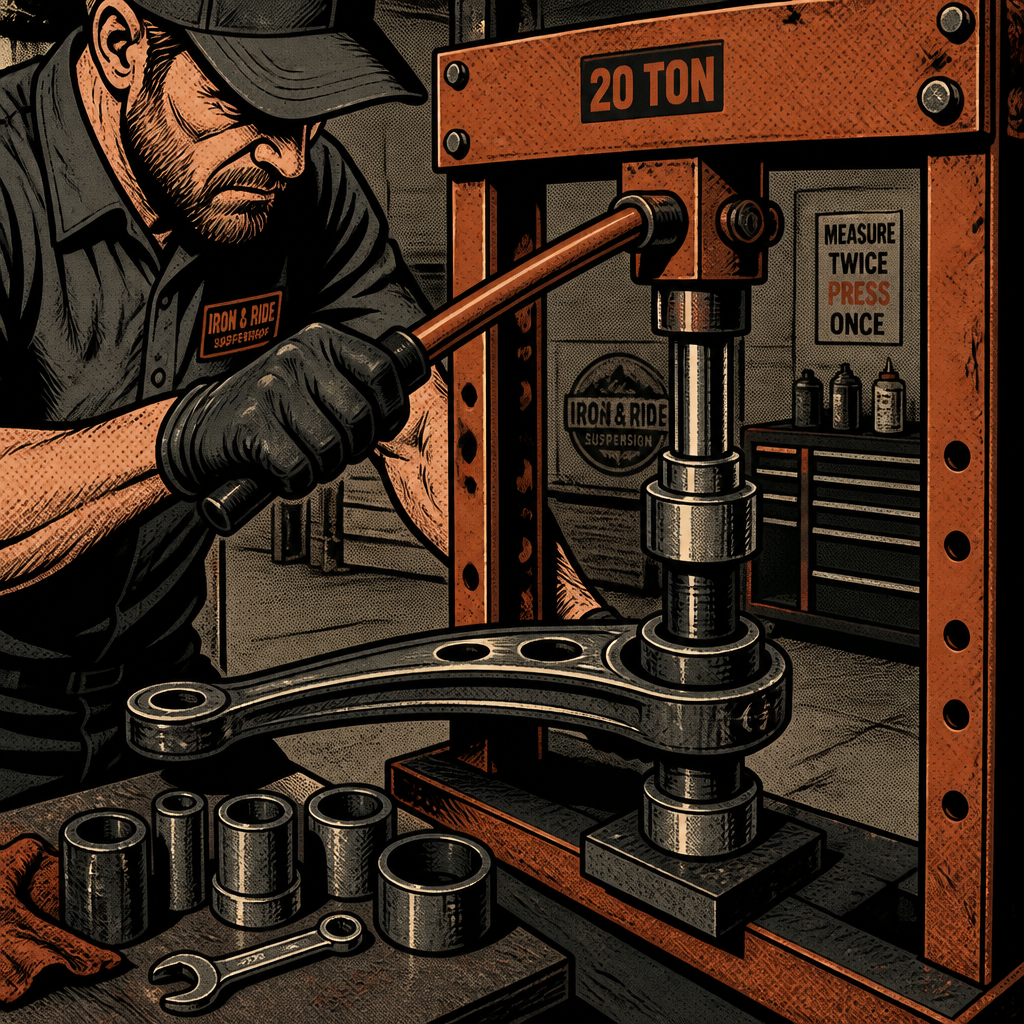
A customer drops off a car with a whining suspension complaint or an alignment shop flags “excessive bushing play,” and now you’re staring at control arm bushings that are either surface-cracked or fully torn through. The distinction matters more than most people think. Surface cracking on rubber bushings is normal aging and often cosmetic. A bushing that’s torn through, separated, or visibly collapsed under load is a different problem — one that snowballs into tire wear, alignment drift, and eventually a full control arm replacement instead of a cheap bushing swap. Here’s how to diagnose it correctly, decide on a repair path, and explain the urgency to a customer without over- or under-selling the job.
Cracked vs. Torn: Reading the Bushing Correctly
Most rubber control arm bushings develop surface cracking over time, especially when photographed with the suspension unloaded (arm hanging free, no vehicle weight on it). That cracking alone isn’t an automatic failure — it’s what rubber looks like at 80,000-plus miles. What separates a “watch it” bushing from a “fix it now” bushing is whether the rubber has torn clean through, separated from the metal sleeve, or is missing chunks entirely. On a lift, load the arm by hand or with a pry bar and watch for movement between the inner and outer sleeve. Any perceptible play — knocking, clunking over bumps, or visible shifting — means the bushing has failed structurally, not just cosmetically.
Check both ends of the arm. Front and rear bushings on the same control arm often wear at different rates, and quoting a whole arm replacement when only one bushing is bad is a common upsell complaint. If the OEM or aftermarket bushing is sold separately and the arm itself, ball joint, and remaining bushing are still in good shape, there’s no mechanical reason to replace the whole arm.
Why a “Ride-It-Out” Bushing Becomes an Expensive Problem
A torn bushing doesn’t cause sudden loss of control, and that’s exactly why it gets ignored. But a control arm bushing’s job is to hold the arm — and therefore the wheel — at a precise geometric position. Alignment specs are set in tenths of a degree. Once a bushing tears through, the arm can shift under acceleration, braking, and cornering loads in ways an alignment rack can’t compensate for, because the bushing itself is the moving part, not a fixed pivot. The practical result: camber and toe wander under load even right after a fresh alignment, and tire wear accelerates — usually showing up as inner or outer edge feathering within a few thousand miles.
Handling is the other cost. A torn bushing lets the wheel move slightly out of intended alignment during hard maneuvers, which is exactly when precise wheel control matters most — panic stops, evasive lane changes, sudden mid-corner corrections. The car will still drive normally on a daily basis, but the margin during an emergency maneuver shrinks. That’s the honest way to frame it for a customer who wants to defer the work: it won’t strand them, but it quietly erodes the vehicle’s emergency handling and eats their next set of tires.
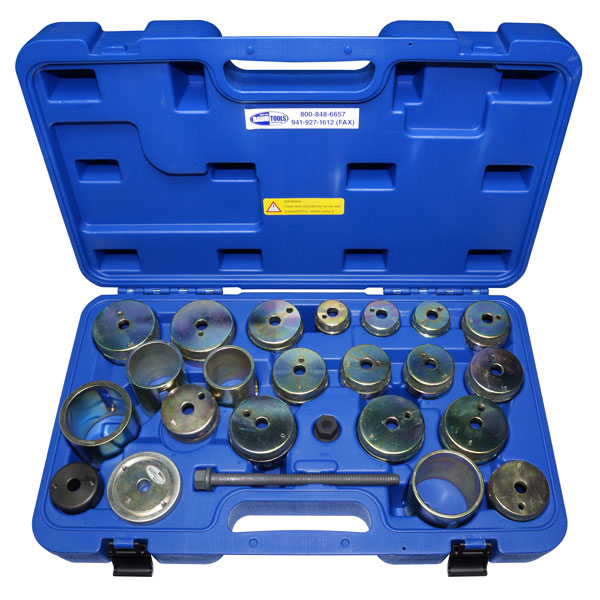
Mercedes Front Lower Control Arm Bushing Kit PLUS
Mfg: Baum Tools
Part #: B220-0643PLUS
Bushing-Only Replacement vs. Full Control Arm
Three factors decide this call: parts availability, arm condition, and labor time. If the bushing is sold as a standalone part and the control arm itself isn’t bent, cracked, or corroded at the mounting points, a bushing-only replacement is the cheaper and often better option — you keep the OEM-spec arm and only replace the wear item. This is common on many domestic and Japanese platforms where aftermarket bushing kits are readily available.
Full control arm replacement makes more sense when: the arm’s stamped steel is rusted or pitted at the bushing bore, the ball joint on the same arm is also worn (bundling the labor), the bushing press job would take longer than swapping a complete assembly, or the customer wants a warrantied bolt-in part instead of a press-in repair. On many modern unibody vehicles, labor to press old bushings out and new ones in — especially rear lateral or trailing arm bushings — can exceed the cost difference versus a reman or aftermarket complete arm. When that’s the case, tell the customer plainly: labor is the expensive part, not the rubber, so a complete arm often isn’t the upsell it looks like.
What the Repair Actually Requires
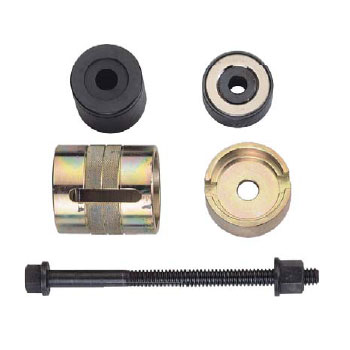
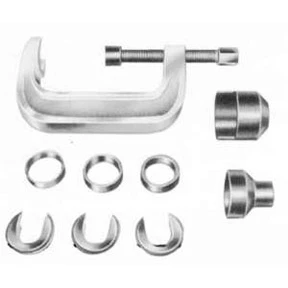
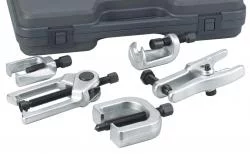
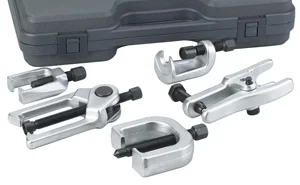
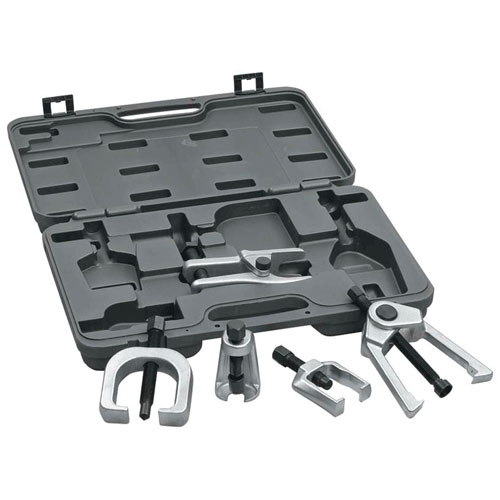
Pressing bushings correctly needs the right adapters for the bore size — improvised methods (sockets, pipe, a bench vise) routinely damage the new bushing’s outer shell or cock it in the bore, causing premature failure and a comeback. A dedicated ball joint and bushing press kit with the correct cup and adapter sizes pays for itself after the first job. Torque the bushing’s through-bolt only after the suspension is loaded to ride height — tightening it with the arm hanging free pre-stresses the rubber and shortens its life.
Any bushing or control arm replacement changes ride-height geometry enough to require a four-wheel alignment afterward. Don’t skip this even if the old alignment numbers “were fine” — the whole point of the repair is that the old numbers were unreliable because the bushing was moving.
Don’t Stop at the Bushings — Check the Shocks
Worn control arm bushings and worn shocks/struts often show up together, and there’s a labor-efficiency argument for handling both in one visit: front and rear suspension work usually shares teardown steps, so doing shocks alongside bushings adds much less labor than a second visit would. If a shock is visibly leaking, blown, or the boot is torn, inspect it while the suspension is already apart rather than sending the customer home to book a second appointment. Parts are comparatively cheap; a second round of labor isn’t.
How to Talk to the Customer About Urgency
Not every worn bushing is an emergency, and not every customer has the budget to fix everything at once. A practical way to prioritize: address anything affecting safe operation (a clunk under braking, a wandering feel at speed, or a bushing torn completely through) before cosmetic wear items. If money is tight and the bushing shows cracking but no measurable play, it’s reasonable to monitor it and recheck at the next service interval. Once play is present — a knock over bumps, visible shift under load, or accelerated tire wear on one axle — that’s the line where deferring the repair starts costing more than fixing it, because the customer will likely be paying for both the suspension work and a premature tire replacement.
Quick Diagnostic Checklist
- Load the arm and check for play at both bushing locations, not just the obviously cracked one
- Distinguish surface cracking (monitor) from torn/separated rubber (repair now)
- Inspect tire wear pattern for inner/outer edge feathering as a secondary confirmation
- Confirm whether the bushing is sold separately or only as part of a complete arm
- Check the arm itself for rust, pitting, or damage at the bushing bore before choosing bushing-only repair
- Inspect shocks/struts while the suspension is disassembled
- Torque bushing bolts at ride height, not with the arm unloaded
- Schedule a four-wheel alignment after any bushing or arm replacement
Frequently Asked Questions
Can I drive on torn control arm bushings for a while?
Yes, in most cases the vehicle won’t fail catastrophically. But expect accelerated tire wear, wandering handling, and reduced precision during emergency maneuvers. Treat it as a near-term repair, not an ignorable item.
Will a bad control arm bushing cause a clunking noise?
Yes — a knock or clunk over bumps, potholes, or during braking is one of the most common symptoms of a bushing with measurable play.
Do I need an alignment after replacing bushings?
Always. Bushing replacement changes the arm’s resting position enough to shift camber and toe, even if the old alignment numbers looked acceptable beforehand.
Is it cheaper to replace just the bushing or the whole control arm?
It depends on labor time and arm condition. If the bushing is sold separately and the arm is otherwise sound, bushing-only replacement is usually cheaper. If the arm is corroded or the press job is labor-intensive, a complete arm can end up cost-competitive.
How do torn bushings affect tire wear specifically?
They let the wheel shift out of its intended alignment position under load, which typically shows up as feathering or uneven edge wear that a standard alignment can’t fully correct until the bushing itself is fixed.
Should I replace shocks at the same time as control arm bushings?
If the shocks are also worn, yes — bundling the labor while the suspension is already disassembled is more cost-effective than a separate future repair visit.
Tools for This Repair
Pressing bushings correctly requires dedicated adapters and a proper press kit—improvised methods risk damaging the new bushing. Find bushing press kits, control arm tools, and suspension equipment in our Tire Tools, Wheels & Suspension selection.
- Bushing press kits and bore adapters in standard sizes
- Control arm pullers and ball joint separators
- Alignment and suspension diagnostic tools

The Toolsource Technical Team blends decades of real-world automotive service experience with up-to-date technical research. Our writers collaborate with professional mechanics, shop owners, and diagnostic specialists to deliver practical, workshop-ready guidance you can trust.


Follow us on social media