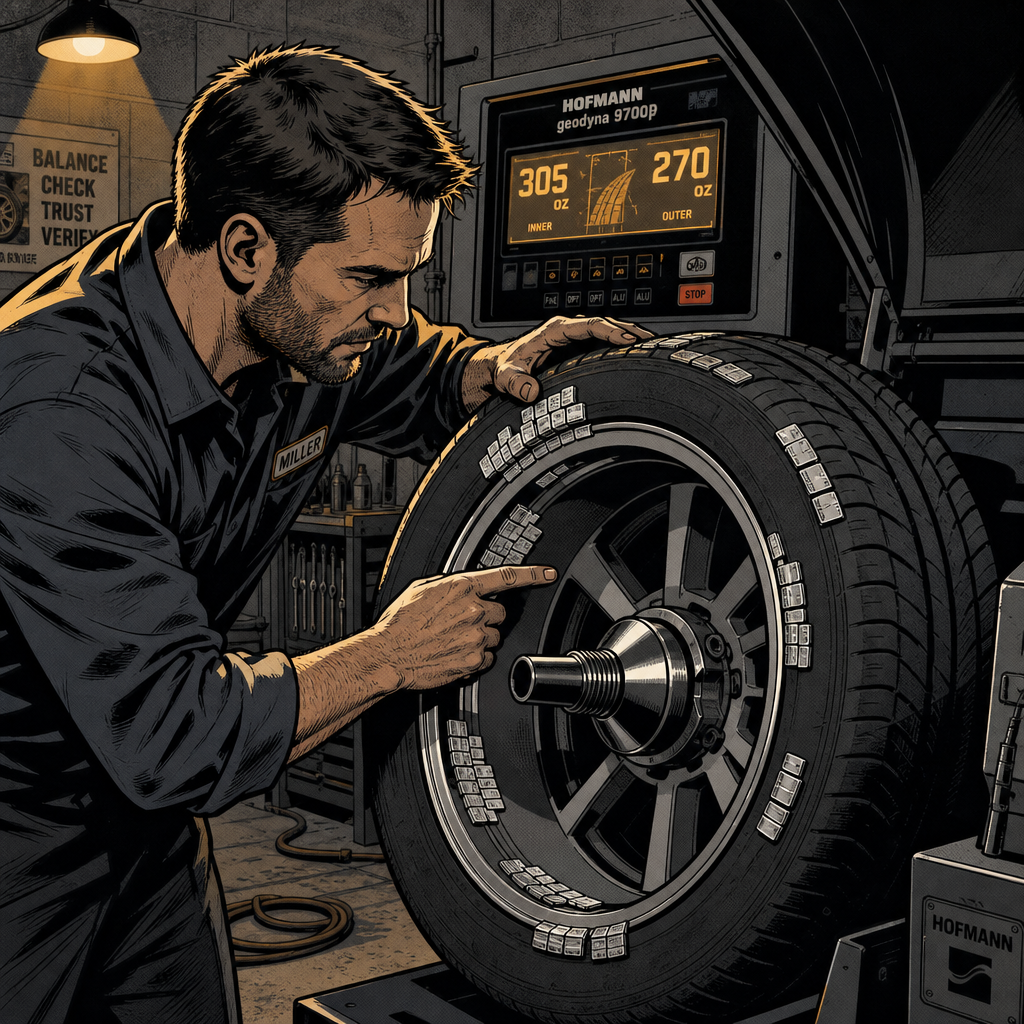
A customer pulls up with a wheel that looks like someone unloaded an entire spool of stick-on weights around the rim — clumps on the inboard flange, more clumps directly across on the outboard side, and nowhere near the clean, single-cluster job a properly balanced wheel should show. This is a common complaint, and the cause is almost always one of two things: a genuinely bad wheel or tire that needed a lot of correction, or a tech who didn’t understand what the balancer was telling them. Knowing how to tell the two apart — and how to avoid causing the second one yourself — is basic shop hygiene that protects your name and the customer’s ride quality.
What Excessive Weight Actually Tells You
Modern computerized balancers (Hunter Road Force machines and similar) are precise enough that a well-made wheel and tire combo should balance out with well under an ounce of weight in most cases, and rarely more than 1–2 ounces total even on larger, heavier wheel-and-tire packages. When a balance job needs several ounces — or worse, weight stacked in multiple locations around the same wheel — that’s a signal, not a normal outcome. It usually means one of three things: the wheel itself is bent or out-of-round, the tire has uneven density or was manufactured poorly, or the wheel wasn’t seated correctly on the balancer cone before the reading was taken. None of these get fixed by throwing more weight at the problem until the readout hits zero.
The other giveaway is weight placed directly opposite other weight on the same plane. Static (bubble-style) balancing puts a single mass correction at one point on the wheel. Dynamic, two-plane balancing on a computerized machine can legitimately call for weight on both the inboard and outboard flanges at different clock positions — that’s normal and not “canceling itself out,” because the planes are separate. But when a tech sees two weights fighting each other on the *same* plane and just keeps adding more instead of recognizing the pattern, they’re masking a problem rather than solving it. A properly trained tech either isolates and fixes the root cause or explains to the customer why the wheel or tire needs to be replaced.
Root Causes: Bent Wheels, Cheap Aftermarket Rims, and Bad Tires
Aftermarket wheels — especially budget dual-drilled or multi-bolt-pattern wheels meant to fit several vehicle applications — are a frequent culprit. Drilling a wheel for more than one bolt pattern removes material asymmetrically and can affect how true the wheel runs, and cheaper casting or extrusion processes are more prone to being out-of-round from the factory. A wheel that’s slightly bent, has an out-of-true bead seat, or has a center bore that isn’t perfectly round will force the balancer to compensate with weight scattered around the circumference instead of concentrated at one clean point.
Overtorqued lug nuts are another underappreciated cause. Air guns set too aggressively, or lug nuts torqued in the wrong sequence, can deform the center of a thinner aftermarket wheel enough to change how it sits on the balancer’s cone or hub adapter — which throws off the whole reading before the machine even spins. Low-quality tires can contribute too: uneven rubber distribution, a heavy splice point in the tire’s internal construction, or a sidewall that isn’t uniform in stiffness all show up as “the machine wants more weight than it should.” In many of these cases, breaking the bead and rotating the tire 90 or 180 degrees on the wheel — or flipping a non-directional tire — can bring the required weight down dramatically, sometimes from over a pound to just an ounce or two.
===FYP-PRODUCT-SEARCH-1===
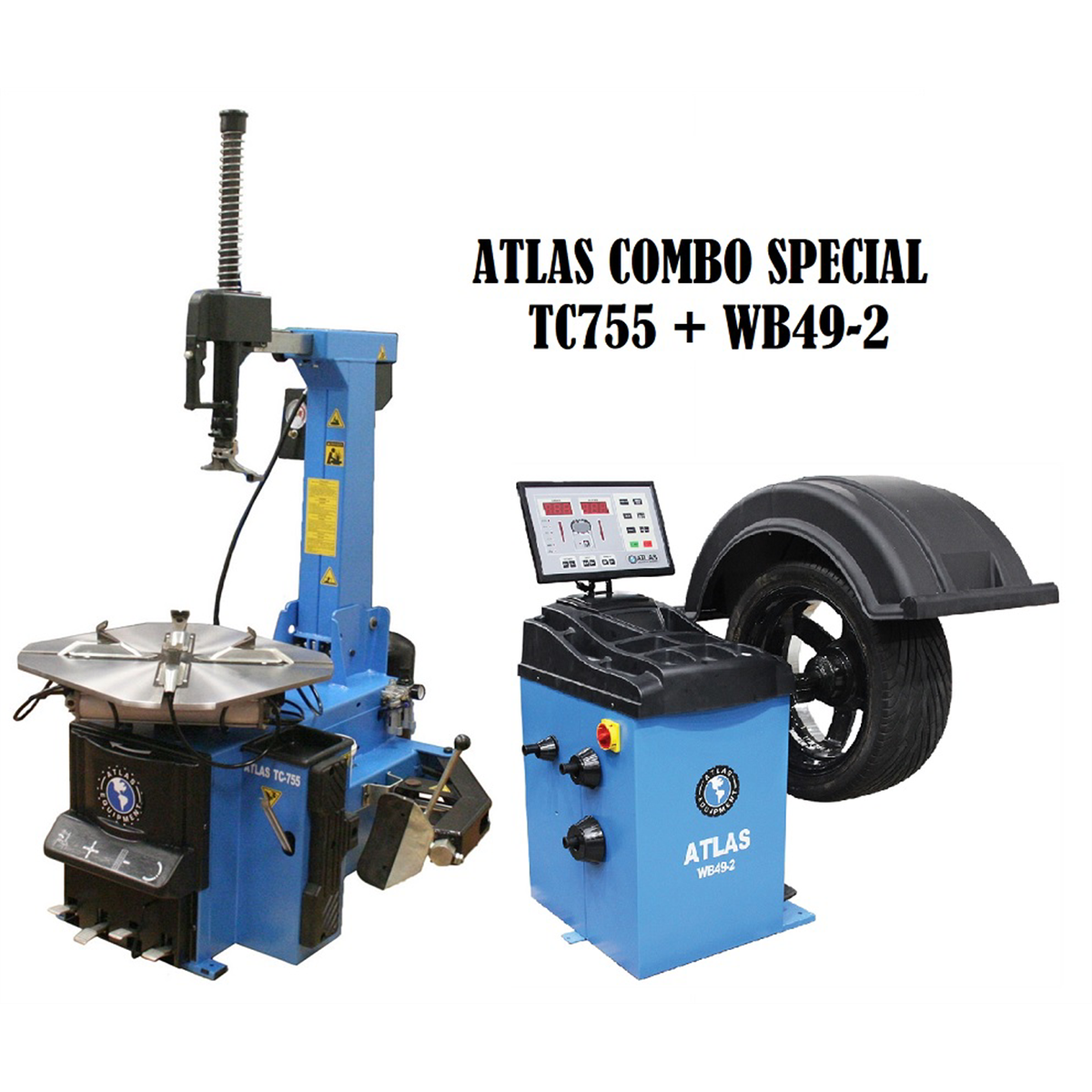
Atlas TC755 Tire Changer & WB49-2 Wheel Balancer Combo
Mfg: Atlas Automotive
Part #: TCWB-COMBO3
Using Road Force Balancing to Diagnose the Real Problem
A road force balancer applies a loaded roller against the spinning tire to simulate the load of the vehicle’s weight, which reveals radial force variation that a standard spin balancer can’t detect. This is the tool that separates “this wheel needs weight” from “this wheel is bent and no amount of weight will fix the ride.” When road force numbers come back high, the fix isn’t more weight — it’s index-matching the tire’s high spot against the wheel’s low spot (or vice versa) to cancel out the variation, and if that doesn’t bring the number into spec, the wheel or tire needs to be replaced outright.
If your shop has this equipment, use it any time a standard balance calls for more than about an ounce and a half to two ounces per wheel, or any time a customer describes a vibration that came back after a “normal” tire rotation or replacement. Skipping this step and just chasing the zero on a basic balancer is exactly how jobs like the one described above end up leaving the shop looking sloppy and still vibrating on the highway.
Balancing Technique: Avoiding the Rookie Mistakes
Several bad habits show up over and over in botched balance jobs, and all of them are avoidable with basic discipline at the machine:
- Not verifying the mount first. Confirm the wheel is seated flush and true on the cone or hub-centric adapter before trusting any reading. A wheel that’s cocked even slightly on the balancer will generate a false high reading that no amount of correctly placed weight will fix.
- Stacking weight instead of diagnosing. If the first spin calls for more than an ounce or two, stop and investigate — check the tire seating, try rotating the tire on the bead, or run it through road force before adding weight.
- Ignoring the split-weight rule. Add weight in small increments (2–3 ounces at a time on tougher wheels) and re-spin between additions rather than guessing and piling it all on at once.
- Confusing inboard/outboard planes. Weight on opposite clock positions across two different planes (inboard flange vs. outboard flange) is legitimate two-plane dynamic balancing. Weight stacked opposite itself on the *same* plane is a red flag and should never be the final answer.
- Skipping static balance as an option. On many wheel and tire combinations, especially narrower or factory wheels, a simple static (single-plane) balance is sufficient and can be quicker and cleaner than fighting a two-plane reading that isn’t converging.
When to Tell the Customer the Wheel Needs to Go
Not every out-of-spec wheel is worth chasing with more shop time. If a wheel needs re-indexing, a second attempt at mounting, and it’s still pulling more than a couple of ounces of correction after road force diagnostics, it’s time to have the conversation about replacement rather than keep sending it back out the door. This is especially true for low-cost aftermarket wheels with multiple drilled bolt patterns, wheels with visible curb damage or finish flaking near the bead, or wheels on low-profile tire setups where even small amounts of radial variation translate into a noticeable vibration at highway speed. Document what you found — road force numbers, weight totals, any visible deformation around the center bore or lug seats — so the customer has something concrete if they want a warranty claim against the wheel manufacturer or want to escalate a complaint about the shop that did the original work.
Quick Checklist Before Signing Off on a Balance Job
- Confirm the wheel is mounted true and flush on the balancer before spinning
- Flag any job needing more than ~1.5–2 oz per wheel for further diagnosis, not just more weight
- Run road force balancing on any high-weight or vibration-complaint wheel
- Try index-matching or flipping the tire before condemning the wheel
- Never leave same-plane weights stacked directly opposite each other as a final fix
- Inspect for overtorqued lugs, bead damage, or center bore deformation
- Tell the customer plainly if the wheel or tire is the actual problem
===FYP-PRODUCT-SEARCH-2===

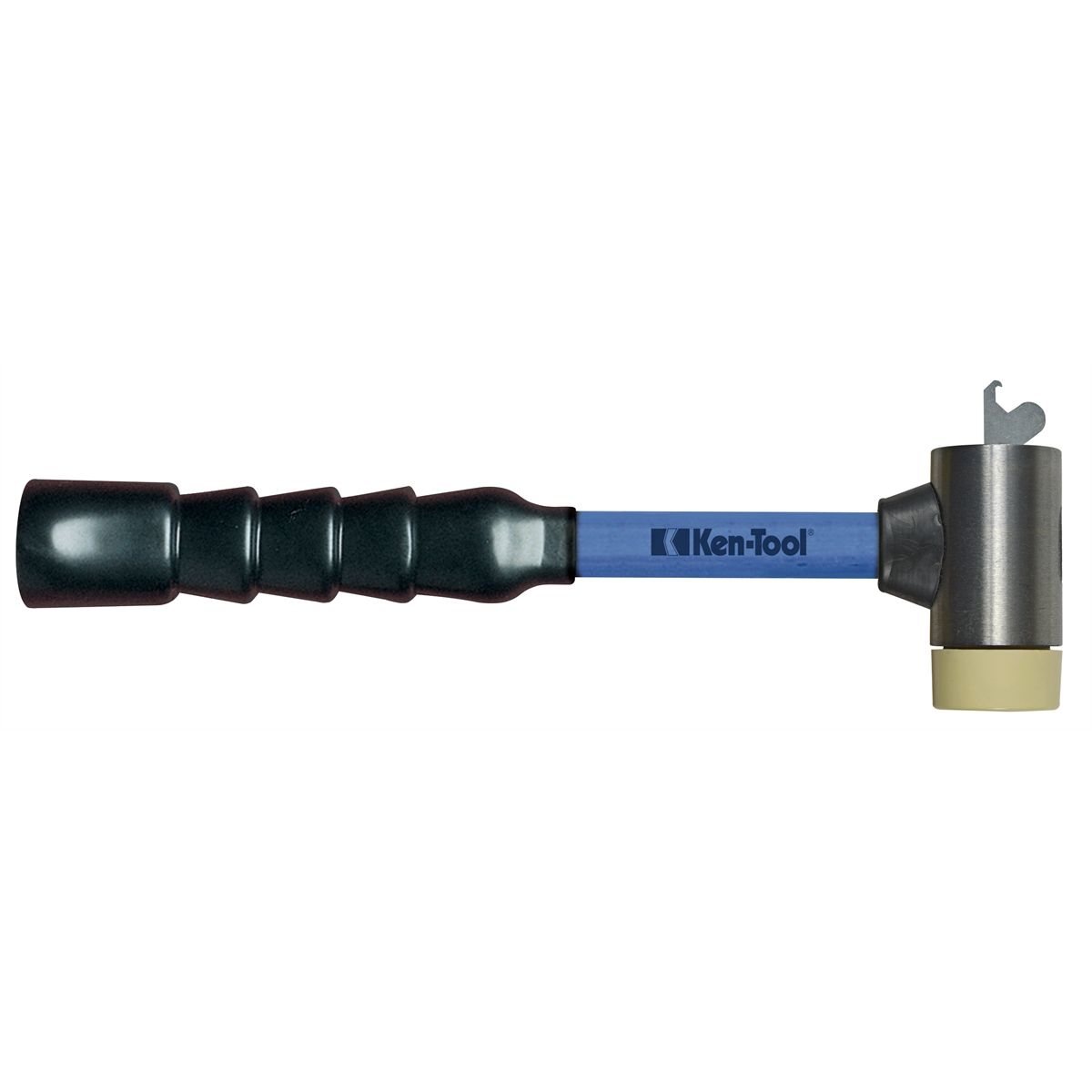
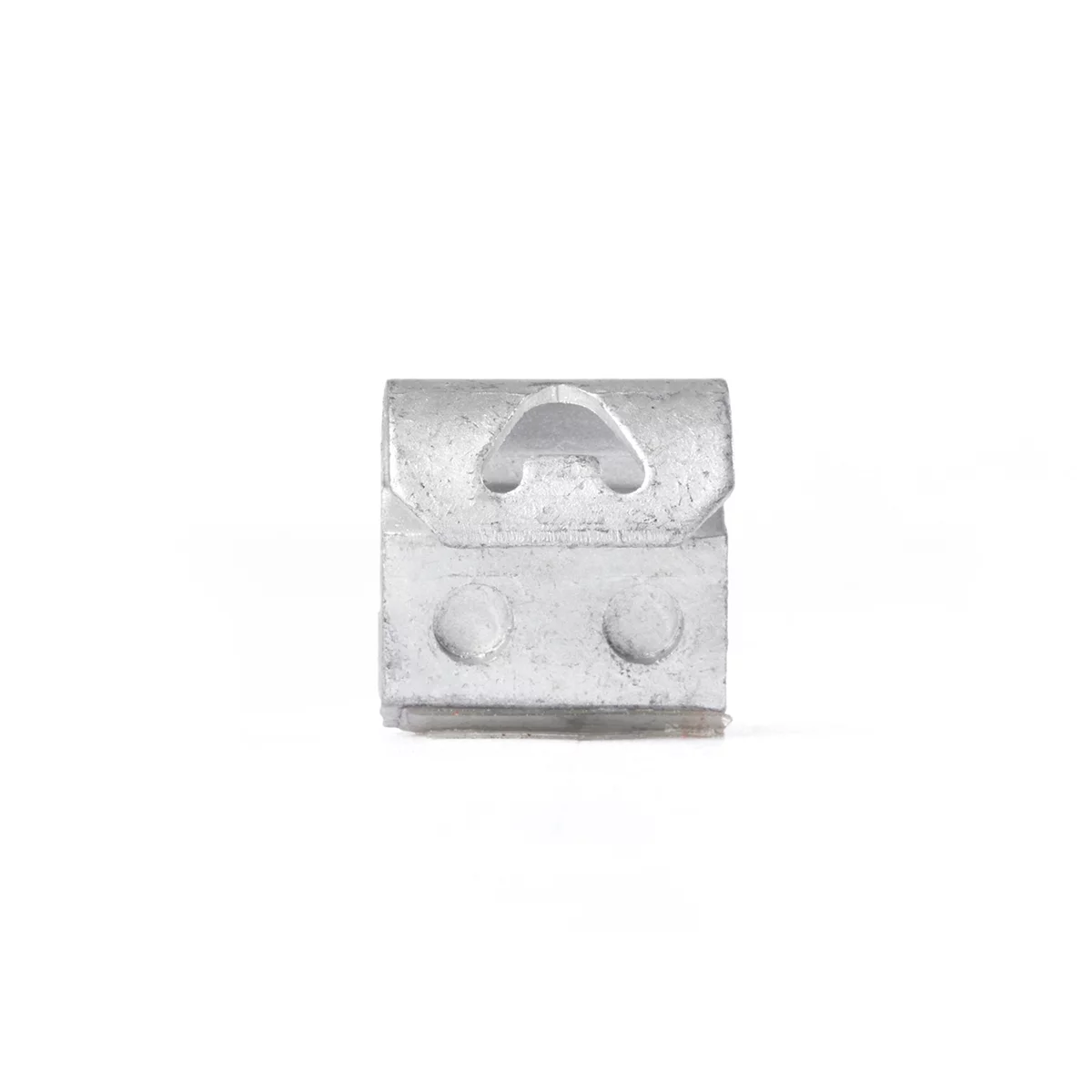
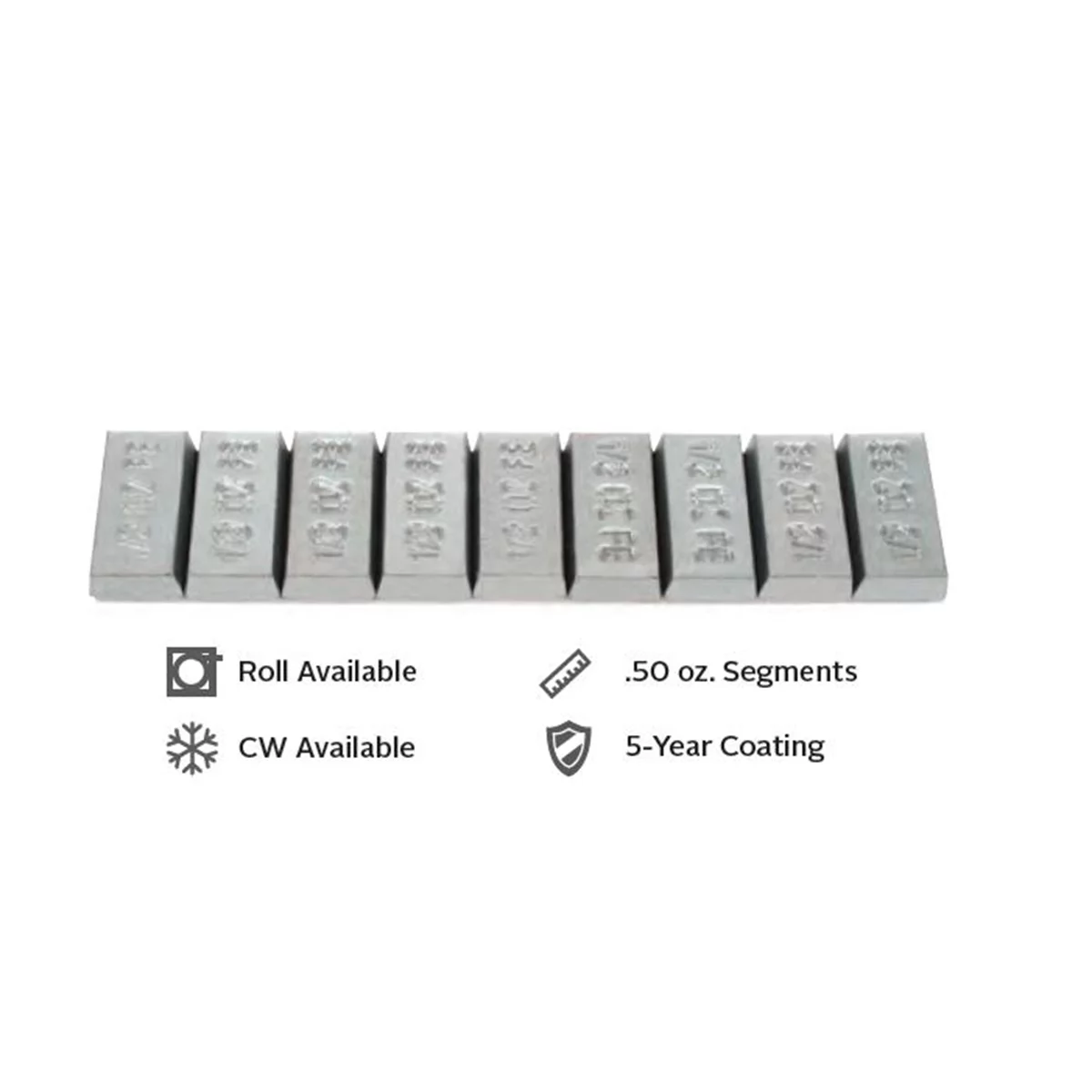
TMR 0.25 oz MCFE Series Steel Clip Wheel Weight (Box of 50)
Mfg: Tire Mechanic's Resource
Part #: MCFE025
FAQs
How much wheel weight is considered normal?
Most factory and quality aftermarket wheel-and-tire combinations balance out with well under an ounce, and rarely more than 1–2 ounces total split between planes. Needing several ounces, especially stacked in multiple spots, points to a wheel, tire, or mounting issue rather than a “difficult” but otherwise normal balance.
Is it ever correct to put weight on opposite sides of a wheel?
Yes, when it’s two-plane dynamic balancing — weight on the inboard flange and weight on the outboard flange at different clock positions is standard and doesn’t cancel out because the planes are separate. It’s only a mistake when weight is stacked directly opposite itself on the same plane, which effectively nets out to nothing useful.
What is road force balancing and when should it be used?
Road force balancing uses a loaded roller to simulate driving load against the tire, revealing radial force variation that a standard spin balance can’t detect. Use it whenever a normal balance is calling for excessive weight or a customer reports a vibration that a standard balance didn’t resolve.
Can a bent wheel be balanced with enough weight?
Weight compensates for mass imbalance, not for physical radial or lateral runout. A bent wheel can sometimes be made to read “zero” on a basic balancer with enough weight, but it will still ride poorly and often continue to vibrate, because the underlying geometry problem hasn’t been corrected.
Why do cheap aftermarket wheels need more weight to balance?
Budget wheels, especially those drilled for multiple bolt patterns, are more prone to casting inconsistencies, off-center bores, and minor runout from manufacturing. These imperfections force the balancer to correct for real physical variation, unlike a precision-made factory or premium aftermarket wheel.
Should a customer request to watch the balance process?
Yes — most shops will let a customer watch the wheel spin on the machine and see the readout before and after weights are applied. This is a reasonable ask, especially after a comeback complaint, and a shop that’s confident in its work shouldn’t hesitate to show the process.
Recommended Tools for Wheel Balancing
Getting accurate balance results requires the right equipment and a disciplined approach. Browse our Tire Tools, Wheels & Suspension selection for balancing weights, adapters, cones, and diagnostic tools.
- Wheel weights and adhesive compounds for precision correction
- Balancer adapters and mounting cones for proper wheel seating
- Tire mounting and diagnostic tools

The Toolsource Technical Team blends decades of real-world automotive service experience with up-to-date technical research. Our writers collaborate with professional mechanics, shop owners, and diagnostic specialists to deliver practical, workshop-ready guidance you can trust.


Follow us on social media