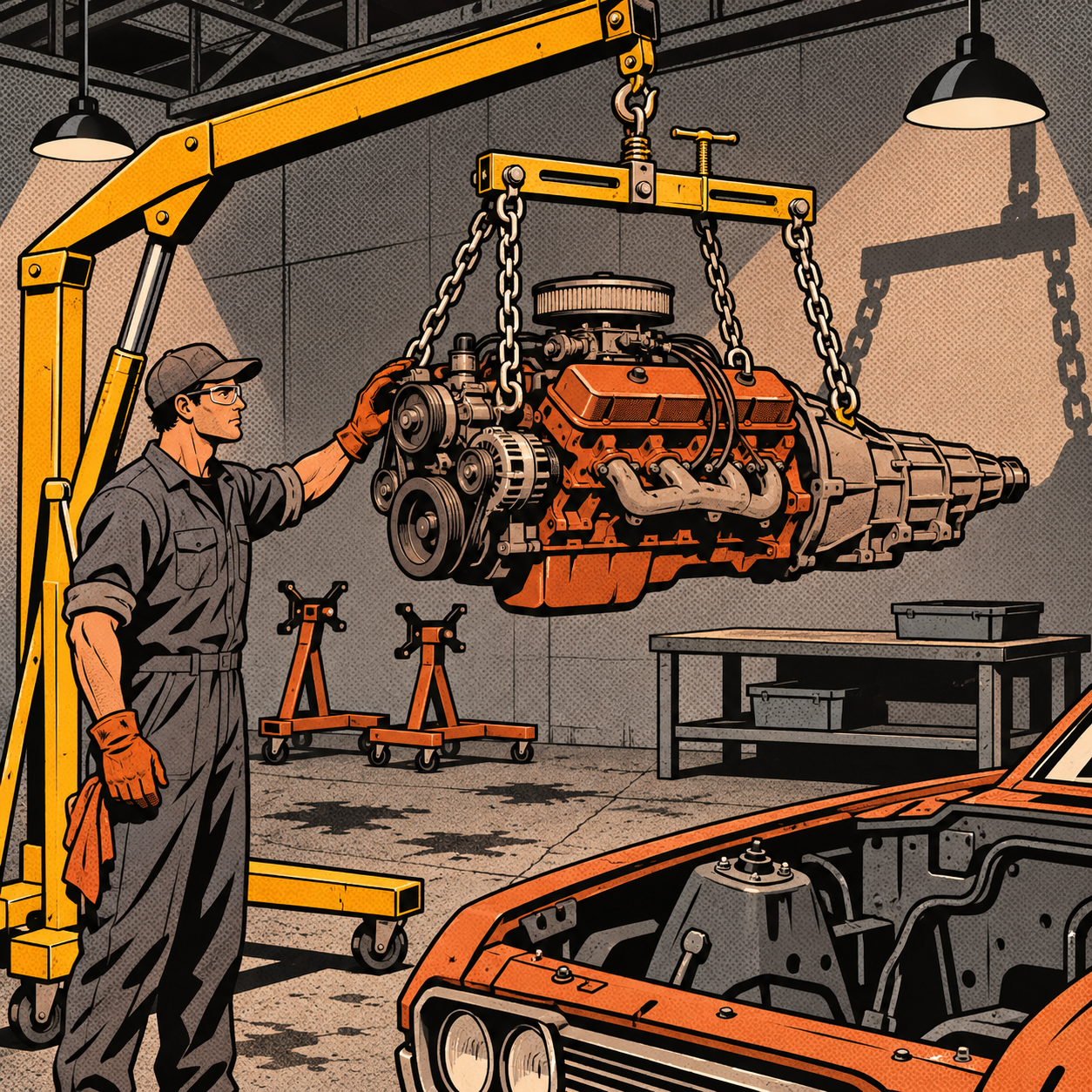
A video making the rounds shows a salvage yard worker carrying a complete engine and transmission assembly on his back, up a ramp, with nothing but a shoulder pillow for padding. It’s impressive in the way a car crash is impressive. It’s also a near-perfect illustration of how techs end up with herniated discs, blown knees, and permanent restrictions by age 40. An assembled 4-cylinder engine with the transaxle attached can easily run 400-500 lbs; a V8 with an iron block, heads, and a transmission can clear 700-800 lbs. None of that belongs on a human spine, no matter how strong you are at 22. This guide covers the equipment, rigging, and technique that let you pull and install engines and transmissions without becoming the next cautionary story.
Know What You’re Actually Lifting
Before you touch a hoist chain, get a real number — or at least a real range — for the assembly you’re moving. Techs consistently underestimate total weight because they’re mentally pricing the bare block, not the block plus heads, intake, accessories, flywheel, and whatever’s still bolted to the back of it.
- Aluminum 4-cylinder, bare long block: roughly 150-250 lbs
- Aluminum 4-cylinder with transaxle attached: 350-500 lbs
- Cast iron V8 long block: 400-550 lbs
- Cast iron V8 with transmission attached: 600-800+ lbs
- Diesel inline-6 or V8 (cast iron head and block): 800-1,200+ lbs
A 6.7L diesel head alone can weigh more than some entire small-block aluminum engines — comments on the original video pointed this out, and it’s true. Treat every pull as unknown weight until you’ve looked it up, because “it didn’t look that heavy” is how people hurt themselves on something they could normally handle fine, just not in that position or at that angle.
Match the Hoist and Rigging to the Job
A 2-ton engine hoist is standard in most shops, but tonnage rating alone doesn’t tell the whole story. Boom extension matters: fully extended for reach, most hoists are only rated for a fraction of their folded-in capacity. Check the capacity plate at the boom length you’re actually using, not the max rating printed on the box.
Rigging matters as much as the hoist itself:
- Use a load leveler or adjustable engine leveler, not a single chain through one lift point. A single-point lift on an unbalanced assembly swings and can shock-load the hoist or drop a corner into the fender or radiator support.
- Bolt into factory lift points or solid cast bosses — intake manifold bolts, accessory brackets, or thin sheet metal are not rigging points.
- Inspect chains and hooks for stretched links, cracked welds, or missing safety latches before every pull, not once a quarter.
- When the transmission is coming out with the engine, support the trans independently with a transmission jack or support strap before you break the final mounts — don’t let the hoist chain take torsional load it wasn’t rigged for.
===FYP-PRODUCTS-MID===


Use a Transmission Jack — Don’t Hand-Walk It
Transmissions get hand-carried more often than engines because they look smaller, but a cast-iron automatic with a torque converter and bellhousing easily hits 150-250 lbs, and it’s an awkward, off-balance shape with no good grip points. A transmission jack with a tilting, swiveling saddle lets you align splines and dowels without muscling the case into position. If you’re pulling a transmission on a lift, cradle it fully before the last bolts come out; don’t let it hang on one or two fasteners while you “walk it down” by hand. If your shop doesn’t have a dedicated transmission jack, a low-profile floor jack with a padded saddle adapter is the minimum acceptable substitute — bare floor jack arms are not.
When You Have to Muscle Something, Do It Right
Not every job justifies pulling out the hoist — a sensor, a small accessory bracket, or a light component might genuinely be a one-person carry. When you do lift something heavy by hand, the basics still apply even though every tech has heard them a thousand times: keep the load close to your body, bend at the hips and knees rather than rounding your back, avoid twisting under load, and get a second set of hands for anything over roughly 50 lbs or anything awkwardly shaped. A short block might be “liftable” in isolation, but add a transmission, intake, or exhaust manifold and the center of gravity shifts far enough that a lift you could normally control becomes one you can’t. If a load requires bracing it against your chest, shoulder, or back to control it, that’s the signal to stop and get equipment, not a sign you’re strong enough to finish the job.
Build Safe Lifting Into Shop Habits, Not Just Policy
Printed safety rules don’t stop injuries if the shop culture rewards speed over caution. A few habits actually change outcomes:
- Stage the hoist and jack stands before you start pulling bolts, so there’s no temptation to “just hold it a second” by hand while equipment is still being fetched.
- Normalize asking for a second person. The comment thread on the original video was full of techs admitting they needed help with a transfer case or a head — that’s not a lack of strength, it’s normal for awkward, heavy components.
- Rotate younger or newer techs through proper hoist and jack use early, rather than letting “the strong guy” become the default solution for every heavy lift. Relying on one person’s back is a single point of failure for your shop.
- Track near-misses, not just injuries. A chain that slipped or a load that swung unexpectedly is useful data even if nobody got hurt.
Quick Pre-Lift Checklist
- Confirmed approximate weight of the full assembly (engine + attached components)
- Hoist capacity verified at the boom length you’re using
- Rigging attached to factory lift points, load leveler in place
- Transmission independently supported before final separation
- Chains, hooks, and jack saddles inspected for damage
- Second person available for guiding, steadying, or spotting
- Clear path to the engine stand or bench before the lift starts
===FYP-PRODUCTS-END===


FAQs
How much does an average engine and transmission weigh together?
It varies widely by application, but a complete 4-cylinder engine and transaxle commonly falls in the 350-500 lb range, while a V8 with a transmission attached can reach 600-800 lbs or more. Diesel applications with cast iron heads and blocks routinely exceed 1,000 lbs. Always check figures for your specific engine family rather than assuming.
Can I use a floor jack instead of a dedicated transmission jack?
A standard floor jack lacks the tilt and swivel needed to align a transmission with the engine or bellhousing, and its saddle isn’t shaped to cradle the case securely. A padded adapter on a low-profile jack is a workable backup, but a real transmission jack is safer and faster for regular use.
What’s the biggest rigging mistake techs make when pulling an engine?
Single-point lifting without a load leveler. It causes the assembly to hang unevenly, which increases the chance of the load swinging, contacting body panels, or shock-loading the hoist chain when it shifts.
Is it ever acceptable to hand-carry an engine short block?
A small, bare, aluminum short block with no accessories might be manageable for an experienced tech over a short distance, but it’s never advisable as standard practice, and it’s a bad idea the moment a transmission, intake, or exhaust components are still attached. Equipment exists specifically because body position and fatigue make hand-carrying unpredictable.
How often should engine hoist chains and hooks be inspected?
Visually inspect before every use, not on a fixed schedule. Look for stretched or deformed links, cracked welds at the hook, and a functioning safety latch. Retire any chain or hook showing wear rather than continuing to use it “until it fails a formal inspection.”
What’s a reasonable weight threshold for requiring a second person?
Most shop safety guidance puts the solo-lift threshold around 50 lbs for awkward or overhead loads, lower than for a compact, easy-to-grip object. For anything resembling an engine component, transmission, or transfer case, treat it as a two-person or hoist-assisted job regardless of exact weight.
The Right Lifting Equipment
The techniques in this guide require proper equipment. Our lifting equipment selection includes hoists, transmission jacks, load levelers, and rigging hardware rated for safe engine and transmission removal.
- Engine hoists with verified capacity at your working boom length
- Transmission jacks with tilt, swivel, and secure cradle capability
- Load levelers, chains, hooks, and inspection gear

The Toolsource Technical Team blends decades of real-world automotive service experience with up-to-date technical research. Our writers collaborate with professional mechanics, shop owners, and diagnostic specialists to deliver practical, workshop-ready guidance you can trust.


Follow us on social media