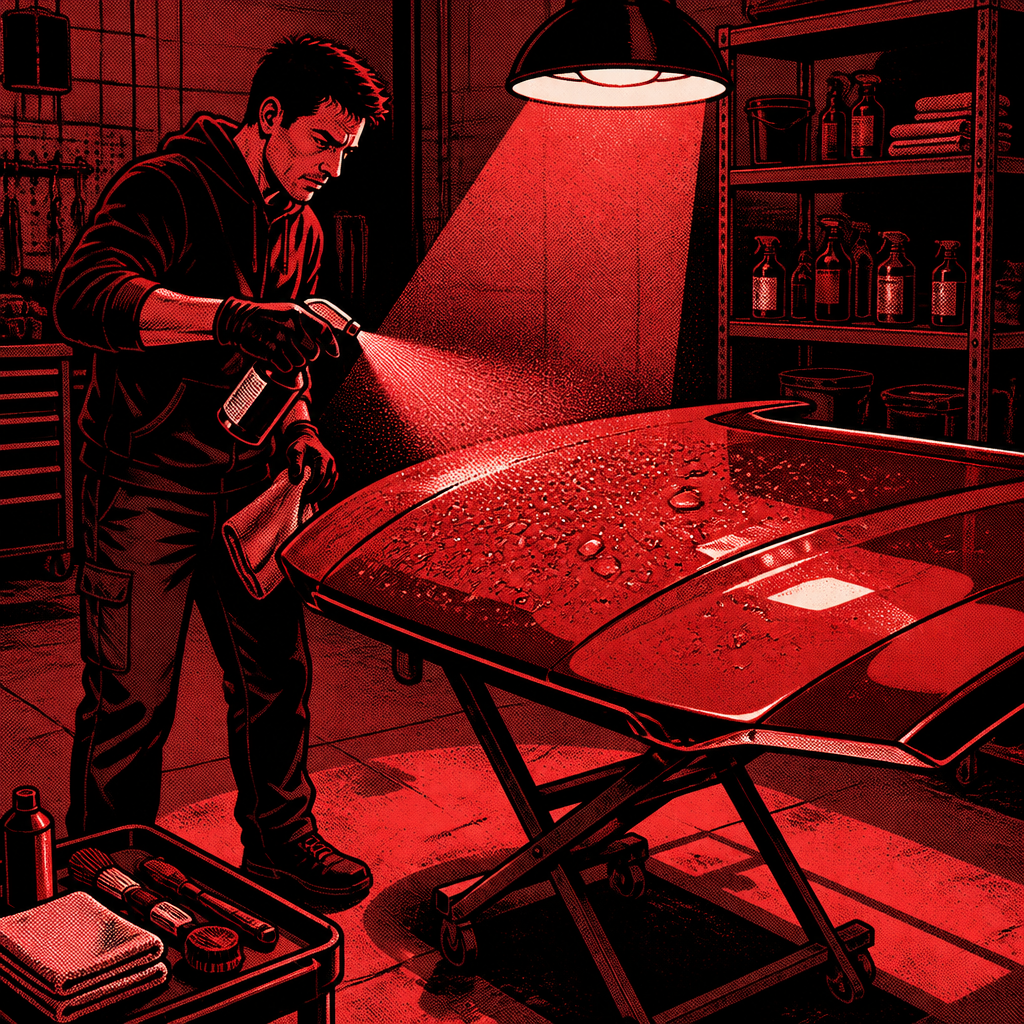
Spray-on ceramic boosters and quick-detail sealants have shifted a lot of detailing workflow away from full paste-wax sessions, but they only deliver consistent results when the underlying chemistry and application steps are understood rather than guessed at. This guide walks through what these products are actually doing on the panel, how pre-wash choices affect their performance, and how to diagnose water spotting instead of just fighting it after the fact—information every shop or serious DIY tech should have dialed in before the next seasonal push.
What Spray Sealants and Ceramic Boosters Are Actually Doing
Most modern spray sealants and “bead” boosters rely on quaternary ammonium compounds or silane/siloxane chemistry to bond a thin hydrophobic layer to clear coat, glass, and even trim. The active ingredient in many of these—compounds like [3-(trimethoxysilyl)propyl]dimethyloctadecylammonium chloride—is well documented as strongly hydrophobic. That’s the mechanism behind the tight beading and sheeting action customers notice immediately after application.
What these compounds are not inherently engineered to do is prevent mineral deposition, which is the actual cause of water spotting. Hydrophobicity changes how water behaves on the surface (beading, sheeting, faster runoff) but doesn’t by itself dissolve or repel the calcium, silica, and other dissolved solids left behind when water evaporates. When a tech sees reduced water spotting after applying one of these products, it’s worth separating two variables: the coating’s surface energy, and how much water was actually left on the panel to evaporate in the first place. Conflating the two leads to false confidence in a product’s spec sheet claims.
Practically, this means spray sealants are best treated as a maintenance layer over a proper base protection (wax, sealant, or coating) rather than a standalone water-spot solution. They extend gloss, add slickness for the next wash, and buy time between full details—but they don’t replace correct drying technique.
Pre-Wash Chemistry Sets Up Everything Downstream
The condition of the surface going into a sealant application determines how well that sealant bonds and performs. An alkaline pre-wash—something like a snow foam or dedicated pre-rinse product used at a low dilution (roughly 1–2% depending on the product and soiling level)—strips road film, traffic film, and oxidized residue before any contact wash happens. This matters for two reasons on a technician’s checklist:
First, it reduces the mitt and towel contact needed during the actual wash, which is the single biggest controllable factor in swirl and marring. Second, it removes the grime layer that would otherwise interfere with sealant bonding, since most hydrophobic chemistry needs a genuinely clean, oil-free surface to cross-link properly rather than sitting on top of residue.
Techs should not default to an alkaline pre-wash on every vehicle. It’s a tool for heavier soiling or when a vehicle hasn’t been washed in a while—not a routine step on a lightly used, already-coated daily driver, where a straight pH-neutral wash is gentler on existing protection. Matching the pre-wash strength to the actual soil load, rather than running the same routine on every car, is what separates a repeatable process from wasted product and unnecessary abrasion risk.
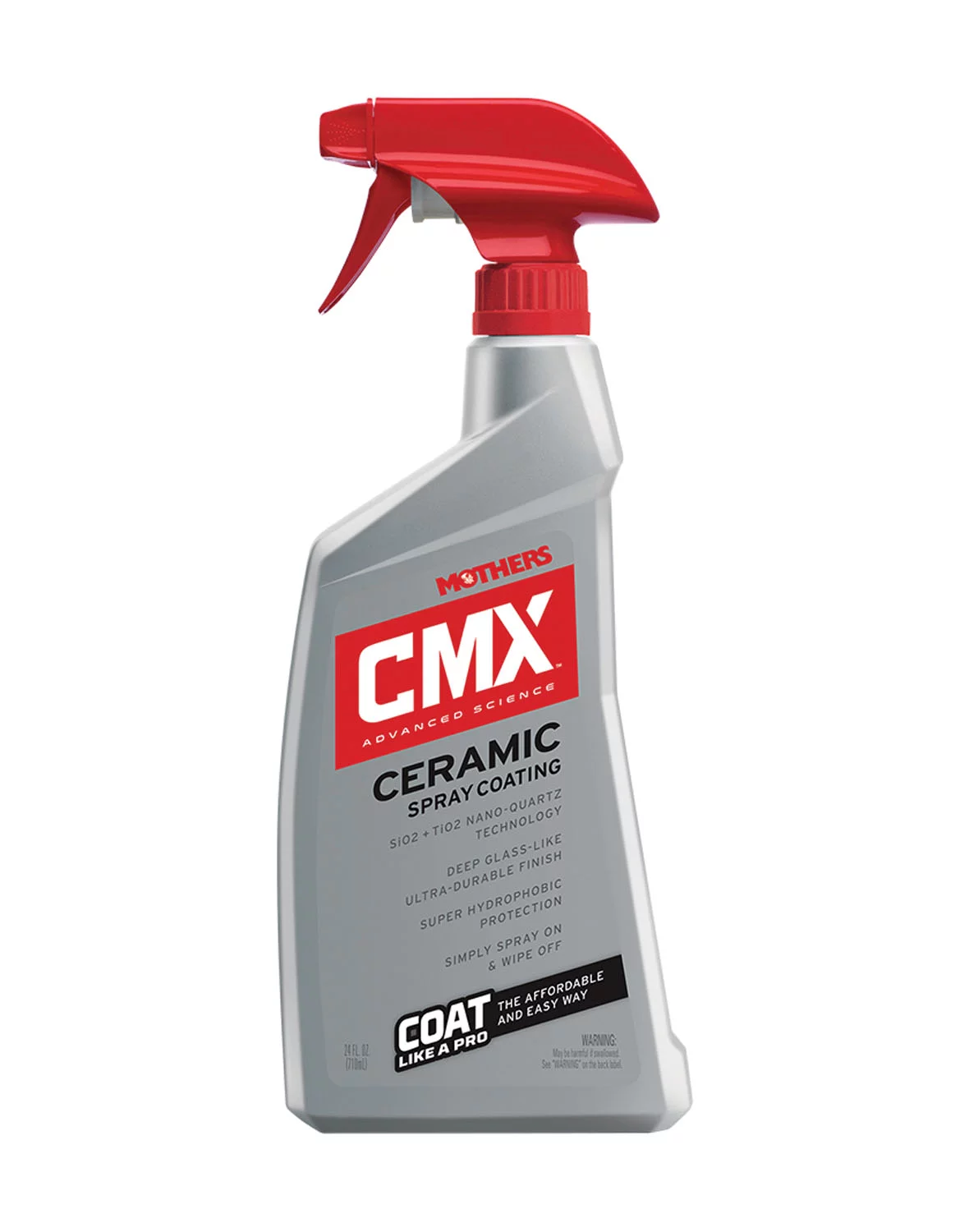

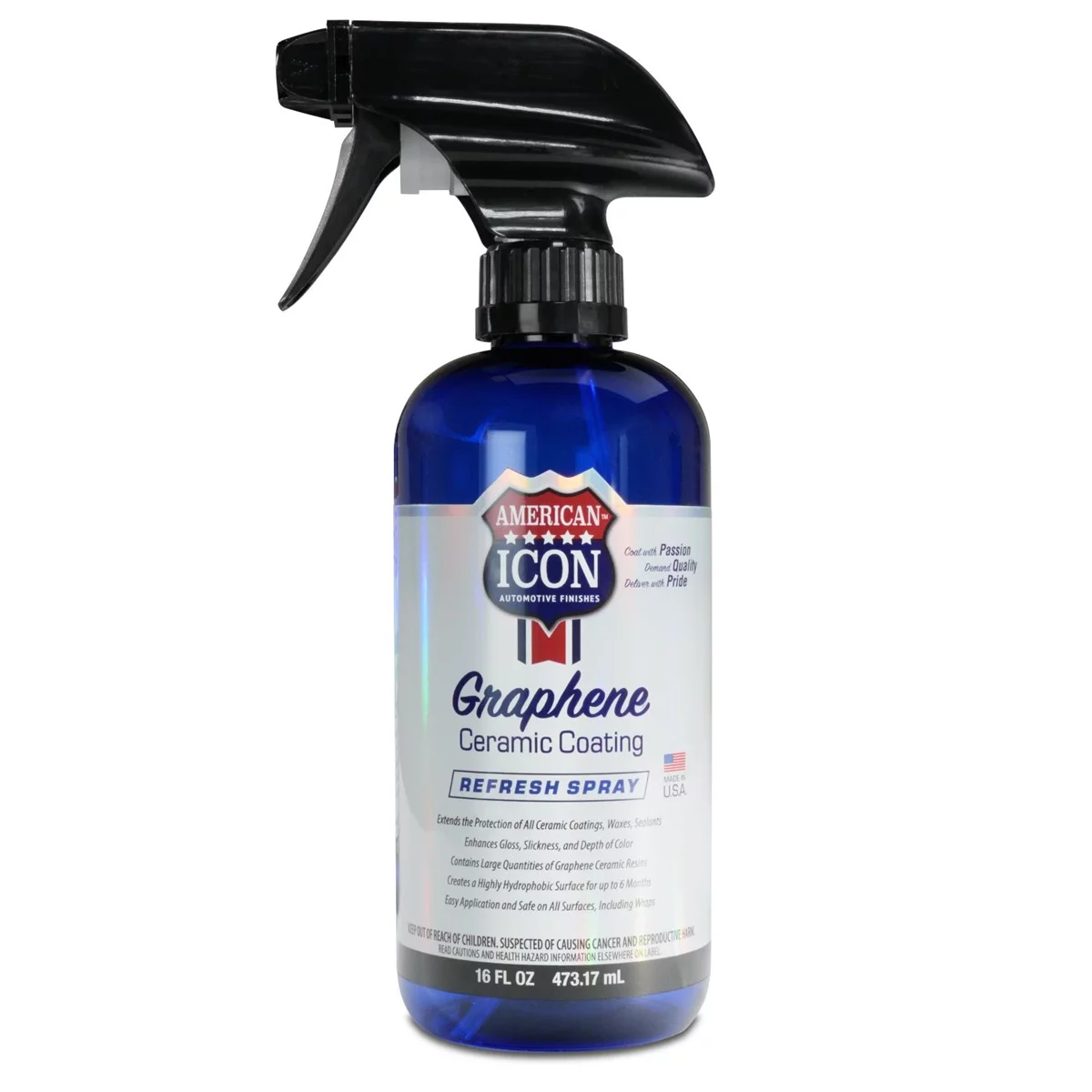
Wheel Coatings: Ceramic vs. Wax-Based Options
Wheels see more thermal cycling, brake dust, and abrasive contamination than any other painted or coated surface on the vehicle, so coating choice matters more here than almost anywhere else. Ceramic-style wheel coatings (branded products marketed as high-temperature ceramic finishes) are generally chosen for their resistance to brake dust bonding and their ability to survive repeated washing without stripping.
A recurring field observation worth passing on to customers: some wax-based or hybrid sealants formulated for wheels can actually shed less accumulated dirt and grime over time than a harder ceramic coating, while also avoiding the “grabby” or tacky feel some ceramic wheel coatings develop as they age between washes. That grabby sensation—felt when a wash mitt or brush drags across the coated wheel face—is a sign of surface degradation or contamination bonding to a coating that’s lost some of its slickness, not necessarily a coating failure outright.
For a shop setting, this means wheel coating selection should be based on the vehicle’s use case: high-mileage daily drivers in dusty or salted climates may do better with an easier-to-maintain wax-based sealant reapplied more frequently, while show cars or low-mileage vehicles can justify a harder, longer-lasting ceramic wheel product with less frequent maintenance.
Drying Technique and Real-World Water Spot Diagnostics
Water spotting is fundamentally a function of how long water sits on a surface and evaporates unassisted, concentrating dissolved minerals as it does. Techs can use this as a diagnostic tool: track how much of the vehicle beads and sheets water off within the first minute or two after a wash rinse, panel by panel. A surface with strong, intact protection will visibly shed the bulk of standing water almost immediately, leaving only fine droplets for a towel or blower to finish. As that sheeting action weakens over weeks of washing and UV exposure, it’s a reliable early sign that a sealant or coating layer needs reapplication—well before spotting or reduced gloss becomes visually obvious.
Vertical glass, particularly rear glass and backlights, is disproportionately prone to water spotting compared to hood or roof panels, largely because of airflow patterns, angle of evaporation, and the fact that glass coatings tend to be applied less consistently than paint sealants. Cleaning glass last in the detail sequence—after all other panels are done—reduces the chance of transferring wash residue or towel contamination onto glass right before it’s inspected.
Forced-air drying (blower) immediately after the final rinse remains the most reliable way to prevent spotting regardless of what sealant is in use, because it removes standing water before evaporation concentration can occur. Where forced-air drying isn’t practical, a clean, dedicated waffle-weave or silk drying towel used with minimal panel contact and frequent rinsing is the next-best option.
Interior Fabric and Multi-Surface Protectants
Some of the same hydrophobic quaternary ammonium chemistry used on paint and glass is cross-marketed for interior fabric and leather, often citing antimicrobial or odor-resistance properties borrowed from textile and footwear industry applications. On seating fabric specifically, techs should set expectations carefully: these products are not reliably going to make cloth seats visibly hydrophobic the way they do on paint, since fabric’s porosity and fiber structure behave very differently from a sealed clear coat.
Any antimicrobial or odor-control claim from a multi-surface spray is difficult to verify without lab-grade testing (growth medium, controlled sampling), so this is not something to promise customers as a guaranteed outcome—frame it as a possible secondary benefit of the product rather than a core selling point. Where these sprays are genuinely useful is as a light, no-residue refresh between deeper interior details, applied sparingly and evaluated on a low-visibility test spot first, especially on lighter fabric or leather that could show staining.
Quick Application Checklist
- Match pre-wash strength (pH-neutral vs. alkaline) to actual soil load, not a fixed routine
- Apply sealants and coatings to a fully decontaminated, oil-free surface
- Track sheeting/beading speed panel-by-panel as an early indicator of coating wear
- Prioritize forced-air drying immediately after final rinse to prevent mineral concentration
- Clean glass last in the sequence to avoid residue transfer before inspection
- Spot-test any fabric or leather protectant before full-interior application
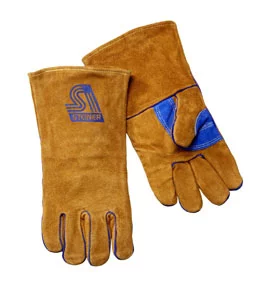
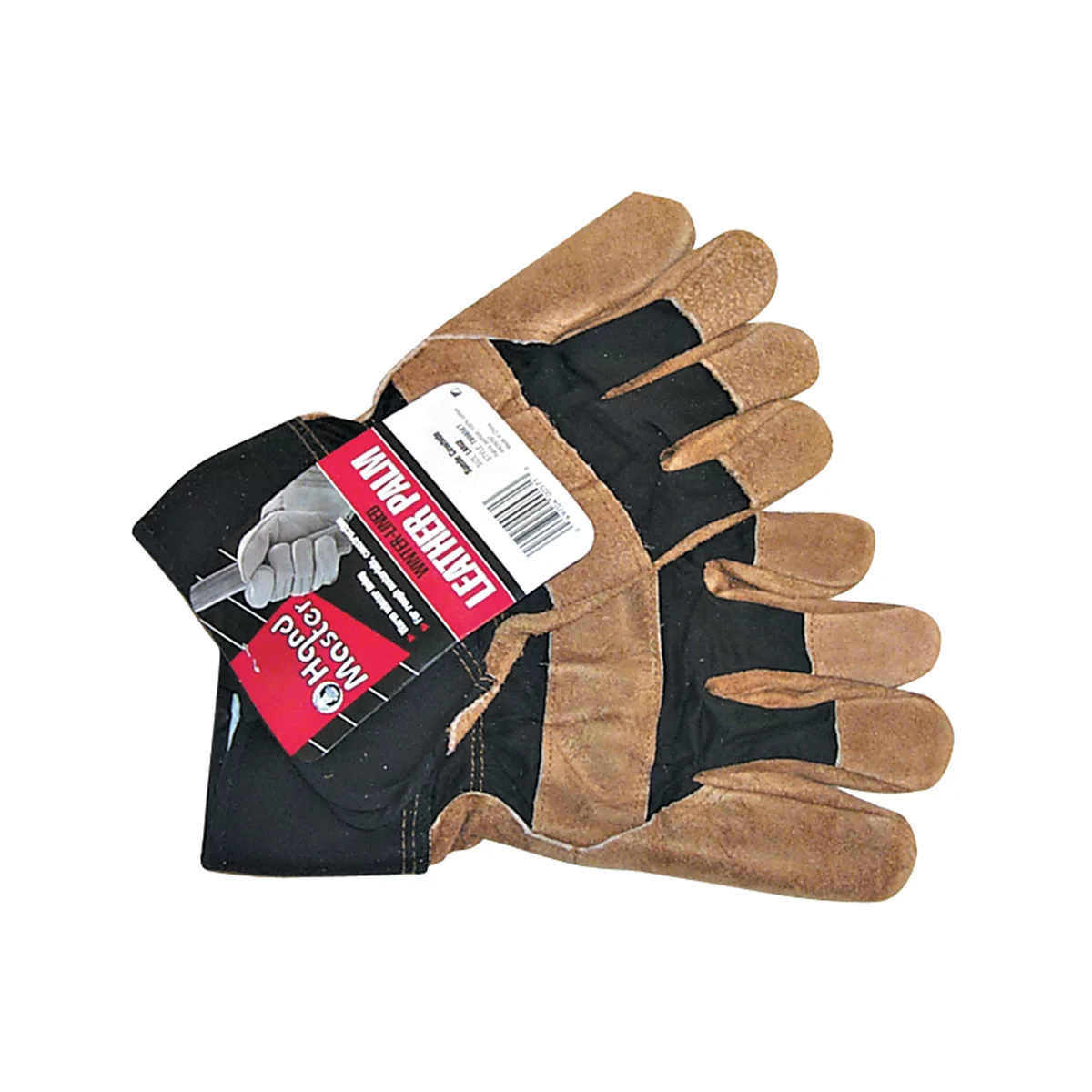
B Series Foam Lined Leather Welding Gloves (Brown L)
Mfg: Steiner Industries
Part #: 2119B
Frequently Asked Questions
Do hydrophobic sprays actually prevent water spots?
Not directly. They change how water beads and sheets off a surface, which reduces the volume and dwell time of standing water, but the actual spotting is caused by mineral deposits left after evaporation. Faster sheeting reduces the opportunity for spots to form; it doesn’t chemically prevent mineral deposition itself.
How often should a spray sealant or ceramic booster be reapplied?
There’s no universal interval—it depends on wash frequency, climate, and UV exposure. Use sheeting/beading performance as the trigger: once water stops sheeting quickly and starts sitting flatter on the surface, it’s time to reapply rather than waiting for a fixed calendar date.
Is an alkaline pre-wash safe to use every time?
It’s safe on paint when properly diluted, but it’s not necessary on every wash. Reserve stronger alkaline pre-washes for heavier soiling and use a pH-neutral pre-wash or straight rinse on vehicles washed frequently or carrying newer sealant/coating layers.
Why does my rear glass water spot more than the rest of the car?
Vertical rear glass typically has less consistent coating coverage, different airflow during drying, and a steeper evaporation angle than hood or roof surfaces, making it more prone to spotting even when the rest of the vehicle is well protected.
Are ceramic wheel coatings better than wax-based wheel sealants?
Not universally—ceramic coatings generally resist brake dust bonding better and last longer, but some wax-based sealants shed grime just as well while staying slicker over time and avoiding the tacky “grabby” feel aged ceramic coatings can develop. Choice should be based on vehicle use and maintenance frequency.
Can interior sprays with antimicrobial claims be trusted?
Treat these claims as unverified without lab testing. The chemistry has documented antimicrobial use in other industries, but confirming that effect on treated fabric in the field isn’t practical, so it shouldn’t be presented as a guaranteed benefit.
Related Products
Our Paint & Body category carries the spray sealants, ceramic coatings, and tools needed to apply the techniques covered in this guide.
- Spray sealants and ceramic boosters for paint and glass
- Wheel coatings and brake dust-resistant finishes
- Drying towels and application equipment

The Toolsource Technical Team blends decades of real-world automotive service experience with up-to-date technical research. Our writers collaborate with professional mechanics, shop owners, and diagnostic specialists to deliver practical, workshop-ready guidance you can trust.


Follow us on social media