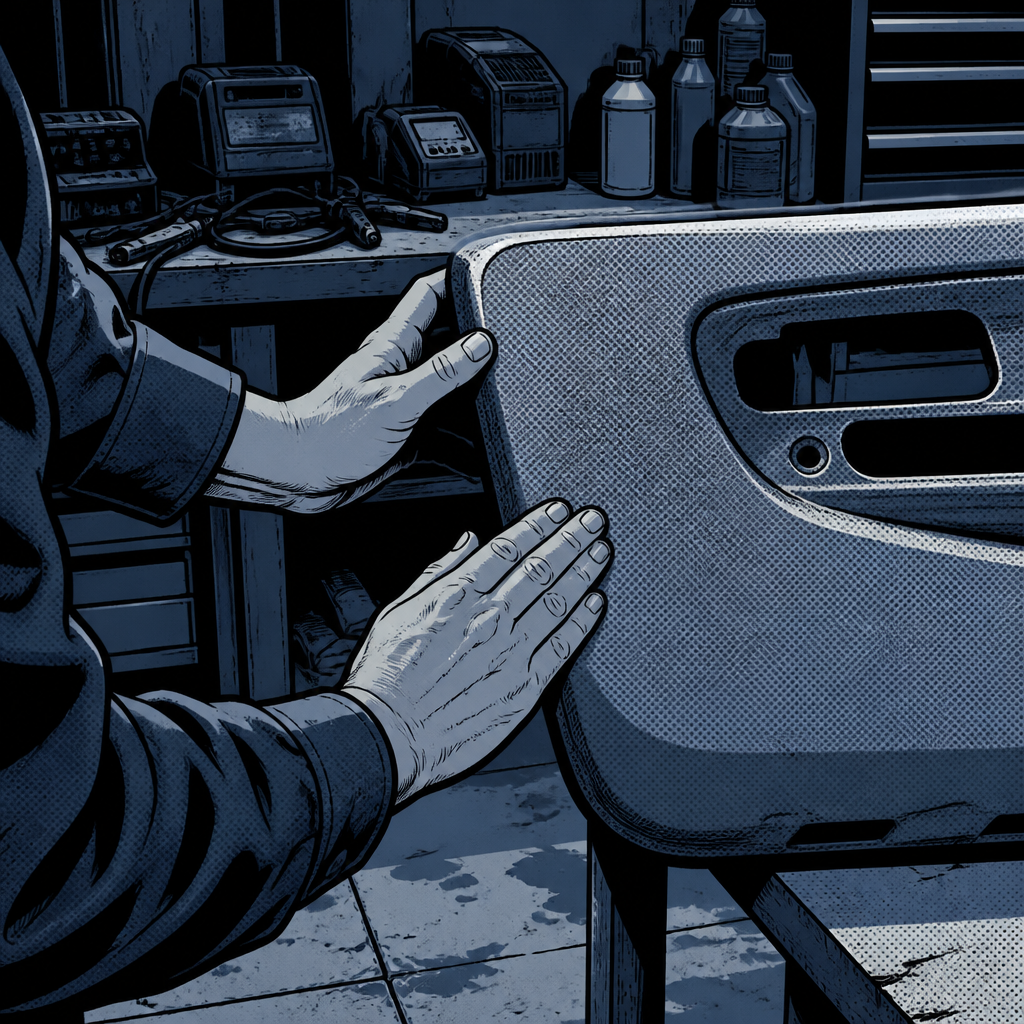
Saturn stopped building cars in 2009 and the brand was fully wound down by 2010, but plenty of these vehicles are still rolling into shops today — some with well over 200,000 miles on the original drivetrain. What made Saturn distinctive wasn’t badge engineering; it was polymer composite body panels that resisted dents and never rusted. That same construction now presents a unique set of inspection and repair challenges as these cars age past two and even three decades. This guide covers what technicians need to know when a Saturn — especially an S-series (SL/SL1/SL2/SC) or early Ion — rolls onto the lift.
What Made Saturn’s Construction Different
From the original 1991 S-series through the mid-2000s, Saturn used a space-frame chassis with door skins, fenders, and other body panels molded from reinforced polymer resin rather than stamped sheet metal. The panels were designed to flex on minor impact and pop back into shape, which is why decades-old Saturns often show zero door dings even in high-traffic parking lots. There’s no sheet metal to rust, so the usual rocker panel and wheel-well corrosion checks that dominate inspections on comparable-age domestic cars largely don’t apply here.
Later models — Ion, Vue, Aura, Sky, and the final Astra/Outlook generation — moved back toward conventional steel panels or GM/Opel-shared platforms as the brand was folded deeper into GM’s global lineup. Before quoting any bodywork, confirm which construction era you’re dealing with. A VIN decode or a simple magnet test on the fenders will tell you immediately whether you’re working with polymer or steel.
Inspecting Polymer Panels for Age-Related Brittleness
The tradeoff for dent resistance is long-term UV and cold-weather degradation. Composite panels that were pliable when new become progressively more brittle with age, and enough owners and dealership techs have reported panels cracking or shattering — particularly in cold climates or after impacts that would have simply bounced back on a newer panel — that it’s worth treating this as a standard inspection point, not an edge case.
- Flex-test panels by hand at the corners and around wheel arches; listen and feel for stress cracking rather than the expected elastic give.
- Check panel edges and mounting points where clips and fasteners attach — this is where composite fatigue concentrates first.
- Inspect for surface crazing (fine web-like cracks), which indicates UV breakdown of the outer coating and predicts reduced impact tolerance.
- Note ambient temperature during inspection. Cold panels are measurably more brittle; a pre-purchase or insurance inspection done in winter should account for this.
Document findings with photos before any panel work — composite cracking is easy to mistake for impact damage after the fact, which matters for warranty or insurance conversations.
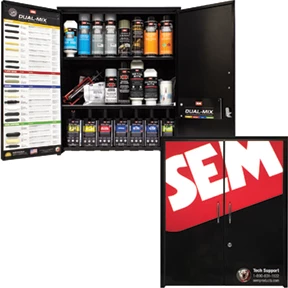
Panel Bonding, Plastic Repair, Corrosion Protection Shop Cabinet
Mfg: Sem Products
Part #: 70080
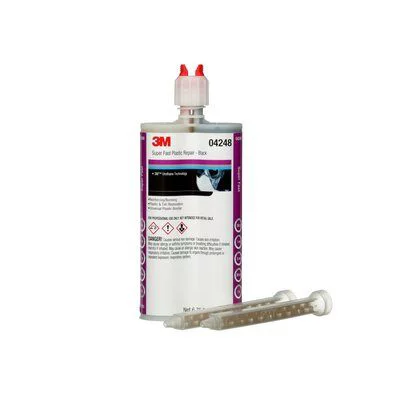
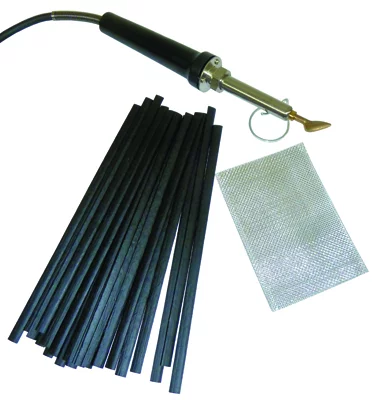
Panel Repair and Replacement Techniques
Composite panels don’t respond to conventional metal body repair methods. You can’t pull, hammer, or weld them back into shape, and standard body filler adheres poorly to the flexible resin surface without proper prep.
- Use flexible panel adhesive systems rated for reinforced composite/SMC panels rather than rigid epoxy fillers, which will crack loose under normal panel flex.
- Surface-prep with an adhesion promoter designed for plastic/composite substrates — skipping this step is the most common cause of repair failure and repeat comebacks.
- For panels showing widespread crazing or multiple stress cracks, replacement is usually more cost-effective than repair, since crazed material continues to fail around any patched area.
- When replacing, source panels from the correct model year — Saturn changed resin formulations and mounting hardware across its production run, and mismatched panels won’t align on the space-frame mounts.
Paint compatibility is worth flagging to customers: composite panels require flexible basecoat/clearcoat systems. A rigid automotive clearcoat applied without a flex additive will craze independently of the substrate within a season or two, even on a panel in good condition.
Engine and Drivetrain Checks on High-Mile Saturns
The 1.9L SOHC/DOHC four-cylinder that powered most S-series Saturns has a strong reputation for longevity when maintained on schedule, with plenty of examples still running well past 200,000 miles. That reputation is earned through basic, consistent maintenance rather than any exotic engineering — which is good news for shops servicing these cars now, since the failure points are predictable.
- Motor mounts wear faster than average on these cars; a rough idle or clunk on shift is more often a mount issue than an engine problem. Inspect all three mount points during any drivetrain service.
- Check timing chain/belt service intervals against the specific engine code — S-series 1.9L used both SOHC and DOHC variants with different service schedules.
- Manual transmissions are common on these cars and generally durable, but clutch hydraulics (slave/master cylinders) are a frequent failure point worth checking on any car with a soft or inconsistent pedal.
- Cooling system components, particularly plastic end-tank radiators and intake manifold gaskets, are the most common age-related failure points and should be part of any pre-purchase or high-mileage inspection.
Sourcing Parts for a Discontinued Brand
Saturn’s dealer network and OEM parts pipeline shut down with the brand, which changes how techs need to approach parts sourcing compared with an active GM nameplate.
- Many drivetrain and mechanical components were shared with other GM platforms of the era and remain available through standard aftermarket channels — cross-reference part numbers rather than assuming Saturn-specific parts are required.
- Composite body panels are the hardest category to source. Salvage yards remain a legitimate source given how well these panels survive; check condition carefully using the brittleness inspection above before installing a used panel of unknown age and storage history.
- Owner and enthusiast communities maintain active parts networks and documentation for the S-series and Ion in particular — useful for identifying panel revisions and mount hardware differences that aren’t otherwise documented.
- Set customer expectations early on lead time for body parts; mechanical and electrical parts are usually straightforward, but panel sourcing can take considerably longer than a same-week metal panel order.
Quick Inspection Checklist
- Confirm construction era (composite vs. steel panels) via VIN or magnet test
- Flex-test panels at corners, arches, and mounting points for stress cracking
- Check for surface crazing indicating UV degradation
- Inspect motor mounts on any car with idle roughness or shift clunk
- Verify cooling system components (radiator end tanks, intake gaskets) on high-mile cars
- Cross-reference mechanical part numbers against shared GM platforms before assuming Saturn-only sourcing is required
Whether a Saturn comes in for routine service or a full pre-purchase inspection, the two things that separate these cars from typical late-model work are the composite panel construction and the reality of servicing a brand with no active OEM pipeline. Building both into your standard inspection routine avoids comebacks and sets accurate expectations with customers who, more often than not, are hanging onto these cars specifically because they’ve been so reliable.

FAQs
Are Saturn’s plastic body panels actually more durable than steel?
For dent and rust resistance, yes — the composite construction was specifically designed to resist minor impacts and eliminates corrosion entirely. The tradeoff shows up over decades, as UV and cold exposure make the resin more brittle and prone to cracking rather than flexing.
Can a cracked composite panel be repaired, or does it need replacement?
Minor cracks can often be repaired with flexible adhesive systems designed for composite substrates. Widespread crazing or multiple stress fractures usually make replacement more reliable and cost-effective than repair.
Do all Saturn models use composite body panels?
No. The original S-series and early Ion used polymer panels on a space-frame chassis. Later models, including the Vue, Aura, Sky, and final Astra/Outlook generation, largely moved to conventional steel construction as Saturn shifted to shared GM/Opel platforms.
Why do Saturn motor mounts wear out faster than expected?
It’s a commonly reported wear point on the S-series rather than a documented defect. Any rough idle, vibration, or clunk on shift should prompt a mount inspection before assuming a more serious engine or transmission issue.
Is it hard to find parts for a car brand that no longer exists?
Mechanical and electrical parts are generally accessible since many components were shared with other GM vehicles of the era. Composite body panels are the harder category — salvage yards and enthusiast parts networks are the most reliable sources, but condition and lead time both need to be checked carefully.
What paint products should be used on composite panels?
Flexible basecoat/clearcoat systems formulated for plastic and composite panels. A rigid clearcoat without a flex additive will craze independently of the panel within a season or two, even on an otherwise sound panel.
Recommended Paint & Body Supplies
Working with Saturn’s composite panels requires specialized materials. Check our Paint & Body selection for the flexible adhesives, composite primers, and clearcoat systems you’ll need for reliable composite repair and finishing.
- Flexible adhesive systems for composite panel repair
- Primers and adhesion promoters for plastic substrates
- Flexible basecoat and clearcoat products for polymer panels

The Toolsource Technical Team blends decades of real-world automotive service experience with up-to-date technical research. Our writers collaborate with professional mechanics, shop owners, and diagnostic specialists to deliver practical, workshop-ready guidance you can trust.


Follow us on social media