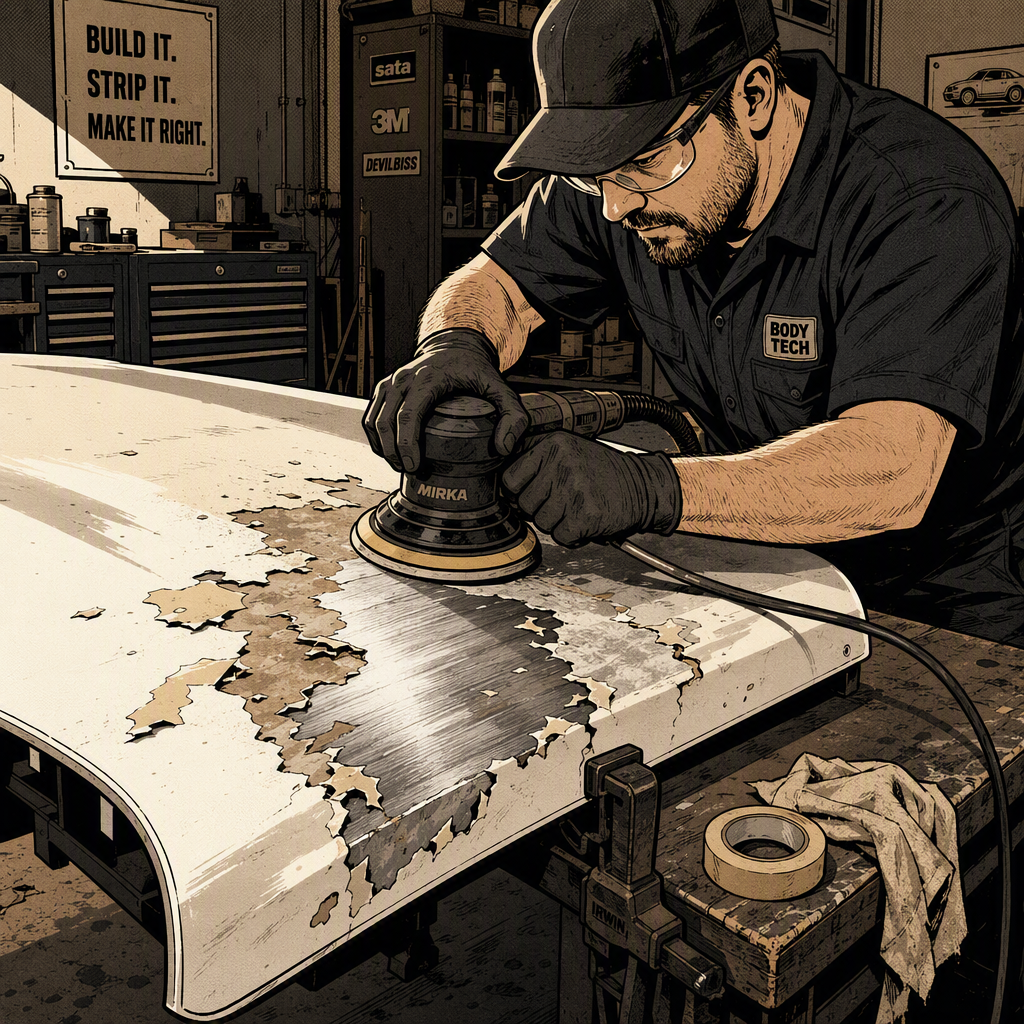
If you’ve had a 2011-2018 Hyundai or Kia painted white roll into your bay with paint sheeting off in dinner-plate-sized chunks, you’re not looking at neglect or road debris damage — you’re looking at a documented factory coating failure. This shows up on hoods, roofs, doors, and fenders, often starting at high-UV-exposure panels and spreading. Owners frequently assume it’s repairable with a can of Rust-Oleum and some patience, but that approach fails fast because the underlying bond between basecoat and e-coat (or primer) is compromised across the whole panel, not just the visible spot. Here’s how to diagnose it correctly, get the customer’s costs covered where possible, and execute a repair that won’t be back on your lift in eighteen months.
Confirm It’s a Coating Defect, Not Impact or Environmental Damage
Before quoting anything, distinguish delamination from other paint failures. Genuine factory delamination has a few consistent signs: the paint lifts in irregular sheets rather than chips at impact points, bare metal or e-coat is exposed underneath with no rust pitting (at least initially), and the failure pattern tracks with panel geometry — hoods, roofs, and trunk lids catching the most sun fail first and worst. Run a fingernail or plastic trim tool under a lifted edge; if a wide area lifts easily with light pressure, the basecoat-to-primer adhesion is gone across that panel, not just at the visible defect.
Compare that against stone chips (small, sharp-edged, isolated to the lower front clip and rocker panels) and prior repaint failures (uneven texture, overspray on trim, mismatched panel gaps suggesting bodywork). A previous insurance or warranty repair gone wrong — improper prep followed by a repaint — will also delaminate, but usually only on the panel that was redone, and it typically peels down to the OEM primer rather than bare metal.
Check Warranty and Recall Coverage Before Any Repair Work
Hyundai issued a paint-related service campaign (commonly referenced as Z05) covering white paint delamination on multiple model years and models. Coverage windows and eligibility vary by VIN, so the first step on any Hyundai is a VIN lookup through Hyundai’s campaign/recall site or a call to Hyundai customer care — this costs nothing and can save the owner a four-figure repair bill. Kia has had comparable coverage on some models and years; check Kia’s recall/campaign lookup the same way.
A few things to set expectations on before the customer calls the dealer:
- Hyundai’s mechanical and paint warranties run on a rolling window tied to model year, so a car that qualified last year may have aged out — check the current cutoff, don’t assume last year’s answer still applies.
- Warranty repairs typically mean strip-to-metal and full refinish of the affected panel only; dealers generally will not blend adjacent panels under warranty, so expect a visible transition unless the customer pays out of pocket for a blend.
- Vehicle condition matters. A clean, low-mileage, well-maintained car with no unrelated body damage has a much better shot at approval than one with broken glass, prior accident repairs, or heavy modification — techs doing the pre-inspection should flag anything that could give a dealer or adjuster grounds to deny the claim.
- If the car has already been modified or “fixed” with touch-up paint, sanding, or DIY clear coat, document that before submitting a claim — some warranty terms are voided by unauthorized repair attempts.
[[PRODUCT_SEARCH: automotive paint stripping disc]]

What a Proper Strip-and-Refinish Repair Actually Involves
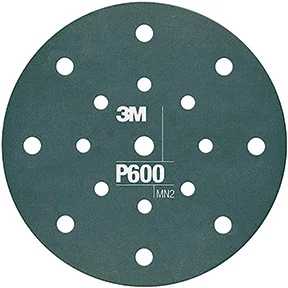
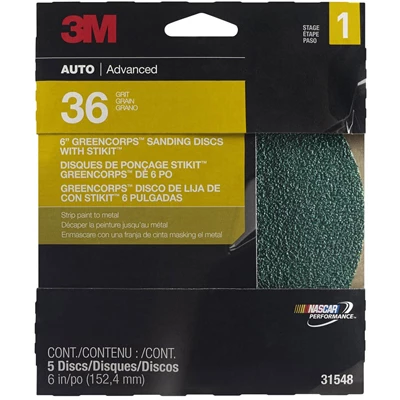
Whether the job is warranty-covered or a paid customer repair, the fix for true delamination is the same: full removal of the failed coating system down to bare metal (or sound e-coat/primer), not a scuff-and-recoat. Skipping this step is the single most common reason DIY and shortcut shop repairs fail again within a year or two — new paint over a compromised bond layer just delaminates on the same schedule.
Standard sequence:
- Media or mechanical strip the affected panel(s) to bare metal using DA sanders with stripping discs or a soda/media blast for stubborn areas, checking coverage with a raking light to catch missed low spots.
- Inspect bare metal for corrosion, especially around edges and seams where moisture could have gotten under the lifted paint; treat or replace metal as needed before priming.
- Apply etch primer or self-etching primer appropriate for bare steel/aluminum, followed by a high-build primer-surfacer and block sanding to restore panel flatness.
- Basecoat and clearcoat per OEM color code, with attention to panel edges and jambs to avoid a visible break line.
- Bake or force-dry per the paint manufacturer’s spec, then buff and inspect under multiple light sources before delivery.
Set the customer’s expectations on cost early. What looks like “just the hood” often turns into hood, both fenders, and part of the roof once you actually pull loose paint and find the delamination extends further than what was visible. Quote strip-to-metal pricing up front rather than a spot-repair estimate that will balloon once the panel is opened up.
DIY and Budget Repair Considerations
Not every owner will pursue warranty coverage or pay for a full refinish, especially on an older, high-mileage car where the repair cost approaches the vehicle’s value. If a customer wants a “good enough from ten feet away” result, the same fundamentals apply at a smaller scale: strip loose and adjacent paint back to a stable edge (feather well past any area that lifts under fingernail pressure), treat bare metal, prime, and use a quality single-stage or basecoat/clearcoat rattle-can or spray-gun system. Warn customers explicitly that touch-up paint applied directly over lifting clearcoat, or skipping the strip step to save time, will fail again — often faster than the original factory finish did.
For panels with broken glass or trim involved (a common complication on these repairs), replace or reseal that hardware before painting, since working around it later risks damaging the new finish. A full vehicle wrap is sometimes a more economical way to mask advanced, widespread peeling on an older car, but it doesn’t stop underlying corrosion from progressing — flag that tradeoff for the customer.
Tooling Up for the Job
Panel strip-and-refinish work goes faster and cleaner with the right equipment on hand:
- A high-CFM air blow gun (shop-grade, not a low-flow OSHA tip) or a pressure washer to clear loose paint chips and debris before you start sanding, so you’re not grinding flaked paint into the surrounding finish.
- Variable-speed DA sanders with a range of stripping and finishing discs (36-80 grit for strip, up to 220+ for block sanding primer).
- A quality masking kit — tape, paper, and panel-edge foam — since these repairs almost always border trim, glass, and unpainted panels that need protection.
- A digital paint thickness gauge to map how far delamination extends before you commit to a repair boundary.
Preventing Recurrence
Once a panel is properly stripped and refinished, normal care extends its life: regular washing to remove UV-accelerating contaminants, a quality wax or ceramic sealant, and prompt touch-up of any new stone chips before moisture gets under the clearcoat. None of this prevents a second wave of factory-defect delamination on panels you haven’t yet repaired, so if one panel failed, inspect the rest of the vehicle at every service visit — catching a lifting edge early is far cheaper than a full strip job after it spreads.
Quick Checklist
- Confirm delamination pattern (sheets, no impact marks) vs. chip/impact damage
- Run a VIN check for active recall/paint campaign coverage before quoting a repair
- Document existing damage (glass, trim, prior repairs) before submitting a warranty claim
- Quote strip-to-metal, not spot repair — expect the affected area to be larger than visible
- Never recoat over lifting paint; feather back to a stable, adhered edge
- Treat any exposed bare metal for corrosion before priming
[[PRODUCT_SEARCH: automotive spray gun and refinishing kit]]
Frequently Asked Questions
Is peeling white paint on Hyundai and Kia models really a factory defect?
On many 2011-2019 model-year vehicles, yes — it’s a documented basecoat/clearcoat adhesion failure specific to certain white paint codes, not a result of normal wear, and it’s been the subject of manufacturer service campaigns.
Will insurance cover this instead of the manufacturer?
Standard collision or comprehensive coverage isn’t designed for manufacturing defects, but some insurers have paid claims when a customer’s deductible made that the cheaper path versus an out-of-warranty repair. It’s worth asking, but check manufacturer coverage first since it may cost the owner nothing.
Can I just sand and repaint the peeling spot without stripping the whole panel?
No. If paint is lifting in one area, the adhesion failure typically extends further than what’s visible. A spot repair over a compromised bond layer will lift again, usually within a year or two.
How much does a proper strip-and-refinish repair typically cost?
It varies by shop, region, and panel count, but expect strip-to-metal refinishing to run well beyond a standard spot repair or blend job — get a written estimate that accounts for the possibility of additional panels once the repair is opened up.
What if my car is past the warranty window?
Ask anyway — coverage terms and goodwill policies change, and some out-of-window vehicles have still received partial manufacturer assistance, particularly if the vehicle is in otherwise excellent condition.
Does a car wrap fix the underlying problem?
A wrap can hide the cosmetic issue and is a reasonable budget option on an older vehicle, but it doesn’t stop moisture and corrosion from progressing under paint that’s already delaminating elsewhere on the car.
Recommended Tools for This Repair
Executing a proper strip-and-refinish repair on delaminated white paint requires the right equipment. Browse our Paint & Body category for the sanders, stripping discs, masking supplies, and spray systems needed for this job.
- Variable-speed DA sanders with medium-grit stripping disc compatibility
- Professional masking tape, paper, and panel-edge protective supplies
- Spray guns, primers, and refinishing equipment

The Toolsource Technical Team blends decades of real-world automotive service experience with up-to-date technical research. Our writers collaborate with professional mechanics, shop owners, and diagnostic specialists to deliver practical, workshop-ready guidance you can trust.


Follow us on social media