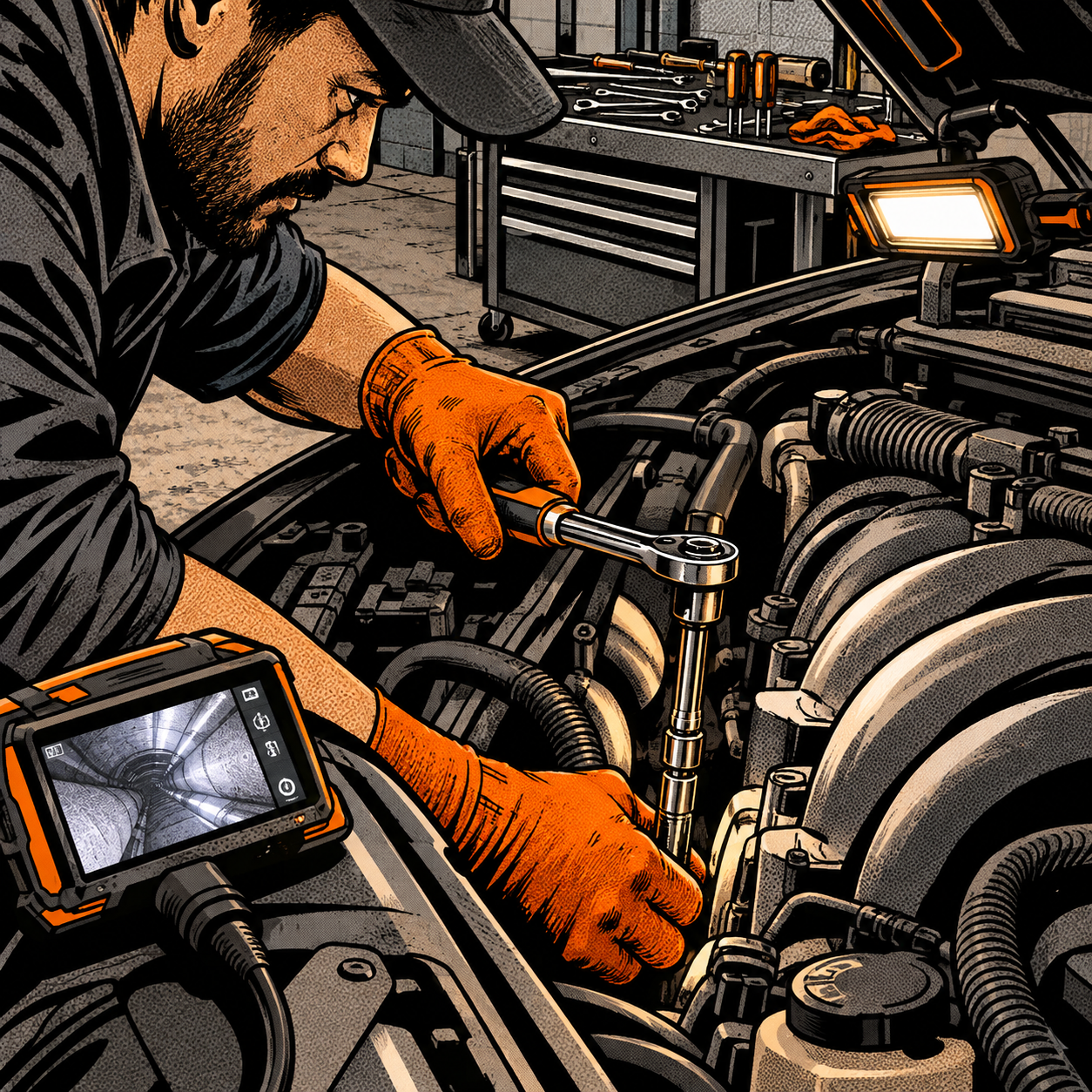
Steep depreciation has put a lot of six-figure cars within reach of buyers who never planned a maintenance budget to match. Aston Martin DB9s and Vantages, Lamborghini Murciélagos, Mercedes SLR McLarens, and Bentley Continentals are turning up at independent shops instead of exclusive dealer service departments, often because the owner can no longer justify the dealer’s hourly rate — or the dealer network for that model has thinned out. For techs, that means more of these cars on the lift, and more jobs where the labor time, not the parts cost, is what blows up the invoice. Here’s a practical rundown of what to expect and how to handle it.
Why These Cars Keep Showing Up in Independent Bays
A car that sold for $150,000–$500,000 new can trade for a fraction of that a decade or two later, while the cost of parts and the complexity of the engineering don’t depreciate at all. Owners who buy in at the bottom of the curve are frequently first-time exotic owners who assumed ownership costs would track the purchase price. They didn’t, and that gap is exactly why these vehicles end up outside the franchised network — looking for a shop that can do the work without the dealer markup.
The practical implication for a shop: expect the customer to be price-sensitive, expect them to be surprised by labor hours, and expect them to shop quotes aggressively. Set expectations on the first call, before the car is on your lift. A short conversation about “this car’s spark plug job is not like your Accord’s” saves a dispute later.
Engine Access and Spark Plug Jobs: Where the Labor Hours Really Go
The single most commonly cited pain point on cars like the DB9 and other transaxle V12 Astons is spark plug replacement. On these engines the plugs sit behind the intake plenum, and reaching them means pulling the intake manifold, disconnecting the throttle bodies, and working around a tightly packed engine bay with almost no clearance. Shops routinely bill 8–10+ hours for what would be a 30-minute job on a mainstream V8. That labor time — not the plugs themselves — is why total bills for a “simple” tune-up run into four figures.
Before you start:
- Pull the factory service procedure rather than relying on a generic V12 workflow — manifold bolt sequences and clip types vary by model year.
- Photograph vacuum lines, electrical connectors, and hose routing before removing the intake. Exotic engine bays have little room for guesswork on reassembly.
- Check coil and boot condition while you’re in there. If you’re already paying the labor to get to the plugs, replacing coils or boots proactively is cheaper for the customer than a return visit.
- Inspect for oil or coolant seepage around the plenum gaskets and valve covers while access is open — on these cars, that visibility doesn’t come around often.
V8 Vantages are meaningfully easier here; the engine layout gives better plug access and shorter labor times, which is part of why that model has a reputation for being the more ownable Aston.


3/8" Drive 6 Point 4" Magnetic Swivel Spark Plug Socket 5/8"
Mfg: GearWrench
Part #: 3927D
Tooling Up for V12 and V8 Exotic Service
Standard shop sockets and wrenches often don’t fit the clearances in these engine bays. A few additions make a real difference in billable efficiency:
- Extended-reach and swivel spark plug sockets for plugs recessed behind manifolds and firewalls.
- Low-profile and stubby ratchets for the inch or two of clearance you get around the plenum and bulkhead.
- Torque wrenches rated for both low in-lb fastener specs (plastic intake components, sensor housings) and higher ft-lb specs for structural and suspension bolts — exotic fasteners are often aluminum or exotic alloy and strip or shear at torques that would be fine on steel.
- Dedicated multi-point sockets and Torx bits — European and Italian manufacturers use fastener head styles that aren’t always in a generic set.
- A **flexible inspection camera/borescope** to check plenum gaskets, valve seats, and hidden corrosion without a full teardown.
Having the right reach and clearance tools on the bench before the car arrives turns a guessed labor estimate into an accurate one — and keeps you from improvising with modified sockets mid-job.
Diagnosing Chronic Problem Areas Before You Quote the Job
Every model in this price bracket has a known list of recurring issues, and a pre-quote inspection should target those specifically rather than a generic once-over:
- Aston Martin V12s (DB9, Vanquish, DBS): intake manifold gasket seepage, coil pack failures, and age-related rubber hose and bushing degradation given how many of these cars sit for long stretches between drives.
- Lamborghini Murciélago: complex hydraulic clutch actuation on e-gear cars, coolant hose and radiator issues given the side-mounted radiators, and general difficulty sourcing OEM trim and electronics.
- Mercedes SLR McLaren: carbon-ceramic brake wear patterns, supercharger belt and tensioner service, and electronics gremlins tied to its early-2000s control modules.
- Bentley Continental GT (W12): timing chain tensioner wear, turbo failures, and air suspension compressor issues — all of which show up more often on cars bought cheap and under-maintained by a previous owner.
Run a full diagnostic scan and a visual inspection of hoses, belts, and fluid seepage before quoting anything beyond the stated complaint. A car that’s been sitting for months between oil changes often has secondary issues the owner doesn’t know about, and finding them during teardown instead of during inspection turns a fixed quote into a dispute.
Pricing and Scheduling Labor-Intensive Jobs So You Don’t Eat the Cost
Flat-rate manuals for these marques, where available, tend to understate real-world time on cars that have sat unused or have corroded fasteners. A few practices protect your margin:
- Quote a labor range, not a fixed number, for any job requiring intake or body panel removal, and explain why up front.
- Bill diagnostic time separately from repair time — on cars with this much known chronic trouble, diagnosis alone can run long.
- Build in extra time for corroded or seized fasteners; penetrating oil and patience cost labor hours even when the repair itself is straightforward.
- Require a deposit before ordering specialty parts — sourcing for low-volume exotics can take weeks, and a cancelled order on a $2,000 part is a real loss.
Sourcing Parts and Managing Owner Expectations
OEM parts availability thins out fast once a model is 10–15 years old, especially for low-production cars like the SLR or Murciélago. Build relationships with specialist importers and salvage networks for trim and electronics, and set owner expectations on lead time in writing. For wear items — brake pads, belts, filters — aftermarket and OEM-equivalent suppliers usually keep pace fine; it’s the one-off electronic modules and exterior trim where delays happen. Be upfront that a “quick fix” on these cars can still mean a multi-week turnaround if a part has to be sourced overseas.
Quick Pre-Job Checklist
- Confirm model-year-specific service procedure before quoting labor hours
- Inspect known chronic failure points for that model during intake, not during teardown
- Stock extended-reach sockets, low-profile ratchets, and correct torque specs before scheduling the job
- Separate diagnostic time from repair time on the estimate
- Confirm parts lead time and get a deposit before ordering specialty components
- Document everything with photos before disassembly



FAQs
Why does a spark plug job cost so much more on a V12 Aston Martin than a typical V8?
Because the plugs are buried behind the intake manifold and throttle bodies, the job requires significant disassembly just to reach them — labor time, not parts cost, drives the bill.
Is the V8 Vantage genuinely easier to maintain than the DB9?
Yes, for most routine service. Its engine layout gives better component access, which generally translates to shorter labor times and lower bills for the same type of job.
Should I trust the manufacturer’s flat-rate labor time for these models?
Use it as a starting point, but expect to exceed it on cars that have sat unused or have corroded fasteners — build a buffer into your quote rather than promising the book time.
What’s the biggest risk when quoting a job on a car like this sight unseen?
Underestimating disassembly time and missing a chronic issue that surfaces mid-teardown. A paid diagnostic inspection before quoting prevents most disputes.
Are these cars actually unreliable, or is it a maintenance issue?
Much of the reputation comes from deferred maintenance by owners who bought in at depreciated prices without budgeting for upkeep, combined with genuinely complex engineering that makes routine jobs labor-intensive.
What should a shop stock before taking on exotic work regularly?
Extended-reach and swivel sockets, low-profile ratchets, a full range of torque wrenches for both delicate and structural fasteners, and a borescope for non-invasive inspection.
Specialized Tools for Complex Jobs
Servicing high-end exotics demands more than standard socket sets. The tight engine bays and precision fasteners on cars like Aston Martins and Lamborghinis require extended-reach tools, low-profile ratchets, and accurate torque specs. Find the equipment that turns estimates into accurate quotes in our Automotive Specialty Tools collection.
- Extended-reach and swivel sockets for confined engine bays
- Precision torque wrenches rated for exotic fastener specifications
- Borescopes and inspection cameras for non-invasive diagnostics

The Toolsource Technical Team blends decades of real-world automotive service experience with up-to-date technical research. Our writers collaborate with professional mechanics, shop owners, and diagnostic specialists to deliver practical, workshop-ready guidance you can trust.


Follow us on social media