An engine knock complaint is one of the most common — and most consequential — diagnoses a shop will run. Get it wrong and you send a customer back on the road with a ticking time bomb; get it right and you can save them from a full teardown they didn’t need, or build the documentation that gets a defective engine replaced under warranty instead of out of pocket. This guide breaks down how to separate rod knock from piston slap and top-end noise, what to check first when oil-related damage is suspected, and how to document findings in a way that actually holds up when a customer disputes a warranty denial.
Recognizing the Symptoms: Rod Knock vs. Piston Slap vs. Top-End Noise
Customers and even some techs use “knocking” as a catch-all term, but the location and character of the noise point to very different failure modes.
Rod knock is a deep, rhythmic, metallic knock that increases in frequency with RPM and is often loudest at idle or under light load. It comes from excessive clearance in a connecting rod bearing, almost always caused by oil starvation — either the engine ran genuinely low on oil, or oil pressure dropped due to a failing pump, clogged pickup, or badly diluted/degraded oil. This is the noise most associated with catastrophic engine failure, and it rarely gets better.
Piston slap is a lighter, higher-pitched slapping noise most noticeable on a cold start that quiets down as the engine warms up and clearances tighten. It’s caused by excessive piston-to-cylinder-wall clearance, sometimes from a factory defect, sometimes from wear. It’s less immediately dangerous than rod knock but is a sign the engine’s days are numbered.
Top-end noise — ticking or clattering from the valve cover area — usually points to valve train issues (lifters, camshaft, timing chain tensioner) rather than bottom-end bearing damage. It’s worth ruling out before you tell a customer they need a new engine, because top-end repairs are dramatically cheaper.
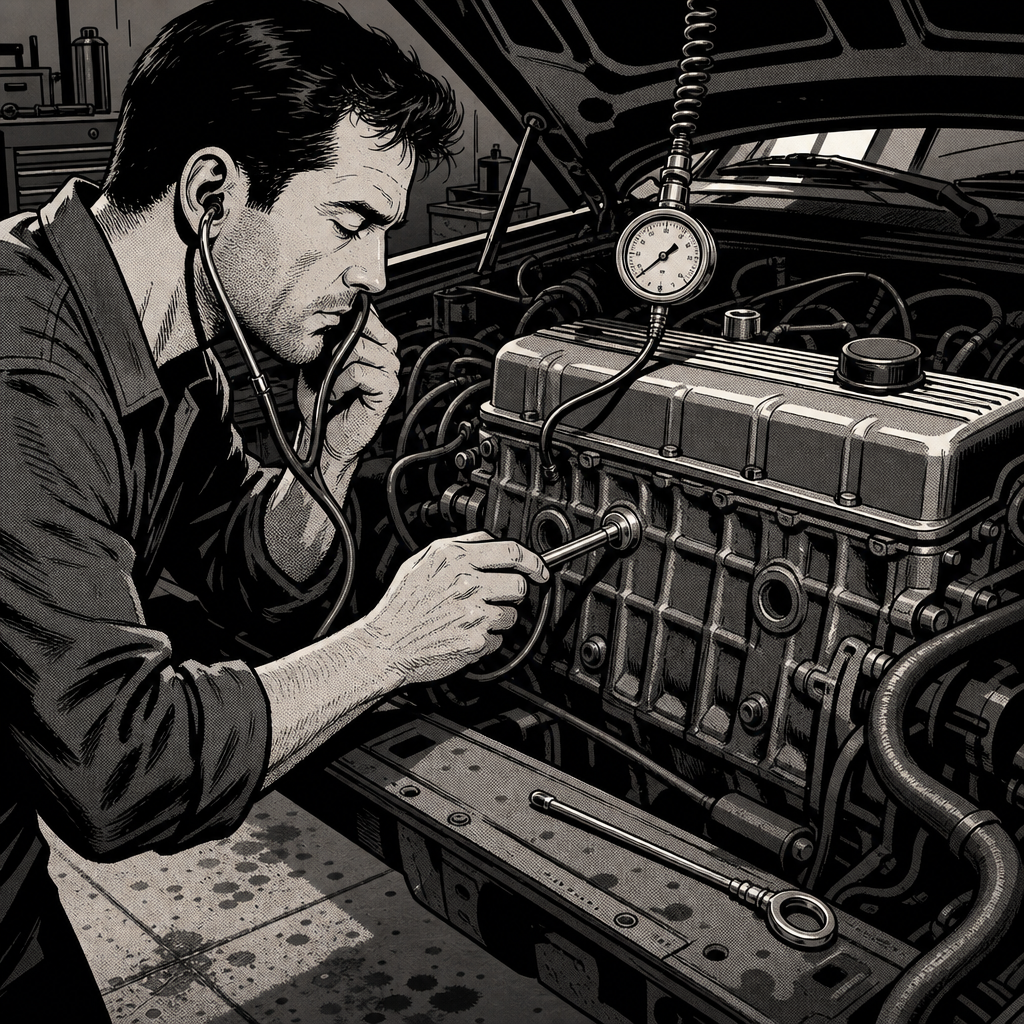
Use a mechanic’s stethoscope to pinpoint the noise location on the block versus the head before committing to a diagnosis. A rod knock will be loudest low on the block near the oil pan rail; top-end noise will be loudest at the valve cover.
First Response: Oil Level, Pressure, and Immediate Diagnostics
Before any teardown, run the basics — they take fifteen minutes and often confirm or rule out the worst-case scenario immediately.
- Check the dipstick for level and condition. Oil that’s several quarts low, milky, or smells burnt tells you a lot before you even start the engine.
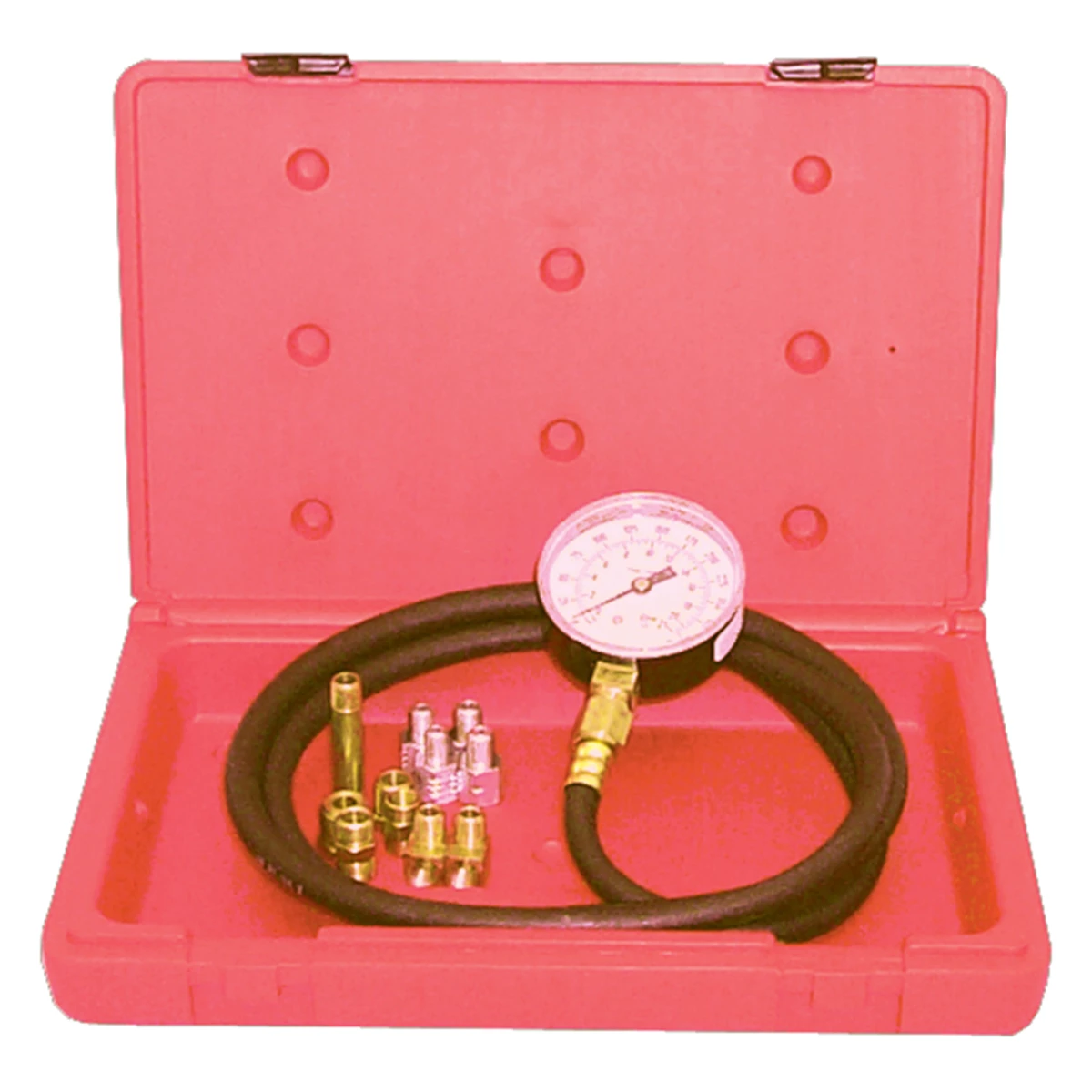
- Pull a live oil pressure reading with a mechanical gauge rather than trusting the dash light or a marginal factory sensor — plenty of engines have run bearings into the ground with no warning light ever illuminating, because the light is tied to a pressure switch, not a level sensor. Many production vehicles have no low-oil-level sensor at all, only a pressure switch that trips well after damage has already started.
- Compare idle and 2,500 RPM pressure against factory spec. Low pressure at idle that improves with RPM often points to worn main/rod bearings; pressure that’s low across the board can mean pump wear, a clogged pickup screen, or the wrong viscosity oil in the crankcase.
- Cross-check for a triggered knock sensor or stored codes. Some manufacturers use a knock-sensor-based engine monitoring system as the gatekeeper for warranty engine replacement — if the sensor never logged an event, some dealers will deny the claim even with clear bearing damage present.
If pressure is significantly out of spec and the noise matches rod knock characteristics, stop diagnosing and start documenting. Further driving on a confirmed low-pressure condition turns a bearing job into a full short-block replacement.
Known GDI Engine Defects and Oil Consumption Testing
Certain direct-injection four-cylinder engines built through the mid-2010s — most notably Hyundai and Kia’s Theta II GDI family used in Sonata, Tucson, Elantra, Optima, and Soul models — have well-documented manufacturing defects tied to debris left in the crankshaft oil passages during production. That debris restricts oil flow to the rod bearings, causing premature bearing wear that presents as rod knock, often alongside abnormal oil consumption between changes. This isn’t an isolated complaint pattern; it led to multiple recalls, a class-action settlement, and extended “lifetime” warranty coverage on affected engines from the manufacturer.
When you see this failure signature — rod knock in a Hyundai or Kia four-cylinder with no obvious external cause like a leak — run an oil consumption test before assuming abuse or neglect. Fill to the full mark, log the mileage, and have the customer return at a set interval (typically 1,000 miles) for a level check. Consumption beyond roughly one quart per 1,000-1,500 miles is generally considered abnormal and supports a defect-based failure rather than owner neglect, which matters enormously for what comes next.
Documenting Maintenance for Warranty and Extended Coverage Claims
A confirmed rod knock diagnosis is only half the job if the vehicle might qualify for manufacturer warranty coverage. Dealers and manufacturers will scrutinize maintenance history hard before authorizing a free engine replacement, so build a file, not just a repair order.
- Pull and copy every oil change receipt the customer has, in date and mileage order. Gaps longer than the recommended interval get flagged by claims reviewers, so note them honestly rather than let the dealer discover them.
- Photograph the oil condition, the dipstick reading, and any debris found at drain — this becomes evidence the failure was mechanical, not the result of running the engine dry through neglect.
- Record oil pressure readings, DTCs, and whether a knock sensor (if the vehicle has a monitoring system) shows a logged event. Some manufacturers require this specific trigger before they’ll even open a claim, regardless of visible bearing damage.
- Write the repair order narrative in plain, factual language: what noise was reported, what tests were run, what the readings were, and what conclusion those readings support. Vague language (“customer reports noise, recommend engine”) gives a claims reviewer room to deny.
Coach customers to escalate past a single service advisor if a claim is denied on an engine with a documented defect history — regional service managers and manufacturer customer care lines have discretion that a first-line advisor often doesn’t. Your documentation is what makes that escalation possible.
When the Engine Is Toast: Repair, Replace, or Walk Away
Once rod knock is confirmed via pressure testing and audible diagnosis, give the customer a realistic set of options rather than just quoting a crate engine.
Full replacement (reman or salvage engine) is the only real fix once bearing damage has progressed — bearing material transferred into the oil galleys will circulate and re-damage a rebuilt bottom end if it isn’t caught in a full teardown and clean.
In-place bearing replacement is sometimes viable if caught early and the crank journals aren’t scored, but it’s labor-intensive and only worth it on vehicles with remaining value.
Heavy oil additives marketed to quiet knock temporarily can buy limited extra miles on a vehicle already headed for the scrap yard, but set expectations clearly — this is a stopgap for a car the owner plans to drive until it dies, not a repair, and it should never be represented as one.
Walking away — recommending against further investment — is the honest answer when the repair cost approaches the vehicle’s value and no warranty coverage applies. Customers respect a straight assessment more than a large invoice for a car that won’t outlast the repair bill.
Quick Diagnostic Checklist
- Check dipstick level and oil condition before starting the engine
- Run a mechanical oil pressure test at idle and 2,500 RPM against factory spec
- Use a stethoscope to locate the noise (block vs. valve cover)
- Scan for stored codes and check knock sensor history if equipped
- Run an oil consumption test if abnormal use is suspected
- Compile maintenance receipts, photos, and readings before quoting warranty work
OTC A/C Compressor Coil Installer Tool T89P-19623-EH
Mfg: OTC Tools and Equipment
Part #: 412-065

Frequently Asked Questions
Can a customer drive a car with confirmed rod knock to get it home or to a dealer?
Short, gentle distances at low RPM carry some risk but are generally survivable. Extended driving is not — a spun or failing bearing can seize the crankshaft or send debris through the oiling system, turning a bearing repair into a full engine replacement. Recommend a tow whenever possible.
Does a working oil pressure warning light rule out low-oil damage?
No. Most factory warning lights are tied to an oil pressure switch, not a level sensor, and many vehicles have no low-level warning at all. An engine can run several quarts low with the dash showing nothing until pressure actually drops.
How much oil consumption is considered normal versus a defect?
Consumption of roughly one quart per 1,000-1,500 miles is generally treated as excessive on a modern engine in good condition. Anything approaching that rate, especially with no visible external leak, warrants a documented consumption test.
If maintenance records are incomplete, is a warranty claim automatically dead?
Not necessarily. Partial records combined with clear evidence of a known manufacturing defect (debris-related bearing wear, matching failure pattern for the engine family) can still support a claim, though incomplete records make denial more likely and escalation more necessary.
Is piston slap dangerous to keep driving on?
It’s less acutely dangerous than rod knock, but it indicates worn cylinder clearance that will progress. It’s reasonable to keep driving in the short term while planning for replacement, but it isn’t a permanent condition.
Are oil additives like “engine honey” products a legitimate repair for rod knock?
No — they’re a temporary noise-masking and lubrication measure at best, appropriate only for a vehicle already at end-of-life where the owner wants extra miles before scrapping it. They don’t repair bearing damage and shouldn’t be billed or represented as a fix.
Diagnostic Tools for Engine Noise Diagnosis
Accurate diagnosis of rod knock versus piston slap requires proper equipment — specifically an oil pressure gauge and a mechanic’s stethoscope to locate the noise and verify your findings. Our Automotive Diagnostic Tools selection covers everything needed for reliable engine assessment.
- Oil pressure test gauges and mechanical diagnostic instruments
- Mechanic’s stethoscopes for noise localization
- Code readers and scan tools for knock sensor monitoring

The Toolsource Technical Team blends decades of real-world automotive service experience with up-to-date technical research. Our writers collaborate with professional mechanics, shop owners, and diagnostic specialists to deliver practical, workshop-ready guidance you can trust.


Follow us on social media