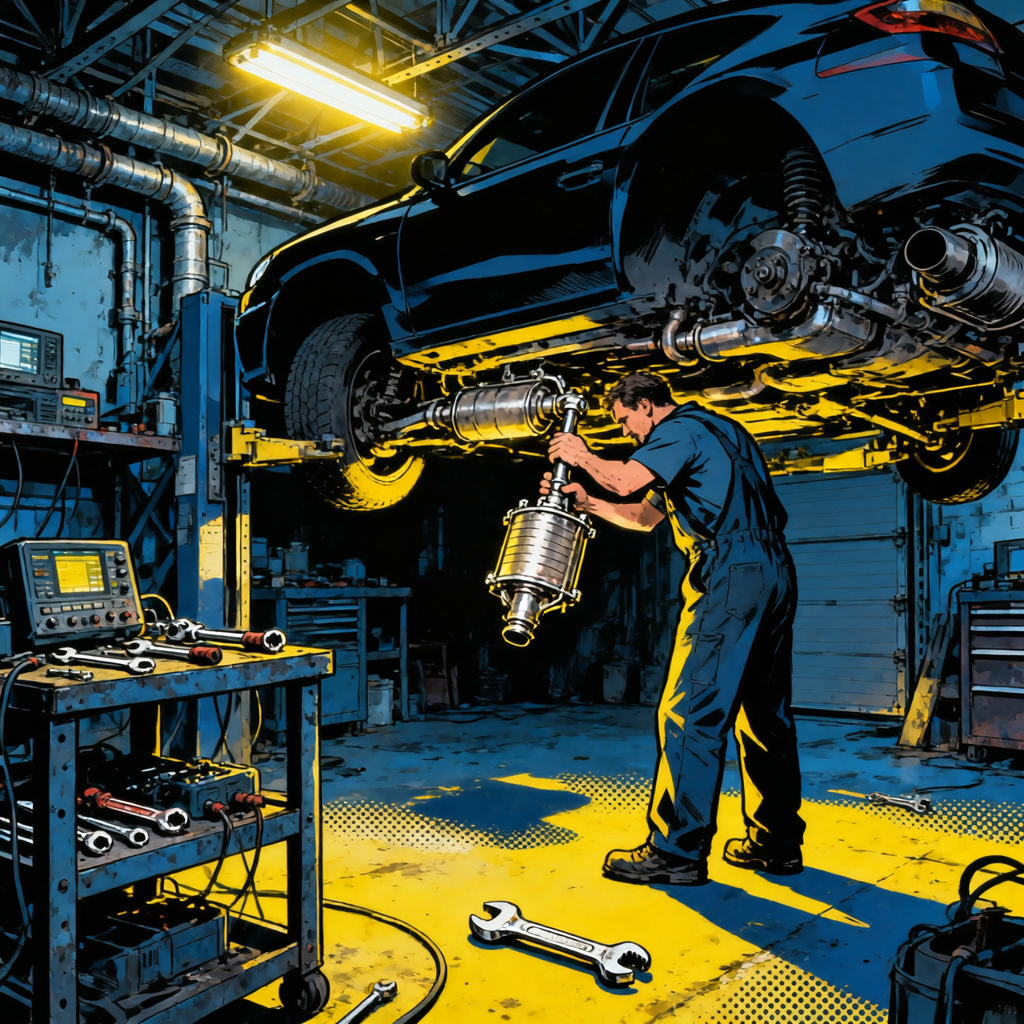
Your check engine light is flashing P0420 or P0430, and you’re dreading the repair bill. Catalytic converter failures run $1,500-$3,300 at dealers, but not every code means you need replacement. This guide covers diagnostic steps, real costs, and legal options.
Signs Your Catalytic Converter Needs Repair
Warning lights and diagnostic codes (P0420, P0430)
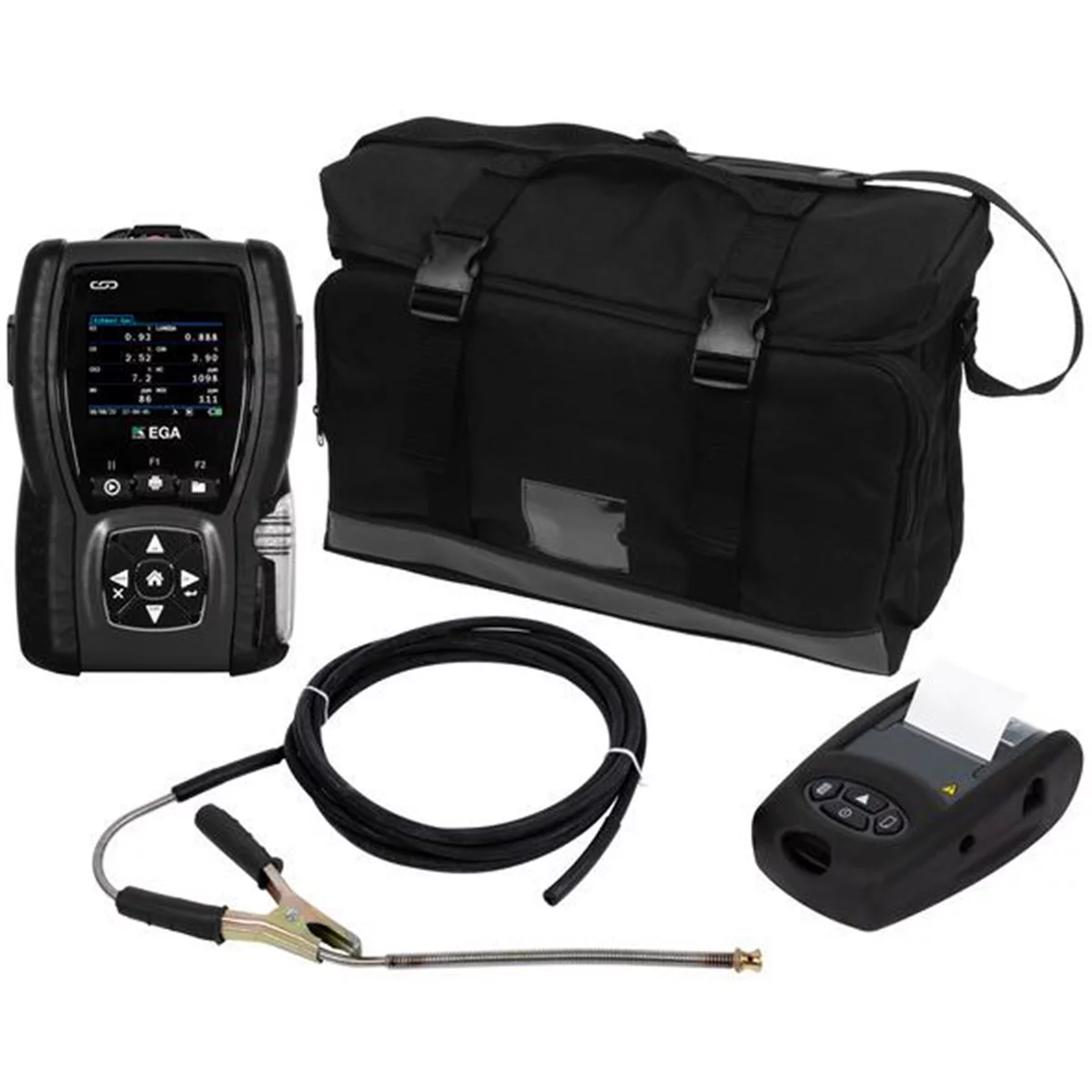
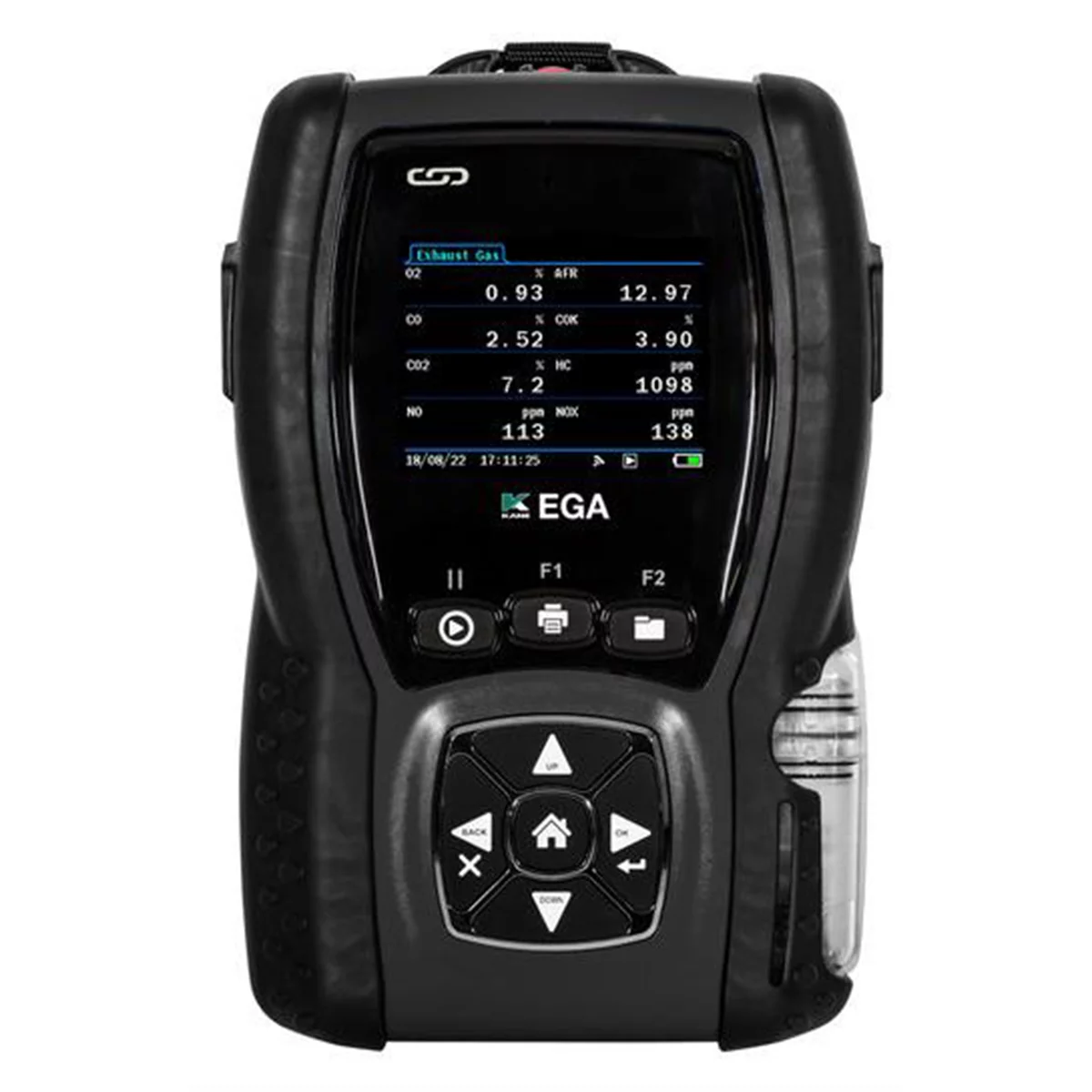
P0420/P0430 codes indicate converter efficiency problems, but they don’t automatically mean replacement is needed. Bad oxygen sensors, exhaust leaks before the rear O2 sensor, or wrong fuel grade trigger the same codes. Before spending $2,000, have a technician run exhaust gas analysis and backpressure testing—not just code scanning. Codes P0421-P0424 and P0431-P0434 point more directly to converter issues. Always check freeze frame data showing conditions when the code appeared.
Performance symptoms: sluggish acceleration and reduced power
A severely clogged converter prevents speeds above 40-50 mph and causes poor hill climbing. Test backpressure with a gauge in the O2 sensor hole: anything above 1.5 PSI at 2,500 RPM indicates restriction; 3 PSI means serious clogging. A glowing red-hot converter indicates blockage. Infrared thermometers show working converters are 100-200°F hotter at the outlet from chemical reaction.
Rotten egg smell and excessive heat
Sulfur compounds in gasoline create the rotten egg stench when converters overheat and break down. Heat radiating through the floor indicates the converter is blocked or failing. Physical inspection may reveal discoloration, melted interior, or rattling ceramic honeycomb that’s cracked—if the ceramic rattles, replacement is the only option.
Repair vs. Replacement: What You Really Need
When catalytic converter cleaning works
Cleaning works only on light carbon buildup before damage occurs. If efficiency codes appear early and the converter isn’t physically clogged, try aggressive fuel system cleaning plus highway driving at high RPM. Chemical cleaning services ($150-$300) soak converters overnight, but only work with intact honeycomb substrates. Aftermarket additives like CataClean might help maintain converters or address minor deposits but won’t fix genuinely failed units. If yours failed before 80,000 miles, something else broke it.
Why melted or severely clogged converters cannot be repaired
Melted ceramic honeycomb, cracks, or complete clogging cannot be repaired. Oil, coolant, or raw fuel coating the platinum, palladium, and rhodium metals kills their function. Melting occurs when raw fuel from misfires ignites inside the converter at temperatures exceeding 2,000°F. Removing or “hollowing out” the substrate is illegal under the Clean Air Act ($2,500+ daily fines) and causes emissions test failure and poor engine performance.
Diagnosing root causes before spending money
Converters rarely fail without cause. Something killed them. Before replacement, identify and fix the root problem or the new converter fails in 20,000 miles:
- Oil consumption: Worn rings or valve seals destroy converters in months. Run compression and leakdown tests.
- Coolant leaks: Bad head or intake gaskets poison the catalyst. Watch for white smoke or coolant loss.
- Oxygen sensor failures: Bad upstream sensors cause rich running. Test sensors first—$150-$250 versus $1,500+ for converter.
- Ignition misfires: Unburned fuel melts converters. Fix spark plugs, coils, or injectors causing misfires.
- Fuel system issues: Leaking injectors or excess fuel pressure stress converters. Check fuel trims and injector function.
Per EPA standards, converters last 100,000+ miles under normal conditions.
No products found for "CARB compliant catalytic converter"
Cost Breakdown: OEM vs. Aftermarket
Dealer replacement ($1,500-$3,300)
OEM converters cost $900-$1,500 plus $400-$800 labor (2-4 hours). Luxury vehicles and trucks with multiple converters hit $3,000-$5,000. OEM converters fit perfectly, include federal warranty (8 years/80,000 miles for emissions parts), and guarantee compliance everywhere. Check if your vehicle is still under emissions warranty—it might be free. Dealership overhead adds 30-50% to costs.
Aftermarket CARB-compliant converters ($500-$1,200)
Quality aftermarket converters from Walker, MagnaFlow, and Bosal cost $300-$800 plus $200-$500 labor. CARB compliance matters in 14 states: California, New York, Massachusetts, Vermont, Maine, Connecticut, Rhode Island, Pennsylvania, New Jersey, Maryland, Delaware, Oregon, Washington, Colorado, and Nevada. Non-CARB converters in these states fail emissions tests. Always verify CARB compliance for your VIN and state before purchase.
Aftermarket warranties cover 2-5 years or 25,000-50,000 miles. Lower precious metal content means slightly lower efficiency and potentially shorter lifespan, but good value for vehicles with 100,000+ miles.
Labor costs and competitive quotes
Labor ranges from 1-2 hours for bolt-on converters to 4-6 hours for welded or manifold-integrated units. Subaru, Ford, and GM trucks require transmission or subframe removal. Get three quotes: dealer, exhaust specialty shop, and independent mechanic. Exhaust shops charge $100-$150/hour versus dealer rates of $150-$200. Ensure quotes specify CARB compliance and include written warranty details. Price variations of 50-100% are common.
| Option | Cost Range | Warranty | Best For |
|---|---|---|---|
| OEM Dealer | $1,500-$3,300 | 8 years/80k miles | Newer vehicles, warranty claims, maximum longevity |
| Aftermarket CARB | $500-$1,200 | 2-5 years/25k-50k miles | High-mileage vehicles, cost-conscious buyers |
| Direct-Fit Aftermarket | $400-$900 | 1-3 years/25k miles | Non-CARB states, older vehicles, budget repairs |
| Universal Weld-In | $200-$500 + welding | 1-2 years/25k miles | Older vehicles, custom exhaust, experienced DIYers |
Alternatives to Expensive Replacement
Fuel additives and cleaners: do they work?
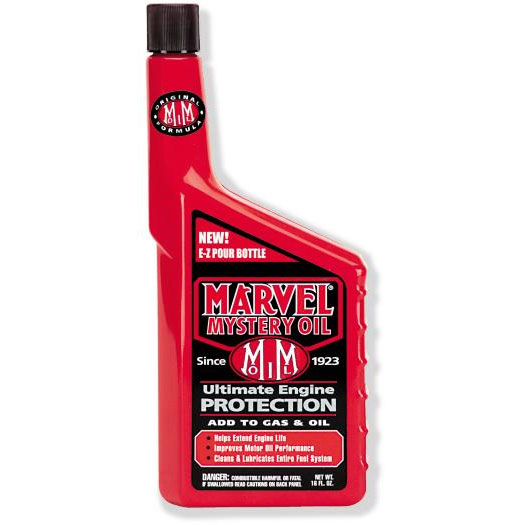
Products like Cataclean and Liqui Moly claim to restore converters with solvents and detergents. Independent testing shows minor help in borderline cases only—nothing for genuinely failed converters. If you have early efficiency codes without performance problems, a $25-$40 bottle with premium fuel and 100-150 highway miles might clear minor deposits. Don’t expect miracles. For melted substrate, physical clogging, or broken ceramic, additives are useless.
Used converters and budget options
Used OEM converters from salvage yards cost $150-$400 but offer no way to verify remaining catalyst life. Most provide minimal warranties (30-90 days) and many fail emissions tests. Only buy used if your state doesn’t require emissions testing and your vehicle is worth under $2,000.
Universal weld-in converters are the cheapest option at $100-$300 plus $100-$200 welding labor. Quality varies wildly—cheap imports fail quickly while Walker and MagnaFlow units hold up. This suits DIY owners with welding equipment or older vehicles.
Straight piping and legal status
Removing catalytic converters for straight pipes is illegal under federal Clean Air Act law everywhere. Fines start at $2,500 and increase for shops. Beyond legal consequences, straight piping triggers check engine lights, fails emissions tests in regulated states, tanks resale value, and damages downstream O2 sensors. Some states exempt vehicles over 25 years old or have no testing, but federal law still applies. Selling or registering a straight-piped vehicle elsewhere creates problems. EPA enforcement applies even to individual owners.
Prevent Engine Damage
Timeline: driving safely with converter failure
Efficiency codes (P0420/P0430) without symptoms allow local driving indefinitely—just fix within 1-3 months. With actual symptoms (sluggish acceleration, heat, smell), you have days to weeks before serious damage. Severe blockage backs exhaust into the engine, diluting oil with raw fuel and damaging bearings. Customers driving blocked converters for months face $5,000-$8,000 engine repairs. Red-hot, glowing converters require immediate towing—you’re hours from catastrophic failure.
Root causes of premature failure
Before replacing converters, diagnose and fix what killed them using this checklist:
Pre-Replacement Diagnostic Checklist
- ☐ Compression test—all cylinders within 10% of each other
- ☐ Oil consumption—less than 1 quart per 1,000 miles acceptable
- ☐ Coolant loss—check for internal leaks
- ☐ Oxygen sensor testing—voltage and response speed
- ☐ Misfire codes—fix ignition or fuel issues first
- ☐ Exhaust leaks upstream of rear O2 sensor
- ☐ Fuel pressure and injector spray pattern
- ☐ Air filter and intake blockages
- ☐ Fuel trims—short and long-term within ±10%
- ☐ PCV system—not pushing excess oil vapor into intake
Skipping diagnostics means your replacement converter fails prematurely. A $150 sensor or $400 gasket fix now beats $2,000 replacement later.
Maintenance tips to extend converter lifespan
Use quality fuel: Top Tier gasoline from Shell, Chevron, and Costco keeps systems cleaner than discount stations.
Fix problems immediately: Address check engine lights within days. One misfiring cylinder destroys converters in 50-100 miles. Oil consumption above 1 quart per 1,000 miles needs repair before poisoning the catalyst.
Avoid short cold-weather trips: Converters need 400-800°F to function properly. Repeated cold starts and short trips prevent reaching temperature, allowing moisture and contaminants to accumulate. Group errands into one longer drive.
Replace O2 sensors on schedule: Upstream sensors last 60,000-100,000 miles, downstream sensors 100,000+ miles. Replace proactively rather than waiting for failure. Tired sensors cause incorrect fuel trim adjustments stressing converters.

FAQ
Can I drive with a clogged catalytic converter?
Early-stage clogging with efficiency codes but no performance problems is drivable—fix within 1-2 months. Severe clogging killing power or glowing red-hot requires immediate attention. Continued driving risks $5,000+ engine damage from backpressure and oil contamination. If you can’t exceed 40-50 mph or struggle hills, have it towed.
Is it really the catalytic converter or just an O2 sensor?
P0420/P0430 codes don’t prove converter failure. Bad O2 sensors, exhaust leaks, or contaminated sensors cause the same codes. Test the downstream O2 sensor first ($150-$250) versus converter replacement ($1,500+). Check voltage readings and response speed. A real shop runs exhaust gas analysis, backpressure testing, and infrared temperature measurement before recommending replacement. Get a second opinion if diagnosed on code reading alone.
What emissions regulations apply in my state?
Fourteen states require CARB-compliant converters: California, New York, Massachusetts, Vermont, Maine, Connecticut, Rhode Island, Pennsylvania, New Jersey, Maryland, Delaware, Oregon, Washington, Colorado, and Nevada. Other states follow federal EPA standards allowing EPA-certified converters. Some states test annually, others exempt vehicles over 25 years old, and some rural counties don’t test. Check your state DMV before buying replacements—non-compliant parts mean automatic test failure.
Do fuel additives like CataClean work?
Additives work only on very light carbon deposits in early efficiency problems. They can’t repair melted substrate, physical clogging, or broken ceramic. Independent testing shows slight improvements in borderline cases only. If you have efficiency codes without symptoms, a $25-$40 bottle with highway driving might help, but don’t expect miracles. Once reduced power, heat, or backpressure appears, replacement is necessary.
How much for aftermarket converter replacement?
CARB-compliant aftermarket converters cost $300-$800 for the part plus $200-$500 labor, totaling $500-$1,300. OEM runs $1,500-$3,300. Ensure quotes specify CARB compliance if required and include written warranties (2-5 years/25,000-50,000 miles). Get three quotes from dealer, exhaust shop, and independent mechanic. Price variations of 50-100% are common.
What causes premature catalytic converter failure?
Common culprits include oil consumption from worn rings or valve seals (coating the catalyst), coolant from failed head or intake gaskets (poisoning metals), ignition misfires (melting from heat), bad oxygen sensors (running too rich), and fuel system leaks or high pressure. Converters last 100,000-150,000 miles normally. Earlier failure always means something else broke them—fix that problem before replacing the converter or it fails again within months.
Ready to tackle your catalytic converter repair? Explore our complete range of exhaust and emissions products to get everything you need for a successful DIY repair or professional installation.
Recommended products in this category:
- Exhaust and muffler tools – OEM and aftermarket options for most vehicles
- Gasket and seal kits – Prevent leaks and ensure proper sealing
- Specialty exhaust tools – Make removal and installation easier

The Toolsource Technical Team blends decades of real-world automotive service experience with up-to-date technical research. Our writers collaborate with professional mechanics, shop owners, and diagnostic specialists to deliver practical, workshop-ready guidance you can trust.


Follow us on social media