Every technician has a version of the same story: a shop rag disappears into an intake, a plastic cap gets left on a port, or a bolt walks off into a bellhousing and nobody notices until the engine is running — or worse, until the customer is driving it. These incidents show up constantly in shop-floor war stories because they’re universal, not because any one tech is careless. The fix isn’t willpower or “paying closer attention.” It’s building small physical habits into teardown and reassembly that make the mistake visible before it becomes expensive. This post pulls together the practical lessons techs have learned the hard way — on diesels, gas V6s, turbo trucks, and heavy equipment alike — into a system you can actually use.
Why Foreign Object Debris (FOD) Incidents Keep Happening
Engines are hungry. Intake vacuum, blower suction, and turbo inlet velocity are strong enough to pull a shop rag, a shop towel, or a glove clean off a surface and feed it into the intake tract, where it either stalls at a restriction (turbo wheel, intercooler core, valve) or gets shredded and ingested. The incidents aren’t rare because techs are sloppy — they’re common because the job itself invites it. You’re blocking drips with a rag, keeping dust out of a port with a cap, or propping something open mid-task, and then you get pulled away by a phone call, a parts run, or a service writer with a question. When you come back, muscle memory says “finish the job,” not “re-verify every open port I touched twenty minutes ago.”
The common thread in nearly every story — rags in a blower, a cap left on an intercooler, a towel in a head gasket job, a rag in a lower radiator hose — is an interruption between opening something up and closing it back up. That gap is where the mistake lives. The goal of everything below is to shrink that gap or make it loud enough that you can’t miss it.
Cover, Don’t Stuff: Rethinking How You Block Open Ports
A recurring piece of advice from experienced techs is simple: stop using loose rags or paper towels to plug or blanket open intake runners, ports, and hose ends. Rags and shop towels are exactly the wrong shape and texture to resist suction — they’re light, flexible, and have no rigid edge to catch on. Once one starts to feed into an opening, there’s often nothing stopping it.
Better options that techs rely on:
- Purpose-made port and hose plugs (rubber or silicone) sized to the bore — they seal the opening instead of just covering it, and they won’t get sucked in.
- A fresh rubber glove or plastic cup stretched or pressed over an opening, held with a hose clamp or tape, as a quick low-cost barrier.
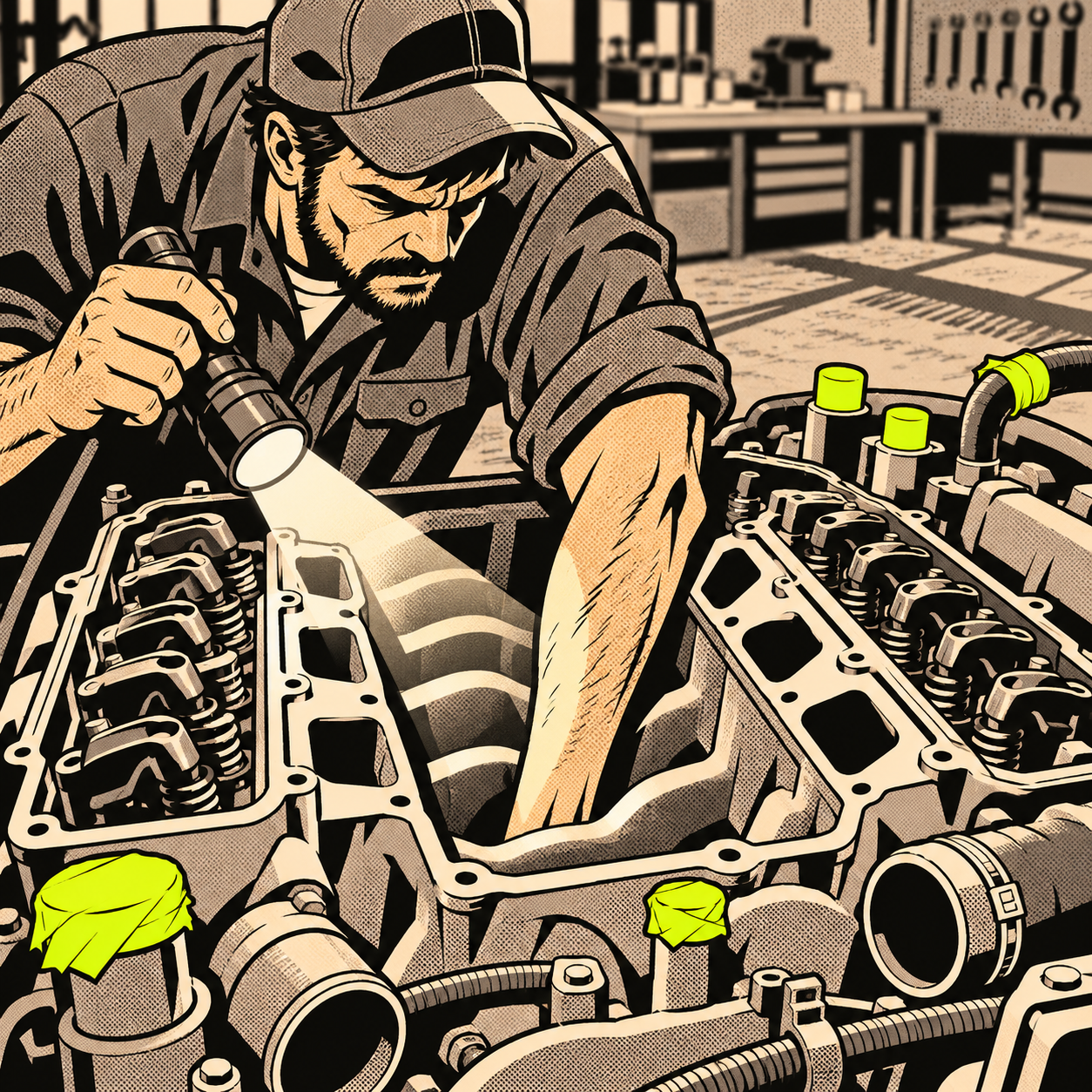
- High-visibility tape (neon green or orange painter’s tape works well) placed over the opening itself, not just nearby — tape over the hole means there’s no cap or plug to forget, and it’s impossible to bolt something down without noticing a strip of bright tape in the way.
- A flat steel “snuffer plate” on a handle for high-volume intakes like blowers — not for plugging, but for emergency shutdown if something does get ingested and the engine starts to run away on its own fuel source.
The underlying principle: anything you use to block an opening should be rigid enough, secured enough, or visible enough that it can’t be ignored, forgotten, or pulled through. If you’re currently using loose rags to blanket an intake manifold or soak up drips near an open port, that’s the single highest-value habit to change first.
===PRODUCT_SEARCH_1===


The Pre-Start Checklist: Catching Mistakes Before the Key Turns
Most FOD incidents aren’t caught during reassembly — they’re caught (or missed) at startup. A short, deliberate pre-start pass costs under a minute and catches the majority of these mistakes before they turn into a comeback, a burned-up rag smell, a no-start, or a chewed-up turbo.
Before you turn the key on any job where something was open, removed, or capped:
- Walk the job physically — don’t just glance. Run a hand or flashlight across every surface you worked on, “knuckle deep” into any opening you touched, including ones you think you already closed.
- Count your rags and towels at the start and end of the job if the task involved packing them near an open port, pan, or hose. If you started with four and only find three, stop and look before you proceed.
- Check for caps and plugs you installed temporarily — these are easy to forget specifically because they look like a finished repair. A cap left on an intercooler or air inlet can present as a baffling no-start or no-power complaint that sends you chasing fuel pressure, FICM voltage, and compression before anyone thinks to check the obvious.
- Verify fasteners you may have only snugged during an interruption — a carrier bearing nut, a hose clamp, a valve cover bolt — got final-torqued, not just “started.”
- If the job involved towing, a callout, or any interruption mid-task, treat the return to the job as a full re-inspection, not a resume point.
Key-Out Protocol: Preventing Accidental Cranks and Runaways
A separate but related risk is someone else — a customer, a driver, another tech — turning the key or hitting the starter while you’re inside the engine. Several hard-earned habits address this directly:
- Remove the key from the ignition the moment you start working under the hood, and keep it on your person or in a fixed, visible spot — not in the switch.
- If you must leave the key accessible, use a visible flag: a note or tag threaded onto the key and left in the ignition lock is a fast, low-tech warning to anyone who might reach for it.
- For diesel engines serviced with the valve cover off, keep an emergency intake shutoff (a snuffer plate, a shutoff valve, or simply knowing where to kill fuel) in reach — a runaway engine is a safety event, not just a repair headache.
- Disconnect or isolate accessory power draws (two-way radios, ignition-on accessories) on vehicles where a driver or owner might inadvertently crank the key further than intended.
If You Suspect Something Was Left Behind
If an engine won’t start, idles rough, misfires, or loses power right after you close up a job where anything was open near the intake, cooling system, or fuel system, treat “something was left inside” as a primary suspect — not a last resort after hours of diagnostics. Several shop stories describe techs chasing fuel pressure, compression, and sensor voltages for hours before finding a leftover cap or rag, when a two-minute visual recheck of every port they’d touched would have caught it first. Pull the air filter, inlet ducting, and any plugs or caps you installed before you start pulling connectors and hooking up a scan tool.
If debris did make it past an intake and into the engine — stalled at a turbo wheel, a grid heater, a valve, or chewed up and spread through a cylinder — don’t assume it’s fine just because the engine runs. Pull the intake back apart far enough to physically confirm no fragments remain, check the oil for contamination if anything reached the crankcase side, and document what you found so the same root cause doesn’t repeat on the next job.
Building a Shop Culture That Catches This Early
The techs who avoid repeat incidents aren’t the ones who never make a mistake — they’re the ones working in a shop where flagging an open port, double-checking a teardown, or asking “did anyone cap that?” is normal, not a sign of weakness. A few cultural habits reduce FOD rates shop-wide:
- Normalize covering/plugging over stuffing as the default method, and stock the plugs, caps, and tape to make that the easy choice.
- Encourage techs to say “I got pulled off this job” out loud when handing off or returning to a task, so the next check is thorough rather than assumed.
- Treat comebacks from FOD causes as a process fix, not just an individual callout — the fix is almost always “cover instead of stuff” or “re-inspect after interruption,” and it’s worth posting at the toolbox.
- When something does happen, fix it right, document it, and move on — dwelling on a single mistake doesn’t prevent the next one; a better habit does.
Quick Pre-Close-Up Checklist
- All open ports plugged or covered with rigid/visible material — not loose rags
- Rag/towel count matches what you started with
- Every temporary cap or plug removed and accounted for
- All fasteners final-torqued, not just started
- Key out of ignition and secured while work is in progress
- Full hand/flashlight pass across every surface touched before startup
===PRODUCT_SEARCH_2===

Tools@Height 3/4 In 12 Pt SAE SUPERCOMBO Combination Wrench
Mfg: J.H. Williams
Part #: 1224SC-TH


FAQ
Why do shop rags get sucked into intakes so easily?
Intake vacuum and turbo/blower suction are strong enough to pull lightweight, flexible material like shop towels through an opening, especially once an edge starts to feed in. Rigid plugs or caps resist this; loose fabric doesn’t.
What’s the fastest way to prevent leaving something in an engine?
Cover open ports with tape, rigid plugs, or a secured glove/cup instead of stuffing rags inside them, and do a full hand-and-flashlight pass across every surface you touched before you turn the key.
I think I left a cap or rag inside — what should I check first?
Before chasing fuel pressure, sensor voltage, or compression, physically re-inspect every port, hose, and cover you touched during the job. A forgotten cap or rag is a far more common cause of a sudden no-start or power loss than most techs assume.
Can a rag damage an engine if it gets ingested?
Yes — it can stall at a turbo wheel, grid heater, or valve and cause a no-run condition, or get shredded and distributed through the intake and cylinders, sometimes requiring a full teardown to clear and inspect for damage.
How do I keep someone from accidentally starting a vehicle while I’m working on it?
Remove the key and keep it on you or in a fixed spot, or leave a visible warning tag through the ignition lock if the key must stay accessible. Never leave the key in the switch while you’re inside the engine.
Is it normal for experienced techs to make this mistake?
Yes — it happens across all experience levels, from first-year apprentices to 20-year veterans on heavy equipment. The difference between a one-time story and a repeat problem is usually whether the shop changes its covering/checking habits afterward.
Recommended Shop Equipment
The simplest FOD prevention starts with the right tools and materials. Shop Equipment and Supplies stocks everything you need to cover and secure open ports, hoses, and manifolds instead of relying on loose rags.
- Purpose-made rubber and silicone port plugs and hose caps
- High-visibility tape for marking open intakes and connections
- Gloves, plastic cups, and clamps for temporary covers and barriers

The Toolsource Technical Team blends decades of real-world automotive service experience with up-to-date technical research. Our writers collaborate with professional mechanics, shop owners, and diagnostic specialists to deliver practical, workshop-ready guidance you can trust.


Follow us on social media