A recent story made the rounds online: a customer dropped off a car for a routine roof paint job and picked it up with a basketball-sized dent and dozens of smaller impact marks across the roof — damage consistent with someone kneeling and shifting their body weight directly on thin, unsupported sheet metal. The shop admitted fault but botched the repair, leaving a wavy roof and an angry customer threatening small claims court. For technicians, this isn’t just a cautionary tale about one bad shop — it’s a reminder that roof and hood panels are some of the least rigid body surfaces on a vehicle, and prep work that ignores that fact creates liability that’s expensive and hard to walk back. Here’s how to keep your own shop off the next viral thread.
Why Roof Panels Fail Under Body Weight

Adjustable Fiberglass Extension Handle w/ Metal Tip - 72 to 144
Mfg: Carrand
Part #: 92509

M18 FUEL QUIK-LOK 3' Attachment Extension
Mfg: Milwaukee Electric Tools
Part #: 49-16-2721

Most automotive roof skins are 0.7–0.9mm stamped steel or aluminum with no internal bracing across large flat sections — the strength comes from the curvature (crown) of the panel, not the material thickness. Once a technician’s knee, palm, or tool case concentrates 40-80 lbs of point load on a flat or low-crown area, the panel can take a permanent set. Unlike a door or fender, which often has reinforcement structure behind it, a roof skin frequently has nothing but headliner clips and a sunroof opening behind the outer surface. This is why “soft” damage — knee-shaped dents, rolling-cart dings, ladder-foot dimples — shows up disproportionately on roofs and hoods rather than rocker panels or quarters.
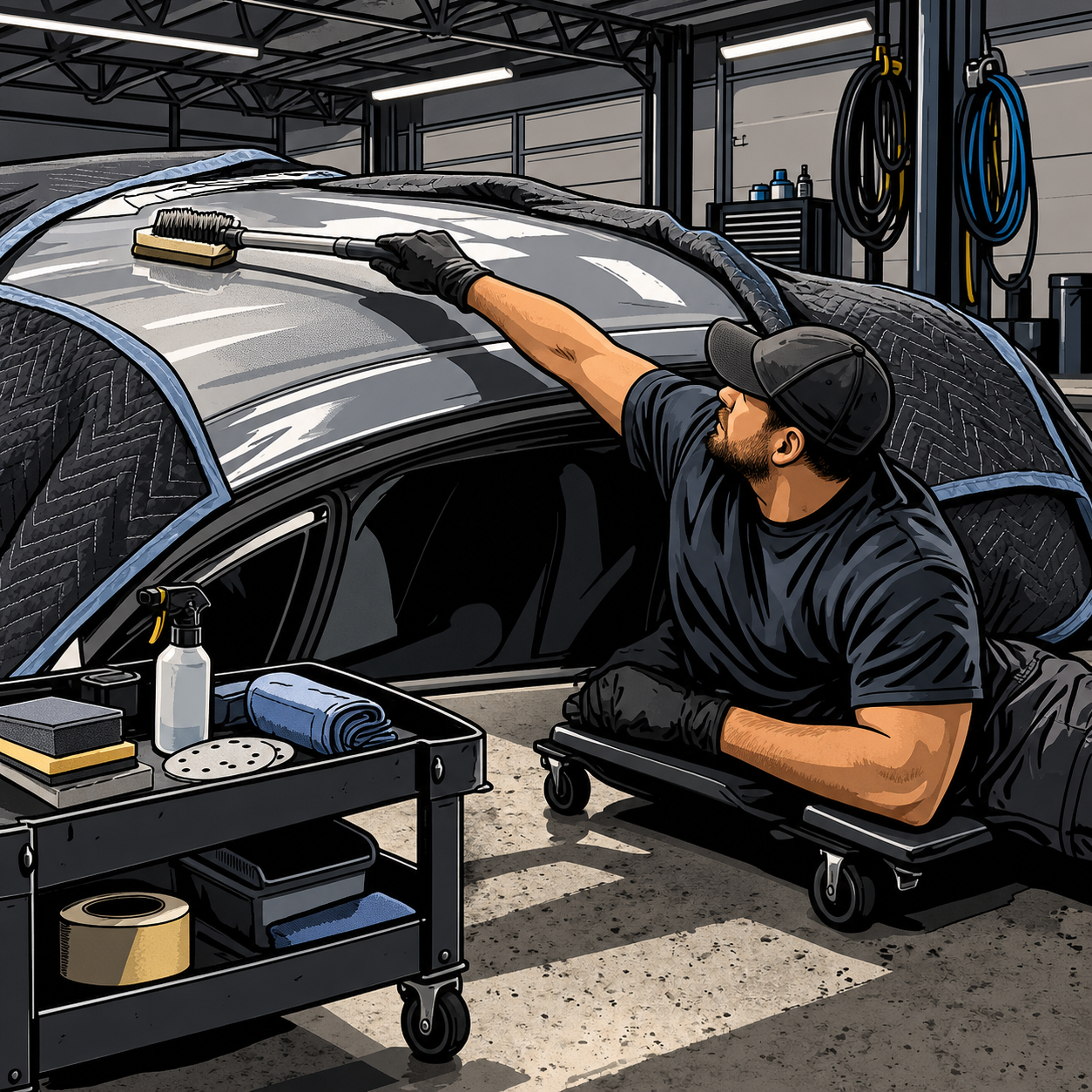
The practical implication: any time prep work (sanding, masking, wet-sanding, polishing) requires a tech to reach the center of a roof, they need to either work from outside the vehicle with proper reach tools or fully support their body weight off the panel. Treating a roof like a workbench — even briefly — is how a $400 paint job becomes a $3,000+ claim.
Protecting Panels Before Masking and Sanding


Body shops that avoid this problem build panel protection into the prep routine instead of leaving it to individual judgment. A few standards worth enforcing shop-wide:
- Fender covers and roof pads (padded, non-marring, with enough surface area to spread load) go on before any sanding or masking begins — not just during mechanical work.
- Rolling creepers or step stools rated for shop use should be positioned so technicians never need to kneel directly on a horizontal panel to reach the center of a roof or hood.
- Soft-bristle brushes and foam-backed sanding blocks reduce the chance of a slip that drives a knuckle or tool corner into bare metal.
- Keep tool trays and detailing caddies off painted surfaces entirely — a dropped wrench on a covered panel is forgivable; the same drop on bare steel usually isn’t.
Shop Paint & Body Tools
Protecting panels during prep work requires the right equipment. Browse our Paint & Body selection for protective covers, padding, and other essentials to prevent damage on every job.
- Fender covers and roof pads for roofs, hoods, and fenders
- Proper sanding blocks, brushes, and detailing tools
- Shop-rated step tools and creepers for safe work positioning
Essential Tools for Paint Prep & Body Work
Protecting your vehicle’s roof and panels during paint prep requires precision tools and the right materials. Browse our complete Paint and Body category to find everything you need for professional-grade results and damage prevention.
- Masking & Protection: Painter’s tape, masking film, and drop cloths for edge control
- Surface Prep: Sanding discs, orbital sanders, and fine-grit pads
- Safety & Precision: Tack cloths, surface cleaners, and blade tools

The Toolsource Technical Team blends decades of real-world automotive service experience with up-to-date technical research. Our writers collaborate with professional mechanics, shop owners, and diagnostic specialists to deliver practical, workshop-ready guidance you can trust.


Follow us on social media