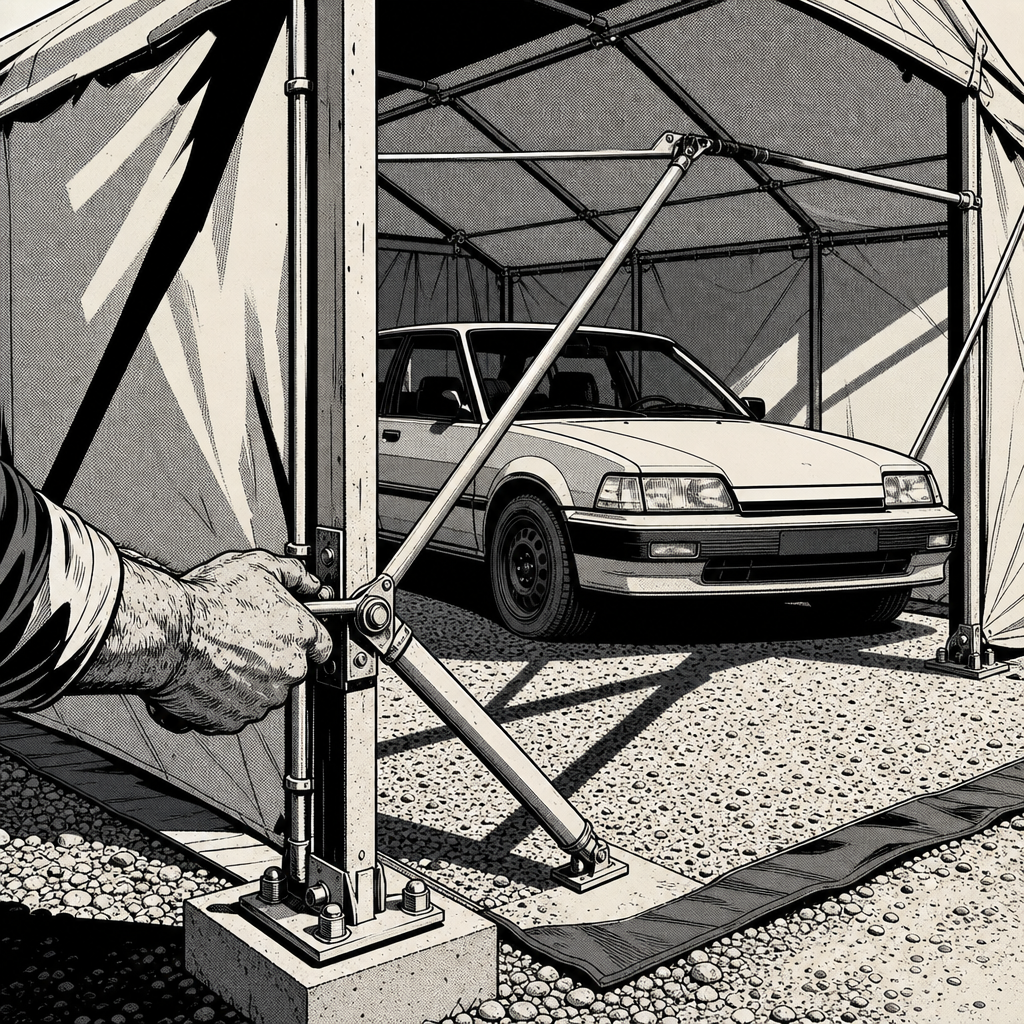
Not every project car gets to live in a garage. Between tool storage, other vehicles, and household overflow, plenty of techs and hobbyists end up protecting their daily driver, classic, or project build under a carport or portable garage instead. Done right, these structures can protect a vehicle for decades — several owners report the same canopy frame holding up for 15 to 30 years. Done wrong, they collapse in the first hard snow or end up rolling across a field in a windstorm. The difference almost always comes down to three things: matching the structure to the job, anchoring it properly, and maintaining the cover on a schedule. Here’s how to do all three without wasting money on the wrong setup.
Match the Shelter to the Job
Before buying anything, figure out what you’re actually protecting against — sun and tree sap, or snow load and high wind. That answer determines which category of structure makes sense.
- Open-roof carports (just an overhead cover, no walls) are the cheapest option and handle sun, sap, and bird droppings well, but they leave the vehicle exposed to blowing rain and don’t do much for security. A 20′ x 20′ steel-frame carport can run under $1,000 installed and will outlast almost anything else on this list if it’s got a solid frame.
- Portable fabric garages (ShelterLogic, Harbor Freight, and similar) are fully enclosed with a steel tube frame and a heavy tarp or polyethylene cover. A 10′ x 20′ kit typically runs $300–$600. These are the most common choice for single-car outdoor storage because they’re affordable and fast to put up, but the frame quality varies a lot between brands — cheaper frames can buckle under snow load if they’re not braced.
- Layered setups — an open carport with a portable fabric garage underneath it — give you the best of both. The outer structure blocks direct sun and rain, extending the life of the inner cover significantly, since UV exposure is what kills these covers fastest.
- Storage units or small sheds make sense if the vehicle doesn’t need frequent access. A 10′ x 16′ shed is tight for anything beyond a compact car but keeps it fully out of the weather.
If insurance coverage matters (especially for a classic or collector vehicle), read the anchoring and insurance sections below before you buy — cheap tarp shelters without proper anchoring often don’t qualify as legitimate “covered storage” for underwriting purposes.
Anchoring and Bracing: The Step Most People Skip
The single biggest failure point on portable structures isn’t the fabric — it’s the anchoring. Stock stake kits that ship with these garages are built for light residential use and are not sufficient once you’re dealing with real wind or snow.
- Dig in the legs. For anything semi-permanent, dig holes at each leg location — at least 6 inches deep — and set the base in concrete rather than relying on surface stakes. This is the difference between a structure that survives a storm and one that doesn’t.
- Upgrade the poles. Stock frame tubing can be thin-gauge. Buying 5/8″ round steel poles (sold for chain-link fencing) and matching brace hardware from a hardware store lets you reinforce weak points and add diagonal bracing the kit doesn’t include.
- Brace corners and midspans. Add diagonal braces at the corners and, on longer structures, at the midpoints of the roof span. This is what keeps a frame from racking sideways under gusts.
- Check the anchoring after every major storm. Ground can shift, especially with freeze-thaw cycles. A quick walk-around after a bad windstorm or heavy snow catches loosening before it becomes a failure.
Skipping this step is how you end up with a structure that separates from its footings and blows across the yard — it has happened to people even in relatively moderate winter weather. Anchoring properly the first time costs a weekend; replacing a totaled frame costs a lot more.
Product search: chain link fence brace hardware kit (after section 2, mid-article)
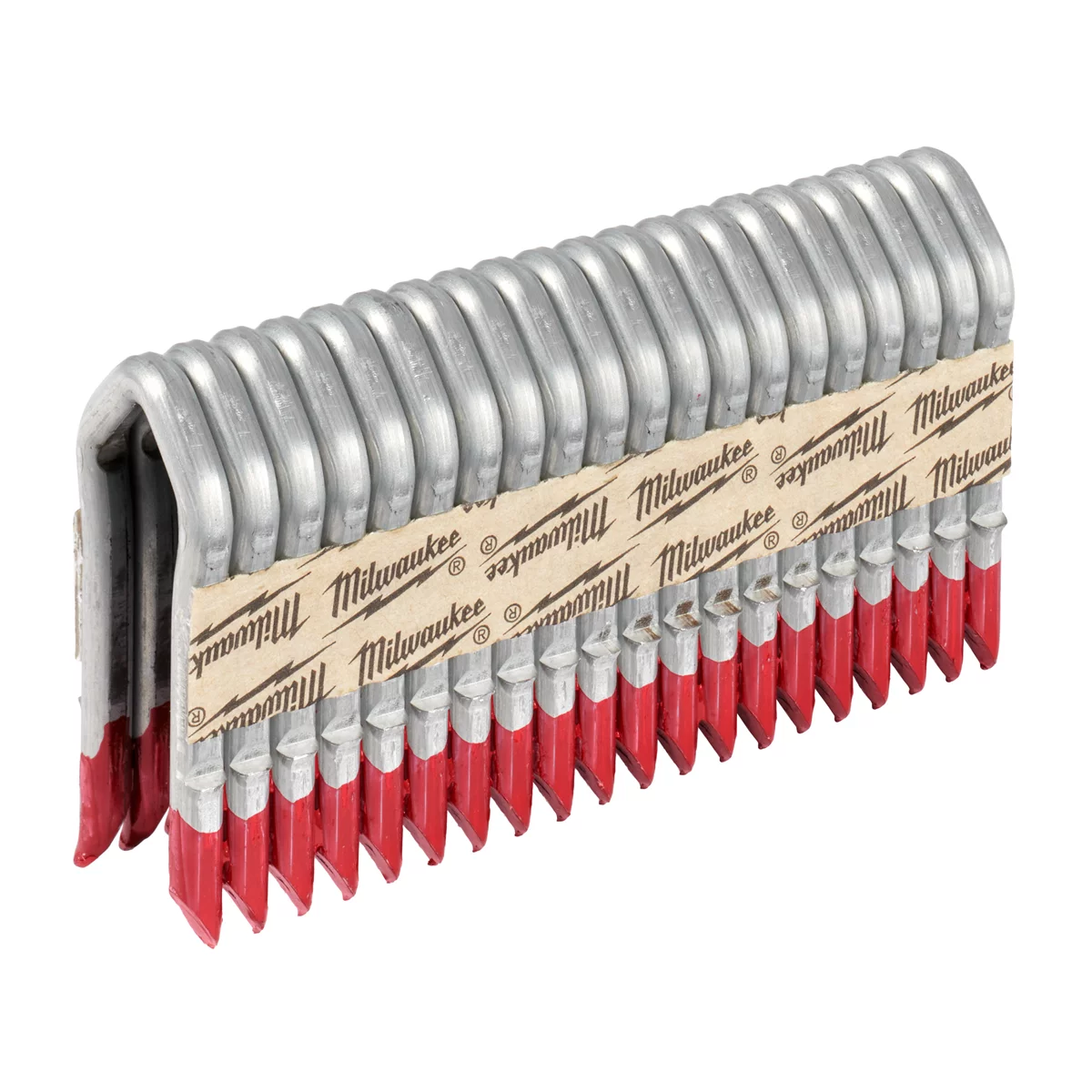
1.75 INCH 9 GAUGE GALVANIZED STAPLES
Mfg: Milwaukee Electric Tools
Part #: MPU134-960
Site Prep: Pad, Drainage, and Skirting
What’s underneath the structure matters almost as much as the structure itself.
- Grade for drainage first. Water pooling under the vehicle or along the frame base accelerates rust on both the car and the frame. If the site isn’t already sloped away from the structure, address that before setup.
- Lay landscape fabric and gravel. A gravel pad under a fabric garage keeps mud out and gives the structure a stable, well-draining base. Edge the gravel with pavers or boards to keep it contained and keep grass from creeping in.
- Add a plywood floor for real work. If you plan to actually wrench on the car inside the structure — not just store it — screwing down a 2x sleeper frame with 3/4″ water-resistant plywood on top gives you a flat, stable surface to set a jack or jack stands anywhere, which a gravel or dirt floor won’t reliably do.
- Skirt the base. Splitting plywood sheets lengthwise and screwing them to the lower frame tubes as a skirt cuts down significantly on wind-driven rain getting blown underneath the walls — a common failure point on fabric garages.
Cover Maintenance and Replacement Cycles
The fabric or tarp cover is a wear item, not a one-time purchase, and budgeting for replacement keeps the whole system cheap over the long run.
- Roof covers wear fastest. Expect to replace the top canopy roughly every 2 years under regular sun exposure — UV is what breaks the material down, not rain or cold.
- Side panels and end caps last longer. Side walls typically go 5 years or more between replacements since they get less direct sun.
- Heavy-duty tarps are a legitimate upgrade. When a stock cover finally fails, a heavy 20-mil tarp (clear or opaque) is a common and durable replacement — some owners report five-plus years out of a single heavy tarp with only minor tears from branches.
- Frame quality determines snow performance. Lighter stock frames can sag or collapse under accumulated snow; if the region gets real snow load, budget for the upgraded pole and bracing kit up front rather than after a collapse.
Budget Tiers: What You Actually Get
Rough pricing for reference, since it varies a lot by region and vendor:
- Under $200: Pop-up canopy with sandbag anchors. Works for short-term protection during a specific job (a rainy-day repair, for example) but isn’t meant to stay up long-term.
- $300–$600: Portable fabric garage kit (10′ x 20′ range). The most common choice for single-vehicle outdoor storage; needs the anchoring upgrades above to last.
- $800–$1,500: Open steel-frame carport, no walls. Long service life on the frame itself (multiple decades is realistic), covers only overhead exposure.
- $2,000+: Prefab shed with a floor, or a layered carport-plus-fabric-garage setup. Best weather protection and, in the shed’s case, added security.
A layered approach — a basic open carport over a fully-enclosed portable garage — routinely comes up as the sweet spot: the outer structure takes the UV and rain hit, dramatically extending the inner cover’s life, for a total cost still well under a shed or permanent structure.
Product search: outdoor car covers and carport accessories (end of article, before FAQ)
Quick Setup Checklist
- Confirm local wind and snow load before picking a frame
- Dig and concrete the leg footings — don’t rely on stock stakes
- Upgrade to 5/8″ bracing poles and diagonal corner/midspan braces
- Grade the site and lay a gravel or plywood pad with proper drainage
- Skirt the base to block wind-driven rain
- Set a 2-year replacement reminder for the roof cover
- Walk the structure after major storms to check anchoring

Frequently Asked Questions
Do portable fabric garages actually hold up to snow?
Only if the frame is upgraded and properly anchored. Stock frames on budget kits are the most common failure point — bracing with chain-link-fence-grade poles and hardware, plus digging in the footings, is what makes the difference between a structure that survives winter and one that doesn’t.
Will an open carport or portable garage satisfy classic car insurance requirements?
Some insurers (Hagerty is a commonly cited example) will accept a fully enclosed portable garage — four walls plus overhead cover — as qualifying “covered storage,” even for structures on a gravel driveway with no permanent foundation. An open-roof carport with no walls typically won’t qualify on its own. Always confirm directly with your insurer before assuming coverage.
How often should I replace the cover on a portable garage?
Plan on the roof panel every 2 years under regular sun exposure, and side/end panels every 5 years or so. Layering an open carport over the fabric garage cuts direct UV exposure and extends both intervals.
Is a gravel pad necessary, or can I set the structure directly on grass or dirt?
Grass and bare dirt hold moisture against the frame base and turn to mud, which accelerates rust and undermines anchoring over time. A graded gravel pad with landscape fabric underneath drains better and gives the footings a stable base.
What’s the cheapest option for short-term protection during a repair?
A basic pop-up canopy with sandbag anchors is the low-cost option for a one-off job like a fuel pump or brake job done outdoors in bad weather. It’s not built for long-term or unattended outdoor storage.
Can I actually work on a car inside a portable garage, or is it storage-only?
You can, but add a real floor first. A 2x sleeper frame topped with 3/4″ water-resistant plywood gives a flat, stable surface so a floor jack or jack stands can go anywhere, which loose gravel or dirt won’t reliably support.
Shop Equipment and Supplies for Your Build
Setting up outdoor car storage requires more than just a frame—you need anchoring hardware, bracing materials, and site prep supplies. Browse Shop Equipment and Supplies for everything your project needs.
- Anchoring hardware, poles, and diagonal bracing materials
- Site prep supplies—landscape fabric, gravel, and plywood flooring
- Covers and replacement fabric panels

The Toolsource Technical Team blends decades of real-world automotive service experience with up-to-date technical research. Our writers collaborate with professional mechanics, shop owners, and diagnostic specialists to deliver practical, workshop-ready guidance you can trust.


Follow us on social media