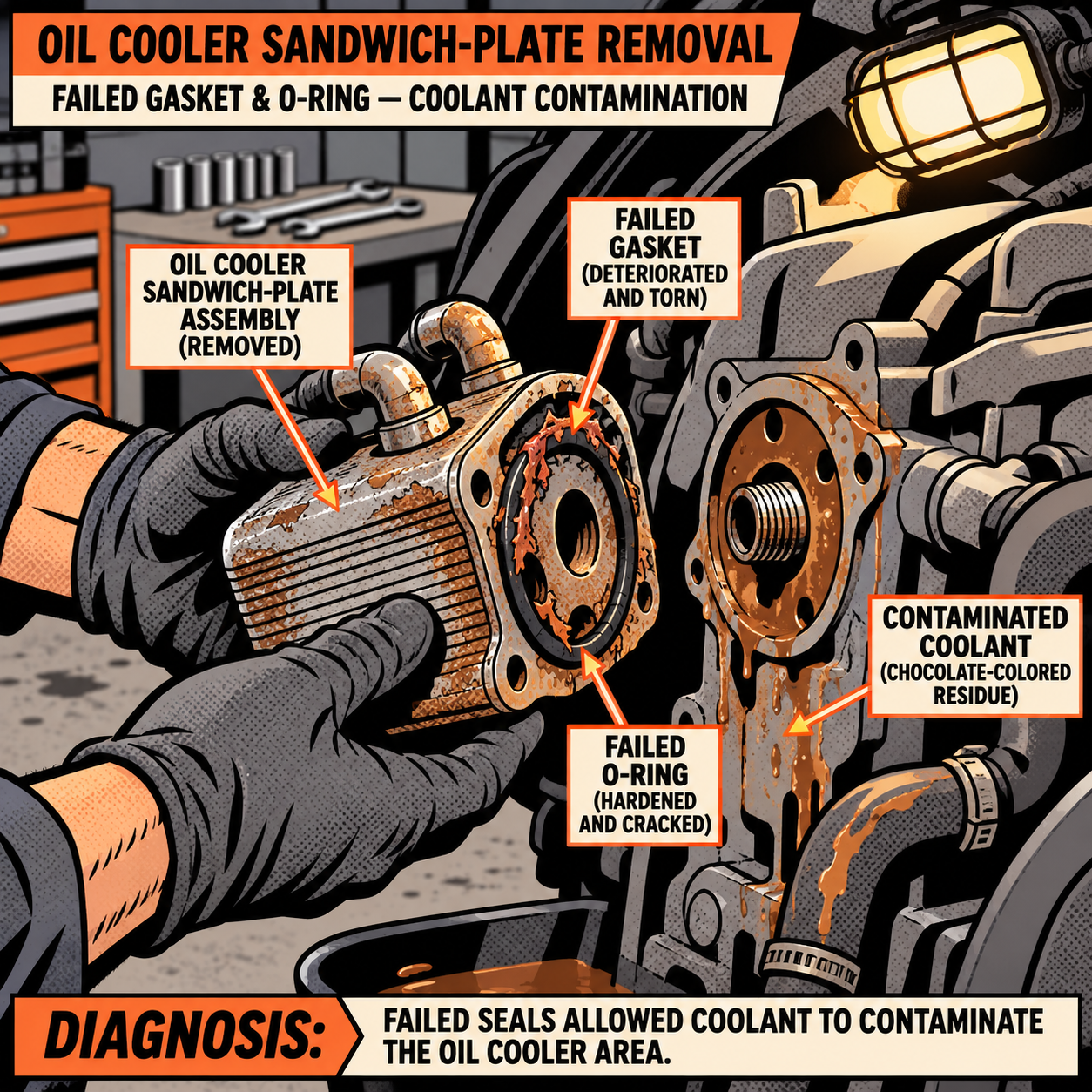
A customer rolls in with chocolate-milk coolant in the overflow tank or mayonnaise-colored residue on the oil fill cap, and the first word out of their mouth is almost always “head gasket.” Sometimes that’s right. Often it isn’t. Before you write an estimate for a head gasket job — or worse, an engine replacement — it’s worth fifteen minutes to confirm which component actually failed, because an oil cooler repair can run a fraction of the cost of a head job and the symptoms on the surface look nearly identical.
Why Milky Fluid Doesn’t Always Mean a Blown Head Gasket
Coolant and oil mixing means pressurized fluid is crossing into a passage it shouldn’t be in, but the direction of that crossover matters. A blown head gasket typically lets combustion gas or coolant into the cylinders or the oil drain-back passages — this is more consistent with finding coolant in the oil (creamy residue on the dipstick, oil level rising, white exhaust smoke). For oil to end up in the coolant, you generally need a direct path between a pressurized oil gallery and a coolant jacket. On most engines that path doesn’t exist through the head gasket at all — it exists through the oil cooler, where oil and coolant run through adjacent channels separated only by a thin gasket or heat-exchanger plate.
Oil runs at higher pressure than coolant in most operating conditions, so when an oil cooler gasket or cooler core fails, oil pushes into the coolant side and you get the classic “chocolate milkshake” in the reservoir — while the oil itself still looks normal. That one detail, oil color versus coolant color, is the fastest first filter you have.
Oil Cooler vs Head Gasket: Key Diagnostic Differences
Run through these checks before you touch anything mechanical:
- Check both fluids separately. If the coolant is contaminated but the oil on the dipstick still looks clean and normal in color, suspect the oil cooler first. If the oil itself is milky/creamy, a head gasket or failed cooler with enough cross-contamination to go both directions becomes more likely.
- Exhaust smoke. Thick white steam-smelling smoke at startup or under load points toward coolant entering the combustion chamber — a head gasket or cracked head/block symptom. Normal exhaust color with contaminated coolant points toward the cooler.
- Combustion gas test. A chemical block tester (the blue-liquid kit many techs keep in the shop) sampled from the coolant system will change color if combustion gases are present, confirming a head gasket or cracked head/block issue. A negative result with milky coolant is a strong vote for the oil cooler.
- Pressure test the cooling system. A cooling system pressure test that won’t hold, combined with no combustion gas reading, again shifts suspicion toward the cooler’s seals or lines rather than the gasket.
- Inspect the cooler and its lines/O-rings. Many factory oil coolers use a sandwich-plate or heat-exchanger design with rubber seals that harden and fail with age and heat cycling. Pull the cooler and visually check gaskets, O-rings, and the small coolant feed pipe/seal that routes into the cooler housing — these are common failure points, and a collapsed or deteriorated rubber seal getting sucked into the cooler core is a frequently reported cause.
{{PRODUCT_SEARCH_1}}


Step-by-Step Diagnostic Procedure
Work through this sequence in order so you don’t waste time or parts:
- Pull a sample of coolant and a sample of oil separately. Let each sit — if oil is present in a liquid sample it will often separate out visibly.
- Check the dipstick and oil fill cap for creamy residue; compare to the coolant reservoir color.
- Run a chemical head gasket test kit on the coolant to rule out combustion gas intrusion.
- Pressure test the cooling system cold, then watch for external leaks at the oil cooler housing, lines, and sandwich plate.
- Remove the oil cooler assembly and inspect gaskets, seals, and the cooler core itself for cracks or corrosion.
- Check for a transmission cooler if the vehicle has one integrated into the radiator — a failed trans cooler produces a similarly discolored coolant, though usually a pinker/strawberry tint rather than the darker chocolate color from engine oil.
- If everything above is negative but symptoms persist (overheating, white smoke, oil level rising), escalate to a full head gasket inspection, including checking for warpage on the head and block mating surfaces.
Flushing the System After a Failure
Whichever component failed, don’t skip the flush. Oil-contaminated coolant leaves sludge and emulsified residue throughout the radiator, hoses, heater core, and water jacket. A quick drain-and-fill will not clear it — the oily film clings to passages and will immediately recontaminate fresh coolant.
Use a proper cooling system flush with a degreasing additive, run the engine to operating temperature to circulate it, then drain and repeat with plain water until it runs clear before refilling with the correct coolant spec. On a severe case like the kind that produces thick, dark sludge in the reservoir, a machine flush at pressure will clear passages that hand-flushing misses, particularly in the heater core and radiator end tanks. Replace the oil filter and do a full oil change (possibly two, spaced a short interval apart) if any oil got into the cooling system or vice versa, since residual contamination will show up again at the next service interval even after the root cause is fixed.
Repair Options and Cost Considerations
Oil cooler gasket or seal replacement is usually a bolt-on job — remove the housing, replace the gasket/O-rings or the whole cooler unit if it’s a sealed heat-exchanger design, reinstall, flush, and refill. Parts cost is often moderate and labor time is a few hours depending on access.
A confirmed head gasket job is a different order of magnitude: cylinder head removal, surface inspection or machining, new gasket set, head bolts, and a full cooling and oil system flush — often approaching or exceeding the vehicle’s value on older economy cars. This is exactly why confirming the actual failure point before quoting matters: customers with a cooler problem who get quoted (and sometimes scrapped) for a head gasket job are losing a vehicle that was fixable for a fraction of the price.
If the test results come back ambiguous — no combustion gas detected, but oil is also showing on the dipstick — budget for both inspections and be upfront with the customer that final cost depends on what’s found once the cooler is pulled and the head is checked for warpage or cracking.
{{PRODUCT_SEARCH_2}}
Quick Diagnostic Checklist
- Coolant discolored, oil still clean → suspect oil cooler first
- Oil creamy/milky on dipstick → suspect head gasket or coolant intrusion into oil passages
- White steam-smelling exhaust smoke → combustion-side coolant leak, test for head gasket
- Chemical block tester negative → rules out combustion gas, points away from head gasket
- Pink/strawberry tint instead of chocolate → check transmission cooler, not engine oil cooler
- After any fix: full cooling system flush plus oil and filter change before returning to customer
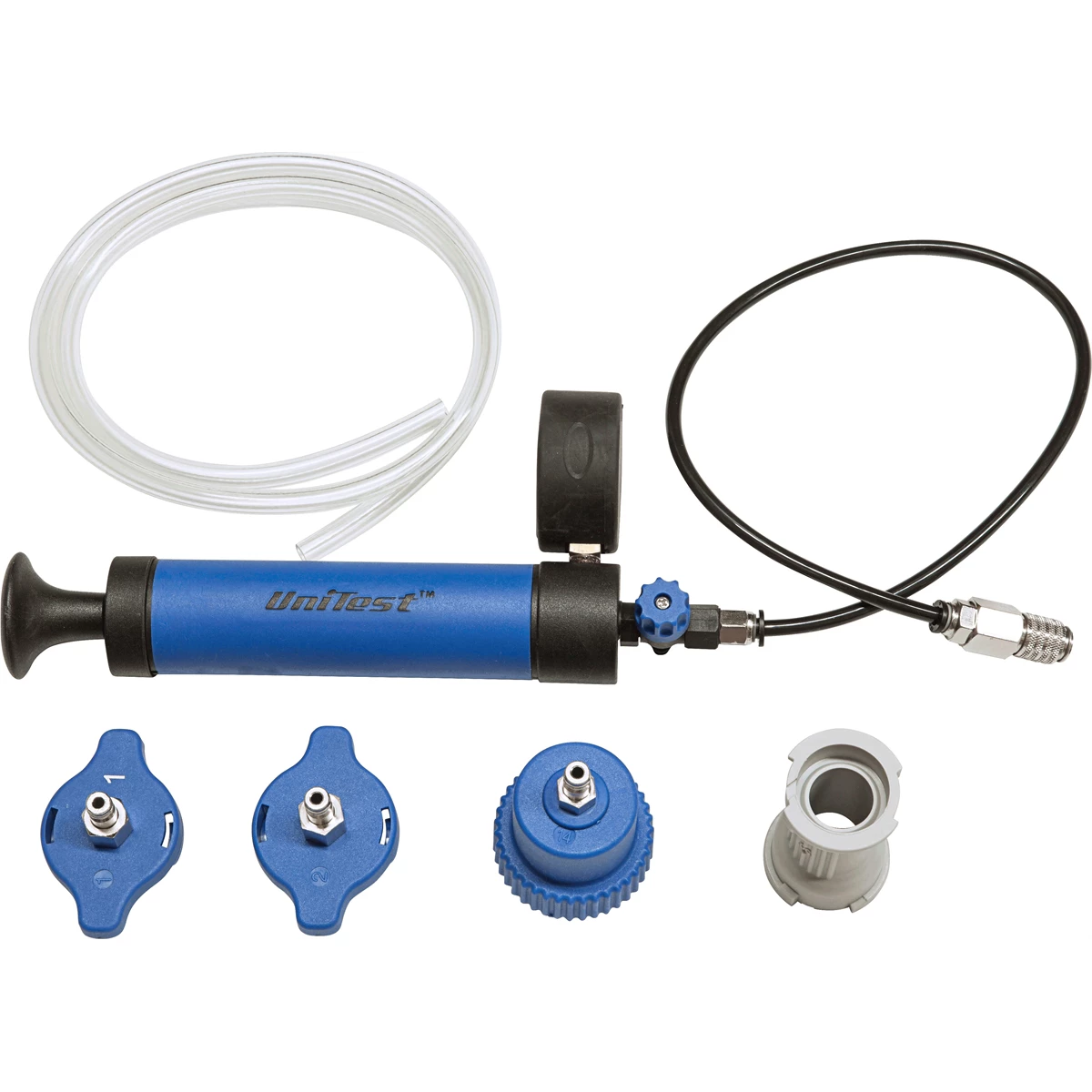
OE Toyota/Lexus Cooling System Pressure Test Kit
Mfg: Private Brand Tools
Part #: 71510

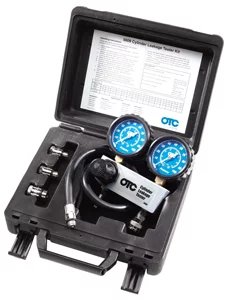
Deluxe Compression Tester Kit for Gasoline Engines
Mfg: OTC Tools and Equipment
Part #: 5605
Frequently Asked Questions
Can a failed oil cooler cause a check engine light?
Not directly from the cooler itself, but if enough oil contaminates the coolant it can trigger temperature sensor readings that look abnormal, or if coolant starvation causes overheating, you may see heat-related codes. The light is more a secondary effect than a direct symptom.
Is it safe to keep driving with milky coolant while waiting for parts?
Short trips at low severity may be tolerable for a day or two, but continued driving risks clogging coolant passages with oil sludge, reducing cooling flow and risking overheating or warping the head. Don’t drive it further than necessary to get it to the shop.
Does a $10 head gasket test kit actually work?
The chemical block testers are reliable for detecting combustion gases in coolant and are a legitimate first screening step, but they only confirm or rule out combustion intrusion — they won’t identify an oil cooler failure. Use it as one data point, not the whole diagnosis.
Why does oil end up in coolant more often than coolant in oil?
Oil galleries typically run at higher pressure than the cooling system, so when a thin separating gasket or core fails, oil is pushed into the lower-pressure coolant side. True head gasket failures are more likely to send coolant into the cylinders or oil passages because that failure path runs through the combustion seal, not a pressure differential across a heat exchanger.
How do I tell an oil cooler failure from a transmission cooler failure?
Color is the quick tell: engine oil contamination tends to produce a darker, chocolate-milk coolant, while transmission fluid contamination often shows a pinker or lighter tint, since ATF is typically red or amber. Confirm by checking which cooler lines show residue and cross-checking fluid levels in each system.
Should I replace the whole oil cooler or just the gasket?
If the failure is isolated to a seal, O-ring, or sandwich-plate gasket and the cooler core itself tests sound, gasket replacement is usually sufficient and far cheaper. If the core shows corrosion, cracking, or has had debris pulled into it, replace the whole unit to avoid a repeat failure.
Recommended Cooling System Tools
Performing the diagnostics outlined above requires a few key tools and possibly replacement parts. Check our Automotive Cooling System section for pressure test kits, cooler gaskets, seals, and related components.
- Cooling system pressure test equipment
- Oil cooler gaskets, O-rings, and replacement assemblies
- System flush supplies and replacement hoses

The Toolsource Technical Team blends decades of real-world automotive service experience with up-to-date technical research. Our writers collaborate with professional mechanics, shop owners, and diagnostic specialists to deliver practical, workshop-ready guidance you can trust.


Follow us on social media