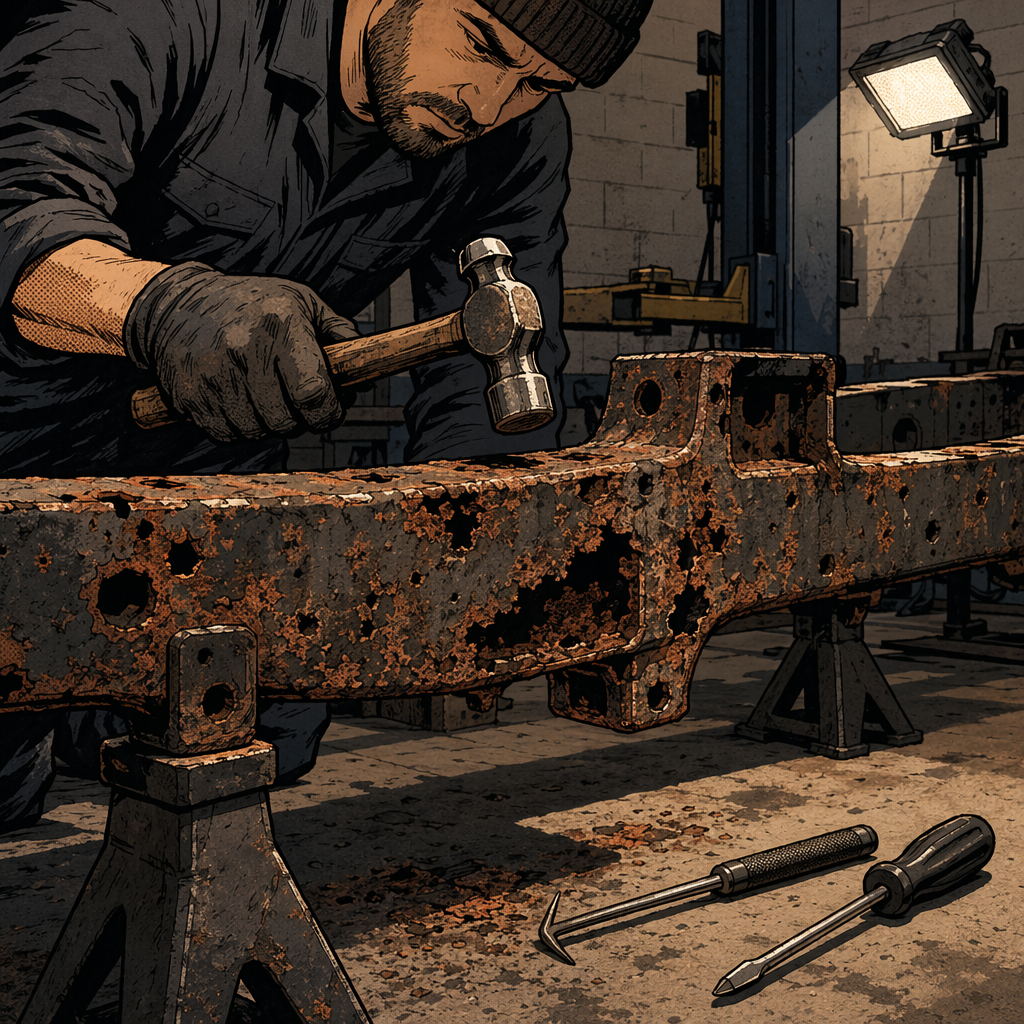
When a customer rolls in with a second-generation Tacoma showing severe frame rust—particularly around the cab mounts and cross members—you’re facing one of the toughest conversations in the shop. While the customer may be hoping for a simple weld-on fix, the reality is often far more complex. Frames that show advanced rust perforation rarely have isolated damage, and what appears to be one bad section typically indicates systemic corrosion throughout the structure. This guide provides a systematic approach to assessing frame rust severity, understanding repair limitations, and helping customers make informed decisions about whether repair or replacement makes economic sense.
Conducting a Thorough Frame Rust Inspection
Before any discussion of repair options, you need a complete picture of the frame’s condition. Visual inspection alone is insufficient—rust is deceptive, often appearing as surface corrosion while the underlying metal has lost substantial thickness and structural integrity. Start your assessment with a methodical tap test using a ball-peen hammer or small sledge. Work systematically along the entire frame length, paying particular attention to known problem areas on second-gen Tacomas: cab mounts, areas immediately forward of the rear leaf spring hangers, and the sections near the catalytic converters where heat cycling accelerates corrosion.
The tap test reveals what your eyes cannot. Solid metal produces a clear, ringing tone. Compromised sections sound dull or hollow, and severely rusted areas may actually perforate under moderate hammer strikes. Use a pick or sharp screwdriver as a secondary test—insert the tip into suspect areas with firm thumb pressure. If the pick penetrates easily, you’re not dealing with surface rust; the base metal is compromised. Document everything with photos and notes. Customers often don’t understand the extent of damage until you show them exactly what the screwdriver revealed.
Check inside the frame rails wherever access points exist. Use a borescope if available, or simply a bright flashlight and mirror. Interior rust is often more advanced than exterior surfaces because moisture gets trapped inside the boxed sections with no drainage or air circulation. If you’re seeing daylight through multiple perforations, or if large sections of the frame sound hollow during tap testing, you’re likely looking at frame replacement rather than repair.
Understanding the Limitations of Welding Rusted Frames
The fundamental problem with welding severely rusted frames is straightforward: you cannot weld to rust, only to solid base metal. When a frame has advanced to the perforation stage with visible holes and flaking rust, there’s rarely enough sound metal remaining to accept a structural weld. Even if you grind away the surface rust and find what appears to be solid steel, the metal immediately adjacent to heavily corroded areas has typically lost thickness through pitting and subsurface oxidation. Welds made to this compromised material lack the penetration and fusion needed for structural integrity.
Many frames carry stampings that explicitly state “no welding” or “no repairs,” particularly in areas designed as crumple zones. Even where welding isn’t prohibited, heat from the welding process can affect the metallurgy of heat-treated or high-strength steel used in modern frames. You’re also dealing with the challenge of welding through layers of undercoating, road grime, and rust inhibitors that previous owners may have applied—all of which create contamination issues that weaken welds.
The “just plate it” approach—welding patch panels over rusted sections—is a temporary fix at best when dealing with advanced rust. The underlying corrosion continues beneath the patch, and the edges of the patch become new sites for crevice corrosion where moisture gets trapped between the old and new metal. Within months, rust blooms around the repair, and you’re back to square one. This is why experienced technicians in the salt belt advise against patch repairs once rust has reached the structural perforation stage.
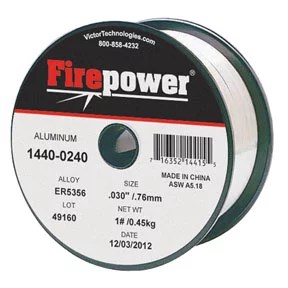
Firepower 1440-0240 1LB .030 Inch Aluminum Welding Wire
Mfg: Firepower
Part #: 1440-0240
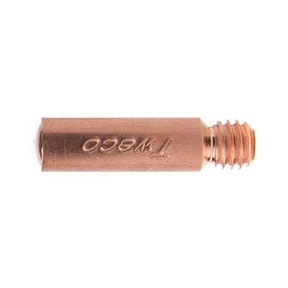
Tweco Professional MIG Welding Contact Tip .030 200A Copper
Mfg: Tweco Professional
Part #: 1110-1100
Evaluating Commercial Frame Repair Panels and Sections
For frames that still have sufficient sound metal, the aftermarket offers engineered repair sections specifically designed for second-generation Tacomas. Companies like AutoRust and RustBuster manufacture replacement cab mount sections, cross member reinforcements, and other common failure points. These are not simple flat patches—they’re formed sections that match the frame profile and include proper mounting points and structural ribs.
The key to successful installation is having enough good metal to weld to. These repair sections require you to cut away the damaged area completely, back to solid steel with no pitting or scale. You’re typically removing six to twelve inches beyond the visible rust, then welding in the replacement section with full-penetration welds. This is skilled work requiring proper fixtures to maintain frame alignment and prevent heat warping. Labor costs typically run $1,500 to $3,000 depending on how many sections need replacement, and that assumes the surrounding frame is sound enough to accept the repairs.
Before recommending this approach, inspect the entire frame. If you’re finding multiple areas that need section replacement, the math starts working against repair. A customer spending $3,000 to fix three or four spots on an 18-year-old truck with 150,000+ miles is making a questionable investment, especially when the rest of the frame likely has advanced rust that will surface in the next year or two. Repair panels make sense when you have one or two isolated problem areas and the rest of the frame passes the tap test cleanly.
Frame Replacement: When It’s the Only Viable Option
When rust is systemic—multiple perforations, failed tap tests in numerous locations, interior frame rot—replacement becomes the only safe option. For valuable trucks with low miles, clean bodies, and desirable features, a complete frame swap can be economically justified. The process involves stripping every component from the old frame and transferring it to a rust-free replacement frame, ideally sourced from a southern state that doesn’t use road salt.
Frame replacement is a major undertaking. You’re looking at 20-40 hours of labor depending on the vehicle’s complexity and condition of fasteners. Every brake line, fuel line, electrical harness, suspension component, steering linkage, and body mount comes off the old frame. Seized fasteners, broken studs, and corroded fittings add hours to the job. While the frame itself might cost $1,000-$2,500 for a good used unit, total job costs including labor and incidental parts typically run $5,000-$8,000.
This investment only makes sense in specific scenarios: the truck has under 100,000 miles, the body and cab are rust-free, the drivetrain is strong, and the customer plans to keep it for five-plus years. For a truck that’s already high-mileage with other issues developing, frame replacement costs approach or exceed the vehicle’s value. That’s when you need to have the difficult conversation about whether the customer should consider replacement rather than repair.
Preventive Measures: Protecting Frames Before Rust Takes Hold
The best frame repair is the one you never have to do. Technicians in salt-belt states know that aggressive prevention is the only way to keep frames viable long-term. This means regular undercarriage washing throughout winter months—not just once in spring, but every two to three weeks when roads are actively salted. High-pressure washing alone isn’t enough; you need to flush out the boxed sections of the frame where salt slurry accumulates and sits.
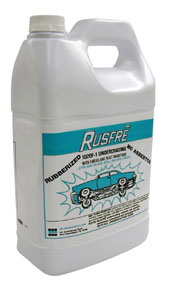
Annual application of a quality undercoating or rust inhibitor provides crucial protection. Fluid Film, Woolwax, and similar lanolin-based products creep into seams and crevices, displacing moisture and creating a barrier against salt. These aren’t permanent solutions—they require annual reapplication—but they dramatically slow corrosion progression. For frames showing early surface rust without perforation, wire brushing the affected areas, treating them with a rust converter or POR-15, and then overcoating with a protective film can arrest corrosion before it becomes structural.
The critical window is the first five to seven years of a vehicle’s life in salt-belt conditions. If owners wait until rust has perforated the frame, prevention is no longer an option. Educating customers about this reality—that a $150 annual undercoating service can prevent a $5,000 frame replacement down the road—is part of responsible service advisory. Unfortunately, many vehicle owners don’t prioritize rust prevention until damage is already severe, at which point your options become far more limited and expensive.
Making the Economic Decision: Repair, Replace, or Move On
When you’ve completed your assessment and identified the scope of frame damage, you need to present the customer with realistic options and honest cost projections. If you’re seeing isolated damage in one or two sections with the rest of the frame solid, repair panels may be viable at $2,000-$3,000 all-in. If you’re finding widespread rust, multiple perforations, and failed tap tests throughout, frame replacement at $5,000-$8,000 is the only safe repair. And if the frame is severely compromised with extensive rot, the honest answer may be that the vehicle has reached end-of-life from a safety and economic standpoint.
Help customers understand the context. An 18-year-old Tacoma with 200,000 miles and a $4,000 trade-in value doesn’t justify a $6,000 frame replacement, even though it’s mechanically possible. The same truck with 80,000 miles, a clean body, and recent drivetrain work might justify that investment if the customer plans another five years of use. Don’t let customers fall into the sunk-cost fallacy—the fact that they’ve already put money into the truck doesn’t mean throwing more money at a failing frame makes sense.
Be particularly cautious about liability. If you perform a patch repair on a severely compromised frame and that frame fails in use, you own that liability. Document everything, be conservative in your assessments, and don’t be afraid to recommend against a repair if you believe the frame lacks structural integrity. Some customers will push back, insist they just need to “get another year out of it,” or ask you to “just do something cheap.” Stand firm—your professional judgment and the safety implications matter more than making a sale on a questionable repair.
Quick Frame Assessment Checklist
- Perform tap test on entire frame length with ball-peen hammer, listening for dull or hollow sounds
- Use pick or screwdriver to probe suspect areas—easy penetration indicates compromised metal
- Inspect cab mounts, catalytic converter areas, and forward of leaf spring hangers closely
- Check inside frame rails with borescope or flashlight for interior corrosion
- Document all findings with photos showing extent of perforation and scaling
- Assess whether sufficient sound metal remains for welding repair sections
- Compare repair costs against vehicle value and customer’s intended use period
- Verify frame stampings don’t prohibit welding in affected areas
Frequently Asked Questions
Can you weld rusted frame sections and have them hold up safely?
You can only weld to solid base metal, not to rust. If the frame has perforated with visible holes and scaling rust, there typically isn’t enough sound metal remaining to accept structural welds. Even if you grind away surface rust, the adjacent metal has often lost thickness through pitting and subsurface corrosion, resulting in weak welds that won’t hold under load. Patch repairs over rusted sections are temporary at best—corrosion continues beneath the patch and typically fails within months.
Are aftermarket frame repair sections a good option for Tacoma rust?
Engineered repair sections from companies like AutoRust and RustBuster work well when you have isolated damage and sufficient sound metal to weld to. They’re formed to match the frame profile and include proper mounting points. However, successful installation requires cutting back to completely solid steel—often 6-12 inches beyond visible rust—and making full-penetration welds with proper fixturing. This is skilled work costing $1,500-$3,000+ in labor. If you need multiple sections replaced, the economics quickly favor frame replacement over repair.
How do I know if frame rust is too far gone to repair?
Perform a systematic tap test with a hammer along the entire frame. Dull or hollow sounds indicate compromised metal. Use a pick to probe suspect areas—if it penetrates easily with thumb pressure, the base metal is gone. Check inside the frame rails for interior corrosion. If you’re finding multiple perforations, failed tap tests in numerous locations, and extensive interior rust, the frame is beyond economical repair. At that point you’re looking at complete replacement or vehicle retirement.
What does frame replacement cost and when does it make sense?
Complete frame replacement typically costs $5,000-$8,000 including a rust-free frame (often sourced from southern states) and 20-40 hours of labor to transfer all components. This only makes economic sense for trucks with under 100,000 miles, clean bodies, strong drivetrains, and owners planning five-plus years of use. For high-mileage trucks with additional issues, replacement costs approach or exceed vehicle value, making it more sensible to buy a different truck rather than invest in major frame work.
How can I prevent frame rust from reaching severe stages?
Regular undercarriage washing every 2-3 weeks during winter months is critical in salt-belt states—not just once in spring. Flush boxed frame sections where salt accumulates. Apply lanolin-based rust inhibitors like Fluid Film or Woolwax annually, ensuring coverage in seams and crevices. For early surface rust, wire brush affected areas, apply rust converter or POR-15, then overcoat with protective film. The critical window is the first 5-7 years in salt conditions—once perforation occurs, prevention is no longer an option.
Did Toyota have a frame recall for second-generation Tacomas?
First-generation Tacomas had a 15-year frame replacement program due to rust issues, but second-generation trucks (2005-2015) had more limited coverage. Some 2005-2010 models qualified for an enhanced corrosion warranty, but this expired years ago for most vehicles. An 18-year-old Tacoma is well beyond any manufacturer warranty coverage. While some owners research recall eligibility, they’re typically disappointed to learn their truck no longer qualifies for free frame replacement.
Metal Fabrication Tools for Frame Repair
Assessing and repairing frame rust requires proper tools and equipment. Whether you’re performing tap tests, probing compromised metal, or preparing surfaces for welding repair sections, having the right metal fabrication tools on hand ensures thorough diagnostics and quality repairs.
- Hammers, picks, and probes for frame inspection and testing
- Grinding and surface preparation equipment for rust removal
- Welding fixtures and measuring tools for precision frame work

The Toolsource Technical Team blends decades of real-world automotive service experience with up-to-date technical research. Our writers collaborate with professional mechanics, shop owners, and diagnostic specialists to deliver practical, workshop-ready guidance you can trust.


Follow us on social media