Hail season brings a predictable spike in estimate requests, and just as predictably, a gap between what the car’s owner expects to pay and what the repair actually costs. Whether you’re running PDR full-time or managing a shop that outsources it, the jobs that go sideways almost always trace back to a rushed first look — missing a popped clip, underestimating dent density, or quoting without checking whether a panel is even repairable. This guide breaks down the assessment, the repair-vs-replace decision, and the pricing conversation so you can move hail jobs through the shop without surprises on either side of the counter.
Start With a Real Assessment, Not a Drive-By Estimate
A phone-photo quote on hail damage is a guess, not an estimate. Dent count, dent depth, and panel material all change the labor math, and none of that is reliable from a few pictures taken in bad light. Before quoting:
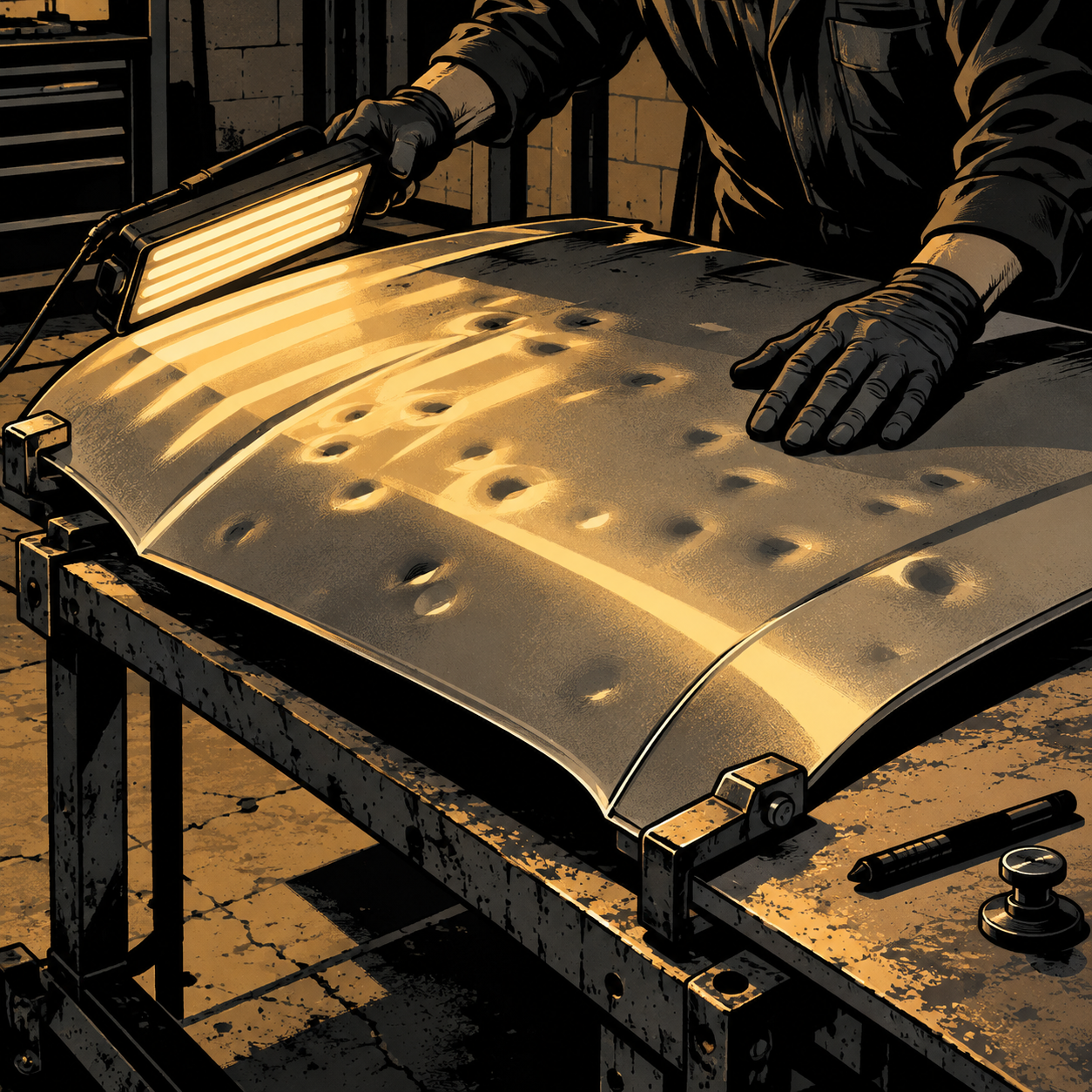
Walk the car in direct sunlight or under a dent-reading light board — fluorescent shop lighting flattens shadows and hides shallow dings. Run a hand over every panel, not just the ones with visible damage; hail dents on sail panels and roof edges are easy to miss by eye. Check for stretched metal, which shows up as a dent with sharp, shiny edges that won’t pull back cleanly with standard tooling — that’s a sign PDR alone won’t finish the job and some filler-and-blend work is coming. Separate the hood, roof, and trunk from the quarters and doors early, because the first group is where the “repair vs. replace” call usually happens.
Document everything with a dent map before you touch the car. On high-volume claims this map is what justifies your invoice to the insurer and protects you if the customer disputes scope later.
Paintless Dent Repair: What It Actually Fixes and What It Costs
PDR is the right tool for the overwhelming majority of hail dents — shallow, unstretched dents on accessible panels with factory paint. A skilled tech working from behind the panel can push dents out without touching the clear coat, which keeps the repair invisible and avoids a paint bill entirely. On a moderate hail hit, PDR-only repairs commonly land in the low thousands; heavy, dense hits with hundreds of dents across every panel can push into five figures once you’re billing per-dent or per-panel at volume.
Pricing models vary by shop. Some charge per dent (roughly $50–150+ depending on size and access), others price per panel once dent density crosses a threshold, and high-volume hail shops often quote a flat “whole car” number after the walk-around. Whatever model you use, be upfront that price drops as density goes up — a car with 300 small dents is usually cheaper per-dent than a car with 20 large ones, because technique and time per dent change. Push-to-paint (finishing a stubborn dent with light filler and blending into the clear) is a legitimate cost-saver on marginal dents, and should be quoted as a distinct line item, not folded into “PDR.”


Know When PDR Stops and Panel Replacement Starts
Three situations take a panel out of PDR territory:
Stretched or creased metal. Sharp dents, deep creases, and anything where the metal has stretched past its elastic limit won’t pull back clean — chasing it with PDR wastes hours and risks popping paint. Hoods. On most hail jobs, replacing the hood with a used, color-matched unit (or a new one painted to match) is faster and cheaper than PDR-ing dense damage on a horizontal panel that’s highly visible and easy to source. Structural roofs. Some platforms — certain coupes and unibody sports cars in particular — don’t support roof panel replacement without significant structural reinforcement work. On those vehicles, a badly dented roof may only be fixable through aggressive PDR and push-to-paint, or it stays as cosmetic damage the owner lives with.
When you hit one of these, say so plainly in the estimate. Mixing a “PDR will fix everything” sales pitch with a roof that structurally can’t take a new panel sets up a comeback and a credibility problem.
Insurance Claims and the Total-Loss Math
Before you finalize scope, ask whether the repair is going through insurance or out of pocket — it changes both the process and the ceiling. Comprehensive hail claims typically don’t affect a policyholder’s rate the way an at-fault claim would, which is worth mentioning to customers who are hesitant to file. But insurers total a vehicle when repair cost plus any prior damage approaches the car’s actual cash value, so a $4,000–8,000 hail repair on a car worth $6,000 is a coin flip on totaling, not a guaranteed repair authorization.
If a customer is buying a car that already has unrepaired hail damage, get a written PDR/body shop quote before closing the deal, not after. Salvage-title and already-discounted hail cars routinely get re-quoted at $8,000–12,000+ for a full restoration, which can exceed the car’s value entirely — at that point the realistic options are driving it as-is, a partial repair (hood replacement plus PDR on doors/fenders only), or accepting the cosmetic damage and moving on.
Shop Workflow for High-Volume Hail Claims
When a hail event generates hundreds of claims at once, an ad-hoc approach burns bay time fast. The workflow that scales:
1. In-house tech tears down trim, moldings, and anything blocking panel access, and flags parts that are clearly unrepairable (moldings, some plastic trim) for replacement rather than repair. 2. Outsourced or specialized PDR techs work every panel except the hood, which gets pulled for replacement rather than repaired in place. 3. The repair returns to the shop for final paint — almost always just the replacement hood and a blend on the adjacent fenders, since a competent PDR pass rarely damages clear coat. 4. Quality control inspects under raking light before reassembly; catch popped paint or missed dents now, not after the customer picks up the car.
Shops running this pipeline on large claim volumes report paint/blend work needed on only a small fraction of panels — most of the job stays in PDR’s hands. That ratio is a useful benchmark: if you’re painting more than the hood and a fender blend on a routine hail job, something in the PDR pass didn’t go as planned.
Setting Customer Expectations
Most comebacks and bad reviews on hail jobs trace to a mismatch between what the customer pictured and what PDR delivers. Set expectations up front: PDR gets a panel very close to factory, not microscope-perfect, and raking light at the right angle may still reveal faint telltales on heavily worked panels. If the customer’s priority is resale value or show-car condition, say so explicitly and price accordingly — that’s a different job than “make it presentable to drive.” If their priority is just a functional, decent-looking daily driver on a tight budget, a hybrid plan (replace the hood, PDR the rest, skip paint on panels that are “good enough”) is a legitimate, defensible scope — just write it into the estimate as a scoped partial repair, not a full restoration, so there’s no ambiguity at pickup.
Quick Reference Checklist
– Inspect every panel in direct light or under a dent board before quoting, not from photos
– Map dent density and depth; flag stretched/creased metal separately from clean PDR candidates
– Default hoods to replacement with color-matched used or painted parts rather than PDR
– Confirm whether the vehicle’s roof structurally supports panel replacement before promising it
– Get the insurance path (claim vs. out-of-pocket) and ACV estimate before finalizing scope
– Write partial-repair scope explicitly into the estimate so expectations match the invoice

QPK-20 Quick Pull Autobody Dent Pulling Attachment Kit
Mfg: Lenco Automotive
Part #: 27420

FAQs
Does filing a hail claim raise insurance rates?
Comprehensive claims, which cover hail, generally don’t carry the same rate impact as at-fault claims with most carriers. Confirm with the specific insurer, but it’s usually worth filing rather than paying out of pocket.
How much does PDR cost per dent?
Pricing varies by shop and region, but per-dent rates commonly run roughly $50–150+ depending on dent size and panel access, with per-dent cost typically dropping as total dent count goes up.
Can every hail dent be fixed with PDR?
No. Dents with stretched or creased metal, and panels where prior damage or paint repairs are already present, often need traditional filler-and-paint work or outright replacement instead of PDR.
Why do shops replace the hood instead of PDR-ing it?
Hoods are usually the densest hail damage and the easiest panel to source and swap. Replacing with a color-matched used hood or a freshly painted one is typically faster and cheaper than extensive PDR on a highly visible horizontal panel.
What if the repair cost is close to the car’s value?
Get a written estimate before deciding anything. If repair cost approaches the vehicle’s actual cash value, the insurer may total it; if it’s a cash deal, weigh a partial repair (hood swap plus PDR on the rest) against simply driving the car as-is.
Is it safe to buy a car with existing hail damage?
Only with an independent repair quote in hand first. Heavily hail-damaged vehicles can run $8,000–12,000+ to fully restore, which can exceed the car’s value — know that number before you negotiate the purchase price.
Tools for Hail Damage Repair
Whether you’re doing PDR full-time or managing a shop, the Paint & Body category stocks the dent repair tools, specialized lighting, and panel replacement supplies you’ll need to handle hail season efficiently.
- Paintless dent repair tools and rods for accessing panels from multiple angles
- Dent boards and raking lights for accurate damage assessment
- Body shop consumables and finishes for push-to-paint work

The Toolsource Technical Team blends decades of real-world automotive service experience with up-to-date technical research. Our writers collaborate with professional mechanics, shop owners, and diagnostic specialists to deliver practical, workshop-ready guidance you can trust.


Follow us on social media