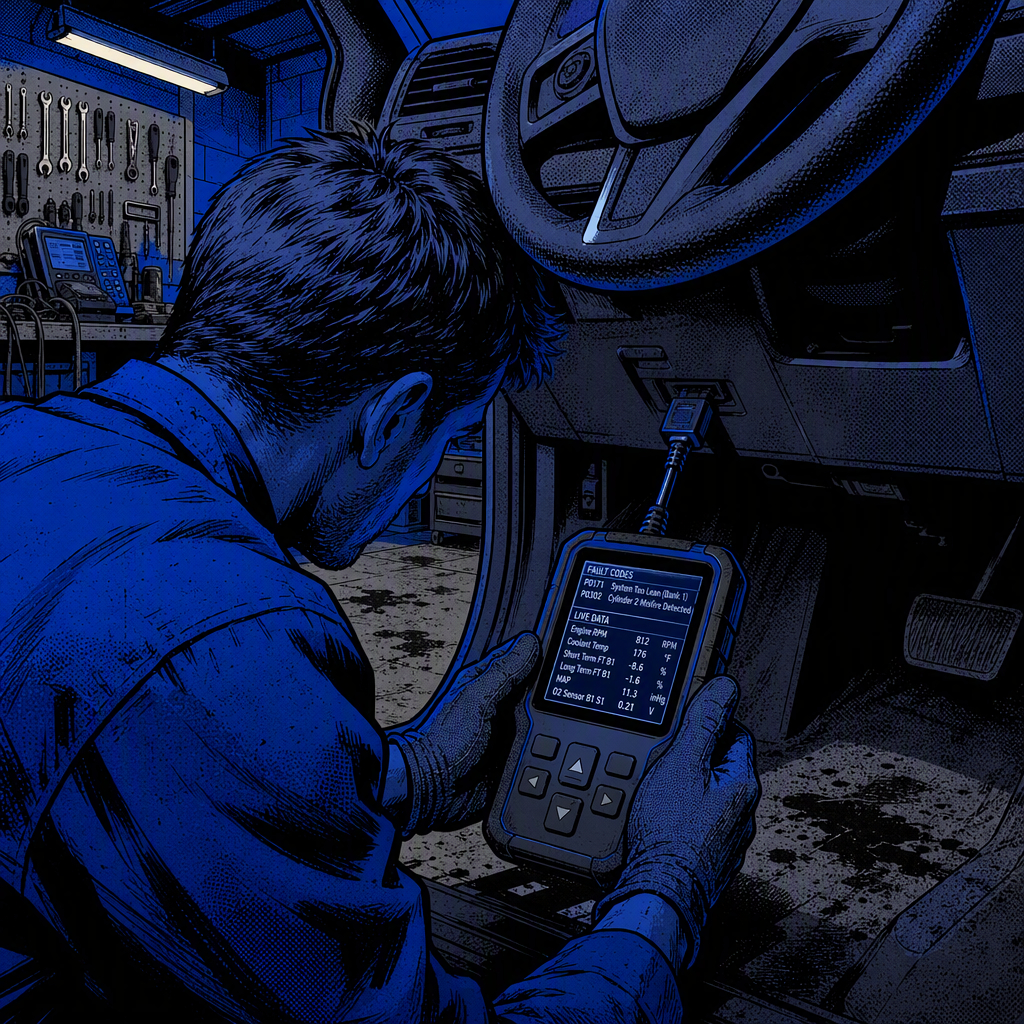
A recent Reddit thread lit up after a traveling mechanic asked a local shop to pull codes on his car for free, since he was “in the industry,” and the shop quoted him $70 instead. The comment section split hard: some technicians said a scan takes two minutes and should be a courtesy, others pointed out that a busy bay has no such thing as a free two minutes. Both sides are right in different contexts, and the disagreement itself is useful — it exposes exactly where shops need a clear, written policy and where individual techs need better gear in their own trunk. Below is a practical breakdown of what a code scan actually costs a shop, how to price walk-in requests, what to carry so you’re never the guy asking for a favor, and how to handle customers who claim industry status to get a discount.
Why “just pull the codes” is never really free
A code scan looks trivial from the customer side: plug in a tool, read a screen, done. From the shop side, it’s never just two minutes. Getting a vehicle a scan requires pulling a tech off a paying job, walking to the vehicle, locating the OBD-II port (which on some trucks and imports means removing a panel), running the scan, interpreting the codes, and often explaining what they mean well beyond just reading a code number off a screen. That interaction routinely eats 10-15 minutes of billable time, not two.
Multiply that by every walk-in who wants “just a quick scan” in a week, and a shop can lose several hours of unbilled labor — hours that come directly out of technician wages and shop overhead, since techs are usually paid on flagged hours, not for standing in the parking lot being helpful. This is why many shops that used to offer free scans as a goodwill gesture have moved to a minimum charge, even if it’s a reduced rate compared to a full diagnostic.
The other cost is equipment. Professional-grade scan tools with OEM-level bidirectional control, subscription updates, and manufacturer-specific software easily run into the thousands of dollars, plus annual licensing fees. A shop charging for scan access isn’t gouging anyone — it’s recovering a real cost of doing business, similar to how a locksmith charges a service call even for a five-minute lockout.
What a scan actually costs the shop: labor, liability, and tool wear
Beyond the direct time cost, there’s liability to consider. The moment a tech plugs a scanner into a stranger’s vehicle, the shop has some level of exposure if something goes wrong — a battery drain, a software conflict, a customer who claims the tool “caused” a check engine light. Shops that do offer free scans typically limit the interaction strictly: plug in, read the screen, unplug, no popping the hood, no test-driving, no touching anything else. That boundary protects the shop from taking on liability disguised as a favor.
There’s also a practical trust issue that came up repeatedly in the discussion: anyone can claim to be “in the industry.” Shops have no way to verify that in the moment, and techs who do walk in claiming professional courtesy are sometimes the hardest customers to deal with, second-guessing recommendations or expecting free labor on top of the free scan. A shop that gives away diagnostic time to every self-identified professional is setting a precedent it can’t sustain.
None of this means shops should refuse every scan request. Many successful shops treat a fast, no-touch code pull as a low-cost lead generator — it’s a two-minute interaction that can turn into a $2,000 repair if the customer likes how they were treated. The key is that it has to be controlled and optional, not an obligation the shop owes to anyone who walks in the door.


Set a written walk-in scan policy — don’t decide it case by case
The shops that avoided the Reddit-style blowup all had one thing in common: a standard answer that didn’t change based on who was asking. Deciding case-by-case, based on how busy the shop is or how the customer presents themselves, guarantees inconsistency and resentment either from the customer or the tech who has to break away from a paying job. A written policy posted at the counter removes the awkward negotiation entirely.
A workable structure that several shop owners described looks like this: a free, no-obligation scan performed at the counter or in the lot (key on, plug in, read codes, unplug — nothing more), paired with a flat diagnostic fee for anything beyond that, such as freeze-frame data interpretation, live data monitoring, or a road test. That way the shop isn’t giving away its diagnostic expertise, only the mechanical act of reading a code, which costs almost nothing if it’s handled by an office manager or advisor rather than a technician pulled off a lift.
Shops without spare front-counter staff to run that free scan should charge a flat minimum instead — commonly in the $50-90 range for a scan-only visit, credited toward the repair if the customer books the job. Whatever the number, it needs to be posted or stated up front, every time, so it isn’t a negotiation.
Carry your own scanner — the fix half the thread missed
The most repeated piece of advice in the discussion wasn’t about shop policy at all — it was that any technician (or frequent road-tripper) should never be caught without a basic OBD-II scanner in their own vehicle. A $20-40 Bluetooth OBD-II dongle paired with a free app like Torque or a manufacturer-specific app covers 90% of “is this safe to drive” situations without ever needing to ask a stranger’s shop for a favor.
This isn’t about replacing a professional-grade scan tool for actual diagnostic work. It’s about having enough information to make a go/no-go decision on the road: is this a misfire that could strand you, or a evap code that can wait until you’re home. A basic reader answers that question in under a minute, at a cost lower than a single shop visit, and it never runs out of business hours.
Pricing models that actually work for shops
Shops in the discussion described a range of approaches, and most of them work fine as long as they’re applied consistently:
- Free counter scan, no diagnosis. Office staff plugs in, reads codes, hands over a printout. No opinion given on repair needs. Costs the shop almost nothing and builds goodwill.
- Flat scan fee, credited toward repair. A set price (commonly under $50) covers the code pull and a brief explanation; if the customer books the repair, the fee is waived or applied to the invoice.
- Scan-and-diagnose bundle. A single price (several shops cited numbers in the $90-190 range) covers the code scan plus up to an hour of diagnostic time, aimed at customers who want an actual repair recommendation, not just a code number.
- No free scans, period. Some shops, especially high-volume or specialty shops, don’t offer any free option and quote a flat diagnostic rate for every walk-in, treating the code scan as the first step of a paid diagnosis rather than a separate service.
None of these is objectively correct — the right model depends on shop volume, staffing, and how much walk-in traffic the location gets. A shop in a high-tourist or high-transient area, as several commenters noted, sees far more of these requests and needs a firmer policy than a neighborhood shop with mostly repeat customers.
Handling the “I’m in the industry” claim
Professional courtesy between shops is real, but it’s typically reciprocal and relationship-based — two shop owners who refer work to each other, not a stranger walking in cold. A claim of industry status from an unknown person doesn’t obligate free labor, and treating it as leverage tends to backfire, since it reads as an attempt to jump the line rather than a legitimate professional courtesy. The cleanest response is to apply the same walk-in policy to everyone, industry claim or not, and offer any discount as a discretionary gesture rather than an expectation.
Quick checklist: walk-in code scan policy
- Post a clear price (or “free, no-obligation”) for walk-in scans at the counter
- Limit the free tier to plug-in-and-read only — no hood, no test drive, no live data
- Assign scans to front-desk staff when possible, not a tech mid-job
- Charge a flat diagnostic fee for anything beyond a raw code pull
- Apply the policy the same way regardless of who’s asking or what they claim
- Carry a personal OBD-II scanner in your own vehicle so you’re never the one asking
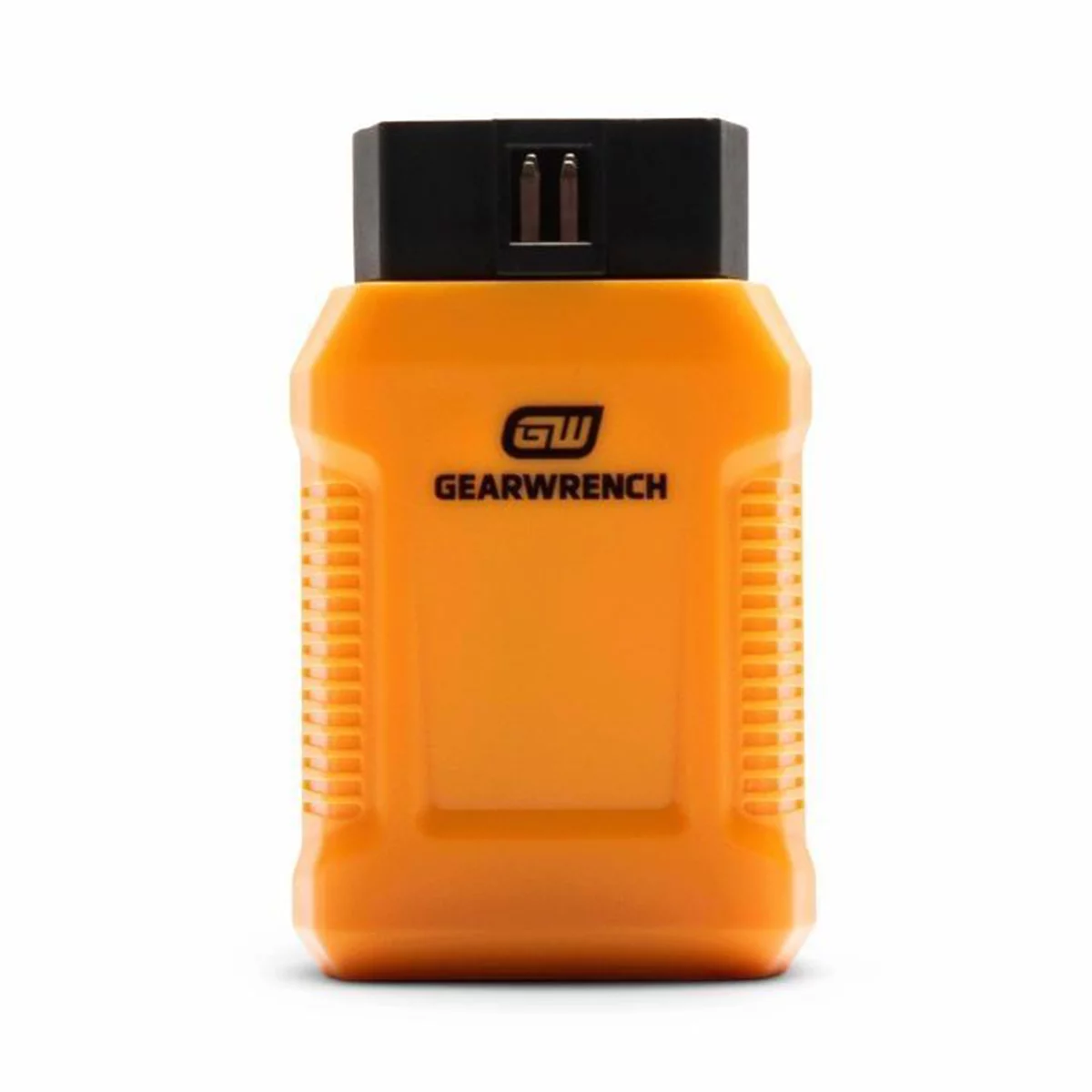
GearWrench Professional Bi-Directional Diagnostic Scan Tool
Mfg: GearWrench
Part #: GWSMARTBT
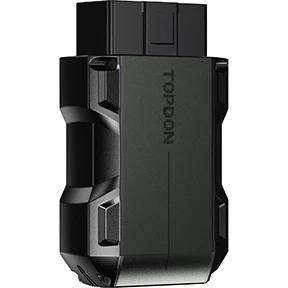
Topdon Pocket-Size Bluetooth Scan Tool w/Bi-Directional Cont
Mfg: TOPDON
Part #: TOPSCANLITE
FAQ
Is it reasonable for a shop to charge for a code scan?
Yes. Even a “quick” scan pulls a person off other work, exposes the shop to some liability, and uses equipment that costs thousands of dollars to buy and license. Charging a flat, modest fee for scan-only visits is standard business practice, not price gouging.
What should a shop charge for just pulling codes, no diagnosis?
Rates vary, but shops in this range commonly charge somewhere between free (counter-only, no-touch) and $50-90 for a scan visit, often credited toward the repair if the customer books the work. A separate, higher flat rate typically applies once actual diagnostic interpretation is involved.
Should I carry my own OBD-II scanner as a technician?
Yes. A basic Bluetooth OBD-II adapter paired with a free app costs far less than a single scan-only shop visit and lets you make an informed go/no-go decision on the road without depending on another shop’s time.
Does claiming to work in the industry entitle someone to a free scan?
No. Professional courtesy is typically reciprocal between shops with an existing relationship, not an obligation owed to any stranger who says they’re a mechanic. Shops can’t verify the claim in the moment and are reasonable to apply their standard policy regardless.
What’s the difference between a code scan and a full diagnostic?
A code scan reads and reports stored trouble codes, taking a few minutes. A diagnostic goes further — interpreting freeze-frame data, checking live sensor readings, and road-testing if needed to confirm a root cause — and typically takes 30-60+ minutes of billed labor.
Can a bad or ignored check engine code actually be dangerous to drive with?
Sometimes. Misfire and overheating codes can leave a vehicle stranded or cause engine damage if driven on, while evaporative emissions or minor sensor codes are usually safe to defer. A quick scan is exactly how a driver tells the difference, which is why keeping a personal reader on hand is worth the small upfront cost.
Automotive Scan Tools
The article covered why shops charge for code scans and why technicians should carry a personal OBD-II reader—having the right equipment eliminates downtime and the need for favors. Our Automotive Scan Tools selection includes options from basic Bluetooth adapters to professional diagnostic platforms.
- Bluetooth OBD-II adapters for personal vehicles and quick field diagnostics
- Professional scan tools with OEM-level access and bidirectional control
- Code readers designed for shop and field use

The Toolsource Technical Team blends decades of real-world automotive service experience with up-to-date technical research. Our writers collaborate with professional mechanics, shop owners, and diagnostic specialists to deliver practical, workshop-ready guidance you can trust.


Follow us on social media