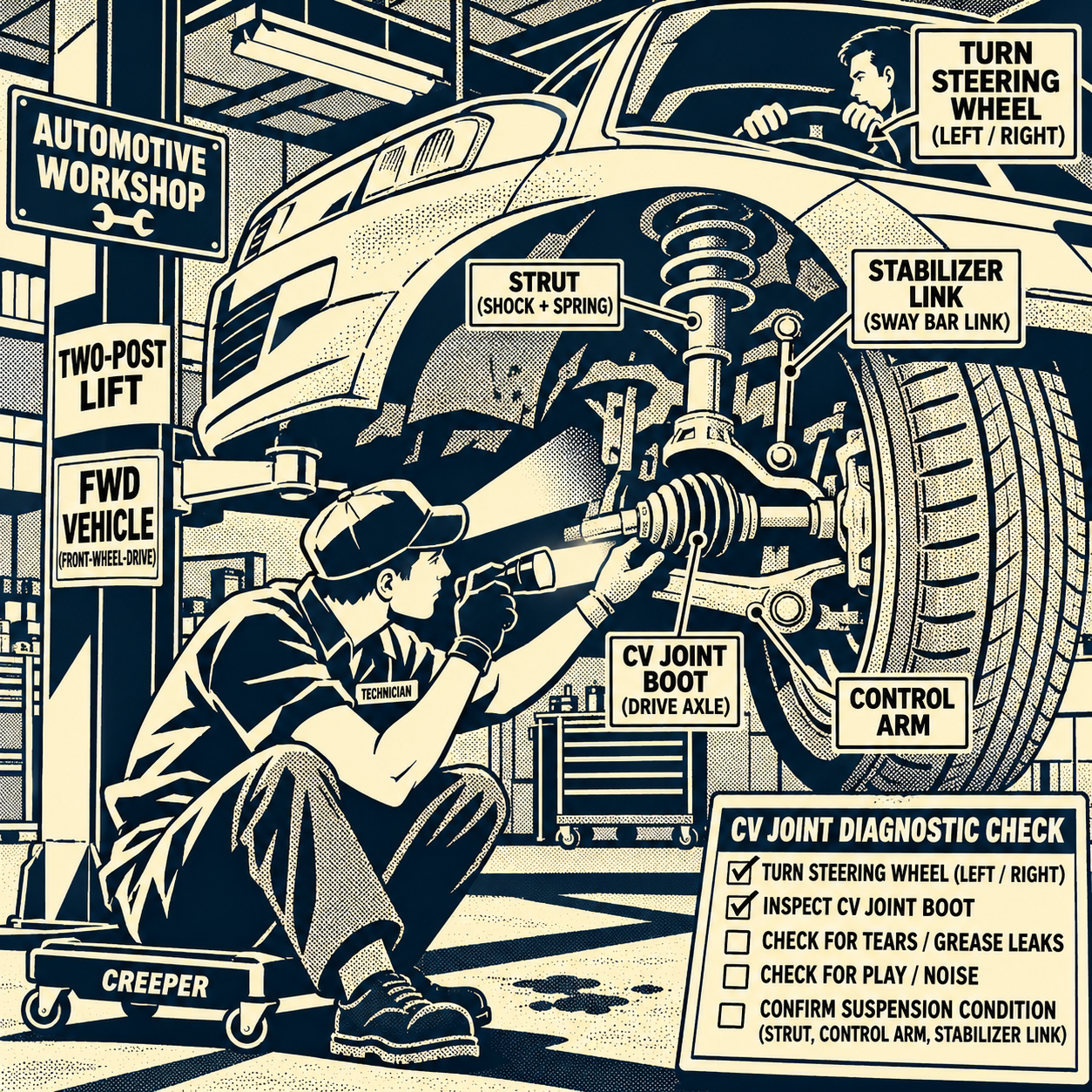
A customer rolls in saying the car makes a noise “only when I turn the wheel all the way.” It’s one of the more common comebacks in a service bay, and it’s also one of the easiest to misdiagnose, because a dozen different components can produce a similar sound at full steering lock. The fact that an older vehicle makes some noise during a lock-to-lock sweep doesn’t mean that noise is normal — a one-sided clunk, creak, or grinding sound almost always points to a specific worn part. This guide walks through a repeatable process for isolating the source instead of guessing from the sound alone.
Why Full-Lock Noise Happens
When the steering wheel is turned to its stop, several things happen at once: the strut (or shock) rotates inside its upper mount, the CV joints on the drive axles reach their maximum articulation angle, the tie rod ends and ball joints swing to the edge of their range of motion, and the steering rack’s inner tie rod travels to the end of its stroke. Any one of these can generate noise when it’s worn, under-lubricated, or has lost its normal range of free movement. The key diagnostic question isn’t “does it make noise at full lock” — it’s “which specific component is making the noise, and is the behavior symmetrical side to side.” A noise that only happens on one side, or that comes with visible movement you wouldn’t expect, is the strongest clue you have before you even get a lift involved.
Start With a Side-to-Side Comparison
Before pulling anything apart, get the car on a lift, turn the wheel lock to lock with the front end raised, and watch both sides at once if you can get a second set of eyes, or run it twice watching one side at a time. If the noise and any visible play is only present on one side, you’ve already ruled out normal wear patterns that would affect both sides equally (like a generally dry steering rack or aged bushings all around). One-sided clunking with a visible back-and-forth shift in a component is a strong indicator of a specific failed part — a worn strut mount, a loose tie rod end, or a CV joint with a torn boot — rather than generalized age-related noise. Mark the wheel position where the noise occurs; that tells you whether it happens at full lock only, through the travel, or both.


Check Strut Mounts and Top Bearings
With the vehicle on the ground or on the lift with wheels loaded (a helper can sit in the driver’s seat and turn the wheel while you watch under the hood or wheel well), inspect the strut mount and bearing plate at the top of the strut tower. A worn upper strut mount or bearing will often produce a clunk or creak specifically as the strut rotates near the end of travel, and you may be able to see or feel movement in the mount itself — some play, a visible shift, or the bearing not rotating smoothly with the strut shaft. Compare both sides. If one mount shows play or rotational resistance the other doesn’t, that’s your source. Grab the top of the strut with the wheel off the ground and try to rock it; excessive movement confirms a worn mount. These are straightforward to replace and are a common failure point on vehicles with 80,000+ miles, especially if the car sees a lot of full-lock parking maneuvers.
Replacement parts and torque specs vary by platform, so confirm the correct strut mount and bearing assembly for the vehicle before ordering.
Inspect CV Joints and Axle Boots
Front-wheel-drive and AWD vehicles route power through CV joints that reach their steepest angle at full steering lock, which is exactly when a failing joint or torn boot will announce itself — typically as a clicking or clunking noise rather than a creak. Pull back or squeeze the CV boot (inner and outer) and look for cracks, splits, or grease flung around the boot and nearby suspension components. A boot that feels dry, stiff, or thin-walled is losing grease and will fail soon even if it hasn’t torn yet. If the boot looks intact and the grease feels adequate but slightly dry, it doesn’t automatically need replacement — packing additional CV grease into the joint through the boot opening is a legitimate interim step if the joint itself still feels tight with no play when rocked by hand. If the boot is torn or the joint has detectable play, don’t repack it — replace the axle or joint, since contaminated or depleted grease accelerates joint wear quickly once the boot seal is broken.
Check Tie Rod Ends and Ball Joints
With the front end unloaded, grab each tie rod end and ball joint and check for play by hand — pushing and pulling, and twisting where applicable. A worn tie rod end will often clunk specifically near full lock because that’s where the linkage geometry puts the most side load on a loose joint. Also check the tie rod boot for tears; a dry or torn boot lets the joint wear faster and can introduce a dry, gritty noise distinct from a clunk. While you’re in there, check the sway bar end links too — they’re a frequent source of clunking noise during steering and suspension travel and are easy to overlook because the symptom pattern looks similar.
Rule Out the Steering Rack and Pump
If every suspension and driveline component checks out tight and the noise still presents only at the extremes of travel, turn attention to the steering rack itself. Inner tie rod ends can develop play that’s only noticeable at full lock when the rack reaches the end of its internal travel. On hydraulic power steering systems, a whining or groaning noise at full lock (as opposed to a clunk) often points to a pump or fluid issue rather than a mechanical linkage problem — check fluid level and condition first, since aerated or low fluid will cause noise under the increased pump load at full lock. On electric power steering systems, a noise at full lock can sometimes be a motor or gear assembly issue inside the rack housing, which is harder to diagnose by ear alone and may need a scan tool to check for stored codes or steering torque sensor faults.
Quick Diagnostic Checklist
- Confirm the noise is one-sided or present on both sides
- Inspect upper strut mounts/bearings for play or rotational resistance
- Check CV boots for tears, dryness, or thrown grease; feel for joint play
- Hand-check tie rod ends, ball joints, and sway bar end links for looseness
- Check inner tie rod travel and steering rack mounting
- For power steering whine, check fluid level/condition before suspecting the pump
Once you’ve isolated the source, a broader suspension and steering inspection kit makes it easier to double-check related wear items before closing out the job.


121pc Auto Maintenance Introductory TEP Set SAE Metric
Mfg: GearWrench
Part #: 83090

Frequently Asked Questions
Is it normal for an older car to make some noise turning lock to lock?
Some very faint noise can occur on higher-mileage vehicles, but a distinct clunk, creak, or grind — especially if it’s one-sided or accompanied by visible movement in a component — is not normal wear and indicates a specific part needs attention.
Can I just repack a CV joint instead of replacing it?
Only if the boot is intact and undamaged and the joint itself shows no play when checked by hand. If the boot is torn or the joint has detectable looseness, repacking won’t fix the underlying wear and the joint should be replaced.
How do I tell a strut mount noise from a CV joint noise?
Strut mount noise is typically a creak or clunk felt and heard near the top of the strut tower as the mount rotates. CV joint noise is usually a clicking or clunking sound from lower in the wheel well, tied to the joint’s articulation angle, and often accompanies a torn or dry boot.
Does a whining noise at full lock mean the power steering pump is failing?
Not necessarily. Check power steering fluid level and condition first — low or aerated fluid causes noise under the pump’s increased load at full lock. If fluid is correct and the noise persists, the pump or rack bearing is a more likely cause.
Why does the noise only happen on one side?
One-sided noise points to an isolated component failure — a specific worn mount, joint, or tie rod end — rather than general age-related wear, which would typically affect both sides more evenly.
What should I check if nothing feels loose by hand but the noise is still there?
Move to the steering rack itself: check inner tie rod travel at full lock, rack mounting bushings, and for electric power steering systems, scan for stored steering-related codes since some noises originate inside the rack assembly.
Shop Suspension & Steering Tools
This guide covers inspection and diagnosis of strut mounts, CV joints, tie rod ends, ball joints, and other critical suspension components. Having the right inspection tools and replacement parts on hand streamlines the diagnostic process. Browse our Tire Tools, Wheels & Suspension category for inspection kits, bearing assemblies, and repair components.
- Suspension and steering inspection tools for evaluating wear and play
- Strut mount and bearing assemblies for common vehicle platforms
- CV joint, tie rod, and axle repair and replacement components

The Toolsource Technical Team blends decades of real-world automotive service experience with up-to-date technical research. Our writers collaborate with professional mechanics, shop owners, and diagnostic specialists to deliver practical, workshop-ready guidance you can trust.


Follow us on social media