A customer pulls in with the radiator cap missing and coolant pulsing out of the neck in rhythm with the engine, then the engine quits and won’t restart. That pattern — pressurized coolant surging on every revolution plus a sudden no-restart — is one of the more unambiguous blown head gasket presentations you’ll see in the bay. Combustion pressure is finding a path into the cooling jacket, and depending on how far the failure has progressed, the engine may also be ingesting coolant into a cylinder. This post walks through how to confirm the failure, why it happens on certain engines more than others, and what decides whether you’re replacing a gasket or the whole engine.
Why Coolant Pressurizes and Sprays From the Radiator Neck
A head gasket seals the combustion chamber from the coolant passages machined into the head and block. When that seal fails between a cylinder and an adjacent water jacket, every compression and power stroke forces a slug of combustion pressure into the cooling system instead of staying contained in the cylinder. With the cap off, that pressure has nowhere to go but back up the neck — so you get a rhythmic surge that tracks engine RPM, not a steady boil-over. This is different from a simple overheating scenario where coolant slowly pushes past a properly seated cap; here the system is being actively pumped by combustion events.
A secondary clue is compression bleeding into the cooling system rather than disappearing. If a tech checks cranking compression and still finds reasonable numbers on some cylinders, that doesn’t rule out a head gasket failure — it often means the breach is large enough to vent into the coolant jacket but the cylinder is still otherwise sealing on the rings and valves. The two problems (coolant intrusion and compression loss) don’t always show up with equal severity on the same cylinder.
First Diagnostic Steps Before Pulling the Head
Before any teardown, run through the quick, non-invasive checks that narrow down where the failure is and how bad it’s gotten:
- Pull the oil dipstick and look for a milky, chocolate-milk coloration — that indicates coolant has migrated into the crankcase, not just the combustion chamber, and points to a more advanced failure.
- Reinstall the radiator cap and watch for the engine to still push coolant past it or into the overflow under load — this confirms system pressurization independent of a missing cap.
- Check for white, sweet-smelling exhaust smoke, which indicates coolant is being burned in at least one cylinder.
- Check the heater core performance — if it’s not producing heat, there could also be an air pocket in the system from a recent coolant service, which can mimic some symptoms and should be ruled out before you commit to a head gasket diagnosis.
If the engine won’t restart after the coolant event, stop cranking it. Repeated cranking with coolant sitting in a cylinder risks hydrolocking the engine — coolant doesn’t compress, and a connecting rod forced against a cylinder full of liquid can bend or snap. Pull the spark plugs and look (and smell) for coolant in the cylinders before you crank the engine again.
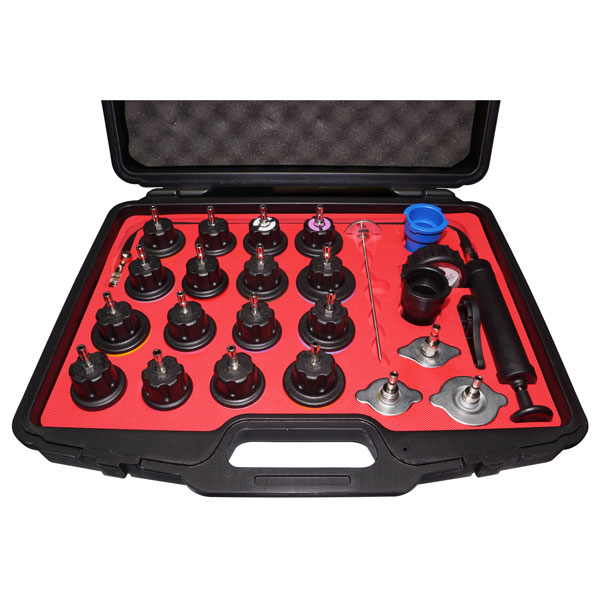
Universal Radiator Pressure Tester & Vacuum Type Cooling System
Mfg: Astro Pneumatic
Part #: 78584

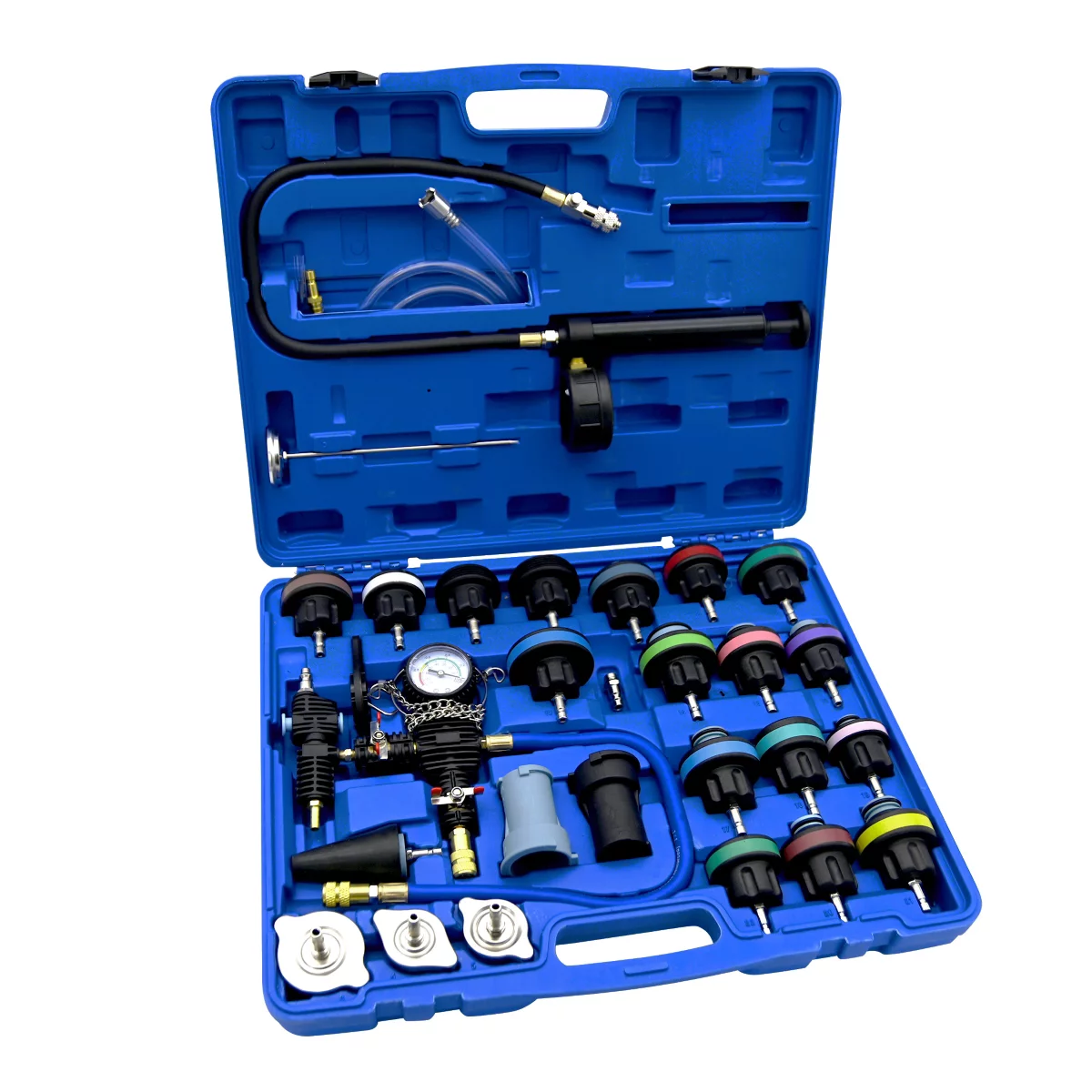
CPS Products Universal Radiator Pressure Test Kit for Detect
Mfg: CPS Products
Part #: 575000
Confirming the Failure: Compression and Block Testing
Once the obvious hazards are ruled out, confirm the diagnosis with two tests rather than relying on symptoms alone:
- Compression test: Pull all the plugs and run a standard cranking compression test. A cylinder reading noticeably lower than its neighbors, especially one adjacent to a coolant passage, supports the head gasket diagnosis. Keep in mind a head gasket breach that vents into the water jacket rather than into an adjacent cylinder can still show acceptable compression, so a passing test doesn’t clear the engine.
- Chemical block test: This is the test that actually confirms combustion gas is present in the cooling system. A block tester draws vapor from the radiator neck through a chemical fluid that changes color when it detects combustion byproducts (CO2). A positive color change is close to definitive for a head gasket or cracked head/block, independent of what the compression numbers show.
A cooling system pressure test (with the engine off) is also worth running to rule out a simply failed radiator cap or a leaking hose as a contributing factor, though it won’t detect gas intrusion on its own — that’s what the block test is for.
What’s Different on Toyota 2.4L (2AZ-FE) and Similar Four-Cylinders
Some engine families have a reputation for this exact failure mode. The Toyota/Lexus 2.4L 2AZ-FE four-cylinder (common in Camry, RAV4, and Scion applications of that era) is a known case: in addition to being prone to head gasket failure, it has a documented tendency for the head bolt threads to pull out of the aluminum block under normal torque, especially after a previous overheating event has already stressed the casting. If you find stripped or damaged threads during teardown, a heli-coil or thread insert repair can work, but severe damage may call for replacing the block outright rather than repairing threads that won’t hold torque reliably.
This same engine family is also known for above-average oil consumption even when the head gasket is intact, so don’t assume every oil-level complaint on one of these is coolant-related — but if you’re already chasing a head gasket failure, check oil consumption history too, since the two issues can compound and make a borderline repair-or-replace decision harder.
Hydrolock Risk and Why the Engine Won’t Restart
A no-restart following visible coolant loss should always be treated as a potential hydrolock until proven otherwise. The sequence that matters:
- Do not crank the starter repeatedly trying to get it running — this is how a bent rod or cracked piston happens.
- Pull all spark plugs and manually rotate the engine (by hand on the crank pulley bolt, or with the starter disabled) to check for resistance and to purge any liquid from the cylinders through the open plug holes.
- If the engine was overheated badly enough to blow the gasket, also check timing chain/belt condition and tension once the head comes off — a failure severe enough to warp the head or deck surface can be accompanied by timing component damage, and on an interference engine a jumped or broken timing chain/belt will bend valves on top of everything else.
If it cranks freely by hand with the plugs out and no fluid is ejected, you likely avoided a hydrolock and the no-start is more related to fouled plugs, flooded cylinders, or the ECU pulling fuel/spark on a safety fault — all worth checking before assuming the worst.
Repair Options: Gasket Replacement vs. Head or Block Replacement
Swapping the gasket alone is only part of the job. Once the head is off:
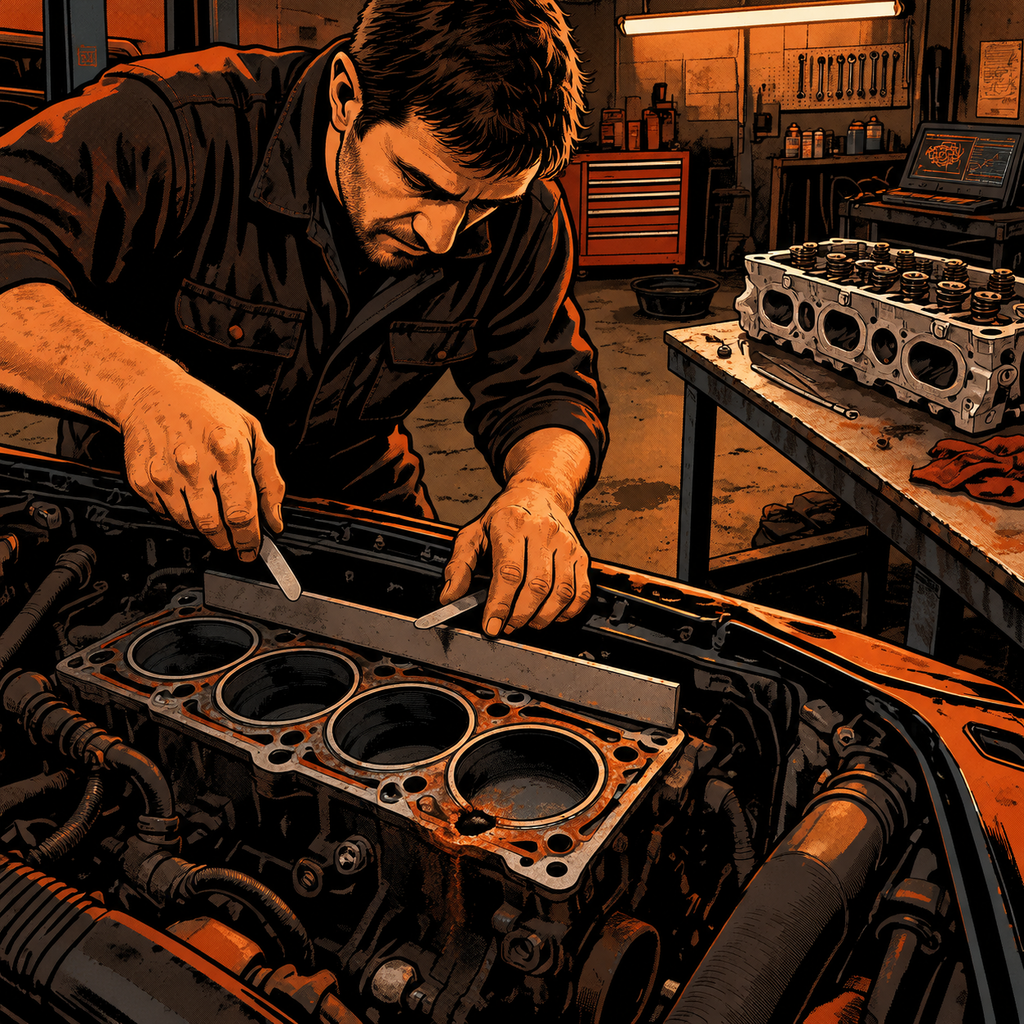
- Check the head and block deck surfaces for flatness with a straightedge and feeler gauge. A head gasket failure caused by overheating commonly warps the head, and sometimes the block deck, enough that a new gasket won’t seal.
- If the head can be machined flat, that’s often cheaper than replacement — but on engines with variable valve timing (VVT) components integrated into the head or cam towers, resurfacing can throw off VVT geometry and clearances. Confirm with the specific engine’s service specs before machining rather than assuming a standard resurface is safe.
- If the block deck is warped or the head bolt threads are damaged beyond a reliable repair, weigh the cost of head/block replacement or a used engine against the vehicle’s overall value — on an older vehicle with other wear items, a full engine swap may be more economical than a piecemeal repair.
Quick Diagnostic Checklist
- Stop cranking immediately if coolant loss and a no-restart happen together.
- Pull the dipstick — check for milky oil.
- Pull the plugs — check for coolant or fouling, and rotate the engine by hand before re-cranking.
- Run a cranking compression test on all cylinders.
- Run a chemical block test on the radiator neck for combustion gas.
- Once confirmed, check head/block deck flatness and head bolt thread condition before reassembly.

OTC 204-208 Adapter for 204-185 T95T-5310-AR2 Tools
Mfg: OTC Tools and Equipment
Part #: 204-208


OTC Tools 26342 Durable Replacement Plug 1 lb
Mfg: OTC Tools and Equipment
Part #: 26342
FAQs
Can a blown head gasket really make coolant spray out of an open radiator neck?
Yes. Combustion pressure venting into the cooling system through the breach pressurizes the coolant on every cycle, pushing it out of the neck in a pulsing pattern tied to engine RPM rather than a slow boil-over.
Is it safe to keep cranking the engine to see if it starts?
No. If coolant has entered a cylinder, repeated cranking risks hydrolock, which can bend a connecting rod or crack a piston. Pull the plugs and check for liquid before cranking again.
Will a cooling system sealant or stop-leak product fix a blown head gasket?
Not reliably. These products are designed for small coolant leaks in hoses or minor casting porosity, not for a combustion-pressure breach between a cylinder and the water jacket. At best it’s a short-term, unpredictable patch; it is not a substitute for gasket replacement.
How do I know if it’s the head gasket versus a cracked head or block?
A positive chemical block test confirms combustion gas in the coolant but doesn’t by itself distinguish a gasket failure from a crack. That distinction is made during teardown with a visual inspection and a straightedge check for warpage, plus a dye-penetrant or pressure test on the head/block if a crack is suspected.
Why do some engines, like Toyota’s 2.4L four-cylinder, seem more prone to this?
Certain aluminum-block designs have known weak points — in this case, head bolt threads that can pull out under torque, especially after a prior overheating event has already stressed the casting. That makes gasket failures on these engines more likely to require thread repair or block replacement rather than a straightforward gasket swap.
Is it worth repairing, or should I consider a used engine?
That depends on what teardown reveals. If the head and block are flat and the bolt threads are intact, a gasket replacement is usually the most economical fix. If the deck is warped, the block is cracked, or thread damage is extensive, compare the repair cost against a used or remanufactured engine, factoring in the vehicle’s overall condition and value.
Essential Diagnostic Tools for This Repair
Confirming a blown head gasket requires precise diagnostic equipment. Our Automotive Diagnostic Tools selection includes the compression testers, block testers, and pressure gauges needed to accurately identify the problem.
- Compression testers to check cylinder pressure across all cylinders
- Chemical block testers to detect combustion gas in the cooling system
- Cooling system pressure testers to rule out secondary failures

The Toolsource Technical Team blends decades of real-world automotive service experience with up-to-date technical research. Our writers collaborate with professional mechanics, shop owners, and diagnostic specialists to deliver practical, workshop-ready guidance you can trust.


Follow us on social media