Walk any shop lot and you’ll see it: a ten-year-old 5 Series parked next to a Civic, both owned by people with similar paychecks. Depreciation curves on German and British luxury cars are brutal, which means nameplates that cost $70-90K new routinely change hands for $15-25K within a decade. For technicians, that means a growing share of walk-ins aren’t wealthy enthusiasts — they’re budget buyers who found a great price on a car that was never built to be cheap to own. Your job isn’t to judge the purchase; it’s to inspect it accurately, diagnose it efficiently, and set realistic expectations before the customer is a thousand dollars into a job they didn’t plan for.
Why So Many Cheap Luxury Cars End Up in Your Bay
The math is simple and it repeats in every shop’s intake log. A luxury car’s third or fourth owner typically paid a fraction of MSRP, which means they also have a fraction of the maintenance budget the original owner assumed when they signed the finance agreement. The car looks the part — detailed, low visible wear, factory badges intact — but the deferred maintenance is invisible until something fails. Plastic components embrittle, software modules degrade, and seals that were due for replacement at 80,000 miles are still original at 150,000.
This isn’t a knock on the owners. Many of them did their homework and got a genuinely good deal on a mechanically sound car. The problem is that “good deal” and “cheap to maintain” are unrelated metrics, and most buyers don’t find that out until they’re sitting in your waiting room. Framing the conversation around total cost of ownership — not just the repair in front of you — builds trust and reduces the odds of a customer walking away confused about why a used luxury car costs more per visit than their neighbor’s Camry.
Building a Pre-Purchase Inspection Checklist for Luxury Vehicles
When a customer brings in a used BMW, Mercedes, Audi, or Jaguar for a pre-purchase inspection, a generic 21-point checklist misses the failure points that actually matter on these platforms. Structure the inspection around systems that are expensive to ignore and cheap to catch early:
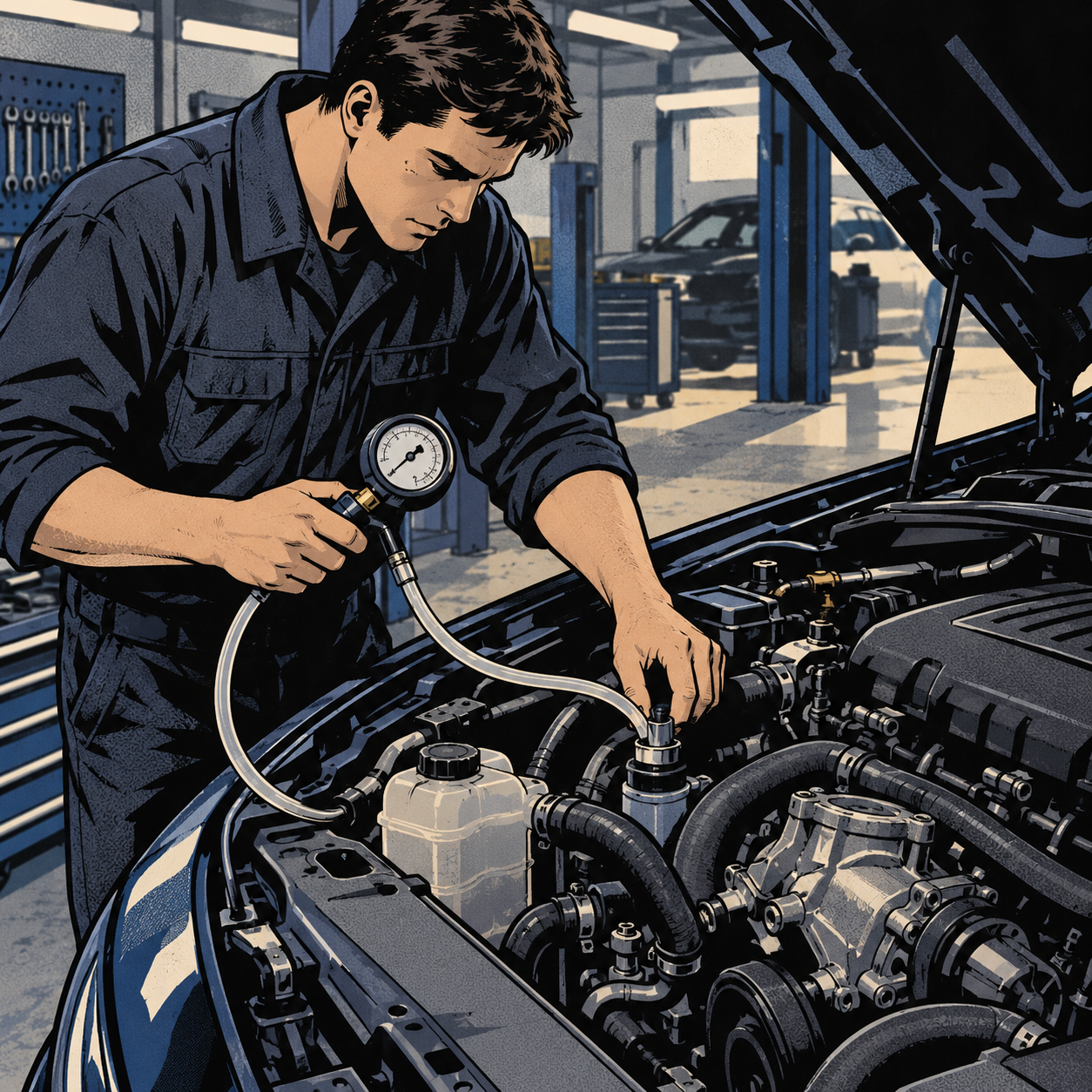
- Cooling system integrity — pressure test the system cold and hot, and visually inspect plastic coolant pipes, expansion tanks, and water pump housings for crazing or seepage stains.
- Electrical module health — pull codes from every accessible module (not just the engine), including body control, suspension, and climate modules. Intermittent faults in these cars are often module-level, not sensor-level.
- Suspension and air ride components — check for compressor cycling frequency, ride height sag overnight, and bushing wear that’s common once a car crosses 100K miles.
- Fluid condition across the board — transmission fluid color and smell, differential fluid, brake fluid moisture content. Luxury automatics are expensive to rebuild and often show warning signs in fluid condition long before a dash light appears.
- Service history gaps — a car with sporadic records at 60K-mile intervals instead of factory intervals is a strong predictor of deferred maintenance elsewhere.
Document everything with photos and a written estimate range, not just a pass/fail. Buyers walking into this segment need a number to compare against the asking price, and a vague “it’s mostly fine” verbal summary doesn’t give them that.
Common Failure Points by Make
Pattern failures are your fastest diagnostic shortcut, and they vary significantly by brand and generation:
Jaguar (pre-2020 models): Plastic coolant pipes running along the engine block are a known weak point and a near-universal failure on cars approaching 100K miles. It typically presents as a slow coolant loss with no visible puddle, and the fix — replacing the plastic pipes with upgraded metal versions — runs $3,000-$6,000 depending on labor rates and whether ancillary components need removal to access the pipes. Flag this proactively on any Jaguar inspection; customers appreciate knowing about it before it strands them.
BMW (E60/E90 and later chassis): Valve cover gaskets, water pumps (plastic impeller designs especially), and VANOS solenoids are recurring failure points. Electrical gremlins — random warning lights that clear and reappear — are often traced to aging wiring harnesses or corroded grounds rather than the component the code points to.
Mercedes-Benz (W211/W212 and air-suspension-equipped models): Air suspension compressors and struts wear out predictably and aren’t cheap to replace in sets. Balance shaft gear wear on some V6/V8 engines is another pattern issue worth checking via oil analysis or listening for a telltale rattle on cold start.
None of these are reasons to refuse the work — they’re reasons to diagnose with pattern knowledge instead of starting from zero on every intake.
Diagnosing Electrical Gremlins and Intermittent Faults
Intermittent faults are the single biggest time sink on aging luxury platforms, and they’re also where shops lose money if they bill hourly without a plan. Before chasing a code, isolate whether the fault is thermal (appears after the car warms up), vibration-related (appears over rough roads), or load-related (appears when multiple electrical systems draw simultaneously). A scan tool that can log live data over a drive cycle, rather than just pulling a static code, is essential here — many of these faults won’t reproduce on a cold, stationary car in the bay.
Ground points and connector corrosion cause a disproportionate share of “unexplainable” faults on cars built before conformal-coated connectors became standard. Checking grounds should happen before swapping modules, not after — a $400 module replacement that doesn’t fix a $20 ground repair is the kind of comeback that damages trust fast.
Setting Customer Expectations on Repair Costs
Customers who bought a cheap luxury car are often comparing your estimate to what a “normal” car repair should cost, not what parts and labor actually run on a platform with lower production volume and often dealer-only parts sourcing. Be direct early: explain that a third-owner BMW or Mercedes isn’t inherently a bad car, but parts availability, specialized tools, and labor time for teardown access all push costs above a mainstream brand doing the same repair.
Giving a written, tiered estimate — what’s safety-critical now, what can wait a few months, and what’s cosmetic or optional — helps customers make an informed decision instead of feeling blindsided. It also protects your shop from disputes when a “simple fix” uncovers a second or third issue once the car is on the lift.
Quick Pre-Purchase Inspection Checklist
- Pressure test cooling system hot and cold; inspect plastic components for cracking
- Scan every accessible module, not just the engine ECU
- Check suspension ride height and air compressor cycle frequency overnight
- Inspect transmission and differential fluid condition and color
- Cross-reference service records against factory maintenance intervals
- Test all electrical accessories under simultaneous load
- Provide a written, tiered cost estimate before work begins
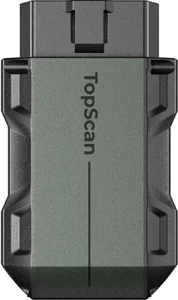
Pocket-Size Bluetooth Scan Tool w/Bi-Directional Controls
Mfg: TOPDON
Part #: TOPSCANPRO

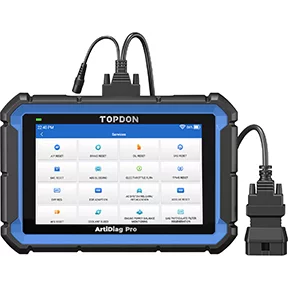
ArtiDiag Pro - 7" Scan Tool w/Service Functions & Bi-Directional
Mfg: TOPDON
Part #: ADPRO
FAQs
Why do used luxury cars cost more to maintain even when bought cheap?
The purchase price reflects depreciation, not the cost of parts and labor. Dealer-sourced components, specialized tools, and longer diagnostic time on complex electrical systems keep repair costs elevated regardless of what the car sold for.
Is it worth doing a pre-purchase inspection on a 10+ year old luxury car?
Yes — a thorough PPI typically costs a fraction of a single major repair and gives the buyer real leverage to negotiate price or walk away from a car with deferred maintenance.
How long does a proper luxury vehicle PPI take?
Budget 1.5 to 2.5 hours for a thorough inspection covering cooling, electrical, suspension, and fluid checks — longer than a standard PPI because these platforms have more modules and known pattern failures to verify.
What’s the single most common failure that surprises buyers?
Cooling system components, especially on Jaguar models with plastic coolant pipes, and suspension or air-ride components on Mercedes models. Both can look fine on a test drive and fail within a few months of purchase.
Should a shop refuse to work on high-mileage luxury cars with uncertain history?
No, but pricing and scheduling should account for extended diagnostic time, and the customer should sign off on a tiered estimate before teardown begins.
Are intermittent electrical faults on these cars usually a bad module?
Not always — ground corrosion and connector degradation cause a large share of intermittent faults. Check those before replacing modules to avoid unnecessary cost and comebacks.
Diagnostic Tools for Luxury Vehicle Inspection
Diagnosing used luxury cars requires multi-module scanning and live data logging capability that static code readers don’t provide. Our Automotive Diagnostic Tools selection includes the equipment needed to isolate intermittent faults and assess these complex platforms.
- Multi-module scan tools with live data logging for BMW, Mercedes, and Jaguar platforms
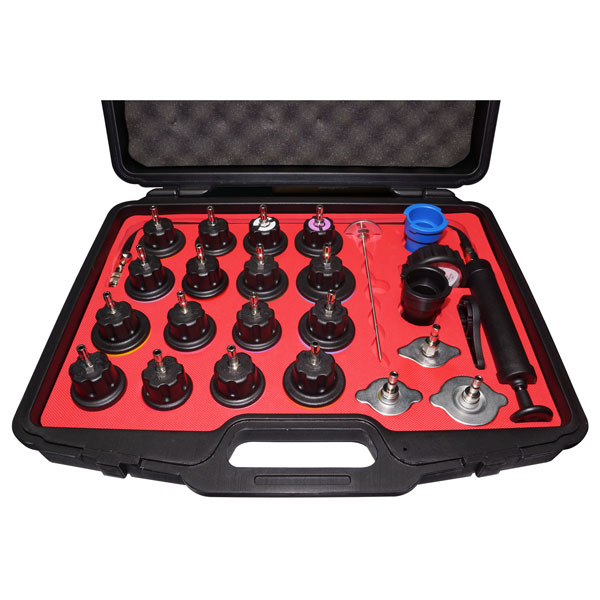
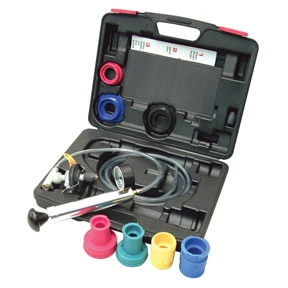
- Cooling system pressure testers for detecting plastic component failures early
- Electrical continuity and ground testing equipment for isolating connector corrosion and intermittent faults

The Toolsource Technical Team blends decades of real-world automotive service experience with up-to-date technical research. Our writers collaborate with professional mechanics, shop owners, and diagnostic specialists to deliver practical, workshop-ready guidance you can trust.


Follow us on social media