A few times a year, a customer brings in a vehicle with a small, perfectly round puncture in a door skin and genuinely no idea what caused it. Before quoting anything, a tech needs to rule in or rule out a ballistic strike, because the repair path — and the insurance claim behind it — is completely different from a dent, a stray cart ding, or a forklift tine poke. This guide covers how to confirm the damage, inspect the door cavity safely, judge repair scope, and get the paperwork right so the shop and the customer aren’t surprised by the final bill.
Confirming It’s Actually a Bullet Hole
Bullet entry holes have a few tells that separate them from other small-diameter damage:
- Clean, round perimeter with inward-curled metal. Entry holes punch metal inward; the edges fold toward the direction of travel rather than outward or jagged like a puncture from a sharp object.
- Diameter consistency. Common calibers leave holes roughly 9mm to .45 caliber in size — noticeably smaller and more uniform than forklift tines, hail, or hardware punctures.
- An angle, not a straight perpendicular hit. Most strikes on a parked or moving vehicle come in at an angle rather than dead-on, which shows up as an elongated or oval entry point with paint “rippling” in the direction the slug traveled.
- A matching mark on the inner door shell or panel. If the round didn’t pass fully through, there’s often a second dimple or hole on the interior structure, sometimes with a visible bulge where it stopped against the intrusion beam.
Rule out the obvious alternatives first: a forklift blade or pallet jack tine leaves a more elongated, scraped puncture with paint transfer; a rock or road debris strike usually shows a shallower, starburst crack in the clearcoat rather than a clean punch. If the hole is small, round, and angled, treat it as a probable firearm strike and move to inspection before quoting any cosmetic work.
Safe Inspection: Checking the Cavity and Finding the Projectile
Don’t just skim the surface — open the door up before writing an estimate.
- Pull the door panel. Remove the trim panel and vapor barrier to access the door cavity directly. This is the only reliable way to confirm whether the round is still inside, whether it struck the window regulator or intrusion beam, and whether there’s a secondary hole on the inner structure.
- Shake test as a first pass. Before disassembly, gently rock the door and listen for a rattle. It’s a useful screening step, but don’t rely on it alone — door cavities are tightly packed with regulators, wiring, and reinforcement beams, so a lodged round often won’t move or make noise.
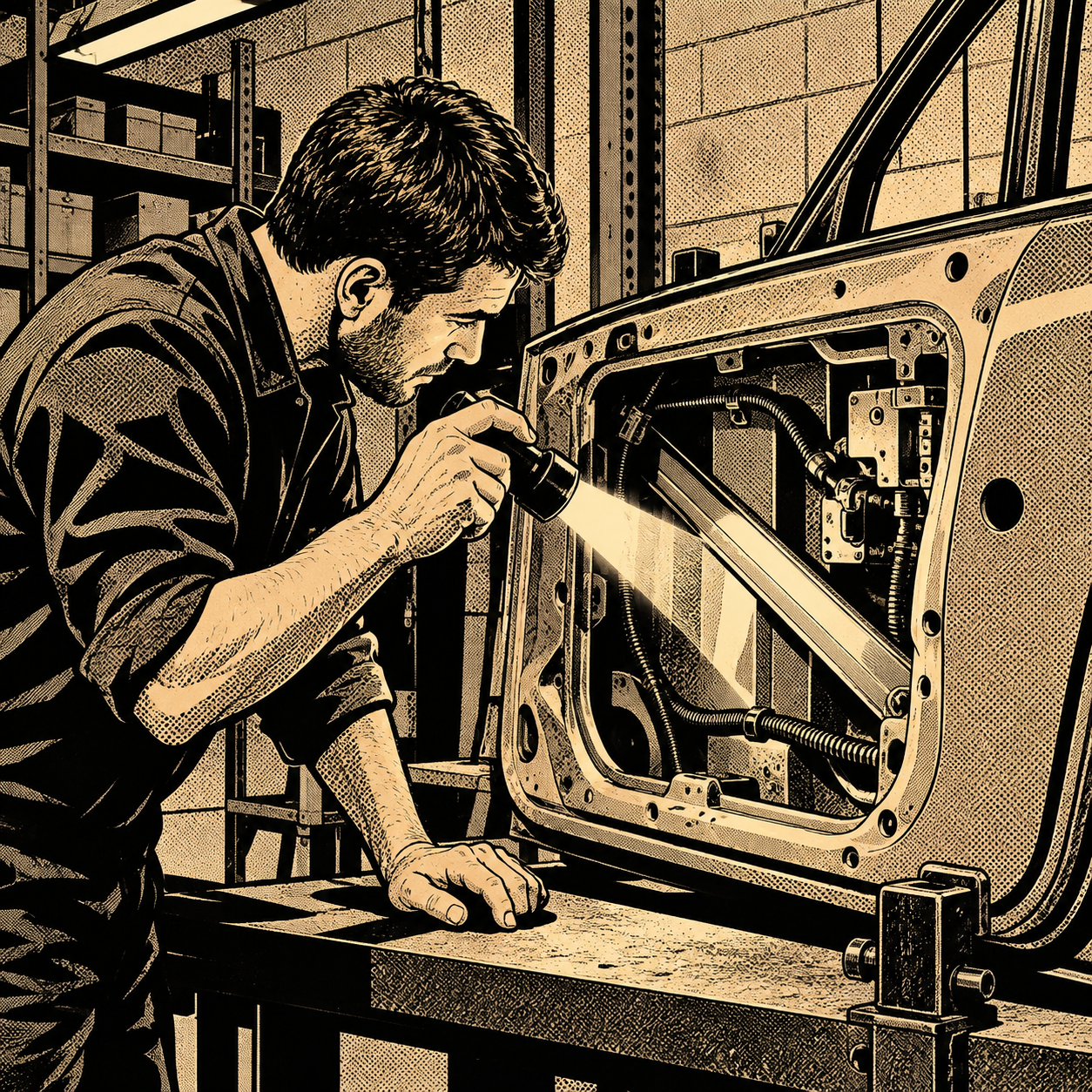
- Use a flashlight and borescope. Shine a light through the entry hole or any drain holes to spot the slug, fragments, or a deformed intrusion beam before pulling the panel if you want a quick look first.
- Handle any recovered round carefully. Wear gloves — lead exposure is a real concern — and don’t disturb it more than necessary if the customer intends to file a police report. Bag it separately from shop debris.
- Check for a through-and-through. If the angle is steep, look for a corresponding exit hole lower on the door, on the rear quarter panel, or the panel behind it. A through shot changes the repair scope significantly.
{{PRODUCT_SEARCH_1}}



Reading the Damage: Trajectory and Structural Impact
Once the panel is off, assess three things before estimating:
- Entry angle and depth. A steep, near-vertical entry increases the odds the round deflected into the door panel or window track rather than passing through — more component damage, more labor.
- Intrusion beam contact. Most doors have a structural beam running diagonally or horizontally inside the shell. A strike against this beam can deform it enough that it needs replacement, not just cosmetic repair, since it’s a safety component in a side impact.
- Window regulator and glass. Check that the regulator still moves freely and the glass isn’t chipped or cracked from fragment spall inside the cavity.
- Wiring harness damage. Door harnesses run through this cavity for power windows, locks, and speakers. A direct hit or fragmentation can nick wiring that won’t fail until later.
Document everything with photos before and after the panel comes off — this protects the shop if the insurance adjuster questions the scope later.
Repair Options: Skin-and-Blend vs. Full Door Replacement
Scope generally falls into one of three buckets:
- Skin-and-blend repair. If the hole is small, isolated to the outer skin, and the intrusion beam and regulator are undamaged, a tech can weld the hole, metal-finish it, and blend paint into the surrounding panel plus the adjacent panel for color match. This is the least expensive path and the most common outcome when the strike only grazed or lodged shallow.
- Full door shell replacement. If the intrusion beam is bent, there’s a second hole further into the shell, or the round fragmented and caused multiple penetration points, replacing the door shell is usually faster and more reliable than trying to weld and finish multiple spots in a structural panel. It’s often cheaper overall than extensive metal finishing labor once you factor in shop time.
- Through-and-through across two panels. If the round passed through the door and struck an adjacent panel (rear door, quarter panel, pillar), both panels need evaluation, and the adjacent panel will likely need its own blend or repair, plus a matching blend on panels beyond that to avoid a visible color step.
Regardless of which path, always blend at least one panel beyond the repair for color match — spot-repairing just the damaged section rarely holds up visually, especially on metallic or pearl finishes.
Insurance, Police Reports, and Cost Expectations
A few things are worth telling the customer up front, since this affects how they file:
- This is a comprehensive claim, not collision. Vandalism, gunfire, and random property damage fall under comprehensive coverage, which typically carries a lower deductible than collision.
- A police report helps the claim and the owner’s peace of mind. Filing a non-emergency report establishes a record of when and where the damage was discovered, which insurers often want before processing a comprehensive claim for this type of damage.
- Typical repair costs range widely. A straightforward skin-and-blend repair commonly runs several hundred to around a thousand dollars depending on paint and labor rates. A full door shell replacement with blending on an adjacent panel can run from roughly fifteen hundred to several thousand dollars once R&I (remove and install), new parts, and paint stages are factored in.
- Get a shop estimate before the customer decides whether to claim. If the repair is likely to exceed the deductible by a wide margin, filing is usually the better move; if it’s a close call, let the customer weigh the deductible against a potential premium impact.
{{PRODUCT_SEARCH_2}}
Quick Intake Checklist
- Confirm hole shape, diameter, and angle before quoting
- Rock-test and visually inspect the door cavity for a secondary hole
- Remove the door panel to check for a lodged round or fragments
- Inspect the intrusion beam, regulator, and wiring harness for damage
- Photograph everything before and after disassembly
- Advise the customer to file a police report and a comprehensive insurance claim


FillClean 3682077 Series C Waterborne Basecoat, 5.8 oz Aeros
Mfg: SprayMax
Part #: 3682077

Frequently Asked Questions
Is a bullet hole covered under collision or comprehensive insurance?
Comprehensive. Collision coverage applies to crashes; gunfire, vandalism, and similar random damage fall under comprehensive, which usually has a lower deductible.
How much does it typically cost to repair a bullet hole in a car door?
A simple skin-and-blend repair often falls in the few-hundred-to-around-a-thousand-dollar range. Full door shell replacement with adjacent panel blending can run from roughly fifteen hundred dollars up to several thousand, depending on parts and paint.
Should the customer file a police report even if there’s no suspect?
Yes. A report creates an official record of the incident, which insurers frequently request for comprehensive claims involving gunfire damage, even with no identified shooter.
Is it dangerous to remove a bullet lodged in the door?
It’s low risk but not zero risk. Wear gloves to avoid lead exposure, handle the round gently if law enforcement wants to examine it, and be aware that fragments can have sharp edges.
Can a bullet hole total the vehicle?
It’s uncommon for a single door strike, but if the repair estimate approaches the vehicle’s actual cash value — especially with structural beam replacement and multi-panel blending — the insurer may deem it a total loss.
Will the paint match perfectly after a blend repair?
A properly executed blend onto at least one adjacent panel, done with the correct formula and clear coat stage, should be visually seamless under normal lighting. Spot-repairing only the damaged area without blending is the usual cause of a visible mismatch.
Paint & Body Supplies
Whether you’re executing a skin-and-blend repair or replacing and refinishing a full door, our Paint & Body selection covers the primer, paint, clear coat, and blending supplies needed for a professional finish.
- Primers, basecoats, and clear coat systems for modern automotive finishes
- Sandpaper, masking supplies, and blending aids for seamless color matching
- Metal finishing compounds and polishing tools for preparation and finishing

The Toolsource Technical Team blends decades of real-world automotive service experience with up-to-date technical research. Our writers collaborate with professional mechanics, shop owners, and diagnostic specialists to deliver practical, workshop-ready guidance you can trust.


Follow us on social media