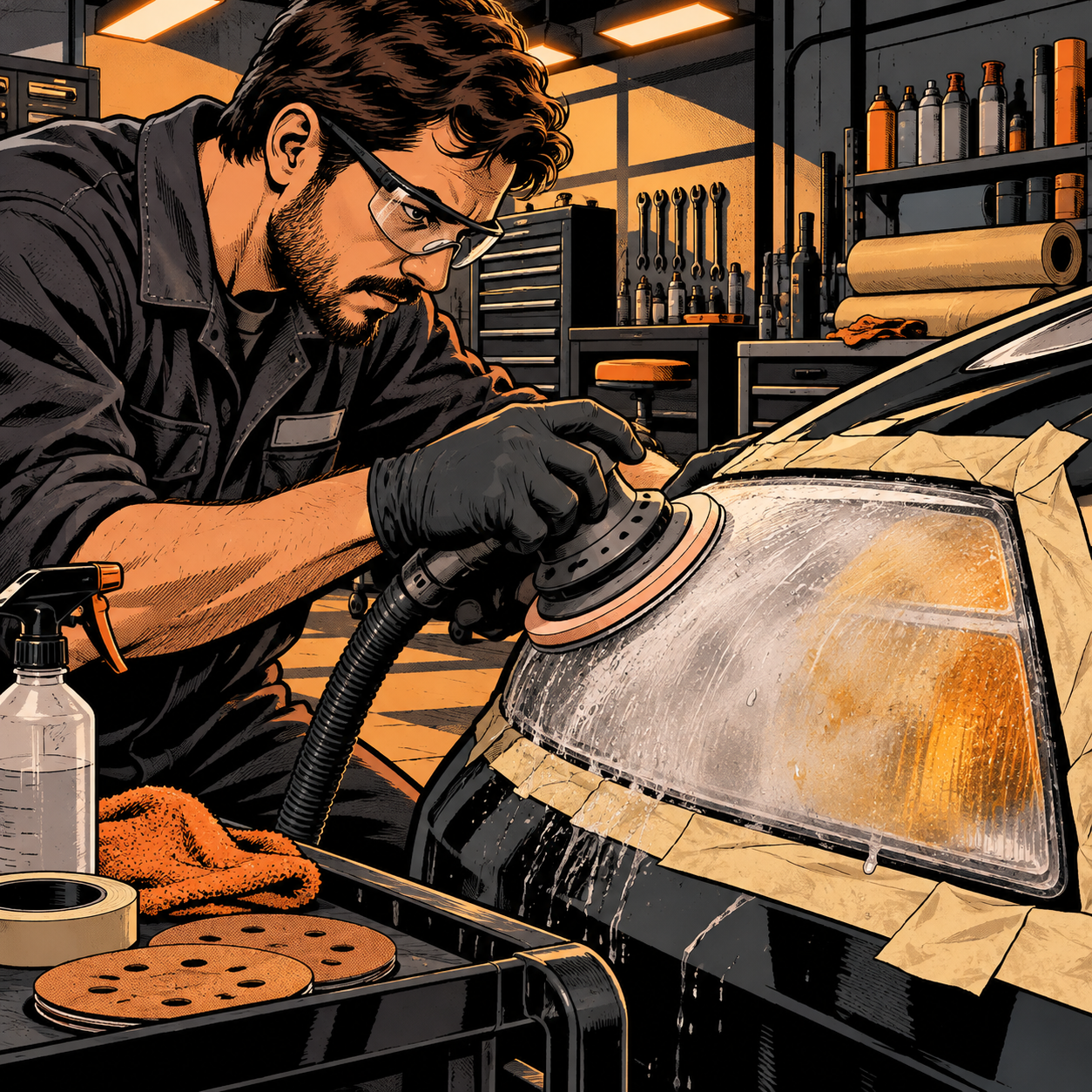
Headlight restoration with 2K clear coat is one of those jobs that looks simple on video and goes sideways in the bay. The sanding is forgiving — almost any reasonable grit progression will clear up a hazy lens. What separates a restoration that lasts five years from one that cracks on the first coat is clear coat selection, prep discipline, and spray technique. This guide pulls together what’s actually working in the field right now, including where regular automotive 2K clear falls short on polycarbonate lenses and how to avoid the most common failure modes.
Why Headlight Lenses Fail and What “2K Clear” Really Means
Modern headlight lenses are polycarbonate, not glass. Polycarbonate is UV-sensitive — manufacturers apply a factory hard-coat specifically to block UV and prevent the plastic from yellowing and crazing. Once that hard-coat degrades from sun exposure, oxidation, and micro-abrasion, the lens turns cloudy or yellow. Sanding removes the degraded layer; clear coat replaces the UV barrier and restores optical clarity.
“2K” refers to two-component (catalyzed) clear coat — a base clear activated with a hardener, as opposed to single-stage (1K) aerosol clears that only dry by solvent evaporation. 2K clears cross-link chemically, which gives them far better durability, chemical resistance, and gloss retention. That said, not all 2K clear is the same: clear coats formulated for painted sheet metal are designed to flex with a base coat on metal, not with polycarbonate. Technicians report mixed results running “regular” automotive 2K clear directly on headlights — some jobs hold up for years, others craze or crack within months. The safer, more consistent choice is a 2K clear specifically labeled for plastic or headlight use.
Choosing the Right Clear Coat
Before buying anything, check the product’s technical data sheet for plastic or polycarbonate compatibility — that’s the deciding factor, not just the “2K” label. Clears marketed explicitly as headlight or plastic-safe formulations are engineered with additional flexibility and adhesion promoters suited to polycarbonate’s expansion and contraction. Standard automotive 2K clear, intended to sit over a flexible base coat on metal panels, can be more rigid when applied directly to plastic, which is where cracking and delamination tend to show up over time.
Price difference between the two is usually marginal — headlight-specific 2K aerosols run close to the same cost per ounce as general-purpose 2K clear, just in smaller cans. Given that the entire point of the job is UV longevity, spending a few extra dollars on the correct formulation is the easy call. If a customer wants maximum insurance against UV failure and isn’t worried about the added cost, paint protection film (PPF) or a wipe-on ceramic coating are viable alternatives to spray clear — more on that in the troubleshooting section below.
===PRODUCT_SEARCH_1===
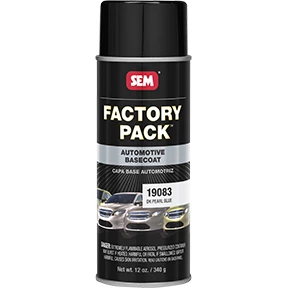
Factory Pack Automotive Basecoat FORD DX Dk Blue Pearl 16 Oz Aer
Mfg: Sem Products
Part #: 19083

Prepping the Lens: Sanding Sequence and Surface Prep
The single most important rule in prep: remove all of the old clear coat and oxidized material before sanding stops. Any remaining degraded layer under new clear will continue to fail and telegraph through, regardless of how good the new clear coat is.
- Mask surrounding paint and trim; the lens should be the only exposed surface.
- Start around 400 grit (wet) to knock down oxidation until the lens turns uniformly white/hazy with no yellow patches remaining. An orbital or DA sander with 3-inch discs speeds this up significantly over hand-sanding, but hand sanding works fine on smaller areas or when a sander isn’t available.
- Step up through 600, then 800, and finish around 1000–1200 grit. There’s a consistent finding among experienced techs that sanding much finer than 1000–1200 grit provides no real benefit and may actually reduce how well the clear mechanically bonds to the surface. Going to 1600 or higher is unnecessary extra labor with no payoff in durability.
- Rinse and inspect under good light between each grit step — any remaining scratch pattern from the previous grit needs to be fully removed before moving finer.
- Clean with plain dish soap and water to strip sanding residue and oils, then dry completely. Any contamination (dust, moisture, fingerprints, silicone-based dressings) trapped under the clear will cause fisheye or adhesion problems.
Spraying Technique: Coats, Timing, and Temperature
2K aerosols are activated by pressing/releasing an internal trigger that mixes the hardener with the clear; once activated, the can has a limited working window — typically used up within about a day. Plan the job so one activated can isn’t sitting half-used for days afterward; one can is usually enough for both headlights on two vehicles if you’re efficient.
- Work in a space between roughly 65–75°F, out of direct sunlight, with reasonable airflow but no wind blowing debris onto the wet surface.
- Apply in multiple coats — three medium-to-heavy passes is a commonly cited sweep — rather than one thick coat. The first coat doesn’t need to look fully saturated or glossy; it’s establishing adhesion. Subsequent coats build the film and gloss.
- Wait roughly 10 minutes between coats at ambient temperature to allow proper flash-off. Spraying the next coat too soon traps solvent; waiting too long between coats can cause poor inter-coat adhesion.
- Keep spray distance and angle consistent on every pass, overlapping each stroke slightly to avoid thin bands or heavy ridges.
- The final coat should go on wet enough to self-level and flow out, which is what produces a glossy, orange-peel-free finish without additional buffing.
- If the can has been sitting in storage, check the expiration date before activating. Expired 2K product has been directly linked to discoloration and flaking within the first year of use — it’s not worth the risk to use old stock.
Isocyanate Safety: This Is Not Optional
2K clear coats cross-link using isocyanate hardeners, and isocyanates are a serious respiratory hazard. A standard cartridge respirator — even a good one rated for organic vapors — does not protect against isocyanate exposure. The only protection that actually works is a supplied-air respirator (a full-face, air-fed system), the same equipment used in professional paint booths. There is no “good enough” half-measure here: holding your breath, spraying outdoors, or using a basic dust mask does not provide real protection against isocyanate inhalation. If a proper air-fed respirator isn’t available, this job should be done in a ventilated spray booth with the right PPE, or outsourced to a shop that has the equipment. Skin and eye protection (nitrile gloves, safety glasses or a face shield) are also necessary — isocyanates are an irritant and sensitizer on contact as well as by inhalation.
Troubleshooting Common Failures and Alternatives
A few failure patterns come up repeatedly with DIY and shop 2K headlight jobs:
- Cracking right after the first coat flashes: This is usually tied to one or more of: sanding past 1000–1200 grit (reducing mechanical bond), spraying the first coat too heavy before it can properly key into the surface, or not warming the can to the manufacturer’s recommended temperature before activating/spraying. If this happens, the cracked clear needs to be fully sanded off and the job restarted — there’s no patching over active cracking.
- Orange peel or dusty-looking finish: Typically caused by coats that are too light/dry rather than a proper wet, flowing pass, or spraying at too great a distance.
- Premature yellowing or flaking within a year: Most often traced to expired product, using a non-plastic-compatible clear, or inadequate removal of the old oxidized layer during sanding.
For customers who want maximum durability or who are nervous about isocyanate exposure, two alternatives are worth mentioning: precut paint protection film (PPF) applied over a polished (not necessarily cleared) lens offers strong UV and rock-chip protection and can last for years, though it’s thicker and less forgiving to install than vinyl wrap, with persistent edges on tight contours. Wipe-on ceramic coatings designed for headlights are a faster, lower-skill, no-spray-equipment option; they’re generally viewed as less durable than a properly applied plastic-safe 2K clear but are a reasonable choice when spray equipment or isocyanate-rated PPE isn’t available.
===PRODUCT_SEARCH_2===
Quick Reference Checklist
- Confirm the clear coat is labeled plastic/polycarbonate-safe (check the data sheet, not just the “2K” name)
- Check expiration date before activating any 2K aerosol
- Sand wet, 400 → 600 → 800 → 1000/1200 grit; stop there, no finer
- Clean with dish soap, rinse, and fully dry before spraying
- Spray 3 coats, ~10 min flash time, 65–75°F, away from direct sun and wind
- Use a supplied-air respirator — no substitute protects against isocyanates


FAQs
Is regular automotive 2K clear coat safe on headlights?
It can work, and some techs report years of success with it, but it’s formulated for flexing with base coat on metal, not for polycarbonate. A clear labeled plastic- or headlight-safe is the more reliable choice for long-term durability.
How long does a 2K clear headlight restoration last?
With correct prep, the right clear, and proper technique, 3–5+ years is realistic. Failures within a year are usually traced to expired product, incompatible clear, or spray/prep errors rather than the 2K process itself.
What grit should I stop sanding at before clear coat?
Around 1000–1200 grit. Sanding finer provides no durability benefit and may reduce how well the clear coat mechanically bonds to the surface.
Can I use a cartridge respirator instead of supplied air for 2K clear?
No. Isocyanate hardeners in 2K products are not filtered by standard cartridge respirators. A full-face, supplied-air system is the only protection that actually works.
Why did my clear coat crack right after spraying?
Common causes are sanding too fine before clear, applying the first coat too heavy before it can bond, or not warming the aerosol can to the recommended temperature before use.
Is PPF or a ceramic headlight coating better than 2K clear?
PPF offers strong UV and chip protection and can outlast clear coat, but costs more and is trickier to install. Wipe-on ceramic coatings are faster and don’t require spray equipment but are generally less durable than a properly applied plastic-safe 2K clear.
Recommended Products
The tools and materials needed for headlight restoration — including 2K clear coats, sanding supplies, and safety equipment — are available in our Paint & Body section.
- 2K clear coat systems, including plastic-safe and headlight-specific formulations
- Sandpaper, sanding discs, and orbital sanders for lens prep
- Masking materials, gloves, and spray application equipment

The Toolsource Technical Team blends decades of real-world automotive service experience with up-to-date technical research. Our writers collaborate with professional mechanics, shop owners, and diagnostic specialists to deliver practical, workshop-ready guidance you can trust.


Follow us on social media