A Pagani Zonda Cinque sighting on a California highway recently went viral, and buried in the comment thread was a detail that matters a lot more to technicians than to spotters: cars in this class use titanium extensively in their fasteners, and a single lug nut set can run into five figures. Most shops will never see a Zonda on a lift, but exotic and hypercar service calls are more common than they used to be, as collector ownership spreads beyond dedicated marque specialists into general high-end shops. If a titanium-fastened exotic, a limited-production supercar, or any six-figure vehicle rolls into your bay, the fundamentals below will keep you from turning a routine service into a very expensive mistake.
Why Titanium Fasteners Behave Differently Than Steel
Titanium alloy fasteners are used in motorsport-derived and exotic platforms because they save weight without sacrificing strength, but they do not behave like the grade 8 steel hardware most techs handle daily. Three things matter immediately:
Titanium galls. Without proper lubrication or anti-seize rated for titanium-to-aluminum or titanium-to-titanium contact, the threads can seize and strip on installation, not just removal. This is the single most common way techs destroy expensive hardware on a first encounter.
Titanium fasteners are often one-time-use or limited-reuse by the manufacturer’s spec. Unlike a steel bolt you can reuse indefinitely if it’s not stretched, many titanium fasteners in motorsport-adjacent applications are torque-to-yield and specified for a set number of reuses, sometimes just one. Check factory documentation or the parts catalog before reinstalling anything you’ve removed.
Torque values are not interchangeable with steel equivalents. A bolt that looks identical in size to its steel counterpart can have a completely different torque spec because the material’s yield strength and elastic modulus differ. Never guess based on a generic torque chart.
Tooling and Torque Procedure for Titanium Hardware
Impact guns are the fastest way to ruin titanium fasteners and the surrounding components. The shock loading from an impact wrench can exceed titanium’s lower fatigue tolerance compared to steel, leading to micro-fractures that aren’t visible until the part fails later, often far from your shop. Use these practices instead:
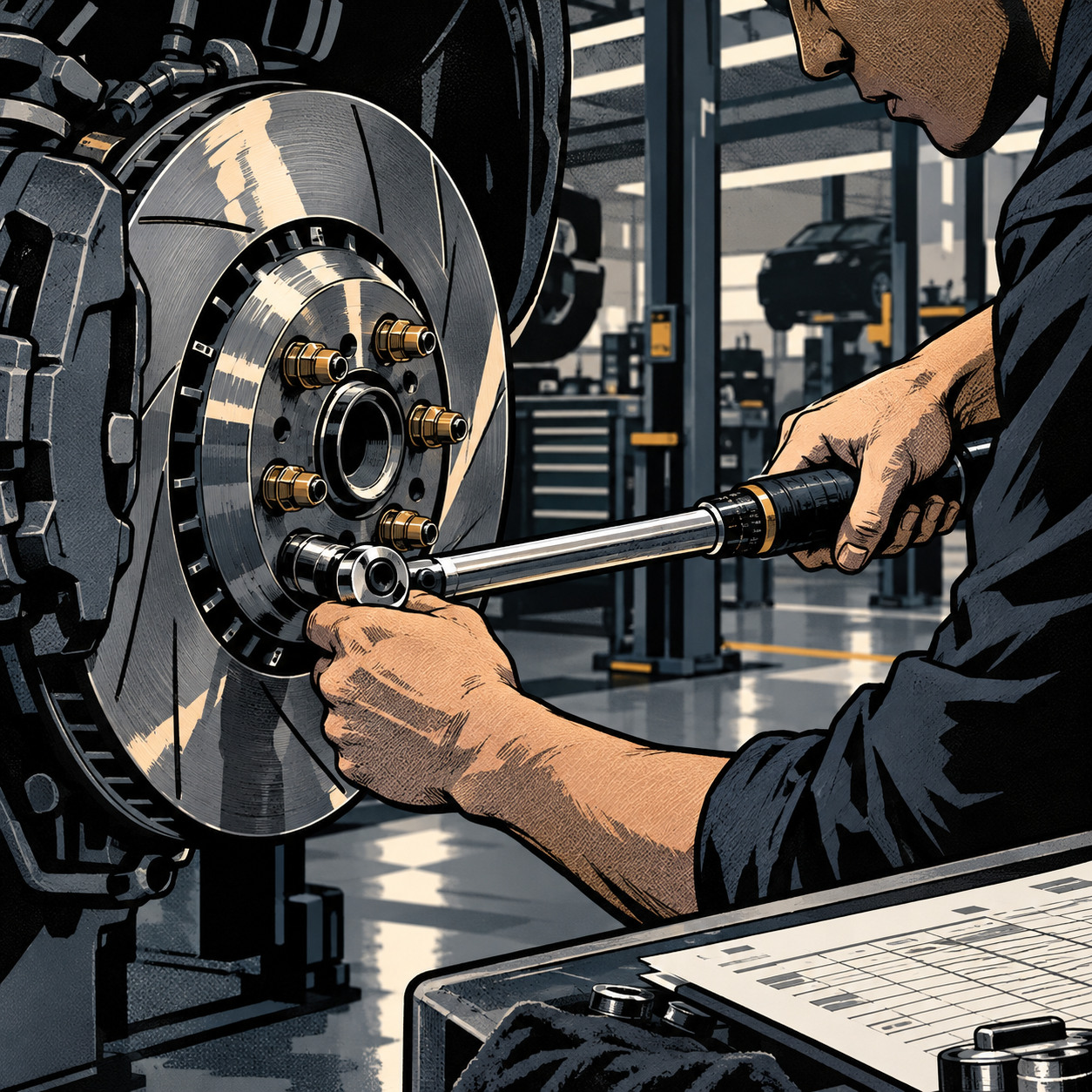
- Break loose and final-tighten by hand with a calibrated torque wrench, never an impact driver, on any confirmed or suspected titanium fastener.
- Use a torque wrench calibrated within the last 12 months, and verify it against a torque tester before a high-value job if there’s any doubt.
- Apply the specific anti-seize or thread lubricant called out in factory documentation. Standard copper anti-seize can be electrochemically incompatible with titanium and accelerate galvanic corrosion against aluminum components.
- Torque in the sequence specified by the manufacturer, not in the pattern you’d default to on a steel-wheeled daily driver. Sequence affects clamping load distribution differently on lightweight alloy hubs and rotors.
- Document the torque value, tool used, and lubricant applied for every fastener on a job sheet. On a vehicle worth seven figures, this record is what protects you if a dispute ever arises.
[PRODUCT_SEARCH: calibrated torque wrench for titanium fasteners]


1/2" Quiet Titanium Impact Wrench - Ext Anvil
Mfg: Ingersoll Rand
Part #: 2235QTIMAX-2

Protecting Yourself and the Shop on High-Value Jobs
One commenter in the thread pointed out the obvious but often overlooked risk: contact damage on a multimillion-dollar car can exceed a shop’s liability coverage entirely, leaving the business or technician personally exposed. Before you take a job like this, confirm the following with your shop owner or insurer:
Check your garage keepers and liability policy limits against the vehicle’s stated value, not its “typical exotic” assumption. Standard garage keepers coverage often caps out well below what a rare hypercar or limited-edition model is worth. If the policy doesn’t cover the car, decline the job or require the owner to provide supplemental coverage before you touch it.
Walk the vehicle with the owner before intake and document every existing scratch, chip, and wheel mark with photos and timestamps. Do this even on routine jobs. It takes five minutes and eliminates the single most common post-service dispute.
Restrict lift and jack points to factory-published locations only. Exotic chassis frequently use carbon fiber tubs or thin-gauge aluminum subframes that will crack or deform if lifted incorrectly. If the factory service points aren’t in your database, contact the manufacturer or a certified specialist before attempting it on guesswork.
Parts and Service Access on Low-Volume and Import-Restricted Models
The Zonda in the viral post was reportedly running on Guernsey plates, a detail that pointed to the US 25-year import rule: vehicles under that age generally cannot be permanently imported or registered for road use in the United States, so very low-volume or newer exotic models sometimes show up on temporary foreign plates while visiting. This matters to technicians for a practical reason: parts and service support for these cars is often extremely limited stateside.
If a vehicle is on temporary import or foreign registration, confirm the owner has legal standing to have the work performed domestically before you proceed, and keep paperwork on file. For parts, expect long lead times, factory-only sourcing, and in some cases a requirement that work be performed or supervised by a factory-trained technician to preserve warranty or provenance. Don’t assume aftermarket equivalents exist for structural or safety-critical hardware on a five-unit production run; in many cases they simply don’t, and substituting the wrong fastener grade is how shops end up liable for a catastrophic failure.
Shop Floor Intake Procedures That Prevent Costly Mistakes
A consistent intake routine matters more on rare, high-value vehicles than on anything else in your bay, because there’s no margin for a guess that turns out wrong.
Pull any available factory service documentation before the car is even on the lift. Confirm fastener torque specs, lift points, and fluid specifications in writing rather than relying on memory or a generic database entry for “similar” models.
Use fender covers, wheel-well liners, and floor mats rated for the job, not shop rags. Exotic paint and trim finishes are frequently softer or more chemically sensitive than mass-production clear coats.
Keep the key and vehicle access limited to the technician assigned, and log every person who moves or touches the car. On a job this far outside routine volume, a clear chain of custody is as important as the wrench work.
Quick Checklist
- Confirm insurance coverage matches or exceeds the vehicle’s value before accepting the job
- Photo-document existing condition with the owner present at intake
- Pull factory torque specs and lift points before raising the vehicle
- Use a freshly calibrated torque wrench by hand, never an impact gun, on titanium hardware
- Apply manufacturer-specified anti-seize/lubricant only
- Verify import/registration status and parts sourcing before ordering hardware
- Log every fastener’s torque value, tool, and technician on the job sheet
[PRODUCT_SEARCH: exotic car shop equipment and lift accessories]



FAQs
Can I reuse a titanium fastener I just removed?
Only if the manufacturer’s documentation explicitly permits reuse at that interval. Many titanium fasteners on performance and exotic platforms are torque-to-yield and rated for limited or single use. When in doubt, replace it with OEM stock.
Is it safe to use an impact wrench on titanium bolts if I’m careful with the final torque?
No. The risk isn’t the final torque value, it’s the shock loading during breakaway and tightening, which can introduce fatigue damage that isn’t visible on inspection. Hand-torque with a calibrated wrench for both removal and installation.
What anti-seize should I use on titanium-to-aluminum fastener joints?
Use the lubricant specified in the factory service manual. Standard copper- or nickel-based anti-seize can cause galvanic corrosion in titanium-aluminum joints; many manufacturers specify a nickel-free or ceramic-based compound instead.
Does my shop’s standard liability insurance cover a multimillion-dollar exotic?
Not automatically. Garage keepers policies have per-vehicle and aggregate limits that are often well below the value of rare hypercars. Confirm limits with your insurer and get supplemental coverage in writing before accepting the job if there’s any gap.
Why would a rare car be running on foreign plates in the US?
Vehicles under 25 years old generally can’t be permanently imported and registered for US road use under federal rules, so some owners bring them in temporarily on foreign registration for events or shows. Confirm the legal status before performing any work.
Where can I find factory torque specs for low-volume exotic models?
Factory-trained dealer networks and manufacturer technical lines are usually the only reliable source; aftermarket torque databases frequently don’t cover five- and ten-unit production runs. Contact the manufacturer directly if your usual database comes up empty.
Precision Torque Equipment for High-Value Work
Proper fastening depends on the right tool. The practices in this guide—hand-torquing titanium hardware, verifying wrench calibration, and following exact torque specs—require a precision instrument you can trust. Browse our selection of torque wrenches for the professional accuracy your shop demands.
- Calibrated click, beam, and electronic torque wrenches
- Torque verification and testing equipment
- Professional-grade tools for precision fastening work

The Toolsource Technical Team blends decades of real-world automotive service experience with up-to-date technical research. Our writers collaborate with professional mechanics, shop owners, and diagnostic specialists to deliver practical, workshop-ready guidance you can trust.


Follow us on social media