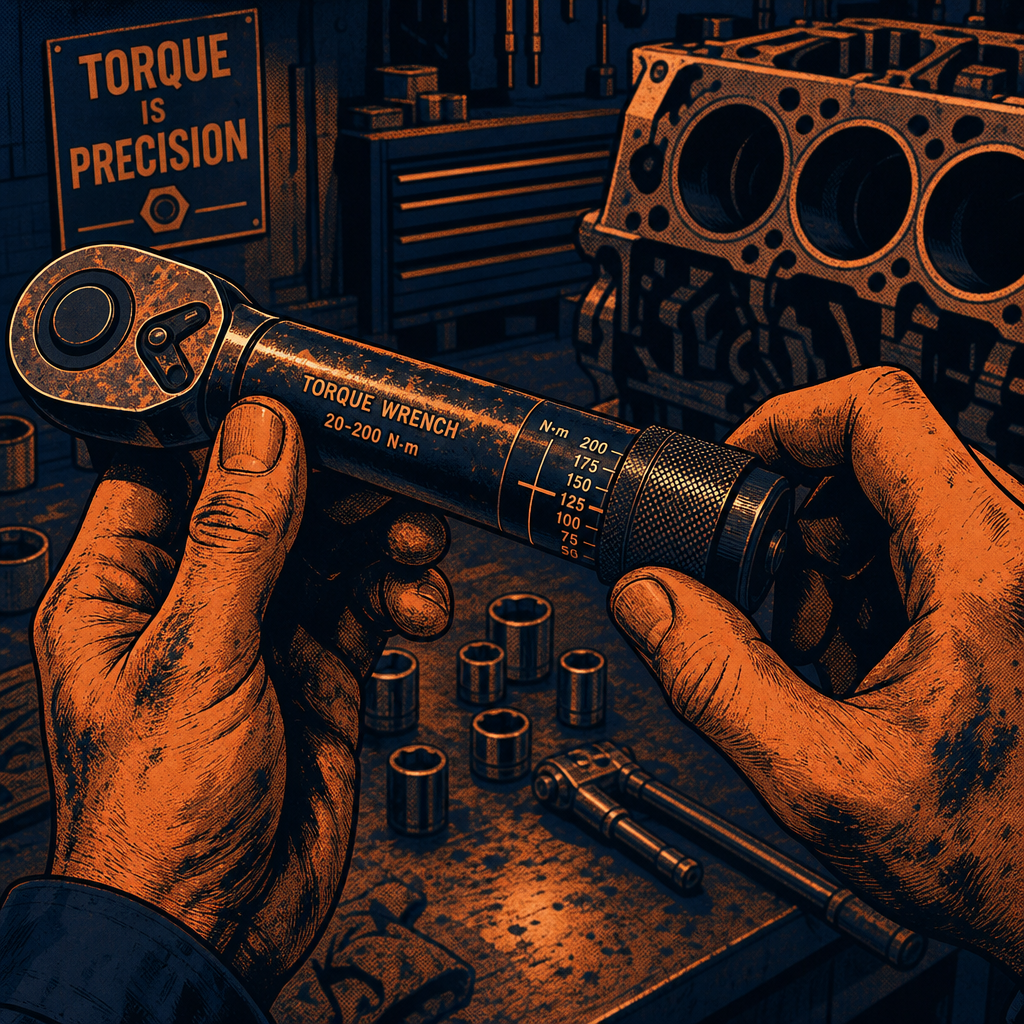
Ask ten technicians to read the same torque wrench setting and you’ll sometimes get three different answers — not because the techs don’t know torque specs, but because click-type wrenches use a vernier-style scale that’s easy to misread, especially on lower-cost tools where the collar and body markings don’t line up cleanly. Add in spring fatigue from improper storage and inconsistent manufacturing tolerances, and it’s no surprise that “is this 75 or 100?” is one of the most common questions in any shop. This guide covers how the scale actually works, why cheap wrenches seem to lie to you, how to store a torque wrench so it holds calibration, and how to sanity-check accuracy without sending the tool out.
How the Click-Type Scale Actually Works
A standard click-type torque wrench has two scales working together: the major numbers printed on the wrench body (in increments of 20, 50, or 100, depending on the tool’s range) and a rotating collar with minor graduations, typically broken into 25 divisions per full turn on many ft-lb wrenches. Turning the collar one full rotation — zero back to zero — moves you exactly one major increment, which is why the minor scale is divided the way it is. The torque value you’ve set is determined by how far you’ve compressed the internal spring, which is a function of the collar’s position relative to the body, not just where a printed number happens to sit.
That distinction matters. The reading is defined by the tool’s spring length and body, not by which number is visible on the handle. On wrenches with sloppy tolerances, the printed numeral can appear to line up a half-turn early or late relative to where the spring is actually compressed. If you’re ever unsure whether a mark corresponds to, say, 75 or 100 ft-lb, count backward from a value you’re certain of (100, 150, 200) rather than trusting an isolated mark in the middle of the scale.
Reading the Scale Without Guessing
Use this method to avoid misreads:
- Identify the major number scale on the fixed body first — this tells you which 20/50/100 bracket you’re in.
- Rotate to the target setting and check where the collar’s reference line sits relative to the body’s zero-index line. The line should meet the target number cleanly, not fall inside the diagonal stroke of the numeral or leave a visible gap below it.
- On wrenches where numerals have a “dogleg” or offset print (common on cheaper tools), follow the line associated with that specific numeral all the way to the collar — don’t assume the nearest number is correct just because it’s visually closest.
- If the setting looks ambiguous, turn the collar to a full, unambiguous number (like exactly 100 or 200) and count graduations down from there to confirm your actual target.
If you’re working with a wrench whose scale is hard to read consistently, or you’re doing enough torque-critical work that ambiguity isn’t acceptable, it’s worth stepping up to a digital torque wrench — several techs in the trade note that digital models tend to read more consistently than mechanical click types, since there’s no vernier scale to misjudge.
[PRODUCT_SEARCH: digital torque wrench 1/2 inch drive]
No products found for "digital torque wrench 1/2 inch drive"
Why Budget Wrenches Don’t Line Up Cleanly
If you’ve ever set a torque wrench to a round number and the scale looked “off” by a few degrees, it’s usually a manufacturing tolerance issue rather than a defect worth returning. Entry-level and mid-tier torque wrenches are generally assembled to a looser tolerance than certified tools, and small variances in thread pitch, collar machining, or scale printing can throw the visual alignment off without meaningfully affecting the actual output torque. This is common enough that it shouldn’t be treated as an emergency — a scale that’s visually a little inconsistent doesn’t necessarily mean the wrench is torquing incorrectly, but it does mean you should rely on the method above rather than eyeballing “close enough.”
It’s also worth knowing that even professional-grade wrenches drift. Shops that recalibrate their torque wrenches on an annual schedule routinely find name-brand tools reading slightly outside spec by the time they’re checked — calibration isn’t a “set it and forget it” property of an expensive tool, it’s a maintenance item for every torque wrench regardless of price point.
Storing a Torque Wrench Correctly
Storage habits have a direct, measurable effect on how long a torque wrench holds its calibration. Leaving a click wrench torqued up to its last-used setting keeps the internal spring under tension indefinitely, which accelerates spring fatigue and shifts the wrench’s accuracy over time. The standard practice is to back the wrench off after every use, but the exact recommended resting position varies by manufacturer — some tools spec storage at the lowest setting on the scale (essentially fully relaxed), while others specify a small non-zero setting to avoid excessive strain on the mechanism at the extreme end of travel. Check the manual or the markings on your specific wrench rather than assuming; two wrenches from different brands can have different storage specs even if they look similar.
Avoid cranking the collar below the lowest marked value “just to be safe” — most wrenches aren’t designed to travel past their printed range, and forcing it past the stop doesn’t provide any extra protection for the spring.
Checking Accuracy Without a Calibration Lab
You don’t need to send a torque wrench to a certified lab every time you want reassurance it’s reading correctly. Two practical, low-cost options:
- Beam-type cross-check wrench: A basic beam torque wrench with a stated accuracy (commonly around ±5%) can be used as a reference to spot-check your click wrenches periodically. Because beam wrenches have no spring mechanism to drift, they hold their accuracy far longer and make a reasonable low-cost benchmark for a shop that doesn’t need certified documentation.
- Tool truck calibration stands: Tool truck vendors frequently carry torque-testing stands on board and will let you check a wrench’s reading, sometimes as a courtesy tied to their sales visit. It’s a fast way to confirm a wrench is in the ballpark without shipping it anywhere.
For work where torque accuracy is safety-critical (head bolts, wheel bearing preload, suspension fasteners), a wrench with a calibration certificate — or an annual send-out for recalibration — is the appropriate standard. For general fastener work, a tolerance of roughly ±5 ft-lb is widely treated as acceptable.
[PRODUCT_SEARCH: torque wrench calibration and testing tools]
Quick Reference Checklist
- Identify the major bracket on the body before reading the collar’s minor graduations.
- Confirm the setting by counting from a known round number if the reading looks ambiguous.
- Don’t assume the nearest printed numeral is correct — follow the specific line to the collar.
- Back the wrench off to its manufacturer-specified storage setting after every use.
- Cross-check accuracy periodically with a beam wrench or a tool truck’s calibration stand.
- Use a certified/calibrated wrench for safety-critical torque specs, not just general fasteners.

1/4" Drive Electronic Torque Tester (ETT™) (40 -400 in-lb)
Mfg: CDI Torque Products
Part #: 4001-O-ETT
1 Inch Drive Dial Torque Wrench w/ Light and Buzzer - 0-2000 ft
Mfg: CDI Torque Products
Part #: 20005LDFESS
FAQs
Why does my torque wrench scale look like it’s between two numbers?
This is usually a manufacturing tolerance issue, more common on budget tools. Confirm the reading by counting graduations from a known round number rather than trusting the visual midpoint.
Do expensive or brand-name torque wrenches stay accurate forever?
No. Even shop-grade wrenches that are professionally calibrated on a yearly schedule are routinely found slightly out of spec at their next check. Calibration is an ongoing maintenance item, not a one-time property of a quality tool.
What setting should I store my torque wrench at?
It depends on the manufacturer — some specify the lowest scale value, others specify a small non-zero setting. Check your tool’s manual; storing it at its last-used high setting will fatigue the spring faster.
Can I trust a $15-40 torque wrench for general work?
For non-critical fasteners, a budget click wrench is generally fine within roughly ±5 ft-lb, but expect scale-reading quirks and consider cross-checking it against a beam wrench occasionally.
How can I verify my torque wrench without sending it to a lab?
Use a beam-type torque wrench as a rough reference check, or ask a tool truck vendor if they can run it on their calibration stand — both are fast, low-cost ways to confirm the reading is in the right range.
Is a digital torque wrench more accurate than a click-type wrench?
Digital wrenches tend to be easier to read precisely since there’s no vernier-style scale to interpret, which reduces reader error even if the underlying mechanical accuracy is comparable.
Recommended Tools
If you’re working with torque wrenches regularly—whether you’re learning to read a click-type wrench accurately or stepping up to digital precision—our Torque Wrenches selection includes click-type, beam-type, and digital models suited to different accuracy needs and budgets.
- Click-type wrenches in 1/4″, 3/8″, and 1/2″ drives for general and precision fastener work
- Beam-type wrenches for cross-checking accuracy and shop reference use
- Digital torque wrenches for consistent, easy-to-read settings on critical fasteners

The Toolsource Technical Team blends decades of real-world automotive service experience with up-to-date technical research. Our writers collaborate with professional mechanics, shop owners, and diagnostic specialists to deliver practical, workshop-ready guidance you can trust.


Follow us on social media