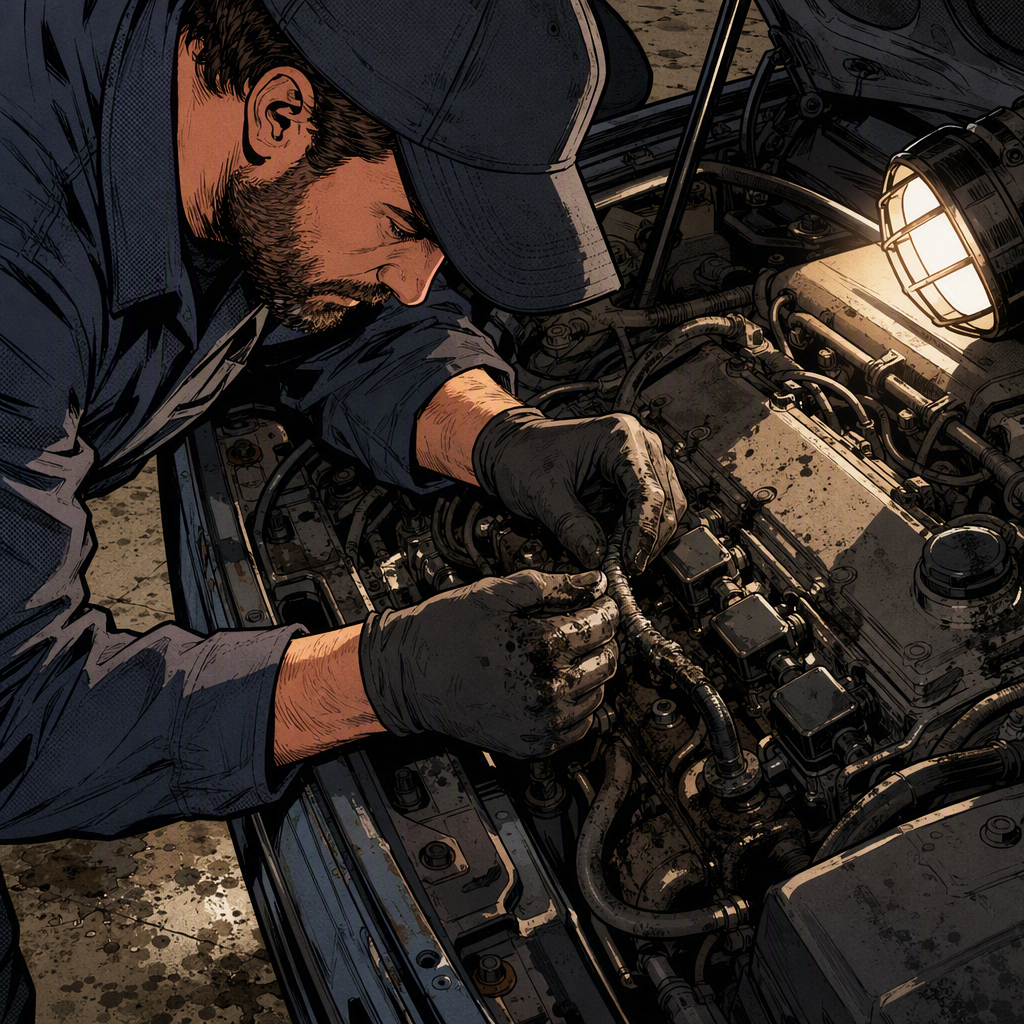
If you’ve ever popped the hood at night with the engine running and seen a faint purple or blue glow dancing around a spark plug wire, you weren’t imagining things — and it’s not a party trick worth keeping around. That glow is corona discharge, a sign that the high-voltage insulation on your ignition wires has broken down enough to let current ionize the surrounding air. It looks striking in photos and video, but it’s a clear signal that the wires (or occasionally the coil boots) need to be replaced before it turns into a rougher problem: a dead miss, a check engine light, or in worse cases, a fire risk from arcing near fuel vapor or oil residue. This guide walks through what’s actually happening, how to confirm the diagnosis, and how to replace the wires correctly.
What Corona Discharge Actually Is
Spark plug wires (also called ignition cables or plug leads) carry extremely high voltage — often 20,000 to 40,000 volts — from the coil to the spark plug. That voltage is meant to stay contained inside the wire’s insulation and travel in a straight line to the plug electrode. When the insulation degrades, cracks, or gets contaminated with oil or dirt, the electromagnetic field around the wire becomes strong enough to ionize the air molecules right next to it. That ionization is corona discharge: a faint glow, a crackling or hissing sound, and often a distinct ozone smell. It is not the same as plasma or true arcing to ground, but it’s a symptom of the same underlying problem — voltage that isn’t staying where it belongs.
The practical takeaway: if you can see it with the naked eye in a dark garage, the insulation breakdown is advanced enough that the wire is no longer doing its job reliably. Corona discharge bleeds off voltage that should be firing the plug, which under load can translate into a weak spark, poor combustion, and eventually a misfire code.

OTC 3688 Genisys Scope Module w/ InfoTech 2006
Mfg: OTC Tools and Equipment
Part #: 3688

Common Causes of Arcing or Glowing Ignition Wires
A few conditions tend to show up together in these cases:
- Age and heat cycling. Rubber and silicone insulation hardens and cracks after years of engine bay heat cycles, especially on wires routed close to exhaust manifolds or headers.
- Chafing and abrasion. Wires rubbing against brackets, valve covers, or each other wear through the outer jacket over time.
- Oil or coolant contamination. A valve cover gasket or seal leak that drips onto the wires accelerates insulation breakdown significantly.
- Cheap or mismatched aftermarket wires. Lower-quality replacement sets with thinner insulation or poor spark plug boot fitment are more prone to this than OE-spec wires.
- Improper routing. Wires bundled too tightly or crossing near sharp edges create wear points that fail first.
Worth noting: this is a wear-and-tear failure, not a manufacturing defect in most cases. Even OEM wires eventually reach the end of their service life, typically in the 60,000–100,000 mile range depending on the vehicle and engine bay heat.
Recommended Ignition Tools
Replacing spark plug wires requires the right equipment. Our Automotive Ignition Tools selection includes replacement wires, ignition coils, and diagnostic gear.
- OE and aftermarket spark plug wires and ignition cables
- Ignition coils, boots, and replacement connectors
- Ignition system testing and diagnostic equipment

The Toolsource Technical Team blends decades of real-world automotive service experience with up-to-date technical research. Our writers collaborate with professional mechanics, shop owners, and diagnostic specialists to deliver practical, workshop-ready guidance you can trust.


Follow us on social media